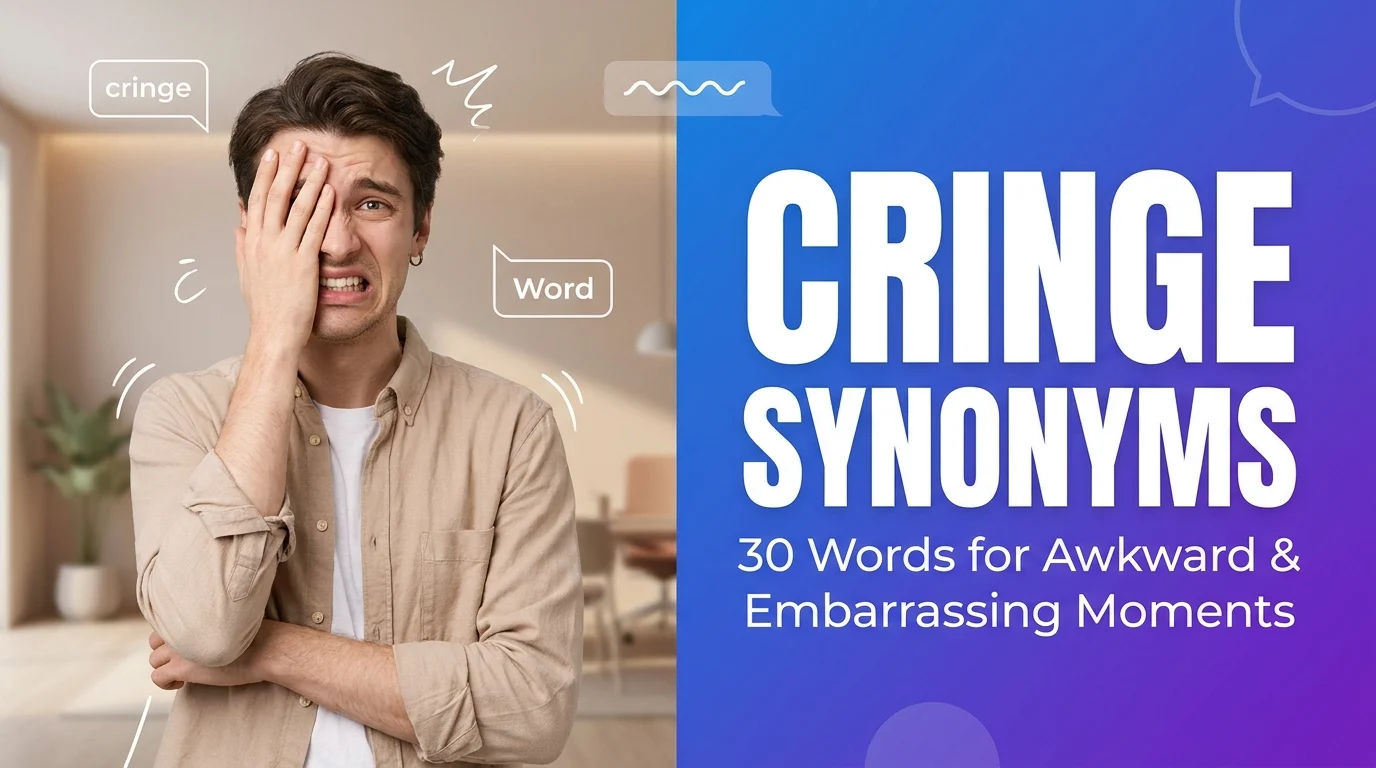
The word cringe is commonly used in everyday English, especially in social media, online conversations, and casual communication. It describes something that makes you feel embarrassed, uncomfortable, awkward, or even ashamed.
A strange comment, an embarrassing situation, or an awkward interaction can all make someone cringe.
However, using the same word repeatedly can make your writing sound less expressive. Learning different cringe synonyms can help you describe uncomfortable feelings and embarrassing situations more accurately.
Some alternatives are funny and informal, while others are stronger, more emotional, or suitable for formal writing.
If you are a student, ESL learner, writer, blogger, or content creator, understanding these alternatives can improve your vocabulary.
In this guide, you will discover 30 useful synonyms for cringe, their simple meanings, example sentences, and the best situations in which to use them.
What Does Cringe Mean?
Cringe means to feel embarrassed, uncomfortable, or awkward because of something someone says or does. It can also describe a physical reaction, such as shrinking back in fear or discomfort.
In modern informal English, people often use cringe to describe something embarrassing, socially awkward, unpleasant, or difficult to watch.
For example:
- His awkward joke made everyone cringe.
- I cringed when I remembered my embarrassing speech.
- That video is so cringe that I cannot watch it again.
Tone and usage: Cringe is an informal word that is especially popular in internet culture and everyday conversations. It can describe personal embarrassment, secondhand embarrassment, awkward behavior, or an uncomfortable experience.
30 Best Cringe Synonyms and Their Meanings
Here are 30 useful alternatives to the word cringe. Each word has a slightly different meaning, so choosing the right one depends on the situation.
1. Embarrassing
Meaning: Something that makes someone feel uncomfortable or ashamed in front of others.
Example: His embarrassing mistake made the entire class laugh.
Best usage: Everyday conversations and situations involving shame or awkwardness.
2. Awkward
Meaning: Uncomfortable or difficult because a situation feels strange or unnatural.
Example: There was an awkward silence after his unusual comment.
Best usage: Social situations, conversations, and uncomfortable interactions.
3. Uncomfortable
Meaning: Causing someone to feel uneasy, nervous, or unhappy.
Example: Her uncomfortable reaction showed that she disliked the conversation.
Best usage: Emotional discomfort and unpleasant experiences.
4. Mortifying
Meaning: Extremely embarrassing or humiliating.
Example: Forgetting his lines during the performance was mortifying.
Best usage: Serious or highly embarrassing situations.
5. Humiliating
Meaning: Making someone feel ashamed or lose confidence in front of others.
Example: Being laughed at during the presentation was humiliating.
Best usage: Situations involving public embarrassment or loss of dignity.
6. Awkwardly
Meaning: In a strange, uncomfortable, or unnatural manner.
Example: He awkwardly tried to change the subject.
Best usage: Describing uncomfortable actions or social interactions.
7. Painful
Meaning: Difficult or unpleasant to experience or watch.
Example: Watching their awkward argument was painful.
Best usage: Emotional discomfort and difficult social moments.
8. Excruciating
Meaning: Extremely uncomfortable, embarrassing, or difficult to experience.
Example: The long and awkward interview was excruciating to watch.
Best usage: Very intense embarrassing experiences.
9. Secondhand Embarrassment
Meaning: Feeling embarrassed because of something embarrassing that another person does.
Example: His strange performance gave me serious secondhand embarrassment.
Best usage: Watching awkward videos, performances, or social interactions.
10. Shameful
Meaning: Something that deserves criticism or causes a feeling of shame.
Example: His shameful behavior disappointed his friends.
Best usage: Behavior that is morally wrong or deserves disapproval.
11. Ridiculous
Meaning: So unreasonable or silly that it becomes difficult to take seriously.
Example: His ridiculous excuse made everyone uncomfortable.
Best usage: Silly behavior, unbelievable situations, and absurd comments.
12. Silly
Meaning: Showing a lack of seriousness or good judgment.
Example: She felt silly after making that unnecessary comment.
Best usage: Lighthearted and mildly embarrassing situations.
13. Cringeworthy
Meaning: So embarrassing or uncomfortable that it makes people cringe.
Example: The old advertisement was full of cringeworthy moments.
Best usage: Social media, entertainment, and embarrassing behavior.
14. Distasteful
Meaning: Unpleasant, offensive, or lacking good taste.
Example: His distasteful joke offended several people.
Best usage: Offensive humor, inappropriate comments, and poor behavior.
15. Unsettling
Meaning: Making someone feel nervous, disturbed, or uncomfortable.
Example: His unsettling smile made everyone feel uneasy.
Best usage: Strange or disturbing situations.
16. Peculiar
Meaning: Strange or unusual in a way that attracts attention.
Example: Her peculiar reaction made the conversation awkward.
Best usage: Unusual behavior and strange situations.
17. Embarrassed
Meaning: Feeling ashamed, uncomfortable, or self-conscious.
Example: I was embarrassed when I called my teacher by the wrong name.
Best usage: Personal feelings after making a mistake.
18. Humbling
Meaning: Making someone realize their limitations or feel less proud.
Example: Losing the competition was a humbling experience.
Best usage: Experiences that teach modesty or self-awareness.
19. Unbecoming
Meaning: Not suitable or appropriate for someone’s position or character.
Example: His rude behavior was unbecoming of a professional.
Best usage: Formal writing and descriptions of inappropriate behavior.
20. Absurd
Meaning: Completely unreasonable, illogical, or ridiculous.
Example: His absurd explanation made the situation even more uncomfortable.
Best usage: Strange ideas, unreasonable actions, and ridiculous situations.
21. Disturbing
Meaning: Causing worry, discomfort, or emotional upset.
Example: The disturbing scene made viewers look away.
Best usage: Unpleasant or upsetting experiences.
22. Tacky
Meaning: Cheap-looking, tasteless, or lacking style.
Example: The tacky decorations made the party look unattractive.
Best usage: Poor fashion choices, decorations, and social behavior.
23. Cheesy
Meaning: Overly sentimental, predictable, or trying too hard to be attractive or funny.
Example: His cheesy pickup line made everyone laugh awkwardly.
Best usage: Romantic expressions, jokes, movies, and exaggerated behavior.
24. Corny
Meaning: Old-fashioned, predictable, or not very original.
Example: That corny joke made the audience groan.
Best usage: Jokes, romantic comments, and predictable expressions.
25. Uncool
Meaning: Not fashionable, impressive, or socially acceptable.
Example: Making fun of someone for their appearance is uncool.
Best usage: Casual conversations and social situations.
26. Awful
Meaning: Extremely bad, unpleasant, or upsetting.
Example: The awkward presentation was an awful experience for him.
Best usage: Strong negative reactions to experiences or behavior.
27. Cringey
Meaning: Informal spelling and variation of cringy, describing something embarrassing or uncomfortable.
Example: That old dance video looks incredibly cringey now.
Best usage: Internet conversations, texting, and casual writing.
28. Unnatural
Meaning: Not appearing normal, comfortable, or genuine.
Example: His unnatural laughter made the conversation feel strange.
Best usage: Forced reactions, fake behavior, and uncomfortable interactions.
29. Forced
Meaning: Not natural or genuine, especially when someone tries too hard.
Example: Their forced jokes made the meeting uncomfortable.
Best usage: Fake humor, unnatural conversations, and exaggerated reactions.
30. Shame-Inducing
Meaning: Causing someone to experience embarrassment or shame.
Example: The shame-inducing mistake became the topic of conversation.
Best usage: Descriptive writing and situations involving strong embarrassment.
Cringe Synonyms Comparison Table
Different cringe synonyms communicate different levels of embarrassment and discomfort. This table helps you choose the most suitable word.
| Synonym | Main meaning | Best context |
|---|---|---|
| Embarrassing | Causing shame | Everyday situations |
| Awkward | Socially uncomfortable | Conversations |
| Mortifying | Extremely embarrassing | Serious mistakes |
| Humiliating | Causing loss of dignity | Public embarrassment |
| Uncomfortable | Creating uneasiness | General situations |
| Cringeworthy | Difficult to watch | Social media |
| Painful | Emotionally unpleasant | Awkward experiences |
| Cheesy | Overly sentimental | Romantic moments |
| Corny | Predictable or unoriginal | Jokes |
| Tacky | Tasteless | Fashion and style |
| Ridiculous | Silly or unreasonable | Strange behavior |
| Disturbing | Emotionally upsetting | Unpleasant experiences |
Different Types of Cringe
Cringe can describe several kinds of uncomfortable experiences. Understanding these categories will help you use the word more naturally.
1. Social Cringe
Social cringe happens when someone behaves awkwardly in a social situation.
Examples include:
- Making an inappropriate joke.
- Saying something embarrassing.
- Interrupting someone at the wrong moment.
- Creating an uncomfortable silence.
Useful synonyms: awkward, embarrassing, uncomfortable, and cringeworthy.
2. Secondhand Cringe
Secondhand cringe happens when you feel embarrassed because of another person’s behavior.
For example, watching someone perform an awkward dance in front of a large audience might make you feel embarrassed even though you are not involved.
Useful synonyms: secondhand embarrassment, painful, mortifying, and cringeworthy.
3. Internet Cringe
Internet cringe refers to embarrassing or uncomfortable content shared online.
Examples include:
- Awkward social media videos.
- Forced jokes.
- Unnatural online performances.
- Overly dramatic posts.
Useful synonyms: cringey, cheesy, corny, and ridiculous.
4. Personal Cringe
Personal cringe happens when you remember something embarrassing from your own past.
For example, remembering an awkward conversation from several years ago might make you feel uncomfortable again.
Useful synonyms: embarrassed, mortifying, humiliating, and shameful.
5. Physical Cringe
Cringe can also describe a physical reaction in which someone moves away or shrinks back because of fear, discomfort, or disgust.
For example: “He cringed when he heard the loud noise.”
Useful alternatives: flinch, recoil, shrink back, and wince.
How to Choose the Right Cringe Synonym
Choosing the best alternative depends on the meaning, situation, and emotional intensity you want to communicate.
For Mild Embarrassment
Use:
- Awkward
- Silly
- Uncool
- Embarrassing
Example: It was an awkward moment, but everyone quickly forgot about it.
For Extreme Embarrassment
Use:
- Mortifying
- Humiliating
- Excruciating
- Shameful
Example: Forgetting her speech in front of hundreds of people was mortifying.
For Strange or Uncomfortable Behavior
Use:
- Peculiar
- Unsettling
- Unnatural
- Disturbing
Example: His unusual reaction made the entire situation unsettling.
For Funny or Cheesy Situations
Use:
- Corny
- Cheesy
- Ridiculous
- Tacky
Example: His cheesy pickup line made everyone laugh.
For Internet and Social Media Content
Use:
- Cringey
- Cringeworthy
- Awkward
- Painful
Example: That old video is so cringeworthy that I cannot watch it again.
Cringe vs. Cringey vs. Cringeworthy: What Is the Difference?
These three words are closely related, but they have different grammatical uses.
Cringe: Can be a verb or noun. It describes the feeling or reaction of embarrassment or discomfort.
Example: I cringe whenever I remember that conversation.
Cringey: An informal adjective describing something embarrassing or uncomfortable.
Example: That was a really cringey performance.
Cringeworthy: An adjective describing something so embarrassing that it makes people cringe.
Example: His cringeworthy speech became a popular topic online.
Understanding these differences helps you use each expression correctly.
How to Use Cringe Synonyms in Everyday Sentences
Here are some additional examples to help you understand how these words work in natural English.
- His embarrassing comment made the room go silent.
- The awkward conversation ended after a few minutes.
- Watching the old performance was painful.
- Her mortifying mistake became a funny memory.
- The cheesy romantic scene made me laugh.
- His ridiculous excuse surprised everyone.
- The uncomfortable situation made her nervous.
- That cringeworthy video quickly went viral.
- His forced smile made the situation even stranger.
- The disturbing scene made several viewers uncomfortable.
Frequently Asked Questions About Cringe Synonyms
1. What is another word for cringe?
Some common alternatives include embarrassing, awkward, uncomfortable, mortifying, humiliating, cringeworthy, and painful.
The best alternative depends on the situation and how strong the feeling is.
2. What is a fancy word for cringe?
Mortifying, excruciating, humiliating, and unbecoming are more sophisticated alternatives.
They are useful in formal writing and situations involving intense embarrassment.
3. What is slang for cringe?
Cringey, awkward, cheesy, corny, and uncool are common informal alternatives.
They are especially useful in social media posts and everyday conversations.
4. What is the opposite of cringe?
Possible opposites include:
- Cool
- Impressive
- Admirable
- Comfortable
- Natural
- Confident
- Entertaining
These words describe things that create positive rather than uncomfortable feelings.
5. What does cringeworthy mean?
Cringeworthy describes something so embarrassing, awkward, or uncomfortable that watching or experiencing it makes someone cringe.
Example: His cringeworthy joke made the audience uncomfortable.
6. Is cringe a formal or informal word?
Cringe is used in both formal and informal English, but its modern slang meaning is mostly informal.
For professional or academic writing, words such as embarrassing, uncomfortable, humiliating, and awkward may be more appropriate.
7. What is the difference between cringe and embarrassment?
Embarrassment is the feeling of being ashamed or uncomfortable. Cringe can describe that feeling, the reaction to it, or something that causes it.
For example, you may feel embarrassment after making a mistake, while you cringe when remembering it.
Conclusion
Learning different cringe synonyms can make your vocabulary more expressive and help you describe embarrassing, awkward, and uncomfortable experiences more accurately.
Words such as embarrassing, awkward, mortifying, humiliating, cringeworthy, and uncomfortable each communicate a slightly different feeling.
Remember that not every alternative has exactly the same meaning. Some describe mild social discomfort, while others express extreme embarrassment, unpleasant behavior, or physical reactions.
Choose your words according to the situation and tone of your writing. If you are writing an article, creating social media content, improving your English, or having an everyday conversation, the right synonym can make your message clearer and more engaging.
Ultimately, understanding cringe synonyms is a simple way to build stronger vocabulary and communicate your feelings with greater precision.

I am Derek Thomas, a passionate word enthusiast and writer. I enjoy exploring synonyms, expanding vocabulary, and helping readers find clear, accurate, and meaningful words for better writing.