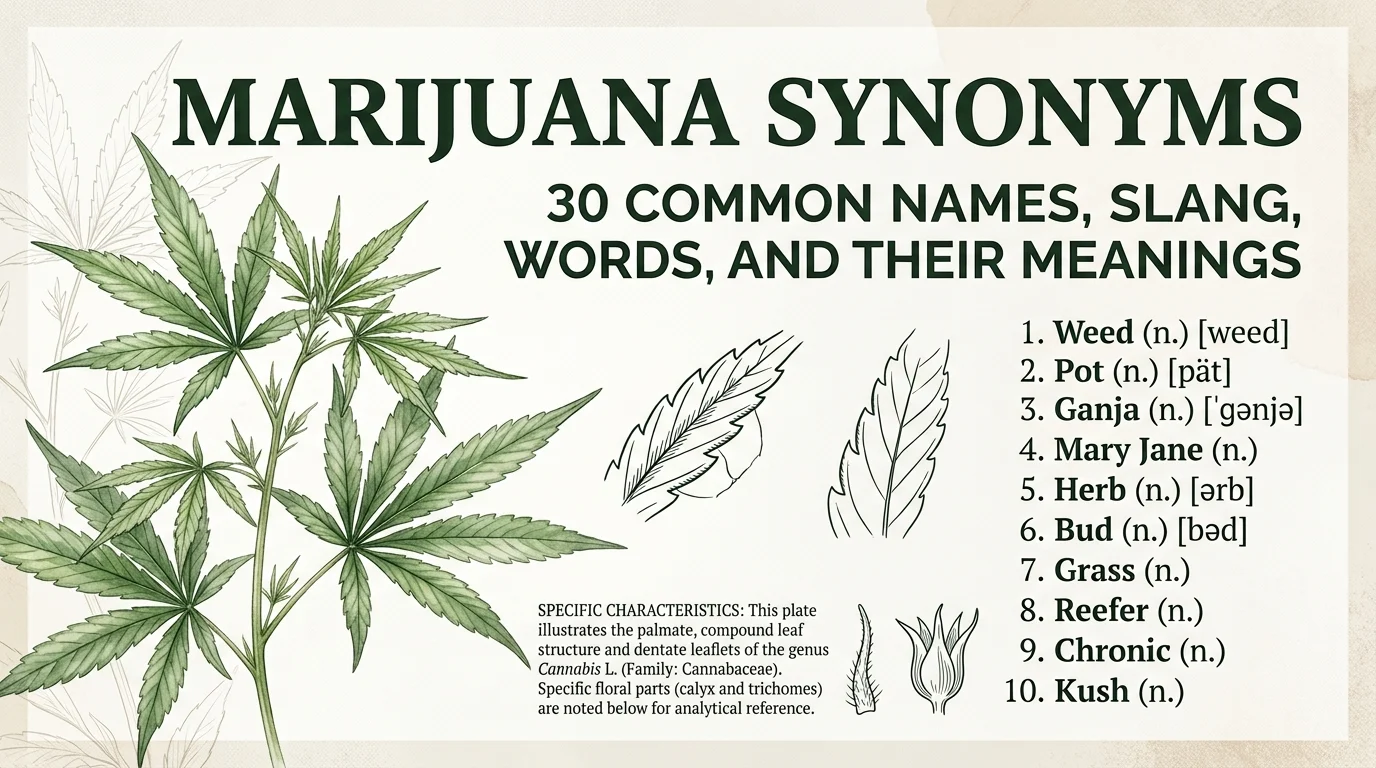
Marijuana is a word used to describe the dried flowers, leaves, stems, and other parts of the cannabis plant that are commonly associated with recreational or medicinal use. It is also known by many other names, including weed, cannabis, pot, ganja, herb, and Mary Jane.
Understanding marijuana synonyms is useful for students, ESL learners, writers, researchers, and content creators. Different words can communicate different tones, cultural backgrounds, and levels of formality.
For example, “cannabis” is commonly used in scientific and formal writing, while “weed” and “pot” are informal terms often found in everyday conversations.
The word you choose depends on your audience, writing style, and context. Some alternatives are widely recognized, while others are regional slang or historical expressions.
This guide explores 30 marijuana synonyms and related names, with simple definitions, example sentences, and practical usage notes.
What Does Marijuana Mean?
Marijuana refers to cannabis plant material, particularly the dried flowers and leaves of certain cannabis varieties. The term is commonly used in discussions about cannabis culture, medicine, law, public health, and recreational use.
Tone and usage context:
- Formal: Cannabis is generally preferred in academic, medical, and professional writing.
- Informal: Weed and pot are common in casual conversations.
- Cultural: Ganja, mota, and dagga are associated with particular regional and cultural traditions.
- Historical: Reefer and grass are older slang expressions.
It is important to understand that not every alternative is an exact synonym. Some words describe particular cannabis products, varieties, or forms of preparation.
30 Marijuana Synonyms and Their Meanings
Below are 30 commonly recognized names, informal alternatives, and slang expressions associated with marijuana.
1. Cannabis
Meaning: The formal botanical name for the plant commonly associated with marijuana.
Example: Researchers published a study about cannabis and its effects on public health.
Best usage context: Academic writing, scientific discussions, medical information, and professional communication.
2. Weed
Meaning: A popular informal word used to refer to marijuana.
Example: The article explained how the word weed became popular in everyday language.
Best usage context: Casual conversations, informal writing, blogs, and popular culture.
3. Pot
Meaning: A familiar slang term for marijuana.
Example: The documentary explored the history of the word pot in American culture.
Best usage context: Informal conversations and discussions about historical slang.
4. Ganja
Meaning: A traditional word for cannabis that has connections to South Asian languages and cultures.
Example: The writer explained the cultural history of the word ganja.
Best usage context: Cultural discussions, historical writing, and conversations about cannabis terminology.
5. Herb
Meaning: An informal expression sometimes used to refer to marijuana.
Example: The musician used the word herb in a song about cannabis culture.
Best usage context: Informal conversations, music, and cultural writing.
6. Mary Jane
Meaning: A playful slang expression for marijuana.
Example: Mary Jane appeared several times in the film’s dialogue.
Best usage context: Pop culture, entertainment, informal writing, and older slang references.
7. Reefer
Meaning: An old-fashioned slang word for marijuana.
Example: The historical article discussed the use of the word reefer during the twentieth century.
Best usage context: Historical discussions, vintage expressions, and older films or literature.
8. Grass
Meaning: An informal slang term traditionally used for marijuana.
Example: The novel included several references to grass in its description of youth culture.
Best usage context: Historical slang, informal conversations, and cultural references.
9. Marihuana
Meaning: An alternative spelling of marijuana.
Example: The researcher found the spelling marihuana in an old newspaper.
Best usage context: Historical documents, archival research, and discussions about the development of the word.
10. Mota
Meaning: A Spanish-language slang term for marijuana, particularly familiar in Mexican and Latin American contexts.
Example: The Spanish-language novel used the word mota in a conversation between its characters.
Best usage context: Spanish-language literature, regional slang, and cultural discussions.
11. Dagga
Meaning: A regional slang term for cannabis, particularly associated with Southern Africa.
Example: The documentary examined the history of dagga terminology in South Africa.
Best usage context: Southern African culture, regional discussions, and historical writing.
12. Bhang
Meaning: A traditional cannabis preparation associated with South Asian cultural and historical practices.
Example: The historian discussed bhang in a chapter about traditional South Asian customs.
Best usage context: Cultural history, religious studies, and discussions of traditional terminology.
13. Charas
Meaning: A cannabis resin product traditionally associated with South Asia.
Example: The travel writer explained the historical meaning of charas in the region.
Best usage context: Regional history and discussions of traditional cannabis products.
14. Hashish
Meaning: A concentrated cannabis product made from the resin of the cannabis plant.
Example: The book explained how hashish differs from dried cannabis flowers.
Best usage context: Educational writing about cannabis products and terminology.
15. Hash
Meaning: A shortened informal name for hashish.
Example: The article included a section explaining the difference between hash and marijuana flowers.
Best usage context: Informal conversations and discussions about cannabis concentrates.
16. Bud
Meaning: A common informal term for the flowering part of the cannabis plant.
Example: The botanical guide explained why the word bud is frequently used in cannabis discussions.
Best usage context: Informal conversations, botanical explanations, and cannabis-related terminology.
17. Flower
Meaning: A term referring to the flowering part of the cannabis plant, often used when discussing dried cannabis flowers.
Example: The educational article described the structure of the cannabis flower.
Best usage context: Educational, botanical, and product-description contexts.
18. Trees
Meaning: A slang expression sometimes used to refer to marijuana.
Example: The character used the word trees during a casual conversation.
Best usage context: Informal dialogue, music, and contemporary slang.
19. Chronic
Meaning: A slang term associated with particularly potent or high-quality marijuana.
Example: The music documentary explored how chronic became part of cannabis-related slang.
Best usage context: Music, popular culture, and informal conversations.
20. Kush
Meaning: A name associated with particular cannabis varieties and strains, with geographical connections to the Hindu Kush region.
Example: The article explained the historical origins of the term Kush.
Best usage context: Cannabis culture, discussions of varieties, and popular terminology.
21. Skunk
Meaning: A slang term commonly associated with strong-smelling cannabis varieties.
Example: The journalist explained why skunk became a familiar term in British cannabis discussions.
Best usage context: British slang, news articles, and discussions about cannabis varieties.
22. Sensi
Meaning: Short for sinsemilla, a term referring to cannabis flowers produced without seeds.
Example: The writer explained the meaning of sensi in a glossary of cannabis expressions.
Best usage context: Cannabis terminology, historical slang, and informal cultural discussions.
23. Sinsemilla
Meaning: A Spanish-derived term meaning seedless, used to describe cannabis flowers produced without seeds.
Example: The textbook included sinsemilla as an example of specialized cannabis vocabulary.
Best usage context: Botanical discussions and educational explanations.
24. Dank
Meaning: An informal slang adjective used to describe particularly strong-smelling or highly regarded cannabis.
Example: The online discussion used dank as a slang description.
Best usage context: Internet slang, informal writing, and popular culture.
25. Loud
Meaning: A modern slang expression sometimes used for strong-smelling or potent cannabis.
Example: The writer explained how loud developed as a term in contemporary slang.
Best usage context: Modern informal conversations and music-related discussions.
26. Dope
Meaning: A slang word that can refer to marijuana, although it also has other meanings and can describe different drugs.
Example: The novel used the word dope in a passage about changing slang expressions.
Best usage context: Informal speech, historical writing, and popular culture. Clarify the meaning when necessary.
27. Mary Jane Weed
Meaning: An extended informal expression combining two familiar slang names for marijuana.
Example: The character used the expression Mary Jane weed in a casual conversation.
Best usage context: Informal writing and explanations of popular slang.
28. Ganj
Meaning: An informal shortened spelling of ganja.
Example: The song included the word ganj as part of its slang vocabulary.
Best usage context: Informal writing, music, and contemporary slang.
29. Green
Meaning: An informal expression sometimes used as a reference to marijuana because of its color.
Example: The fictional dialogue used green as a slang expression.
Best usage context: Informal conversations and creative writing. The meaning depends on context.
30. Mary Jane Herb
Meaning: An informal descriptive expression combining two familiar names associated with marijuana.
Example: The glossary listed Mary Jane herb among several alternative cannabis expressions.
Best usage context: Informal explanations, creative writing, and discussions of slang.
Marijuana Synonyms Comparison Table
Different marijuana-related words have different meanings and levels of formality. The following table helps readers understand which expressions are suitable for particular writing situations.
| Word | Tone | Common context |
|---|---|---|
| Cannabis | Formal | Academic and scientific writing |
| Marijuana | Neutral | General information |
| Weed | Informal | Everyday conversation |
| Pot | Informal | Casual discussions |
| Ganja | Cultural | Regional and historical writing |
| Herb | Informal | Music and popular culture |
| Mary Jane | Playful | Entertainment and slang |
| Reefer | Old-fashioned | Historical references |
| Grass | Informal | Older slang |
| Mota | Regional | Spanish language contexts |
| Dagga | Regional | Southern African contexts |
| Bhang | Traditional | South Asian cultural history |
| Hashish | Specific product | Cannabis education |
| Hash | Informal | Cannabis terminology |
| Bud | Informal | Cannabis flowers |
| Flower | Neutral | Botanical discussions |
| Kush | Variety related | Cannabis culture |
| Skunk | Slang | British terminology |
| Chronic | Slang | Popular culture |
| Sinsemilla | Technical | Botanical terminology |
Quick tip: Use cannabis or marijuana in formal writing. Choose informal expressions such as weed or pot when discussing everyday language. Use regional terms only when their cultural meaning is relevant.
How to Choose the Right Marijuana Synonym
Choosing the right word depends on your purpose, audience, and writing style. Although many marijuana related expressions refer to the same general subject, their meanings are not always identical.
Here are some useful ways to select the appropriate term.
For Academic and Educational Writing
Use formal and recognizable terms.
Examples:
- Cannabis
- Marijuana
- Sinsemilla
- Hashish
These terms are useful for educational articles, research papers, textbooks, and informative content.
For Casual Conversations
Choose familiar informal expressions.
Examples:
- Weed
- Pot
- Herb
- Bud
- Grass
These expressions are common in informal discussions and popular culture.
For Historical and Cultural Discussions
Some expressions have particular regional or historical associations.
Examples:
- Ganja
- Bhang
- Dagga
- Reefer
- Mota
- Charas
These words are useful when discussing language, cultural traditions, regional history, and older literature.
For Creative Writing and Entertainment
Writers sometimes use slang to make dialogue sound more natural or reflect a character’s background.
Examples:
- Mary Jane
- Trees
- Chronic
- Dank
- Ganj
- Green
However, writers should consider the age, location, and cultural background of their characters before choosing slang.
For Specific Cannabis Products
Some terms describe a particular form or part of the cannabis plant rather than marijuana as a whole.
Examples:
- Hashish: Cannabis resin concentrate.
- Hash: Informal name for hashish.
- Bud: Cannabis flower.
- Flower: The flowering part of the plant.
- Charas: A traditional cannabis resin product.
Using these distinctions correctly makes your writing more accurate.
Marijuana, Cannabis, and Weed: What Is the Difference?
Although these words are frequently used interchangeably, they have slightly different meanings and levels of formality.
Marijuana: A widely recognized common term for cannabis plant material, especially dried flowers and leaves.
Cannabis: The botanical and scientific name of the plant genus. It is commonly preferred in formal and educational discussions.
Weed: An informal slang expression for marijuana. It is more common in everyday speech than in academic writing.
For example:
- Formal: The study examined cannabis terminology.
- Neutral: The article explained the meaning of marijuana.
- Informal: The conversation included the word weed.
Understanding these differences helps students and writers communicate more clearly.
Common Mistakes When Using Marijuana Synonyms
Using alternative vocabulary can make writing more interesting, but it is important to avoid confusing related terms.
Here are some common mistakes to avoid.
1. Treating every term as an exact synonym
Hashish, charas, and bhang refer to particular cannabis products or preparations. They are not exact substitutes for the general word marijuana.
2. Using slang in formal writing
Words such as weed, pot, and Mary Jane may sound too informal in academic or professional documents.
3. Ignoring regional differences
Terms such as mota and dagga are associated with particular linguistic and cultural settings. Their meanings and familiarity can vary by location.
4. Confusing hemp with marijuana
Hemp and marijuana both belong to the Cannabis sativa species, but the terms are used for different categories of cannabis plants and products. Hemp is not simply another synonym for marijuana.
5. Forgetting that slang can have multiple meanings
Words such as dope, green, and loud can mean different things depending on the conversation.
Frequently Asked Questions About Marijuana Synonyms
What are the most common synonyms for marijuana?
Some widely recognized alternatives include cannabis, weed, pot, ganja, herb, Mary Jane, reefer, and grass.
What is another word for marijuana in formal writing?
Cannabis is generally the most suitable alternative in formal, scientific, medical, and academic writing.
Is weed another name for marijuana?
Yes. Weed is a common informal slang expression used to refer to marijuana.
Is ganja the same as marijuana?
Ganja is a commonly recognized alternative name for marijuana. It has historical and cultural connections to South Asian languages and traditions.
Is pot a synonym for marijuana?
Yes. Pot is an informal slang term for marijuana, particularly familiar in American English.
What is an old-fashioned word for marijuana?
Reefer and grass are two well-known older slang expressions associated with marijuana.
Is hashish another word for marijuana?
Not exactly. Hashish is a cannabis resin concentrate, whereas marijuana commonly refers to cannabis plant material, particularly dried flowers.
What is the difference between cannabis and marijuana?
Cannabis is the botanical name of the plant genus. Marijuana is a common term used for cannabis plant material, especially when discussing recreational or medicinal use.
Which marijuana synonyms are commonly used in slang?
Weed, pot, ganja, herb, Mary Jane, trees, chronic, dank, and grass are examples of informal expressions.
Are marijuana and hemp the same thing?
No. Both are associated with the cannabis plant, but hemp is a distinct classification generally associated with varieties containing very low levels of THC under applicable legal definitions.
Conclusion
Learning marijuana synonyms helps readers understand different expressions used in everyday conversations, literature, music, history, and educational writing. Words such as cannabis, weed, pot, ganja, herb, and Mary Jane are widely recognized alternatives, but each has its own tone and cultural background.
Some terms, including hashish, charas, bhang, bud, and sinsemilla, describe particular cannabis products, preparations, or plant characteristics rather than serving as exact synonyms for marijuana.
The most important lesson is to choose words according to their meaning, audience, and context. Use cannabis for formal and educational writing, familiar terms such as weed for casual language, and regional expressions when discussing specific cultures or historical traditions.
By understanding these 30 marijuana related terms, students, ESL learners, writers, and content creators can improve their vocabulary and communicate more accurately and naturally.

I am Scarlett Jane, a passionate language writer who loves exploring synonyms and word meanings. I create helpful content that makes vocabulary easier, clearer, and more enjoyable for everyone.