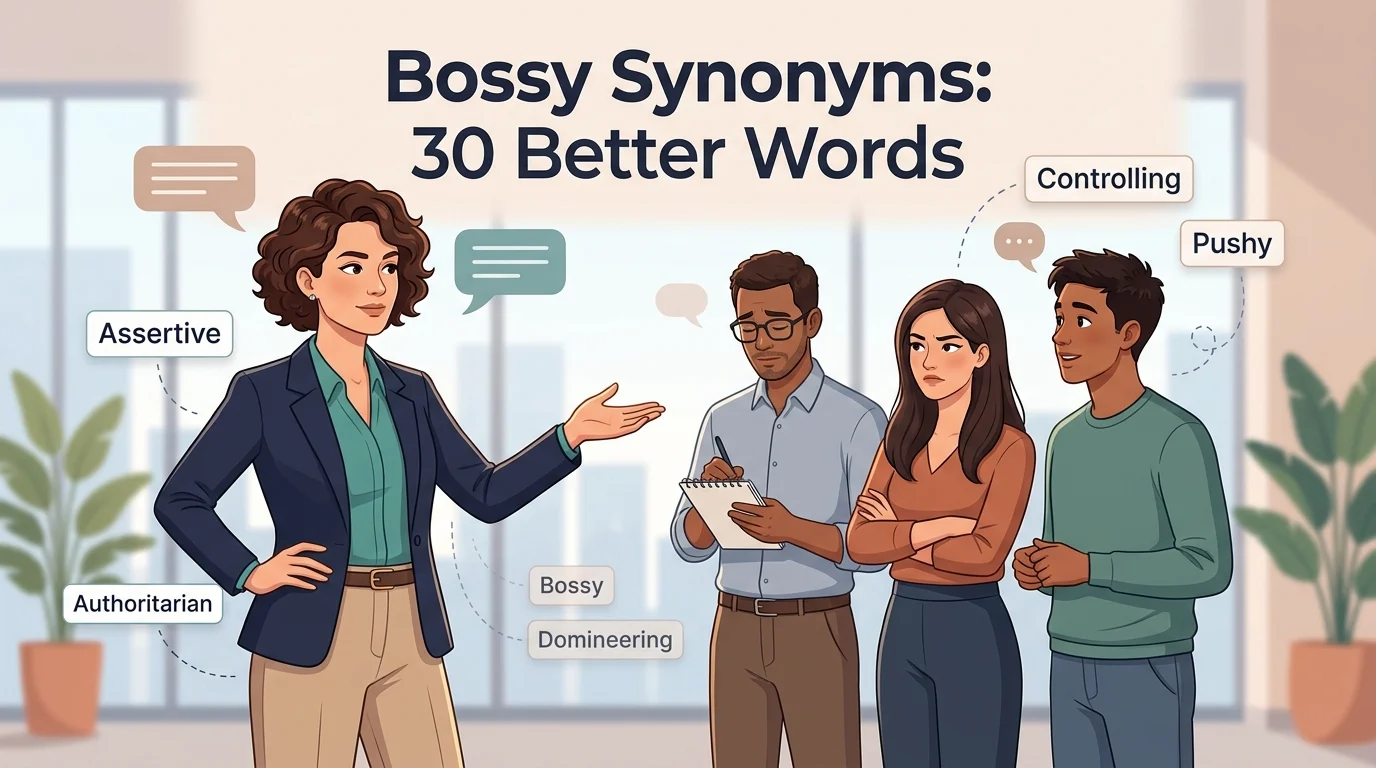
Finding the right bossy synonyms can help you describe a person’s behavior more accurately. The word bossy usually describes someone who frequently tells other people what to do, expects others to follow their instructions, or tries to control a situation.
However, the exact meaning can change depending on whether the person is simply confident, naturally authoritative, overly controlling, or openly demanding.
Using a synonym for bossy can make your writing more precise. For example, assertive can describe someone who confidently expresses their ideas without necessarily being unpleasant, while controlling suggests a stronger desire to manage other people’s actions. Similarly, domineering and authoritarian can sound much stronger and more negative than bossy.
This guide explains 30 useful synonyms for bossy, with simple meanings, example sentences, and notes about when each word works best. It is designed for students, ESL learners, writers, and anyone who wants to choose the right word for a particular situation.
What Does “Bossy” Mean?
Bossy is an adjective used to describe someone who likes telling other people what to do, often in an annoying, forceful, or controlling way.
For example:
My older brother can be bossy when we work on projects together.
Here, bossy suggests that the brother gives too many instructions or expects others to follow his decisions.
The tone of bossy is usually informal and negative. It can be used seriously, but it is also common in everyday conversations, especially when talking about children, friends, family members, coworkers, or classmates.
Bossy: Tone and Usage
The word bossy does not always mean that someone is genuinely a bad leader. Context matters.
Compare these sentences:
- She is bossy and never listens to anyone.
- She is assertive and makes sure everyone understands the plan.
- She is authoritative and has extensive experience managing teams.
- He is controlling and wants to make every decision himself.
All four sentences describe someone who may influence other people, but their meanings and emotional tones are different.
That is why choosing the right synonym is important.
30 Bossy Synonyms
Below are 30 useful alternatives to bossy. Some are close synonyms, while others describe specific types or degrees of controlling behavior.
1. Domineering
Meaning: A person who tries to control others in a powerful or forceful way.
Example:
His domineering personality made it difficult for others to share their opinions.
Best usage context: Use domineering when someone’s behavior is strongly controlling and overpowering.
2. Controlling
Meaning: Wanting to control other people’s actions, choices, or behavior.
Example:
Her controlling attitude caused tension among her friends.
Best usage context: Useful when someone regularly tries to decide what others should do.
3. Authoritarian
Meaning: Expecting people to obey rules or orders without questioning them.
Example:
The manager had an authoritarian approach to running the department.
Best usage context: Best for formal, political, organizational, educational, or workplace contexts.
4. Dictatorial
Meaning: Acting as though you have complete authority and expecting others to obey you.
Example:
His dictatorial management style discouraged employees from expressing new ideas.
Best usage context: Use when someone’s behavior resembles that of a dictator.
5. Overbearing
Meaning: Too forceful, demanding, or dominant toward other people.
Example:
Her overbearing personality sometimes made conversations uncomfortable.
Best usage context: Good for describing someone whose presence or behavior feels excessively forceful.
6. Pushy
Meaning: Trying too hard to persuade, influence, or control someone.
Example:
The salesperson became pushy when I said I needed more time to decide.
Best usage context: Common in everyday English when someone is too forceful about getting what they want.
7. Imperious
Meaning: Acting as though you have the right to give orders.
Example:
The imperious director expected everyone to follow her instructions immediately.
Best usage context: A formal or literary word for someone who behaves like a superior.
8. Authoritative
Meaning: Confident and knowledgeable in a way that shows authority.
Example:
The teacher gave an authoritative explanation of the subject.
Best usage context: Use when the person has legitimate knowledge, experience, or authority. Unlike bossy, this word is often positive or neutral.
9. Assertive
Meaning: Confidently expressing your opinions, needs, or decisions.
Example:
She was assertive when explaining what she expected from the team.
Best usage context: Useful when someone is confident without necessarily being rude or controlling.
Important: Assertive is not always a true negative synonym for bossy. It can describe healthy and respectful communication.
10. Dominating
Meaning: Having or trying to have more control, attention, or influence than others.
Example:
He has a dominating personality and often takes control of group discussions.
Best usage context: Good for describing someone who consistently takes control of situations.
11. Dictatorial minded
Meaning: Having a tendency to expect obedience and make decisions without considering others.
Example:
His dictatorial minded approach frustrated the rest of the team.
Best usage context: Useful when emphasizing an individual’s tendency toward command and control behavior.
12. Commanding
Meaning: Having a strong presence or manner that makes people pay attention or follow instructions.
Example:
She has a commanding presence in meetings.
Best usage context: Often positive or neutral when describing leadership, confidence, or authority.
13. Demanding
Meaning: Expecting a lot from other people and often insisting that things be done in a particular way.
Example:
Our demanding supervisor expects every report to be completed on time.
Best usage context: Use when someone expects a high level of effort, attention, or obedience.
14. Coercive
Meaning: Using pressure, threats, or force to make someone do something.
Example:
The employee complained about the manager’s coercive behavior.
Best usage context: A formal word for situations involving pressure or force. It is considerably stronger than bossy.
15. Forceful
Meaning: Strong and confident in expressing opinions or getting something done.
Example:
She used a forceful tone when explaining the importance of the deadline.
Best usage context: Suitable for professional or formal writing when someone communicates strongly.
16. High handed
Meaning: Using authority in an unreasonable way without considering other people’s opinions.
Example:
The committee criticized the chairman for his high handed decisions.
Best usage context: Best for formal writing when authority is being used unfairly or arrogantly.
17. Peremptory
Meaning: Giving an order in a way that allows no discussion or refusal.
Example:
The officer gave a peremptory instruction to leave the building.
Best usage context: Formal writing, especially when describing abrupt or unquestionable commands.
18. Overcontrolling
Meaning: Trying to control too many details or too much of another person’s behavior.
Example:
Her overcontrolling approach made the team feel unable to make independent decisions.
Best usage context: Useful for describing excessive control in relationships, workplaces, families, or group settings.
19. Meddlesome
Meaning: Becoming involved in other people’s affairs when you are not needed or invited.
Example:
His meddlesome behavior annoyed his coworkers.
Best usage context: Use when the person interferes unnecessarily rather than simply giving orders.
20. Intrusive
Meaning: Becoming involved in someone’s private affairs or personal space in an unwanted way.
Example:
The manager’s intrusive questions made the employee uncomfortable.
Best usage context: Best when someone’s controlling behavior crosses personal boundaries.
21. Manipulative
Meaning: Trying to control people indirectly, often by influencing their feelings or decisions.
Example:
He used manipulative tactics to persuade his colleagues to support his proposal.
Best usage context: Use when control happens through emotional pressure, deception, or indirect influence.
22. Obstructive
Meaning: Making it difficult for other people to act, progress, or make decisions.
Example:
Her obstructive behavior slowed down the entire project.
Best usage context: Better for describing behavior that prevents progress rather than simply giving orders.
23. Tyrannical
Meaning: Extremely controlling and cruel in the use of power.
Example:
The workers complained about the owner’s tyrannical leadership style.
Best usage context: A very strong word for oppressive or abusive authority.
24. Autocratic
Meaning: Making decisions alone and expecting others to accept them.
Example:
The company’s autocratic leadership structure gave employees little influence over important decisions.
Best usage context: Formal discussions about leadership, management, government, or organizations.
25. Dogmatic
Meaning: Insisting that your beliefs or opinions are correct and refusing to consider other views.
Example:
His dogmatic attitude made it difficult to have an open discussion.
Best usage context: Use when the problem is rigid thinking rather than direct commanding behavior.
26. Obstinate
Meaning: Refusing to change your opinion or behavior even when there are good reasons to do so.
Example:
The obstinate team leader refused to consider any alternative plan.
Best usage context: Best when stubbornness is the main problem.
27. Bossy minded
Meaning: Having a strong tendency to give orders or control other people.
Example:
His bossy minded approach sometimes caused disagreements with his classmates.
Best usage context: An informal descriptive expression, though more natural alternatives include controlling, domineering, or overbearing.
28. Dictatorial
Meaning: Extremely authoritative and unwilling to allow disagreement.
Example:
The coach’s dictatorial style left players afraid to ask questions.
Best usage context: Use when someone exercises authority in an excessively commanding way.
29. Dominant
Meaning: Having greater control, influence, or power than others.
Example:
She has a dominant personality and often leads conversations.
Best usage context: Useful when describing a strong personality, but it does not automatically mean the person is unpleasant.
30. Inflexible
Meaning: Unwilling to change decisions, rules, or methods.
Example:
The supervisor was inflexible about how the project had to be completed.
Best usage context: Best when the person refuses to compromise or consider alternatives.
Bossy Synonyms Comparison Table
Choosing the right synonym depends heavily on the exact behavior you want to describe.
| Synonym | Basic Meaning | Tone | Best Used For |
|---|---|---|---|
| Bossy | Always telling others what to do | Negative, informal | Everyday situations |
| Domineering | Controlling and overpowering | Strong negative | Strong personalities |
| Controlling | Trying to manage others | Negative | Personal or professional situations |
| Pushy | Too forceful in getting what you want | Negative, informal | Sales, conversations, requests |
| Overbearing | Excessively forceful | Negative | Personality and relationships |
| Authoritarian | Demanding obedience | Formal, negative | Leadership and institutions |
| Assertive | Confident and direct | Neutral/positive | Communication |
| Authoritative | Showing legitimate authority or expertise | Neutral/positive | Leadership and expertise |
| Dictatorial | Expecting unquestioning obedience | Strong negative | Leadership and management |
| Demanding | Expecting a lot from others | Neutral/negative | Work and relationships |
| Imperious | Giving orders as if superior | Negative/formal | Formal or literary writing |
| Dominant | Having greater influence or control | Neutral | Personality and groups |
| Manipulative | Controlling people indirectly | Negative | Emotional or social behavior |
| Coercive | Using pressure or force | Strong negative | Serious formal contexts |
| Autocratic | Making decisions alone | Formal | Organizations and leadership |
Bossy vs. Assertive: What’s the Difference?
One of the most important distinctions is between bossy and assertive.
A bossy person may tell others what to do without considering their opinions. An assertive person, however, can express their needs and expectations confidently while still respecting other people.
Compare:
Bossy:
“Do this now because I said so.”
Assertive:
“I need this completed by Friday. Can we agree on how to divide the work?”
Both speakers communicate an expectation, but the second approach allows room for cooperation.
Therefore, assertive should not automatically be used as a synonym for bossy. In many contexts, assertive has a positive meaning.
Bossy vs. Controlling
The words bossy and controlling are closely related, but they are not identical.
Someone who is bossy often gives unwanted instructions or orders.
Someone who is controlling may go further by trying to influence another person’s choices, relationships, activities, or decisions.
For example:
- My coworker is bossy during meetings.
- My coworker is controlling and wants to approve every decision I make.
The second sentence suggests a broader pattern of behavior.
Bossy vs. Domineering
Domineering is stronger than bossy.
A bossy child might repeatedly tell friends how to play a game. A domineering adult might consistently overpower discussions, ignore other people’s opinions, and insist on making decisions.
Therefore, domineering works well when you want to emphasize power and control.
Bossy vs. Authoritative
These words have very different emotional meanings.
Bossy generally suggests unwanted or excessive commands.
Authoritative can describe someone who has legitimate knowledge, experience, or responsibility.
For example:
The teacher has an authoritative voice.
This does not necessarily mean the teacher is bossy. It may simply mean that the teacher speaks with confidence and authority.
Bossy vs. Pushy
Pushy focuses more on pressure.
A pushy person may repeatedly persuade someone to buy something, agree with an idea, accept an invitation, or make a decision.
For example:
The salesperson was pushy.
This suggests excessive pressure rather than simply giving orders.
How to Choose the Right Synonym for Bossy
The best synonym depends on what the person is doing, how strongly they are doing it, and the tone of your writing.
For Mild or Everyday Behavior
Use:
- Bossy
- Pushy
- Demanding
- Dominant
These words are useful in casual conversations and general writing.
Example:
My little sister can be bossy when we play games.
For Strong Controlling Behavior
Use:
- Controlling
- Domineering
- Overbearing
- Overcontrolling
These words suggest that the person’s behavior goes beyond ordinary confidence.
Example:
His controlling behavior made group discussions difficult.
For Leadership and Authority
Use:
- Authoritative
- Commanding
- Assertive
- Forceful
These words can be neutral or positive depending on the context.
Example:
She has a commanding presence during presentations.
For Excessive Use of Power
Use:
- Dictatorial
- Tyrannical
- Autocratic
- Authoritarian
- Imperious
These are stronger terms and are usually appropriate when someone uses authority in an extreme or unreasonable way.
Example:
Employees disliked his authoritarian management style.
For Indirect Control
Use:
- Manipulative
- Meddlesome
- Intrusive
- Coercive
These words describe specific methods of influencing or controlling other people.
Example:
The manager was accused of using manipulative tactics to influence the team.
For Stubborn Behavior
Use:
- Dogmatic
- Obstinate
- Inflexible
These words are appropriate when the person refuses to consider alternative opinions or approaches.
Example:
The director was inflexible about changing the original plan.
Positive or Neutral Alternatives to “Bossy”
Sometimes you do not actually want a negative synonym. You may want to describe a confident person who naturally takes responsibility.
In that case, consider:
- Assertive
- Confident
- Decisive
- Authoritative
- Commanding
- Leadership oriented
- Proactive
For example, instead of saying:
She is bossy.
You might say:
She is confident and decisive when leading the team.
This changes the meaning significantly. The second sentence focuses on leadership rather than unwanted control.
Negative Alternatives to “Bossy”
When the behavior is clearly unpleasant or excessive, these words may be more precise:
- Controlling
- Domineering
- Overbearing
- Pushy
- Dictatorial
- Manipulative
- Tyrannical
- High handed
- Coercive
- Imperious
Choose carefully because some of these words are much stronger than bossy.
Calling someone tyrannical, for example, implies a far more serious level of oppressive behavior than simply calling them bossy.
Formal Synonyms for Bossy
For academic, professional, or formal writing, consider:
- Authoritarian
- Autocratic
- Imperious
- Peremptory
- Domineering
- Coercive
- High handed
- Dictatorial
- Overbearing
Instead of:
The manager was very bossy.
A formal version could be:
The manager adopted an authoritarian approach to decision-making.
The best choice depends on the evidence and the exact behavior being described.
Informal Synonyms for Bossy
For everyday conversations, these words are more natural:
- Bossy
- Pushy
- Controlling
- Demanding
- Dominant
For example:
Don’t be so bossy.
or:
He’s always being pushy about where we should go.
Synonyms for Bossy in the Workplace
When describing workplace behavior, precision matters. Depending on the situation, you could use:
- Authoritative — if the person demonstrates legitimate expertise or authority.
- Assertive — if they communicate confidently.
- Demanding — if they expect a lot from employees.
- Controlling — if they interfere with other people’s decisions.
- Domineering — if they overpower coworkers.
- Authoritarian — if they expect strict obedience.
- Autocratic — if they make decisions without meaningful input.
- Dictatorial — if their leadership is excessively commanding.
These words should not be treated as interchangeable because each describes a different aspect of leadership.
Synonyms for Bossy in a Sentence
Here are several examples showing how different words can change a sentence:
- Bossy:
My friend can be bossy when organizing trips. - Controlling:
My friend can be controlling and wants to make every decision. - Domineering:
His domineering personality often silences other people. - Assertive:
She is assertive when discussing project deadlines. - Pushy:
The salesperson was too pushy. - Authoritarian:
The director used an authoritarian management style. - Overbearing:
His overbearing behavior made the meeting uncomfortable. - Manipulative:
She used manipulative tactics to influence the decision. - Decisive:
The team leader was decisive when the deadline approached. - Commanding:
The speaker had a commanding presence on stage.
Common Mistakes When Using Bossy Synonyms
Mistake 1: Treating Every Synonym as Identical
Words that appear in a synonym list do not always have exactly the same meaning.
For example:
- Assertive = confident and direct
- Bossy = overly commanding
- Controlling = wanting to control others
- Manipulative = influencing others indirectly
- Domineering = overpowering others
The context determines which word is most accurate.
Mistake 2: Using Very Strong Words for Mild Behavior
Calling someone tyrannical or coercive when they simply give too many instructions can exaggerate the situation.
Use strong vocabulary only when the behavior supports it.
Mistake 3: Assuming “Assertive” Is Negative
Assertive often has a positive or neutral meaning.
A person can be assertive while remaining respectful, cooperative, and considerate.
Mistake 4: Ignoring Formality
Some words sound natural in conversation but unusual in academic writing.
For example, bossy is common in everyday speech, while authoritarian or peremptory may be more suitable in formal writing.
Quick Guide: Which Bossy Synonym Should You Use?
Ask yourself what you really mean:
Does the person simply give too many orders?
→ Bossy
Do they try to control other people?
→ Controlling
Do they overpower everyone around them?
→ Domineering
Are they too forceful when persuading someone?
→ Pushy
Do they expect strict obedience?
→ Authoritarian
Do they make all decisions themselves?
→ Autocratic
Do they behave like they are superior?
→ Imperious
Do they use pressure or force?
→ Coercive
Do they influence people indirectly?
→ Manipulative
Are they confident rather than unpleasantly controlling?
→ Assertive
Do they have legitimate authority or expertise?
→ Authoritative
Are they unwilling to consider alternatives?
→ Inflexible or dogmatic
Frequently Asked Questions About Bossy Synonyms
What is the best synonym for bossy?
There is no single synonym that works best in every situation. Controlling, domineering, overbearing, and pushy are common alternatives, but the appropriate word depends on the behavior and tone you want to express.
What is a polite word for bossy?
If you want a more positive or neutral description, consider assertive, decisive, confident, authoritative, or commanding, depending on the context.
What is a stronger word for bossy?
Words such as domineering, dictatorial, authoritarian, tyrannical, and overbearing can express stronger forms of controlling behavior.
Is “controlling” the same as “bossy”?
They are related but not exactly the same. Bossy usually describes someone who gives unwanted orders or instructions, while controlling can describe a broader attempt to influence another person’s choices and behavior.
Is “assertive” a synonym for bossy?
Not exactly. Assertive generally means communicating confidently and directly. It does not necessarily involve controlling or disrespecting other people.
What is the opposite of bossy?
Possible opposites include:
- Cooperative
- Flexible
- Easygoing
- Considerate
- Accommodating
- Respectful
- Unassuming
The exact opposite depends on which aspect of bossy you mean.
Final Thoughts on Bossy Synonyms
Learning bossy synonyms is useful because bossy is a broad and informal word. It can describe anything from someone who gives too many instructions to someone who consistently tries to control other people.
The most useful alternatives include controlling, domineering, overbearing, pushy, authoritarian, dictatorial, assertive, authoritative, commanding, demanding, manipulative, and autocratic. However, these words are not interchangeable in every situation.
For everyday conversations, bossy, pushy, and demanding are natural choices. For stronger descriptions, domineering, controlling, and overbearing may be more precise.
In formal writing, words such as authoritarian, autocratic, and peremptory can provide greater accuracy. If you want a positive or neutral description, assertive, decisive, or authoritative may be better.
The key is to focus on the exact behavior, tone, and context. Choosing a precise synonym makes your writing clearer, more natural, and more effective.

I am Derek Thomas, a passionate word enthusiast and writer. I enjoy exploring synonyms, expanding vocabulary, and helping readers find clear, accurate, and meaningful words for better writing.