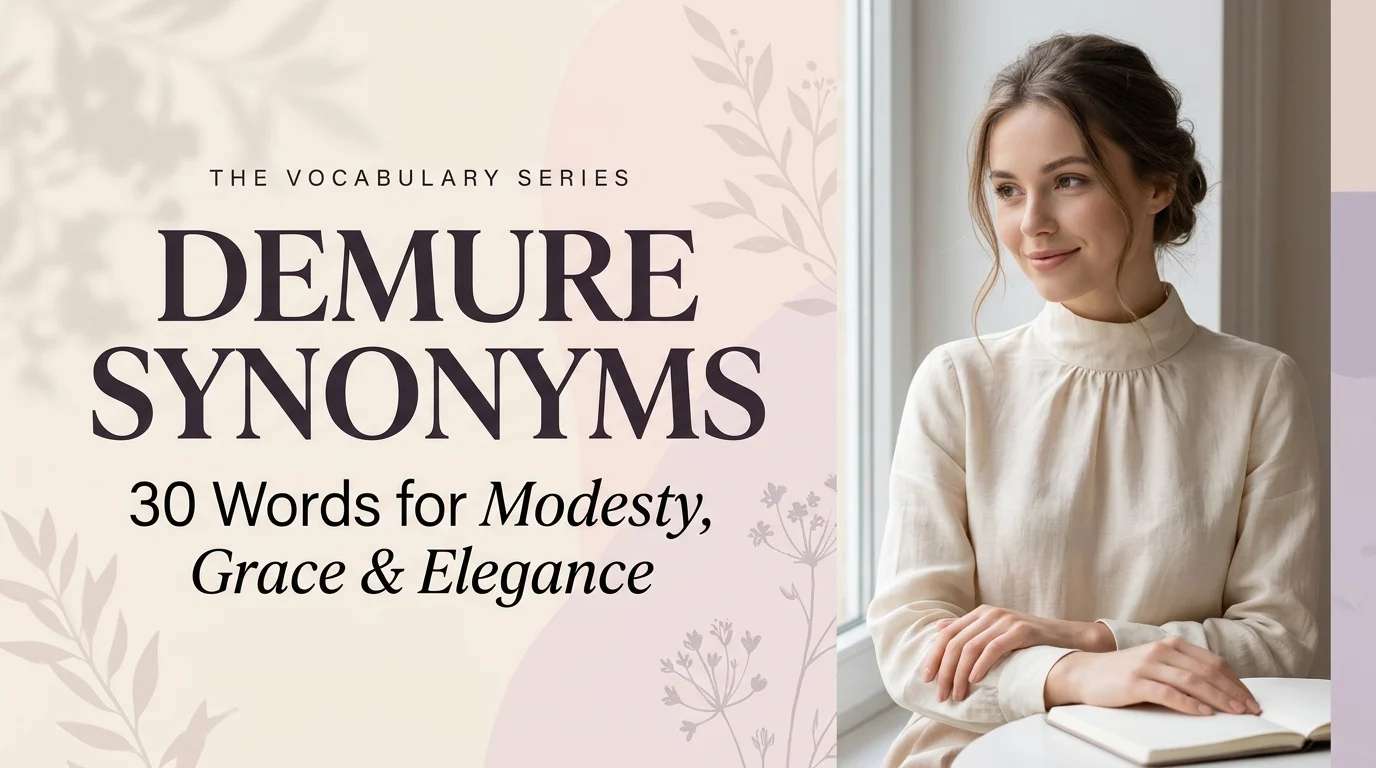
The word demure describes someone who is quiet, modest, reserved, and naturally shy in their behavior or appearance.
It is often used to describe a person who behaves politely, avoids attracting too much attention, and carries themselves with calm confidence.
Understanding demure synonyms can help you express these qualities more accurately in everyday conversations and writing.
Although demure is a beautiful descriptive word, using it repeatedly can make your writing sound repetitive. Learning alternative words allows you to describe modesty, shyness, politeness, elegance, and reserved behavior with greater variety.
In this guide, you will discover 30 useful synonyms for demure, along with simple meanings, example sentences, and practical usage tips. Whether you are a student, ESL learner, writer, or content creator, these words will help you build a stronger vocabulary and communicate more naturally.
What Does Demure Mean?
Demure is an adjective that describes someone who behaves in a modest, quiet, reserved, and sometimes shy manner.
A demure person usually avoids showing off, attracting unnecessary attention, or behaving in an overly confident way. Their personality or appearance may seem gentle, graceful, and modest.
The word is often associated with traditional politeness, elegance, and reserved behavior. However, it does not always mean that someone is shy. A person can be confident and still have a demure personality or style.
Examples:
- She wore a demure dress to the formal dinner.
- His demure personality made him seem polite and reserved.
- The student gave a demure smile when receiving the compliment.
Tone and usage: Demure is generally a positive or neutral word. It is commonly used in formal writing, fashion descriptions, literature, and everyday conversations.
30 Best Synonyms of Demure
Here are 30 alternatives to demure, with simple explanations and examples to help you understand their meanings.
1. Modest
Meaning: Someone who does not show off their abilities, achievements, appearance, or possessions.
Example: Despite winning the competition, she remained modest about her success.
Best usage: Describing humble behavior, simple fashion, and a lack of arrogance.
2. Shy
Meaning: Someone who feels nervous or uncomfortable around other people.
Example: The shy girl smiled quietly when her teacher praised her work.
Best usage: Describing someone who feels uncomfortable attracting attention or speaking publicly.
3. Reserved
Meaning: Someone who does not express their thoughts or feelings openly.
Example: He was reserved during the meeting but listened carefully to everyone.
Best usage: Describing quiet personalities and people who prefer privacy.
4. Quiet
Meaning: Someone who speaks very little or behaves calmly.
Example: She was a quiet student who preferred reading books to talking.
Best usage: Everyday descriptions of calm or less talkative people.
5. Gentle
Meaning: Someone who behaves kindly, softly, and without aggression.
Example: Her gentle personality made everyone feel comfortable.
Best usage: Describing kind behavior, soft manners, and a peaceful personality.
6. Unassuming
Meaning: Someone who does not try to attract attention or appear important.
Example: Despite his impressive achievements, he remained unassuming.
Best usage: Describing humble and naturally modest people.
7. Retiring
Meaning: Someone who avoids attention and prefers to stay in the background.
Example: Her retiring nature made her uncomfortable at large gatherings.
Best usage: Formal writing and descriptions of introverted personalities.
8. Meek
Meaning: Someone who is very gentle, quiet, and not likely to argue or challenge others.
Example: The meek child rarely interrupted anyone during conversations.
Best usage: Describing a submissive or unusually mild personality. It can sometimes suggest a lack of confidence.
9. Subdued
Meaning: Someone or something that is quiet, restrained, or lacking strong emotion.
Example: She gave a subdued response to the unexpected announcement.
Best usage: Describing quiet emotions, restrained reactions, and understated appearances.
10. Demurely
Meaning: In a quiet, modest, or reserved manner.
Example: She smiled demurely when someone complimented her dress.
Best usage: As an adverb when explaining how someone behaves or reacts.
11. Dainty
Meaning: Delicate, small, graceful, or carefully presented.
Example: She wore a dainty necklace with her elegant dress.
Best usage: Describing delicate clothing, accessories, movements, and appearances.
12. Ladylike
Meaning: Behaving in a polite, graceful, and traditionally feminine manner.
Example: Her ladylike manners impressed the guests.
Best usage: Describing traditional ideas of feminine politeness and graceful behavior.
13. Reservedly
Meaning: In a quiet, controlled, or emotionally restrained manner.
Example: He answered the question reservedly without sharing too much information.
Best usage: Formal writing when describing someone’s manner of speaking or responding.
14. Unobtrusive
Meaning: Not attracting unnecessary attention or disturbing others.
Example: She chose an unobtrusive outfit for the professional event.
Best usage: Describing understated behavior, clothing, designs, and appearances.
15. Timid
Meaning: Someone who lacks confidence and feels nervous in unfamiliar situations.
Example: The timid student hesitated before asking a question.
Best usage: Describing nervousness, fear, or a lack of confidence.
16. Mild
Meaning: Someone who has a gentle, calm, and peaceful personality.
Example: His mild temperament helped him avoid unnecessary arguments.
Best usage: Describing calm personalities and gentle behavior.
17. Courteous
Meaning: Someone who is polite, respectful, and considerate toward others.
Example: The courteous receptionist welcomed every visitor warmly.
Best usage: Professional communication, respectful behavior, and good manners.
18. Polite
Meaning: Someone who shows good manners and respects other people.
Example: She was polite to everyone she met at the event.
Best usage: Everyday conversations, workplace communication, and social situations.
19. Graceful
Meaning: Someone who moves or behaves in an elegant and smooth way.
Example: Her graceful movements attracted attention during the performance.
Best usage: Describing elegant behavior, movement, appearance, and style.
20. Elegant
Meaning: Someone or something that looks stylish, refined, and attractive.
Example: She wore an elegant outfit to the wedding ceremony.
Best usage: Fashion, appearance, manners, and sophisticated style.
21. Unpretentious
Meaning: Someone who is natural and does not pretend to be more important than they are.
Example: Despite her popularity, she remained unpretentious and friendly.
Best usage: Describing humble personalities and simple lifestyles.
22. Demure-looking
Meaning: Having a modest, quiet, and reserved appearance.
Example: She chose a demure-looking outfit for the formal occasion.
Best usage: Fashion descriptions and discussions of personal appearance.
23. Bashful
Meaning: Feeling shy or embarrassed, especially when receiving attention.
Example: He became bashful when his friends praised his performance.
Best usage: Describing someone who feels shy around compliments or unfamiliar people.
24. Introverted
Meaning: Someone who usually prefers quiet activities or spending time alone rather than being in large social groups.
Example: As an introverted person, she enjoyed reading in peaceful surroundings.
Best usage: Describing personality preferences and social behavior.
25. Composed
Meaning: Someone who remains calm and in control of their emotions.
Example: She remained composed even during the difficult interview.
Best usage: Professional situations, emotional control, and calm behavior.
26. Soft-spoken
Meaning: Someone who speaks quietly and gently.
Example: The soft-spoken teacher explained the lesson patiently.
Best usage: Describing a person’s voice and communication style.
27. Unpretending
Meaning: Not trying to impress others or appear more important than you are.
Example: His unpretending manner made him easy to approach.
Best usage: Describing simple, humble, and natural behavior.
28. Restrained
Meaning: Someone who controls their emotions, actions, or expressions.
Example: She gave a restrained smile during the formal presentation.
Best usage: Formal writing and descriptions of controlled behavior or emotions.
29. Unobtrusive
Meaning: Quiet and not likely to attract unwanted attention.
Example: He maintained an unobtrusive presence throughout the meeting.
Best usage: Describing subtle behavior, understated fashion, and quiet appearances.
30. Refined
Meaning: Someone who has polished manners, tasteful behavior, and sophisticated qualities.
Example: Her refined manners made a positive impression on the guests.
Best usage: Describing sophisticated personalities, elegant style, and polished manners.
Demure Synonyms Comparison Table
Different synonyms of demure express different qualities. Some focus on modesty, while others describe shyness, elegance, or quiet behavior.
| Synonym | Main meaning | Best context |
|---|---|---|
| Modest | Not showing off | Personality |
| Shy | Nervous around others | Social situations |
| Reserved | Not openly expressive | Personality |
| Quiet | Speaking very little | Everyday use |
| Gentle | Kind and soft | Behavior |
| Unassuming | Not seeking attention | Personality |
| Meek | Mild and submissive | Behavior |
| Timid | Lacking confidence | Emotions |
| Courteous | Respectful and polite | Manners |
| Graceful | Elegant movements | Appearance |
| Bashful | Easily embarrassed | Social situations |
| Elegant | Stylish and refined | Fashion |
| Composed | Calm and controlled | Professional situations |
| Soft-spoken | Speaking gently | Communication |
| Refined | Polished and sophisticated | Manners |
How to Choose the Right Demure Synonym
Choosing the best synonym depends on the specific quality you want to describe. Although these words are related, they do not all have exactly the same meaning.
Here are some useful categories to help you choose.
1. For Modest and Humble Behavior
Choose these words when describing someone who does not show off or seek unnecessary attention.
- Modest
- Unassuming
- Unpretentious
- Unpretending
- Restrained
Example: Despite her success, she remained modest and unassuming.
2. For Shy and Reserved Personalities
Use these words when describing someone who is uncomfortable with attention or prefers quiet surroundings.
- Shy
- Timid
- Bashful
- Reserved
- Retiring
- Introverted
Example: The shy and reserved student preferred working independently.
3. For Gentle and Polite Behavior
These alternatives are useful when describing someone who treats others with kindness and respect.
- Gentle
- Mild
- Courteous
- Polite
- Meek
Example: Her gentle and courteous behavior impressed everyone.
4. For Elegant and Sophisticated Appearance
Choose these words when describing someone’s clothing, appearance, or graceful personality.
- Elegant
- Graceful
- Dainty
- Refined
- Ladylike
Example: She looked elegant in her simple and refined outfit.
5. For Quiet and Understated Behavior
These words describe people who avoid drawing attention to themselves.
- Quiet
- Subdued
- Unobtrusive
- Restrained
- Soft-spoken
Example: His soft spoken and unobtrusive manner made him pleasant to work with.
Demure vs. Shy: What Is the Difference?
Demure and shy are similar, but they have different meanings.
Demure describes someone who behaves in a modest, reserved, and sometimes graceful way. It can describe both personality and appearance.
Shy describes someone who feels nervous, uncomfortable, or uncertain around other people.
For example:
- Demure: She wore a demure dress to the formal dinner.
- Shy: She felt shy when speaking in front of the audience.
A person can be demure without feeling nervous. Similarly, someone can be shy without having a particularly modest or elegant appearance.
Demure vs. Modest: What Is the Difference?
Both words can describe someone who does not seek attention, but their meanings are slightly different.
Demure usually suggests quiet, reserved, and modest behavior or appearance.
Modest focuses more on humility and avoiding excessive attention or praise.
Examples:
- Demure: She gave a demure smile during the conversation.
- Modest: He remained modest despite his professional success.
Use demure when describing reserved behavior or appearance. Use modest when describing humility or a lack of arrogance.
How to Use Demure in Everyday Sentences
Here are some additional examples to help you understand how to use demure naturally.
- Her demure personality made her seem calm and approachable.
- The actress wore a demure outfit to the formal event.
- He gave a demure smile when receiving the award.
- The young woman was polite, modest, and reserved.
- Her gentle nature made her popular among her classmates.
- She preferred an elegant and understated fashion style.
- His quiet personality did not mean he lacked confidence.
- The teacher appreciated her courteous behavior.
- She remained composed throughout the difficult conversation.
- His unassuming attitude made him easy to respect.
Frequently Asked Questions About Demure Synonyms
1. What is the best synonym for demure?
Some of the closest synonyms for demure are modest, reserved, shy, unassuming, and retiring.
The best choice depends on the context. Modest works well for humility, while reserved describes someone who does not express themselves openly.
2. What is another word for demure in a positive way?
Positive alternatives include graceful, elegant, gentle, refined, modest, and unassuming.
These words describe qualities such as good manners, elegance, humility, and calm behavior.
3. What is the opposite of demure?
Common antonyms of demure include:
- Bold
- Outgoing
- Confident
- Assertive
- Flamboyant
- Forward
- Ostentatious
- Unrestrained
These words describe behavior that is more noticeable, expressive, or attention-seeking.
4. Is demure a positive or negative word?
Demure is generally a positive or neutral word. It often describes someone who is modest, polite, graceful, and reserved.
However, depending on the context, it can sometimes suggest excessive shyness or a lack of confidence.
5. Can demure describe clothing?
Yes. Demure can describe clothing that is modest, simple, understated, and elegant.
For example: “She wore a demure dress with a simple design and soft colors.”
6. What is a fancy word for demure?
Some sophisticated alternatives include reserved, unassuming, refined, retiring, and unobtrusive.
These words are particularly useful in formal writing, literature, and descriptive content.
7. Is demure the same as introverted?
No. Demure and introverted have different meanings.
Demure describes modest or reserved behavior, while introverted describes someone who generally prefers quieter environments or smaller social settings.
An introverted person may be outgoing in certain situations, and a demure person may be socially confident.
8. How do you pronounce demure?
Demure is pronounced dih-MYOOR.
It has two syllables, with the stress on the second syllable.
Conclusion
Learning demure synonyms can make your vocabulary richer and help you describe different personalities, appearances, and behaviors more accurately.
Words such as modest, reserved, shy, gentle, graceful, unassuming, and refined are useful alternatives, but each carries a slightly different meaning.
Some emphasize humility, others describe quiet personalities, and some highlight elegance or politeness.
The key is to choose a synonym that matches your intended meaning and writing style. If you are writing an article, describing a character, improving your English, or preparing an academic assignment, understanding these differences will help you communicate more clearly.
Remember that being demure does not necessarily mean being weak or lacking confidence. It can simply describe someone who expresses themselves with modesty, grace, and quiet confidence.

I am Joel Michael, an enthusiastic language writer and synonym enthusiast. I enjoy exploring words, finding their meanings, and discovering useful alternatives. I create clear, helpful content to make vocabulary learning simple and enjoyable for every reader.