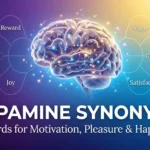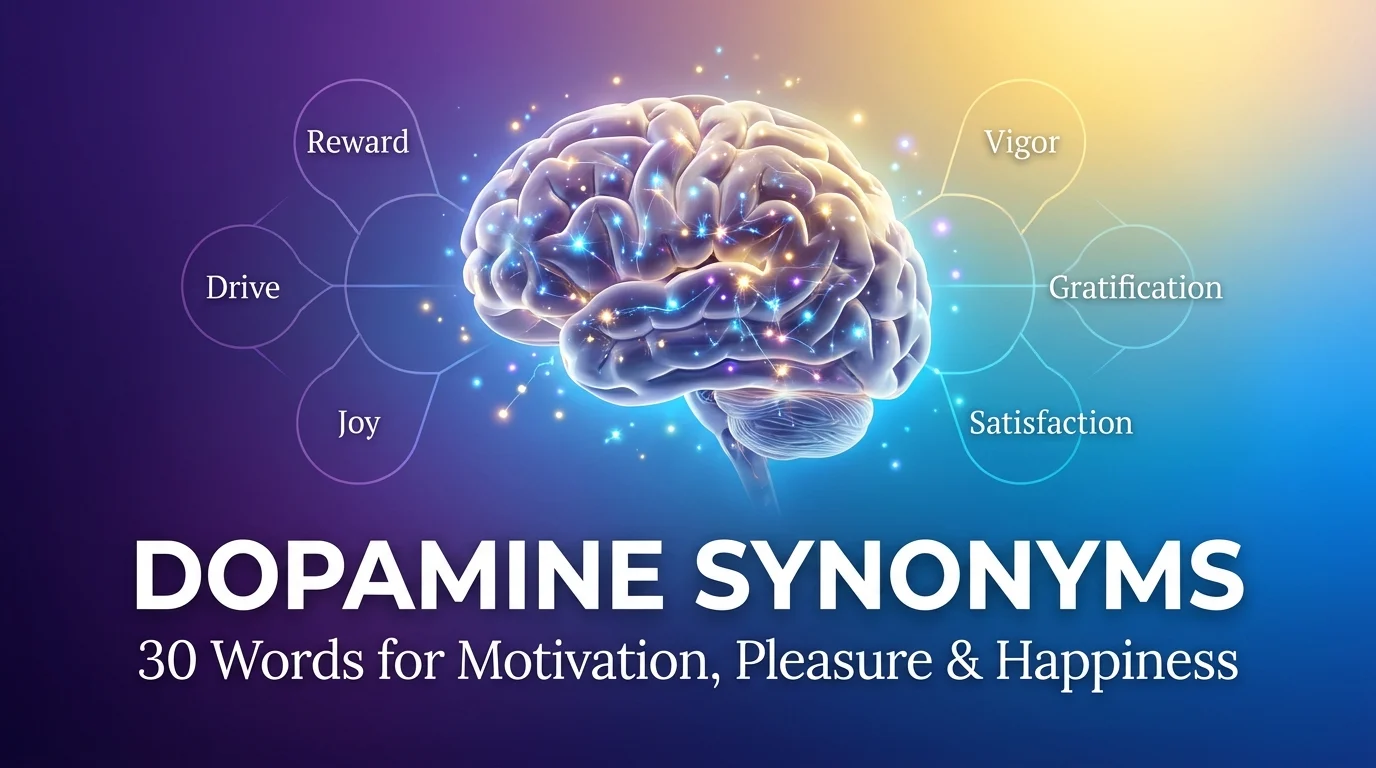
Dopamine is a chemical messenger in the brain that plays an important role in motivation, learning, movement, and reward. It is often associated with pleasure and happiness, but its functions are much broader.
It helps the brain recognize rewarding experiences, build habits, and encourage actions that support personal goals.
When searching for dopamine synonyms, you may be looking for alternative words to describe this brain chemical, its effects, or the feelings associated with it.
Although dopamine has no exact synonym in scientific language, several related terms can help explain its meaning in different contexts.
If you are a student, ESL learner, writer, blogger, or content creator, learning these alternatives can improve your vocabulary and help you communicate ideas about brain chemistry, motivation, pleasure, and emotional well-being more clearly.
What Does Dopamine Mean?
Dopamine is a neurotransmitter, which means it is a chemical messenger that helps nerve cells communicate with one another.
It is involved in several important brain functions, including:
- Motivation and goal-directed behavior.
- Learning and memory.
- Movement and coordination.
- Reward processing.
- Attention and decision-making.
Dopamine is commonly called the feel-good chemical, but this description is incomplete. It is particularly important in motivation, reward learning, and anticipating rewarding experiences.
Example sentences:
- Dopamine plays an important role in the brain’s reward system.
- Achieving a personal goal can activate dopamine-related reward pathways.
- Scientists study dopamine to understand motivation and behavior.
Tone and usage: Dopamine is a scientific and medical term. It is appropriate for educational articles, neuroscience discussions, health content, and everyday conversations about motivation.
30 Dopamine Synonyms and Related Words
Because dopamine is a specific chemical, the following words are not all direct scientific synonyms. Some describe its biological role, while others describe related feelings, effects, and experiences.
1. Neurotransmitter
Meaning: A chemical messenger that allows nerve cells to communicate.
Example: Dopamine is an important neurotransmitter in the human brain.
Best usage: Scientific writing and neuroscience education.
2. Chemical Messenger
Meaning: A chemical that carries messages between cells.
Example: Dopamine acts as a chemical messenger in the nervous system.
Best usage: Beginner-friendly scientific explanations.
3. Reward Chemical
Meaning: An informal expression describing a chemical involved in the brain’s reward system.
Example: Dopamine is often described as a reward chemical.
Best usage: Popular science articles and educational blogs.
4. Feel-Good Chemical
Meaning: An informal term associated with chemicals involved in positive experiences and emotional states.
Example: Many people refer to dopamine as a feel-good chemical.
Best usage: Casual conversations and lifestyle content.
5. Brain Chemical
Meaning: A chemical substance that helps the brain perform different functions.
Example: Dopamine is an important brain chemical involved in motivation.
Best usage: General educational writing.
6. Neuromodulator
Meaning: A chemical that changes how nerve cells communicate and respond to signals.
Example: Dopamine functions as a neuromodulator in several brain circuits.
Best usage: Advanced neuroscience and scientific writing.
7. Motivation
Meaning: The desire or willingness to do something.
Example: Dopamine is involved in the brain processes that support motivation.
Best usage: Personal development and behavioral psychology.
8. Pleasure
Meaning: A feeling of enjoyment or satisfaction.
Example: The experience of pleasure involves several brain systems, including dopamine pathways.
Best usage: Emotional descriptions and psychology.
9. Reward
Meaning: Something positive that follows an action or experience.
Example: The brain learns to recognize rewards through several chemical signaling systems.
Best usage: Psychology, learning, and behavior.
10. Excitement
Meaning: A feeling of enthusiasm, energy, or anticipation.
Example: She felt excitement while preparing for her long-awaited trip.
Best usage: Everyday emotional descriptions.
11. Satisfaction
Meaning: A feeling of happiness or fulfillment after achieving something.
Example: Completing the project gave him a strong sense of satisfaction.
Best usage: Personal achievements and emotional well-being.
12. Euphoria
Meaning: An intense feeling of happiness or excitement.
Example: Winning the competition filled her with euphoria.
Best usage: Describing powerful positive emotions.
13. Gratification
Meaning: Pleasure or satisfaction gained from fulfilling a desire.
Example: Finishing a difficult assignment brought immediate gratification.
Best usage: Psychology and behavioral discussions.
14. Reinforcement
Meaning: A process that makes a behavior more likely to happen again.
Example: Positive reinforcement can encourage someone to repeat a useful habit.
Best usage: Behavioral psychology and learning.
15. Incentive
Meaning: Something that encourages a person to take action.
Example: The possibility of success provided an incentive to keep working.
Best usage: Motivation, education, and business.
16. Drive
Meaning: A strong desire or determination to achieve something.
Example: Her drive helped her continue working toward her goals.
Best usage: Personal motivation and ambition.
17. Enthusiasm
Meaning: Strong interest, excitement, or eagerness.
Example: He showed enthusiasm when learning a new skill.
Best usage: Everyday conversations and positive writing.
18. Excitement Response
Meaning: A reaction involving increased emotional or physical arousal.
Example: The exciting news triggered a strong emotional response.
Best usage: Psychology and emotional descriptions.
19. Reward Signaling
Meaning: Communication within the brain related to rewarding experiences and learning.
Example: Dopamine plays an important role in reward signaling.
Best usage: Neuroscience and scientific explanations.
20. Anticipation
Meaning: The feeling of expecting something that may happen in the future.
Example: She felt anticipation before opening her birthday present.
Best usage: Motivation, emotions, and everyday writing.
21. Desire
Meaning: A strong feeling of wanting something.
Example: His desire to improve encouraged him to practice every day.
Best usage: Psychology and personal development.
22. Craving
Meaning: A powerful urge to have or experience something.
Example: Certain rewarding experiences can strengthen cravings through brain learning systems.
Best usage: Behavioral science and discussions about habits.
23. Alertness
Meaning: The state of being attentive and aware of your surroundings.
Example: Dopamine contributes to brain processes involved in attention and alertness.
Best usage: Cognitive science and educational writing.
24. Focus
Meaning: The ability to direct attention toward something.
Example: She improved her focus by creating a quiet study environment.
Best usage: Productivity and concentration topics.
25. Learning
Meaning: The process of gaining knowledge or developing skills.
Example: Dopamine helps the brain learn from rewarding and unexpected experiences.
Best usage: Education and neuroscience.
26. Positive Reinforcement
Meaning: Encouraging a behavior by providing a positive consequence.
Example: Positive reinforcement helped the child develop better study habits.
Best usage: Education, parenting, and behavioral psychology.
27. Emotional Reward
Meaning: A positive emotional experience that follows an action or event.
Example: Helping someone can provide an emotional reward.
Best usage: Emotional well-being and relationships.
28. Brain Reward System
Meaning: A group of brain structures and pathways involved in reward, motivation, and learning.
Example: Dopamine is an important part of the brain reward system.
Best usage: Neuroscience and educational content.
29. Neurochemical
Meaning: A chemical substance involved in nervous system activity.
Example: Dopamine is a neurochemical that supports communication within the brain.
Best usage: Scientific and medical writing.
30. Motivation Signal
Meaning: An informal description of a signal that helps the brain respond to important goals or rewards.
Example: Dopamine activity can provide motivation-related signals during learning.
Best usage: Simple explanations of brain function and motivation.
Dopamine Synonyms: Comparison Table
The best alternative depends on whether you are discussing the chemical itself, its biological role, or the experiences associated with it.
| Word | Main meaning | Best context |
|---|---|---|
| Neurotransmitter | Chemical messenger | Science |
| Neuromodulator | Regulates neural activity | Neuroscience |
| Chemical messenger | Carries cellular signals | Education |
| Reward chemical | Related to reward processing | Informal writing |
| Feel-good chemical | Informal emotional description | Casual writing |
| Brain chemical | Chemical in the brain | General education |
| Motivation | Desire to act | Psychology |
| Pleasure | Enjoyment | Emotions |
| Euphoria | Intense happiness | Emotional writing |
| Reinforcement | Strengthening behavior | Psychology |
| Reward signaling | Brain communication | Neuroscience |
| Neurochemical | Nervous system chemical | Science |
Different Ways to Describe Dopamine
Dopamine can be discussed from several perspectives. Understanding these differences helps you select the most accurate word.
1. Scientific and Biological Context
When discussing dopamine as a chemical in the nervous system, use:
- Neurotransmitter
- Neuromodulator
- Neurochemical
- Chemical messenger
- Brain chemical
Example: Dopamine is a neurotransmitter that helps regulate several important brain functions.
2. Motivation and Productivity Context
When describing the processes associated with motivation, use:
- Motivation
- Drive
- Incentive
- Anticipation
- Desire
Example: Achieving small goals can support motivation and encourage continued effort.
3. Pleasure and Happiness Context
When describing positive emotional experiences, use:
- Pleasure
- Satisfaction
- Euphoria
- Gratification
- Excitement
Example: Completing a challenging task can create a feeling of satisfaction.
4. Learning and Behavioral Context
When discussing how the brain learns from experiences, use:
- Reinforcement
- Positive reinforcement
- Reward signaling
- Reward
- Learning
Example: Reward signaling helps the brain adjust its behavior based on experience.
5. Attention and Cognitive Context
When discussing mental processes, use:
- Focus
- Alertness
- Learning
- Motivation
- Neuromodulation
Example: Dopamine contributes to the regulation of attention and cognitive processes.
How to Choose the Right Dopamine Synonym
Choosing an alternative to dopamine depends on your intended meaning.
Here are some practical guidelines.
For scientific writing
Choose neurotransmitter, neuromodulator, or neurochemical.
These terms are useful when discussing brain chemistry and nervous system functions.
For simple educational writing
Choose brain chemical or chemical messenger.
These expressions make complicated scientific information easier for beginners to understand.
For motivational content
Choose motivation, drive, incentive, or anticipation.
These words help describe the feelings and behaviors associated with goal-directed activities.
For emotional descriptions
Choose pleasure, satisfaction, excitement, or euphoria.
These alternatives describe experiences rather than the chemical itself.
For psychology and behavioral science
Choose reward, reinforcement, or reward signaling.
These terms are useful when discussing learning, habits, and behavior.
Dopamine vs. Serotonin: What Is the Difference?
Dopamine and serotonin are both important chemical messengers in the nervous system, but they have different functions.
Dopamine is strongly involved in motivation, reward learning, movement, and goal-directed behavior.
Serotonin helps regulate several processes, including mood, sleep, appetite, and other bodily functions.
Although both are sometimes called feel-good chemicals, neither should be understood as simply a happiness chemical.
Understanding this difference is useful when writing about brain chemistry, mental processes, and emotional well-being.
Frequently Asked Questions About Dopamine Synonyms
1. What is another word for dopamine?
There is no exact replacement for dopamine in scientific terminology. However, related terms include neurotransmitter, neurochemical, neuromodulator, and chemical messenger.
2. What is dopamine commonly called?
Dopamine is commonly called the feel-good chemical or reward chemical. These are informal descriptions, not precise scientific definitions.
3. Is dopamine a neurotransmitter?
Yes. Dopamine is a neurotransmitter that helps nerve cells communicate and plays important roles in movement, motivation, learning, and reward processing.
4. What is the opposite of dopamine?
Dopamine does not have a direct opposite. It is a specific chemical messenger, not an emotion or personality trait. Other neurotransmitters have different functions, but they are not opposites of dopamine.
5. What words are related to dopamine?
Some related words include motivation, reward, pleasure, reinforcement, anticipation, satisfaction, neurochemical, and neurotransmitter.
6. Is dopamine the same as happiness?
No. Dopamine is involved in reward processing and motivation, but happiness is a complex emotional experience involving multiple brain systems and life circumstances.
7. Why is dopamine called the motivation chemical?
Dopamine helps the brain respond to rewarding opportunities, learn from experiences, and support goal-directed behavior. This is why it is often associated with motivation.
8. Can dopamine be used as an adjective?
Dopamine itself is a noun. However, you can use the adjective dopaminergic to describe something related to dopamine or dopamine-producing neurons.
For example: “Dopaminergic pathways are involved in reward processing.”
Conclusion
Understanding dopamine synonyms and related terms can make your writing more informative, accurate, and engaging.
Although dopamine does not have an exact scientific synonym, words such as neurotransmitter, neuromodulator, neurochemical, and chemical messenger can describe its biological role.
Other related expressions, including motivation, reward, pleasure, satisfaction, and reinforcement, help explain the experiences and processes associated with dopamine.
The most important thing is to choose words according to their context. Use scientific terms when discussing brain chemistry, motivational words when describing behavior, and emotional expressions when talking about positive experiences.
By learning these 30 dopamine related words and expressions, you can expand your vocabulary and explain the fascinating connection between brain chemistry, motivation, learning, and human behavior.

I am Joel Michael, an enthusiastic language writer and synonym enthusiast. I enjoy exploring words, finding their meanings, and discovering useful alternatives. I create clear, helpful content to make vocabulary learning simple and enjoyable for every reader.