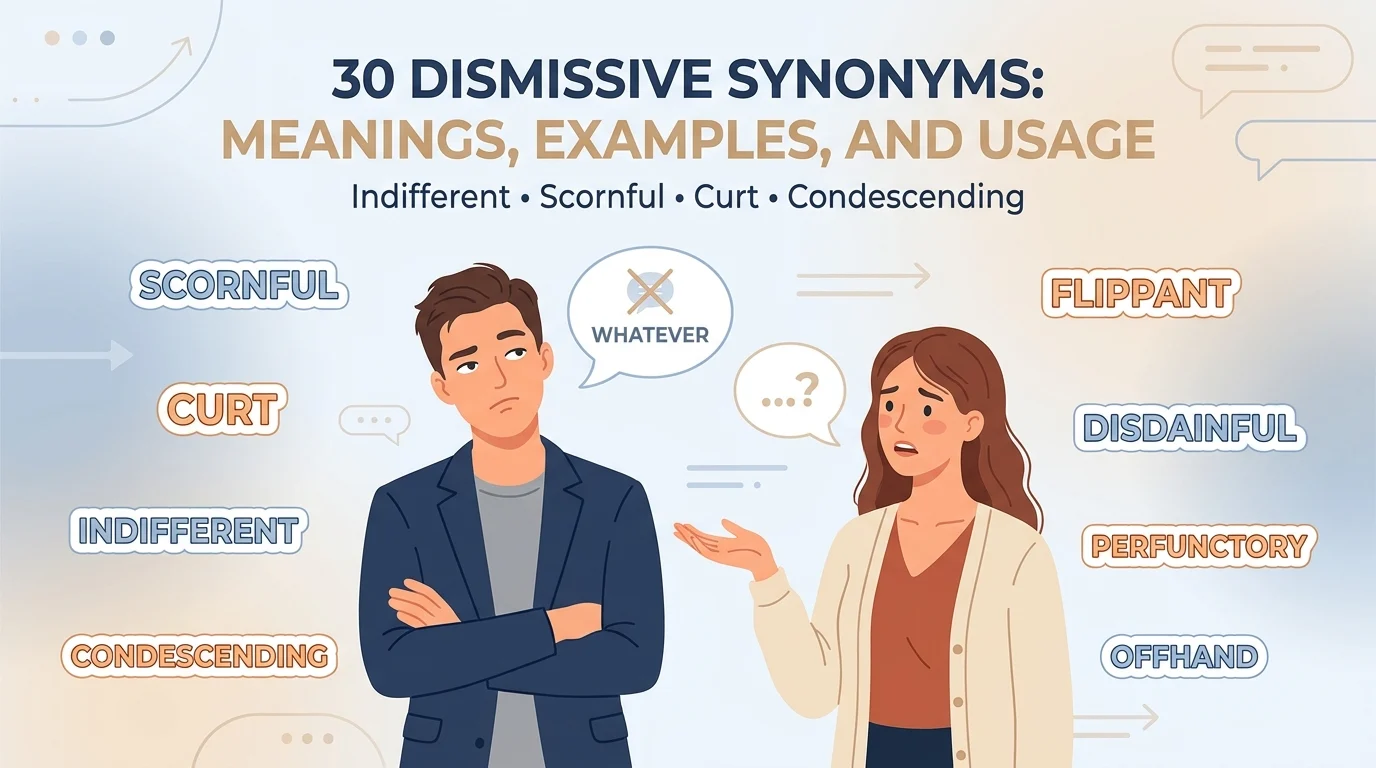
Dismissive synonyms help you describe someone who shows little interest, respect, or concern for another person, idea, or situation. Words such as scornful, disdainful, indifferent, and contemptuous can express different levels of disrespect or lack of interest.
Understanding these words can improve your writing, expand your vocabulary, and help you communicate emotions more accurately.
If you are a student, an ESL learner, a writer, or a content creator, learning the differences between dismissive synonyms can help you choose the right word for every context.
Although many of these words are related, they are not always interchangeable. Some describe a lack of interest, while others suggest arrogance, disrespect, or open contempt.
This guide explains 30 useful dismissive synonyms with simple meanings, example sentences, and practical usage tips.
What Does Dismissive Mean?
Dismissive is an adjective that describes someone who treats a person, idea, feeling, or concern as unimportant or unworthy of attention.
A dismissive person might ignore someone’s opinion, respond rudely to a question, or make another person feel that their concerns do not matter.
For example: Her dismissive response made him feel that his opinion was not important.
The word usually has a negative tone, especially when it describes how someone treats another person. It can be used in everyday conversations, professional communication, literature, and descriptions of relationships.
30 Dismissive Synonyms With Meanings and Examples
1. Disdainful
Meaning: Showing that you believe someone or something is beneath your respect.
Example: She gave a disdainful look when he shared his suggestion.
Best usage: Use it when someone displays clear disrespect or a feeling of superiority.
2. Scornful
Meaning: Showing strong disrespect or a feeling that someone deserves no admiration.
Example: He made a scornful comment about their efforts.
Best usage: Suitable for situations involving open disrespect or ridicule.
3. Contemptuous
Meaning: Showing that you consider someone or something worthless or undeserving of respect.
Example: The manager spoke in a contemptuous tone during the meeting.
Best usage: Use it to describe strong disrespect in speech, behavior, or facial expressions.
4. Indifferent
Meaning: Not interested in or concerned about something.
Example: She seemed indifferent to the results of the competition.
Best usage: Best when someone shows little interest or emotional involvement, rather than deliberate disrespect.
5. Disrespectful
Meaning: Showing a lack of respect for someone or something.
Example: His disrespectful reply upset the teacher.
Best usage: Use it when a person’s words or actions are rude or fail to show proper respect.
6. Curt
Meaning: Using very few words in a way that may seem rude or impatient.
Example: He gave a curt answer and returned to his work.
Best usage: Ideal for describing short, unfriendly replies.
7. Brusque
Meaning: Speaking or behaving in a quick, direct, and sometimes unfriendly manner.
Example: The receptionist sounded brusque when answering the question.
Best usage: Use it when someone’s manner feels abrupt or unnecessarily sharp.
8. Aloof
Meaning: Emotionally distant or unwilling to become friendly or involved.
Example: She remained aloof while the others discussed their plans.
Best usage: Suitable for describing a distant attitude or reserved social behavior.
9. Scathing
Meaning: Extremely critical in a way that causes embarrassment or hurt.
Example: The reviewer wrote a scathing response to the proposal.
Best usage: Use it for harsh criticism rather than simple lack of interest.
10. Derisive
Meaning: Showing ridicule or making someone seem foolish.
Example: A derisive laugh followed his suggestion.
Best usage: Best when a person mocks another person or their ideas.
11. Condescending
Meaning: Acting as if you are more intelligent or important than someone else.
Example: His condescending explanation made the new employee uncomfortable.
Best usage: Use it when someone talks down to another person.
12. Patronizing
Meaning: Treating someone as less capable or less intelligent than you.
Example: She disliked his patronizing advice.
Best usage: Useful for describing advice, comments, or behavior that sounds falsely kind but disrespectful.
13. Haughty
Meaning: Acting proudly and believing you are better than others.
Example: He gave a haughty response to the question.
Best usage: Use it when dismissiveness comes from arrogance.
14. Arrogant
Meaning: Having an exaggerated belief in your own importance or abilities.
Example: His arrogant attitude prevented him from listening to feedback.
Best usage: Best for describing excessive pride that makes someone disregard others.
15. Uncaring
Meaning: Showing little concern for another person’s feelings or needs.
Example: Her uncaring response left her friend feeling alone.
Best usage: Use it when a person appears unconcerned about someone’s well-being.
16. Unresponsive
Meaning: Not replying or reacting when a response is expected.
Example: The department remained unresponsive to repeated requests.
Best usage: Suitable for professional, personal, and customer-service situations.
17. Neglectful
Meaning: Failing to give someone or something the attention or care needed.
Example: His neglectful behavior made the team feel unsupported.
Best usage: Use it when a lack of attention involves a responsibility or duty.
18. Offhand
Meaning: Casual or unconcerned, sometimes suggesting that something is not important.
Example: She made an offhand remark about his concerns.
Best usage: Useful for casual comments that unintentionally or deliberately minimize an issue.
19. Flippant
Meaning: Treating a serious subject as if it were unimportant, often through joking.
Example: His flippant response upset everyone in the room.
Best usage: Best for inappropriate humor or unserious remarks about important matters.
20. Insensitive
Meaning: Not understanding or caring enough about another person’s feelings.
Example: It was insensitive of him to dismiss her worries.
Best usage: Use it when a response ignores emotional needs or causes hurt.
21. Unconcerned
Meaning: Not worried or interested about a particular matter.
Example: He appeared unconcerned about the delay.
Best usage: Suitable for situations where someone does not seem troubled by an issue.
22. Apathetic
Meaning: Showing little interest, enthusiasm, or emotion.
Example: The audience seemed apathetic during the presentation.
Best usage: Use it when someone lacks interest or motivation, rather than when they openly insult someone.
23. Negligent
Meaning: Failing to take proper care or fulfill a responsibility.
Example: The supervisor was negligent in addressing the safety concerns.
Best usage: Best for formal or professional contexts involving a failure of duty.
24. Hostile
Meaning: Unfriendly, aggressive, or strongly opposed to someone.
Example: He received a hostile response when he questioned the decision.
Best usage: Use it when dismissiveness includes aggression or opposition.
25. Rude
Meaning: Behaving in a way that is impolite or offensive.
Example: It was rude to interrupt her before she finished speaking.
Best usage: A common, simple word for everyday situations involving disrespect.
26. Impolite
Meaning: Not showing good manners or courtesy.
Example: His impolite reply ended the conversation quickly.
Best usage: Use it for behavior that breaks ordinary social expectations.
27. Unfeeling
Meaning: Showing little sympathy or emotion toward another person’s suffering.
Example: Her unfeeling response made the situation more painful.
Best usage: Suitable for describing a lack of compassion or emotional warmth.
28. Supercilious
Meaning: Behaving as though you are superior to other people.
Example: His supercilious expression suggested that he considered the idea foolish.
Best usage: Best for formal writing and literary descriptions of arrogant behavior.
29. Derogatory
Meaning: Showing disrespect or expressing a negative opinion about someone.
Example: The article contained derogatory remarks about the group.
Best usage: Use it for insulting language, comments, labels, or descriptions.
30. Scornful minded
Meaning: Inclined to treat people or ideas with scorn or contempt.
Example: His scornful-minded attitude made constructive discussions difficult.
Best usage: This is an uncommon, nonstandard sounding expression. In most writing, use scornful, contemptuous, or dismissive instead.
Comparison Table: Which Dismissive Synonym Should You Use?
| Synonym | Main meaning | Best context |
|---|---|---|
| Disdainful | Looking down on someone | Superiority |
| Scornful | Showing strong disrespect | Open ridicule |
| Contemptuous | Showing deep disrespect | Serious criticism |
| Indifferent | Showing no interest | Emotional neutrality |
| Curt | Giving a short, unfriendly reply | Conversation |
| Aloof | Remaining emotionally distant | Social situations |
| Condescending | Talking down to others | Workplace or personal interactions |
| Flippant | Treating something serious as trivial | Inappropriate jokes |
| Insensitive | Ignoring feelings | Emotional situations |
| Apathetic | Lacking interest or enthusiasm | General attitudes |
| Hostile | Acting aggressively or unfriendly | Conflict |
| Rude | Lacking politeness | Everyday communication |
| Derogatory | Expressing an insulting opinion | Language and writing |
| Unresponsive | Failing to reply | Emails and requests |
| Unconcerned | Showing little worry | Problems or delays |
Dismissive Synonyms by Tone and Intensity
Different synonyms communicate different levels of negativity. Choosing the right one helps readers understand the exact attitude you want to describe.
- Mild or indirect: indifferent, unconcerned, offhand, aloof.
- Abrupt or unfriendly: curt, brusque, rude, impolite.
- Arrogant or superior: haughty, arrogant, supercilious, condescending.
- Strongly disrespectful: scornful, disdainful, contemptuous, derisive.
- Emotionally insensitive: uncaring, unfeeling, insensitive, apathetic.
- Critical or insulting: scathing, derogatory, hostile, flippant.
These groups overlap. For example, a person can be both condescending and rude, but condescending specifically suggests treating someone as inferior.
How to Choose the Right Dismissive Synonym
Choosing the best synonym depends on what the person does, how strongly they express their attitude, and the situation in which the behavior occurs.
1. When Someone Ignores an Opinion
Choose indifferent, unresponsive, or unconcerned.
Example: “The committee seemed indifferent to the employees’ suggestions.”
These words are useful when someone does not appear interested in responding or taking action.
2. When Someone Talks Rudely
Choose curt, brusque, rude, or disrespectful.
Example: “He gave a curt reply when asked for clarification.”
These words work well when the dismissive behavior is visible in speech or manners.
3. When Someone Acts Superior
Choose condescending, patronizing, haughty, or supercilious.
Example: “Her condescending tone made the student feel embarrassed.”
These words describe behavior that suggests one person considers themselves better than another.
4. When Someone Shows Strong Contempt
Choose scornful, disdainful, or contemptuous.
Example: “He gave a contemptuous response to the proposal.”
These synonyms are appropriate when the behavior communicates serious disrespect.
5. When Someone Dismisses Feelings
Choose insensitive, uncaring, or unfeeling.
Example: “Her insensitive comment hurt his feelings.”
These words are particularly useful when describing relationships, emotional conversations, and personal experiences.
6. When Someone Makes a Serious Issue Seem Unimportant
Choose flippant or offhand.
Example: “His flippant remark about the problem frustrated the team.”
Use flippant when the person seems inappropriately joking or unserious. Use offhand when the remark seems casual or made without much thought.
Dismissive Synonyms in Different Contexts
In Everyday Conversation
Words such as rude, curt, indifferent, and insensitive are easy to understand and work well in everyday speech.
Example: “Her dismissive response made it clear that she did not want to discuss the issue.”
In Professional Writing
Words such as unresponsive, negligent, disrespectful, and condescending can be useful in workplace reports, feedback, and formal communication.
Example: “The team considered the repeated failure to address customer complaints unresponsive and unprofessional.”
Use neutral, evidence based descriptions when discussing workplace behavior.
In Creative Writing
Words such as scornful, haughty, aloof, and contemptuous can help establish a character’s personality and attitude.
Example: “He glanced at the invitation with a scornful smile and returned to his book.”
Specific word choices help readers picture a character’s reaction without lengthy explanations.
In Academic Writing
Words such as indifferent, apathetic, derogatory, and contemptuous may be suitable when discussing attitudes, communication, or social behavior.
Example: “The report described an indifferent response to the concerns raised by residents.”
Always choose the word that accurately reflects the evidence rather than using a stronger term simply for emphasis.
Dismissive vs. Similar Words: Important Differences
Not every word associated with dismissive behavior has the same meaning.
- Dismissive vs. indifferent: Dismissive suggests treating something as unimportant; indifferent means showing little interest or concern.
- Dismissive vs. rude: Dismissive behavior minimizes a person or idea, while rude behavior generally violates standards of politeness.
- Dismissive vs. condescending: Dismissive behavior brushes something aside; condescending behavior treats another person as inferior.
- Dismissive vs. contemptuous: Dismissive can be relatively mild, while contemptuous suggests stronger disrespect.
- Dismissive vs. apathetic: Dismissive describes a way of responding or treating something; apathetic describes a lack of interest, enthusiasm, or emotion.
Understanding these distinctions makes your vocabulary more precise and your writing more natural.
Frequently Asked Questions
What is the closest synonym for dismissive?
Disdainful, scornful, indifferent, and contemptuous can be close synonyms, depending on the context. Disdainful emphasizes looking down on someone, while indifferent emphasizes a lack of interest.
What is a polite word for dismissive?
Unconcerned, unresponsive, or not receptive may sound more neutral, depending on the situation. For example, “The team was not receptive to the suggestion” is less emotionally charged than “The team was contemptuous of the suggestion.”
What is the opposite of dismissive?
Possible antonyms include attentive, respectful, receptive, considerate, appreciative, and responsive. The best choice depends on whether you mean showing interest, respect, or concern.
Is dismissive always negative?
Not necessarily in every context, but it usually carries a negative meaning when describing interpersonal behavior. In some situations, dismissing an irrelevant concern or rejecting an unsupported claim may be reasonable. The word itself focuses on how something is treated as unimportant.
How can I use dismissive in a sentence?
Here are three examples:
- “The teacher was dismissive of the student’s concerns.”
- “His dismissive tone made the discussion uncomfortable.”
- “The company received criticism for its dismissive response to customer complaints.”
Conclusion
Learning dismissive synonyms helps you express different types of disrespect, disinterest, emotional distance, and negative attitudes more accurately.
Words such as indifferent, curt, condescending, scornful, and contemptuous share some similarities, but each communicates a different meaning or level of intensity.
For everyday communication, simple words such as rude and uncaring are often enough. For formal writing, unresponsive or disrespectful may be more suitable.
For creative writing, words such as haughty, aloof, and scornful can create a clearer picture of a character’s attitude.
The key is to consider the situation, the person’s behavior, and the tone you want to communicate. By choosing the most accurate synonym instead of repeating the same word, you can improve your vocabulary and make your writing clearer, more engaging, and more precise.

I am Derek Thomas, a passionate word enthusiast and writer. I enjoy exploring synonyms, expanding vocabulary, and helping readers find clear, accurate, and meaningful words for better writing.