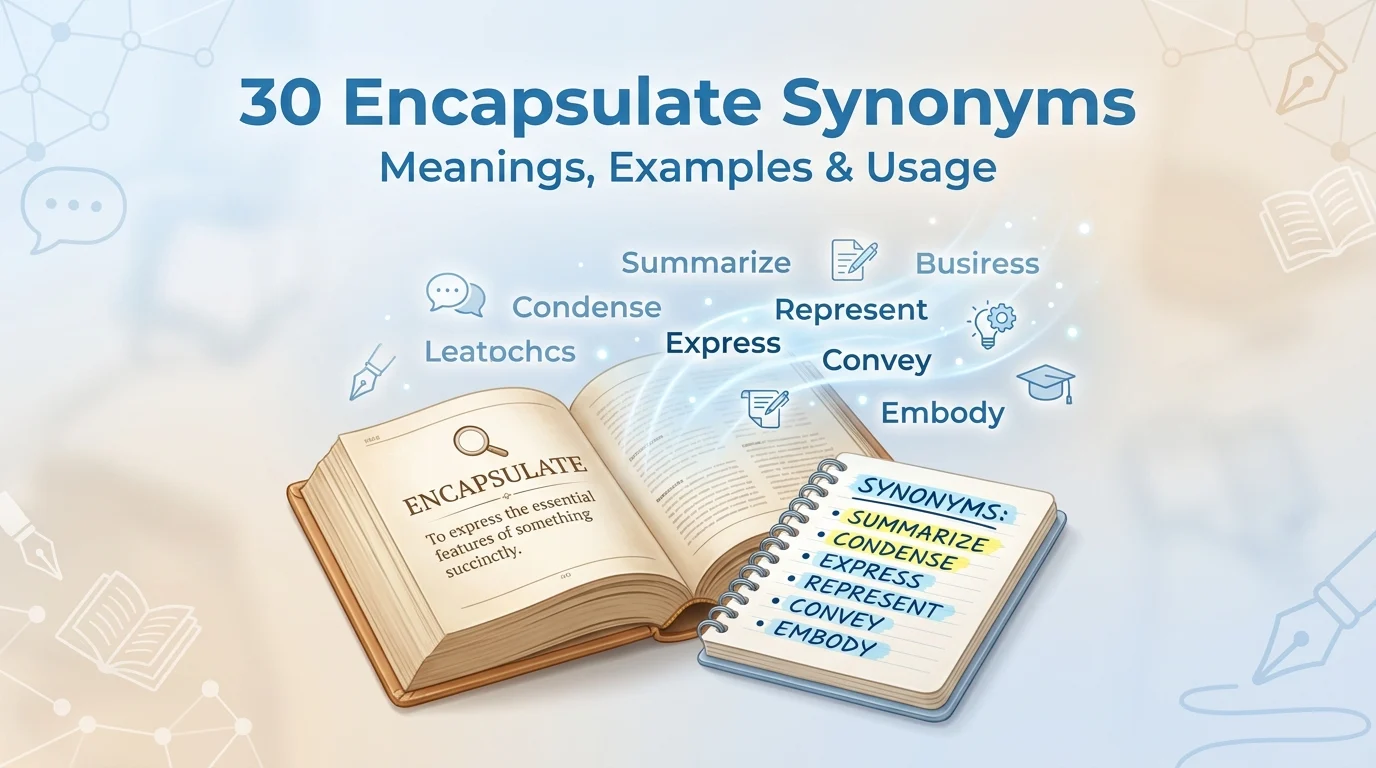
The word encapsulate is useful when you want to explain an idea, feeling, message, or experience in a short and meaningful way.
It helps writers communicate complex information clearly without using too many words. Learning encapsulate synonyms can also make your writing more natural, engaging, and varied.
If you are a student, ESL learner, professional writer, or content creator, understanding alternative words for encapsulate can improve your vocabulary.
Some alternatives emphasize summarizing information, while others focus on expressing an idea, representing something, or containing it within a defined space.
In this guide, you will discover 30 useful synonyms for encapsulate, along with simple meanings, example sentences, and practical usage tips. You will also learn how to choose the best alternative depending on your sentence and intended meaning.
What Does Encapsulate Mean?
Encapsulate means to express something complicated in a short and clear way or to enclose something within a covering or container.
The word has two common meanings:
- To summarize: To explain the main idea of something using only a few words.
- To enclose: To surround or contain something within a protective covering or defined space.
For example:
- This paragraph encapsulates the main argument of the article.
- The medicine is encapsulated in a small coating.
Encapsulate is commonly used in academic writing, business communication, everyday conversations, science, and technology.
Its tone is generally formal or professional, although it can also appear in ordinary conversation.
30 Best Encapsulate Synonyms With Meanings and Examples
Here are 30 useful alternatives to encapsulate. Each word has a slightly different meaning, so choosing the right one depends on your context.
1. Summarize
Meaning: To explain the main points of something briefly.
Example: Please summarize the report before the meeting.
Best usage context: Academic writing, reports, articles, and presentations.
2. Condense
Meaning: To make something shorter while keeping its most important information.
Example: She condensed the entire chapter into two pages.
Best usage context: Shortening essays, documents, and lengthy explanations.
3. Encompass
Meaning: To include or cover several different things.
Example: The course encompasses history, science, and literature.
Best usage context: Describing broad topics, subjects, or ideas.
4. Contain
Meaning: To have something inside or within something else.
Example: The report contains all the necessary information.
Best usage context: Physical objects, documents, information, and materials.
5. Express
Meaning: To communicate an idea, thought, or feeling.
Example: Her poem expresses the sadness of losing a loved one.
Best usage context: Writing, speaking, emotions, and personal opinions.
6. Represent
Meaning: To stand for or show something.
Example: This painting represents the beauty of nature.
Best usage context: Art, symbolism, communication, and descriptions.
7. Summate
Meaning: To bring different amounts or elements together into a total.
Example: The final calculation summates the results of all experiments.
Best usage context: Mathematics, statistics, and technical discussions.
8. Embody
Meaning: To represent an idea or quality in a clear and noticeable way.
Example: She embodies the values of honesty and kindness.
Best usage context: Describing people, qualities, principles, and ideals.
9. Include
Meaning: To make something part of a larger group or collection.
Example: The presentation includes several important examples.
Best usage context: Lists, reports, instructions, and general communication.
10. Capture
Meaning: To successfully express or show the most important part of something.
Example: The photograph captures the excitement of the celebration.
Best usage context: Emotions, moments, ideas, and experiences.
11. Describe
Meaning: To explain what someone or something is like.
Example: The author describes the city in great detail.
Best usage context: Storytelling, explanations, and informative writing.
12. Define
Meaning: To explain the exact meaning or nature of something.
Example: The introduction defines the main problem clearly.
Best usage context: Academic writing, dictionaries, and explanations.
13. Portray
Meaning: To represent someone or something through words, images, or actions.
Example: The movie portrays the struggles of a young family.
Best usage context: Literature, films, art, and storytelling.
14. Illustrate
Meaning: To explain or make something clear using examples or pictures.
Example: The teacher used a diagram to illustrate the concept.
Best usage context: Education, presentations, and explanatory writing.
15. Summarise
Meaning: To give a shorter version of the main points of something.
Example: Can you summarise the discussion in a few sentences?
Best usage context: British English spelling and everyday academic communication.
16. Enclose
Meaning: To surround something or place it inside a covering.
Example: The document was enclosed in a protective folder.
Best usage context: Physical objects, packaging, and written communication.
17. Incorporate
Meaning: To combine something with another thing as part of a whole.
Example: The writer incorporated several useful examples into the article.
Best usage context: Business, academic writing, planning, and creative work.
18. Compress
Meaning: To make something smaller, shorter, or more compact.
Example: The editor compressed the article without removing its main message.
Best usage context: Technology, writing, data, and physical materials.
19. Outline
Meaning: To present the main points of something without explaining every detail.
Example: The manager outlined the company’s goals for the coming year.
Best usage context: Essays, plans, presentations, and reports.
20. Summarize Briefly
Meaning: To communicate the most important information in very few words.
Example: The speaker summarized briefly before answering questions.
Best usage context: Meetings, discussions, and short explanations.
21. Synthesize
Meaning: To combine different ideas or pieces of information into a unified whole.
Example: The researcher synthesized information from several studies.
Best usage context: Academic research, analysis, and complex discussions.
22. Encircle
Meaning: To surround something completely or form a circle around it.
Example: A beautiful stone wall encircles the garden.
Best usage context: Physical surroundings and spatial descriptions.
23. Reflect
Meaning: To show, express, or demonstrate a particular quality or idea.
Example: Her actions reflect her strong sense of responsibility.
Best usage context: Personal qualities, emotions, opinions, and descriptions.
24. Convey
Meaning: To communicate or deliver an idea, feeling, or message.
Example: The short speech conveys an important message about friendship.
Best usage context: Communication, writing, speeches, and emotions.
25. Integrate
Meaning: To combine different parts so they work together as one.
Example: The school integrated technology into its teaching methods.
Best usage context: Education, business, systems, and teamwork.
26. Summarize Concisely
Meaning: To explain the main information using very few words.
Example: The journalist summarized the findings concisely.
Best usage context: Professional writing, reports, and presentations.
27. Contain Within
Meaning: To keep something inside a particular space, limit, or boundary.
Example: The instructions explain how to contain the material within the designated area.
Best usage context: Physical boundaries, technical instructions, and limitations.
28. Personify
Meaning: To represent an idea, quality, or characteristic through a person or character.
Example: The character personifies courage and determination.
Best usage context: Literature, storytelling, and creative writing.
29. Exemplify
Meaning: To serve as a clear example of something.
Example: Her dedication exemplifies the importance of hard work.
Best usage context: Academic writing, professional communication, and explanations.
30. Encapsulate in Words
Meaning: To express the main meaning or feeling of something through a short statement.
Example: It is difficult to encapsulate in words the happiness of becoming a parent.
Best usage context: Personal experiences, emotions, creative writing, and descriptions.
Comparison Table: Encapsulate Synonyms and Their Uses
Not every synonym for encapsulate works in every situation. Some words focus on shortening information, while others describe representing or enclosing something.
Use this comparison table to understand the differences.
| Synonym | Main meaning | Best situation |
|---|---|---|
| Summarize | Explain briefly | Reports and articles |
| Condense | Make shorter | Essays and documents |
| Encompass | Cover several things | Broad subjects |
| Contain | Hold inside | Objects and information |
| Express | Communicate an idea | Thoughts and feelings |
| Represent | Stand for something | Symbols and concepts |
| Embody | Clearly demonstrate | Qualities and values |
| Capture | Show the essence | Moments and emotions |
| Convey | Communicate a message | Speeches and writing |
| Synthesize | Combine ideas | Research and analysis |
| Incorporate | Add into a whole | Projects and documents |
| Exemplify | Provide an example | Explanations and arguments |
Different Ways to Use Encapsulate in Sentences
Understanding how encapsulate works in real sentences will help you choose better alternatives.
Here are some examples:
1. Academic writing
Original: The conclusion encapsulates the main findings of the research.
Alternative: The conclusion summarizes the main findings of the research.
2. Business communication
Original: This presentation encapsulates our company’s future goals.
Alternative: This presentation outlines our company’s future goals.
3. Emotional expression
Original: These photographs encapsulate the happiness of our childhood.
Alternative: These photographs capture the happiness of our childhood.
4. Literature
Original: The character encapsulates the idea of bravery.
Alternative: The character embodies the idea of bravery.
5. Physical containment
Original: The substance is encapsulated in a protective covering.
Alternative: The substance is enclosed in a protective covering.
These examples show why context matters when choosing an encapsulate synonym.
How to Choose the Right Synonym for Encapsulate
Choosing the best synonym depends on what you want to communicate. Although many words have similar meanings, they are not always interchangeable.
Here are some helpful ways to select the right word.
1. When You Want to Summarize Information
Choose words that focus on presenting the main points in a shorter form.
Best choices:
- Summarize
- Condense
- Outline
- Synthesize
Example: Instead of saying, “This paragraph encapsulates the main argument,” you can write, “This paragraph summarizes the main argument.”
2. When You Want to Express an Idea
Use alternatives that communicate thoughts, messages, or emotions.
Best choices:
- Express
- Convey
- Reflect
- Capture
Example: “The poem captures the feeling of loneliness.”
3. When You Want to Represent a Quality
Choose words that demonstrate or symbolize a particular characteristic.
Best choices:
- Embody
- Represent
- Personify
- Exemplify
- Portray
Example: “The athlete embodies determination and discipline.”
4. When You Want to Describe Something Broad
Use words that suggest including several elements or covering a wide subject.
Best choices:
- Encompass
- Include
- Incorporate
- Integrate
Example: “The program encompasses several important subjects.”
5. When You Want to Describe Physical Containment
Choose words that describe placing or keeping something inside a particular space.
Best choices:
- Enclose
- Contain
- Encircle
- Compress
Example: “The material is enclosed in a protective container.”
Common Mistakes to Avoid When Using Encapsulate Synonyms
Learning synonyms is not just about finding words with similar meanings. It is also important to understand how they work in different situations.
Avoid these common mistakes:
1. Using summarize and embody interchangeably
Summarize means explaining the main points briefly. Embody means representing a quality or idea.
2. Confusing contain with convey
Contain means to hold something inside. Convey means to communicate a message or feeling.
3. Using formal words in casual conversations
Words such as synthesize and encompass are useful in academic and professional writing but may sound unnecessarily formal in everyday conversations.
4. Ignoring the original sentence’s meaning
Always check if the alternative preserves the intended meaning of your original sentence.
5. Choosing complicated words unnecessarily
Simple words are often better. For example, summarize may be more appropriate than synthesize when you only want to explain the main points of a passage.
Frequently Asked Questions About Encapsulate Synonyms
1. What is the closest synonym for encapsulate?
The closest synonym depends on the context. Summarize is a good alternative when encapsulate means expressing the main idea briefly. Enclose is more suitable when referring to something physically contained within a covering.
2. What is another word for encapsulate in simple English?
Some simple alternatives include summarize, explain, describe, contain, express, and represent.
3. What does encapsulate mean in writing?
In writing, encapsulate usually means expressing the main idea, message, or meaning of something in a short and clear way.
4. Is summarize the same as encapsulate?
They have similar meanings, but they are not exactly the same. Summarize focuses on presenting the main points briefly, while encapsulate can also mean capturing the essential nature or meaning of something.
5. What is a formal synonym for encapsulate?
Formal alternatives include synthesize, encompass, condense, embody, incorporate, and represent. The best choice depends on the sentence.
6. What is the opposite of encapsulate?
Possible opposites depend on the meaning. When encapsulate means summarizing, expand, elaborate, and explain in detail can work as opposites. When it means enclosing something, release, expose, and uncover may be suitable alternatives.
Conclusion
Learning encapsulate synonyms can make your vocabulary stronger and help you communicate ideas more effectively.
Words such as summarize, condense, encompass, embody, represent, and convey provide different ways to express the meaning of encapsulate.
However, the best synonym depends on your intended message. Use summarize when explaining the main points, embody when describing a quality, convey when communicating an idea, and enclose when talking about physical containment.
By understanding these differences and practicing the examples in this guide, you can choose more accurate words for essays, professional documents, everyday conversations, and creative writing.
Remember, good vocabulary is not about using the most complicated words. It is about choosing the right word to express your meaning clearly and naturally.

I am Connor James, Administrator at SynoHut. I enjoy exploring synonyms, improving vocabulary, and helping readers discover clear, useful, and engaging word alternatives for everyday writing and communication.