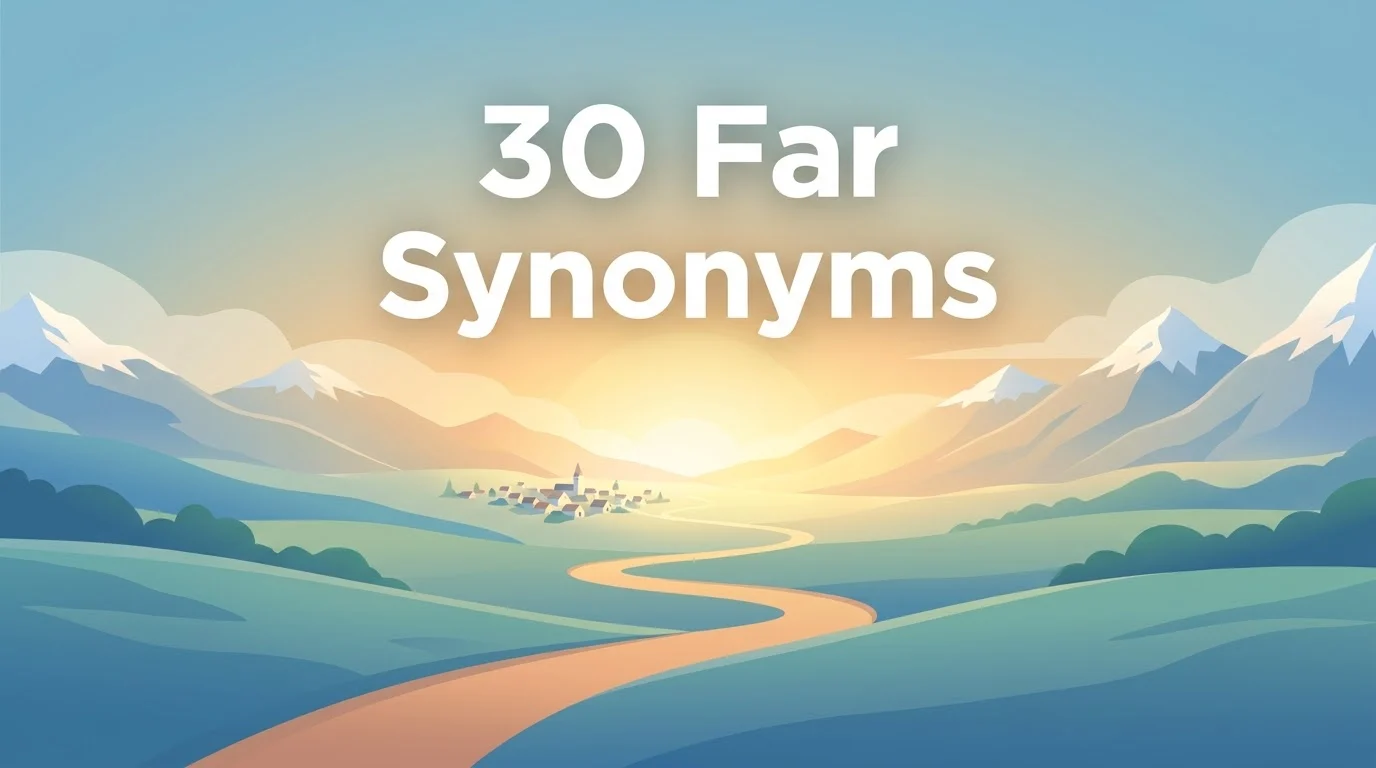
The word far is commonly used in English to describe a great distance between two places, people, or things. It can also describe something that is distant in time, difficult to reach, or significantly different from another idea or situation.
Although it is a simple word, choosing the right alternative can make your writing more descriptive and interesting.
Learning far synonyms can help students, ESL learners, writers, and content creators improve their vocabulary and communicate more clearly.
Words such as distant, remote, faraway, isolated, and extensive can sometimes replace far, depending on the sentence and intended meaning.
In this guide, you will discover 30 synonyms and related expressions for far, including their simple meanings, example sentences, and best usage contexts.
You will also learn how to choose the right alternative for everyday conversations, academic writing, and creative descriptions.
What Does Far Mean?
Far means a long distance away from a particular place, person, or point. It can describe physical distance, time, or a difference between two things.
In simple English, when something is far, it is not near or close.
For example:
- The school is far from my house.
- Her family lives far away.
- The event is still far in the future.
- His opinion is far different from mine.
The word far can function as an adverb, adjective, or part of common expressions. Its meaning depends on how it is used in a sentence.
Tone and Usage Context
- Tone: Neutral, conversational, descriptive, and sometimes formal.
- Usage: Everyday conversations, academic writing, storytelling, travel descriptions, and professional communication.
- Common associations: Distance, remoteness, separation, extent, and difference.
30 Far Synonyms and Their Meanings
Here are 30 useful synonyms and related expressions for far. Each word includes a simple definition, an example sentence, and its best usage context.
1. Distant
Meaning: Located a long way from a particular place or person.
Example: The distant mountains looked beautiful in the morning sunlight.
Best usage context: Describing places, objects, and locations that are far away.
2. Remote
Meaning: Situated far from towns, cities, or other populated areas.
Example: They built a small cabin in a remote village.
Best usage context: Travel writing, geography, and descriptions of isolated locations.
3. Faraway
Meaning: Located at a great distance from where someone is.
Example: She dreamed of visiting a faraway country.
Best usage context: Creative writing, storytelling, and casual descriptions.
4. Away
Meaning: At a distance from a particular place or person.
Example: My grandparents live several miles away.
Best usage context: Everyday conversations and simple descriptions of distance.
5. Distantly
Meaning: From a considerable distance or in a way that suggests separation.
Example: We could distantly hear music coming from the village.
Best usage context: Descriptive writing and conversations about sounds or observations.
6. Remote
Meaning: Far removed from a familiar or central location.
Example: The explorers discovered a remote island in the ocean.
Best usage context: Geography, travel articles, and adventure stories.
7. Outlying
Meaning: Located away from the center of a town, city, or area.
Example: The company opened a new office in an outlying district.
Best usage context: Geography, urban planning, and business writing.
8. Isolated
Meaning: Separated from other places or people.
Example: The isolated farmhouse stood beyond the green hills.
Best usage context: Describing lonely, separated, or difficult-to-reach places.
9. Secluded
Meaning: Located away from busy places and other people.
Example: We spent the weekend in a secluded mountain cottage.
Best usage context: Travel writing, peaceful settings, and nature descriptions.
10. Removed
Meaning: Situated at a distance from something else.
Example: The hotel is located several miles removed from the city center.
Best usage context: Formal descriptions of physical or figurative separation.
11. Far flung
Meaning: Located across a very large area or at great distances.
Example: The organization provides support to far flung communities.
Best usage context: Journalism, travel writing, and global discussions.
12. Outlying
Meaning: Positioned on the outer edge of a particular area.
Example: Farmers from outlying villages traveled to the market.
Best usage context: Regional descriptions, geography, and news writing.
13. Extensive
Meaning: Covering a large area or involving a great amount.
Example: The travelers explored an extensive region of the country.
Best usage context: Describing large areas, distances, or coverage rather than simple physical separation.
14. Lengthy
Meaning: Continuing for a long time or covering a considerable length.
Example: The lengthy journey took several days to complete.
Best usage context: Describing long journeys, periods, and processes.
15. Remote controlled
Meaning: Operated from a distance rather than directly.
Example: The remote controlled vehicle traveled across the field.
Best usage context: Technology, machines, and technical descriptions. This is not a general synonym for far.
16. Beyond
Meaning: At or to the other side of a particular point or limit.
Example: The small village lies beyond the river.
Best usage context: Describing locations or boundaries.
17. Afar
Meaning: At or from a great distance.
Example: We could see the lighthouse from afar.
Best usage context: Literary writing, poetry, and descriptive storytelling.
18. Yonder
Meaning: At some distance away, usually within sight.
Example: The old farmhouse stands over yonder near the trees.
Best usage context: Traditional English, storytelling, and informal regional speech.
19. Distantly Located
Meaning: Situated a considerable distance away.
Example: The research center is distantly located from the main campus.
Best usage context: Formal and descriptive writing.
20. Long Distance
Meaning: Covering or involving a considerable distance.
Example: They maintained a long distance friendship for many years.
Best usage context: Travel, communication, relationships, and transportation.
21. Far Off
Meaning: Situated at a great distance.
Example: A far off island appeared on the horizon.
Best usage context: Creative writing, storytelling, and descriptive language.
22. Inaccessible
Meaning: Difficult or impossible to reach or enter.
Example: Heavy snowfall made the mountain village inaccessible.
Best usage context: Geography, travel, safety, and difficult locations.
23. Astray
Meaning: Away from the correct path or intended direction.
Example: The hikers wandered astray in the thick forest.
Best usage context: Describing someone or something that has moved away from the correct route. It is not a direct synonym for far.
24. Peripheral
Meaning: Located on the outer edge of something rather than near its center.
Example: The village is situated in a peripheral area of the region.
Best usage context: Geography, academic writing, and descriptions of outer areas.
25. Wide-Ranging
Meaning: Covering many different areas, subjects, or locations.
Example: The organization has wide-ranging connections across the country.
Best usage context: Professional writing, research, and discussions about broad coverage.
26. Dispersed
Meaning: Spread over a large area rather than gathered in one place.
Example: The houses were dispersed across the countryside.
Best usage context: Geography, population studies, and descriptions of scattered locations.
27. Remote Access
Meaning: Accessing a system or location from another place.
Example: Employees can use remote access to connect to their office computers.
Best usage context: Technology and workplace communication. It describes access from a distance rather than physical distance itself.
28. Separated
Meaning: Kept apart from another person, place, or object.
Example: The two villages are separated by a wide river.
Best usage context: Everyday English, relationships, and geographical descriptions.
29. Far Removed
Meaning: Very different from or distant from something in position, time, or nature.
Example: Modern technology is far removed from the tools used centuries ago.
Best usage context: Formal writing, comparisons, and figurative descriptions.
30. Out of Reach
Meaning: Too far away or difficult to reach.
Example: The beautiful island seemed out of reach during the storm.
Best usage context: Everyday conversations, storytelling, and figurative expressions.
Comparison Table: Far Synonyms and When to Use Them
Different alternatives for far work better in different situations. This table will help you choose the most appropriate word.
| Synonym | Main meaning | Best usage |
|---|---|---|
| Distant | A long way away | General writing |
| Remote | Far from populated areas | Geography |
| Faraway | Located at a great distance | Storytelling |
| Away | At a distance | Everyday English |
| Outlying | On the outer edge | Geography |
| Isolated | Separated from others | Descriptions |
| Secluded | Away from busy places | Travel writing |
| Far-flung | Spread across great distances | Journalism |
| Afar | At a great distance | Literary writing |
| Yonder | At some distance | Traditional English |
| Beyond | On the other side | Directions |
| Far-off | Located far away | Creative writing |
| Inaccessible | Difficult to reach | Geography |
| Peripheral | Near the outer edge | Academic writing |
| Long-distance | Covering a long distance | Travel and communication |
How to Choose the Right Far Synonym
Choosing the correct synonym depends on the meaning, tone, and context of your sentence. Here are some helpful groups to make your choice easier.
1. For Physical Distance
Use these words when describing something that is located a long way from another place.
- Distant
- Faraway
- Afar
- Far-off
- Away
- Yonder
Example: Instead of saying, “The village is far away,” you can write, “The village is distant from the city.”
2. For Isolated or Hard-to-Reach Places
Use these alternatives when describing locations that are separated from busy areas or difficult to access.
- Remote
- Isolated
- Secluded
- Inaccessible
- Outlying
Example: “The family lives in a remote mountain village.”
These words are particularly useful in travel articles, geographical descriptions, and storytelling.
3. For Formal and Academic Writing
Choose more precise words when writing reports, essays, or professional documents.
- Distant
- Peripheral
- Extensive
- Dispersed
- Far removed
Example: “The research center is situated in a peripheral region.”
4. For Creative and Descriptive Writing
Use expressive alternatives to make your descriptions more interesting.
- Far flung
- Faraway
- Afar
- Far off
- Yonder
Example: “A mysterious castle stood on a faraway hill.”
5. For Figurative Meanings
Sometimes far describes differences, limitations, or separation rather than physical distance.
- Far removed
- Beyond
- Out of reach
- Separated
- Wide ranging
Example: “Her new lifestyle was far removed from her childhood experiences.”
Common Questions About Far Synonyms
What is another word for far?
Some common synonyms for far include distant, remote, faraway, away, afar, far-off, and far-flung. The best alternative depends on the sentence.
What is a better word for far away?
You can use distant, remote, faraway, far-off, or afar. For example, “a distant village” sounds natural when describing a place located a long way away.
What is a formal synonym for far?
Distant, remote, peripheral, and far removed are useful alternatives in formal and academic writing.
What is the opposite of far?
The most common opposite of far is near. Other alternatives include:
- Close
- Nearby
- Adjacent
- Within reach
- Not distant
For example, instead of saying “The shop is far from my house,” you can say “The shop is near my house.”
What is a literary word for far?
Afar is a popular literary alternative for far. Other descriptive choices include far-off, faraway, and yonder.
What is the difference between far and distant?
Far is commonly used in everyday English to describe distance. Distant is often used as an adjective before a noun.
Examples:
- The school is far from here.
- The distant mountains look beautiful.
Can far describe time?
Yes. Far can describe something that is a long time away.
For example:
- The holiday is still far in the future.
- We have come a long way since those far-off days.
Conclusion
Learning different far synonyms can improve your vocabulary and help you express distance more accurately.
Words such as distant, remote, faraway, afar, far-off, isolated, and far-flung offer useful alternatives for different situations.
For everyday conversations, words like away and distant are simple and natural. For academic writing, peripheral and far removed may be more suitable.
Meanwhile, faraway, afar, and far off can make creative writing more descriptive and engaging.
Remember that not every related expression is a perfect replacement for far. Some describe isolation, accessibility, or the size of an area rather than distance itself.
By understanding these 30 far synonyms and their meanings, you can choose better words, avoid repetition, and make your English writing clearer, more natural, and more expressive.

I am Connor James, Administrator at SynoHut. I enjoy exploring synonyms, improving vocabulary, and helping readers discover clear, useful, and engaging word alternatives for everyday writing and communication.