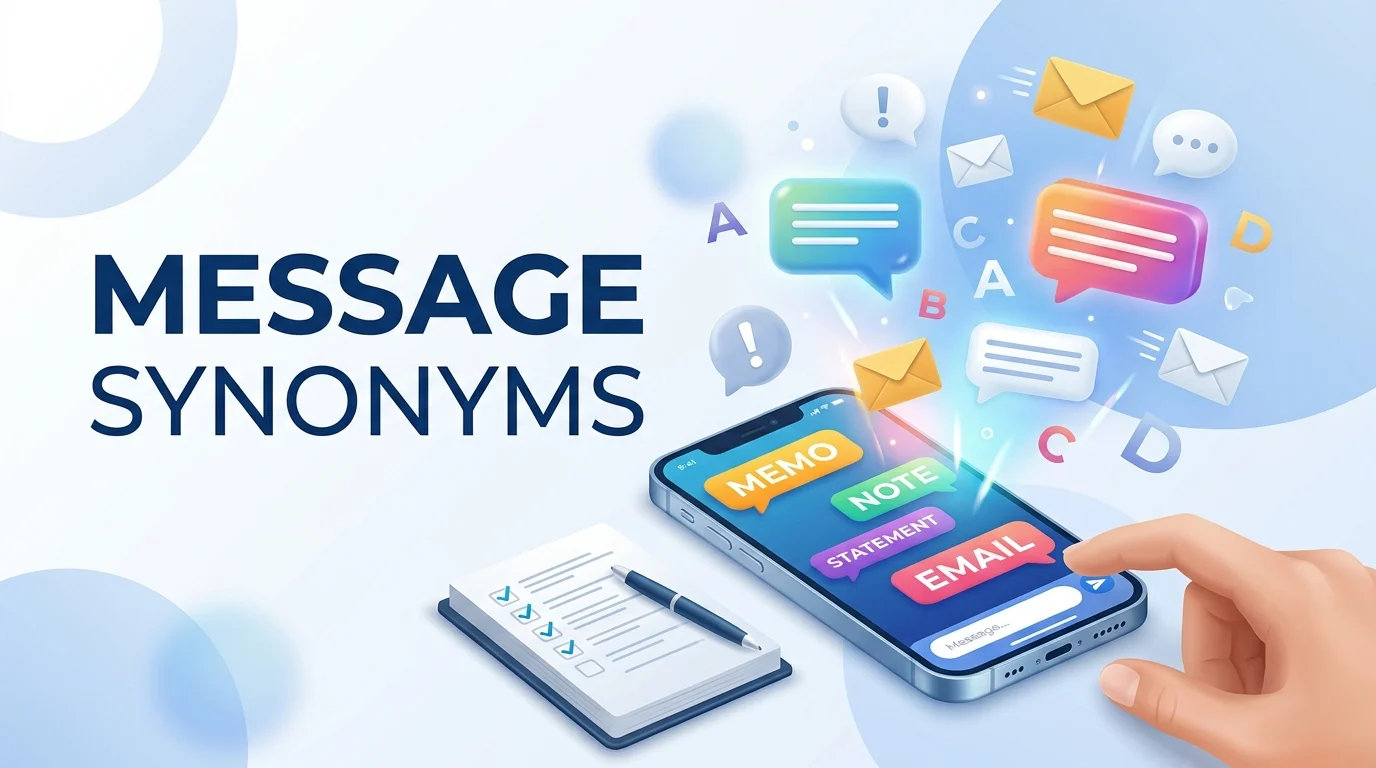
Finding the right message synonyms can make your writing clearer, more natural, and more precise. The word message is common in everyday English, but its best replacement depends on what you mean.
A message can be a short text sent to someone, an important idea in a speech, a piece of information, or even a communication delivered through a formal channel.
For students, ESL learners, writers, and content creators, learning alternatives to message is useful because different words carry different tones.
For example, note sounds natural for a short written communication, while announcement suggests information shared publicly. Likewise, meaning or idea may work better when you are talking about the main point of a book, speech, or story.
This guide covers 30 useful alternatives to message, with simple meanings, example sentences, and practical usage notes. It also explains how to choose the best synonym depending on context and tone.
What Does “Message” Mean?
The noun message generally means a piece of information, communication, or an idea that someone gives to another person or group.
For example:
“I received a message from my teacher.”
Here, message means a communication sent to you.
The word can also describe the main idea someone wants to communicate:
“The message of the story is that kindness matters.”
In this case, message refers to the central idea or lesson.
As a verb, message can mean to communicate with someone, especially through a phone or online platform:
“I messaged my friend about the meeting.”
Because message has several meanings, there is no single synonym that works in every situation. The right alternative depends on whether you mean a text, piece of information, announcement, idea, instruction, or lesson.
30 Message Synonyms
1. Note
Meaning: A short written communication.
Example:
“I left a note on your desk.”
Best usage context: Use note for short personal or informal written communications.
2. Communication
Meaning: Information shared between people or groups.
Example:
“Clear communication is important in every workplace.”
Best usage context: Best for formal, professional, or general discussions about exchanging information.
3. Information
Meaning: Facts or details given to someone.
Example:
“She sent me information about the new course.”
Best usage context: Use when the message mainly provides facts or useful details.
4. Memo
Meaning: A short official communication, usually used at work or in an organization.
Example:
“The manager sent a memo to all employees.”
Best usage context: Best for workplace and organizational communication.
5. Announcement
Meaning: Information formally or publicly shared with people.
Example:
“The school made an announcement about the holiday.”
Best usage context: Use when information is being shared publicly or officially.
6. Statement
Meaning: Something said or written clearly to express information, an opinion, or a position.
Example:
“The company released a statement about the changes.”
Best usage context: Useful in formal, business, political, and professional writing.
7. Notice
Meaning: A written or spoken piece of information intended to inform people.
Example:
“A notice was posted on the classroom door.”
Best usage context: Common for public information, warnings, and official instructions.
8. Communication
Meaning: The act or result of sharing thoughts, information, or feelings.
Example:
“Email is an important form of communication.”
Best usage context: Particularly useful in academic and professional contexts.
9. Dispatch
Meaning: An official or written communication sent from one place to another.
Example:
“The reporter sent a dispatch from the affected area.”
Best usage context: Often used in journalism, military contexts, and formal communication.
10. Correspondence
Meaning: Written communication exchanged between people.
Example:
“They continued their correspondence for several years.”
Best usage context: Best for formal letters, emails, or ongoing written communication.
11. Letter
Meaning: A written communication sent to someone.
Example:
“She received a letter from her university.”
Best usage context: Use when the message is specifically a letter.
12. Email
Meaning: An electronic message sent through the internet.
Example:
“I sent you an email with the details.”
Best usage context: Best when referring specifically to digital communication sent by email.
13. Text
Meaning: A short written message sent by phone.
Example:
“I’ll send you a text when I arrive.”
Best usage context: Common in casual, everyday communication.
14. Chat
Meaning: An informal conversation or message exchange, especially online.
Example:
“We had a quick chat about the project.”
Best usage context: Best for informal online or spoken communication.
15. Reply
Meaning: An answer given in response to another communication.
Example:
“I received her reply this morning.”
Best usage context: Use when the communication is specifically an answer to a previous message.
16. Response
Meaning: Something said or written in answer to another person.
Example:
“His response to the question was very clear.”
Best usage context: Useful in formal, academic, business, and everyday writing.
17. Answer
Meaning: A response to a question or request.
Example:
“She sent an answer to my question.”
Best usage context: Use when the message directly responds to a question.
18. Word
Meaning: A piece of information or news communicated to someone.
Example:
“Have you heard any word from the manager?”
Best usage context: Often used in informal expressions involving news or information.
19. Signal
Meaning: Something that communicates information, intention, or meaning.
Example:
“His silence was a signal that he disagreed.”
Best usage context: Useful when communication is indirect or nonverbal.
20. Indication
Meaning: Something that shows or suggests an idea, fact, or intention.
Example:
“The sudden change was an indication that something was wrong.”
Best usage context: Best for indirect messages or signs.
21. Meaning
Meaning: The idea or significance communicated by something.
Example:
“The meaning of the poem is open to interpretation.”
Best usage context: Use when message means the deeper idea behind a story, speech, image, or text.
22. Idea
Meaning: A thought, concept, or point someone wants to communicate.
Example:
“The main idea of the presentation was easy to understand.”
Best usage context: Useful when discussing the central thought being communicated.
23. Point
Meaning: The main idea someone is trying to communicate.
Example:
“I understand your point.”
Best usage context: Excellent for conversations, essays, arguments, and explanations.
24. Lesson
Meaning: An idea or principle learned from an experience, story, or situation.
Example:
“The story teaches an important lesson about honesty.”
Best usage context: Use when a message contains advice, wisdom, or a moral.
25. Moral
Meaning: A lesson about right, wrong, or good behavior.
Example:
“The moral of the story is to treat others with respect.”
Best usage context: Best for stories, fables, literature, and situations involving ethical lessons.
26. Theme
Meaning: A central subject or idea explored in a work.
Example:
“Friendship is a major theme in the novel.”
Best usage context: Particularly useful when discussing books, movies, literature, art, and other creative works.
27. Content
Meaning: The information, ideas, or material contained in something.
Example:
“The content of the message was easy to understand.”
Best usage context: Useful for websites, emails, documents, social media, and digital communication.
28. Instruction
Meaning: Information that tells someone what to do.
Example:
“The message included instructions for completing the application.”
Best usage context: Use when communication gives directions or tells someone how to perform a task.
29. Reminder
Meaning: A message that helps someone remember something.
Example:
“She sent me a reminder about tomorrow’s appointment.”
Best usage context: Best for appointments, deadlines, tasks, events, and everyday communication.
30. Communiqué
Meaning: An official announcement or formal communication.
Example:
“The government issued a communiqué after the meeting.”
Best usage context: Best for highly formal, diplomatic, governmental, or institutional writing.
Message Synonyms Comparison Table
| Synonym | Main Meaning | Tone | Best Context |
|---|---|---|---|
| Note | Short written communication | Neutral | Personal messages |
| Communication | Exchange of information | Formal/Neutral | Business, academic |
| Information | Facts or details | Neutral | General information |
| Memo | Official short communication | Formal | Workplace |
| Announcement | Public information | Formal | Schools, companies, events |
| Statement | Formal expression | Formal | Business, public affairs |
| Notice | Information for attention | Formal/Neutral | Public information |
| Correspondence | Written exchange | Formal | Letters and emails |
| Letter | Written communication | Neutral | Personal/formal writing |
| Electronic communication | Neutral | Digital communication | |
| Text | Short phone message | Informal | Everyday communication |
| Reply | Answer to a message | Neutral | Conversations |
| Response | Answer or reaction | Neutral/Formal | Professional writing |
| Answer | Response to a question | Neutral | Questions |
| Signal | Indirect communication | Neutral | Signs and behavior |
| Indication | Sign or suggestion | Formal | Analysis |
| Meaning | Idea being communicated | Neutral | Literature and ideas |
| Idea | Thought being expressed | Neutral | Discussions and writing |
| Point | Main idea | Neutral | Arguments and conversation |
| Lesson | Principle learned | Neutral | Stories and experiences |
| Moral | Ethical lesson | Neutral/Formal | Fables and literature |
| Theme | Central idea | Academic | Books and movies |
| Content | Material or information | Neutral | Websites and media |
| Instruction | Direction or command | Formal | Tasks and procedures |
| Reminder | Prompt to remember | Neutral | Events and deadlines |
| Communiqué | Official communication | Very formal | Government and diplomacy |
How to Choose the Right Synonym for “Message”
Choosing the right alternative depends mainly on what kind of message you are describing.
For a short personal message
Choose:
- Note
- Text
- Letter
- Chat
For example:
“I’ll send you a text later.”
This sounds much more natural than using a formal word such as communiqué.
For professional communication
Choose:
- Memo
- Statement
- Communication
- Notice
- Correspondence
For example:
“The company issued a statement about the new policy.”
For public information
Choose:
- Announcement
- Notice
- Statement
- Communiqué
These words suggest that information is being officially shared with a larger audience.
For the main idea of a story or speech
Choose:
- Meaning
- Idea
- Point
- Lesson
- Moral
- Theme
For example:
“The main message of the novel is the importance of friendship.”
You could replace message with:
“The main theme of the novel is the importance of friendship.”
However, theme and message are not always identical. A theme is a recurring subject or idea, while a message is usually what the creator wants the audience to understand or learn.
For indirect communication
Choose:
- Signal
- Indication
For example:
“Her silence was a signal that she was unhappy.”
Here, message would be possible, but signal more clearly suggests communication without direct words.
For directions or instructions
Choose:
- Instruction
- Notice
- Reminder
For example:
“The email contained instructions for submitting the form.”
The word instruction is much more precise than the general word message.
Message vs. Synonyms: Important Differences
Not every synonym is interchangeable with message. Some alternatives are only suitable in specific situations.
Message vs. note:
A note is usually short and written. A message is broader and can be spoken, written, digital, or symbolic.
Message vs. information:
Information focuses on facts or details, while a message can also communicate feelings, opinions, intentions, or ideas.
Message vs. announcement:
An announcement is normally intended for a group or public audience.
Message vs. communication:
Communication is a broader term that includes the process of sharing information, not just one particular message.
Message vs. theme:
A theme is a central subject or recurring idea in creative work. A message is often the lesson or point the creator wants the audience to take away.
Message vs. moral:
A moral is specifically a lesson about behavior, values, or right and wrong.
Common Phrases Using “Message”
Understanding common expressions can also help ESL learners use message naturally.
“Send a message”
Meaning: Communicate something to someone.
Example:
“I’ll send you a message when I get home.”
“Leave a message”
Meaning: Record or write information for someone who is unavailable.
Example:
“Please leave a message after the tone.”
“Get the message”
Meaning: Understand what someone is trying to communicate.
Example:
“He finally got the message and stopped asking.”
“The message is clear”
Meaning: The intended meaning is easy to understand.
Example:
“The message is clear: everyone must follow the rules.”
“The message behind…”
Meaning: The deeper idea communicated by something.
Example:
“The message behind the story is about forgiveness.”
Why Learning Message Synonyms Matters
Learning synonyms is not simply about replacing one word with another. Good vocabulary means knowing which word sounds natural in a particular situation.
For students, understanding these differences can make essays and assignments more precise. ESL learners can use the right words in conversations and professional situations. Writers can avoid repetition and communicate ideas with greater accuracy. Content creators can also choose vocabulary that matches the tone of an article, email, social post, or marketing message.
For example, instead of repeatedly writing:
“The message says…”
you might write:
- “The announcement explains…”
- “The statement confirms…”
- “The note reminds readers…”
- “The story teaches a lesson…”
- “The speech communicates an important idea…”
This creates more varied and natural writing.
Final Thoughts on Message Synonyms
The best message synonym depends on what you are trying to communicate. Note, text, and email work well for everyday written communication.
Memo, statement, and communiqué are better suited to formal settings. When message refers to an idea or lesson, words such as meaning, point, theme, lesson, and moral can be more precise.
The key is not to choose the most complicated synonym. Choose the word that communicates your exact meaning and matches the situation. A simple word used correctly is usually better than an impressive word used incorrectly.
By learning these 30 alternatives and understanding their differences, you can make your English more flexible, precise, and natural if you are writing an essay, sending an email, creating content, or having an everyday conversation.

I am Derek Thomas, a passionate word enthusiast and writer. I enjoy exploring synonyms, expanding vocabulary, and helping readers find clear, accurate, and meaningful words for better writing.