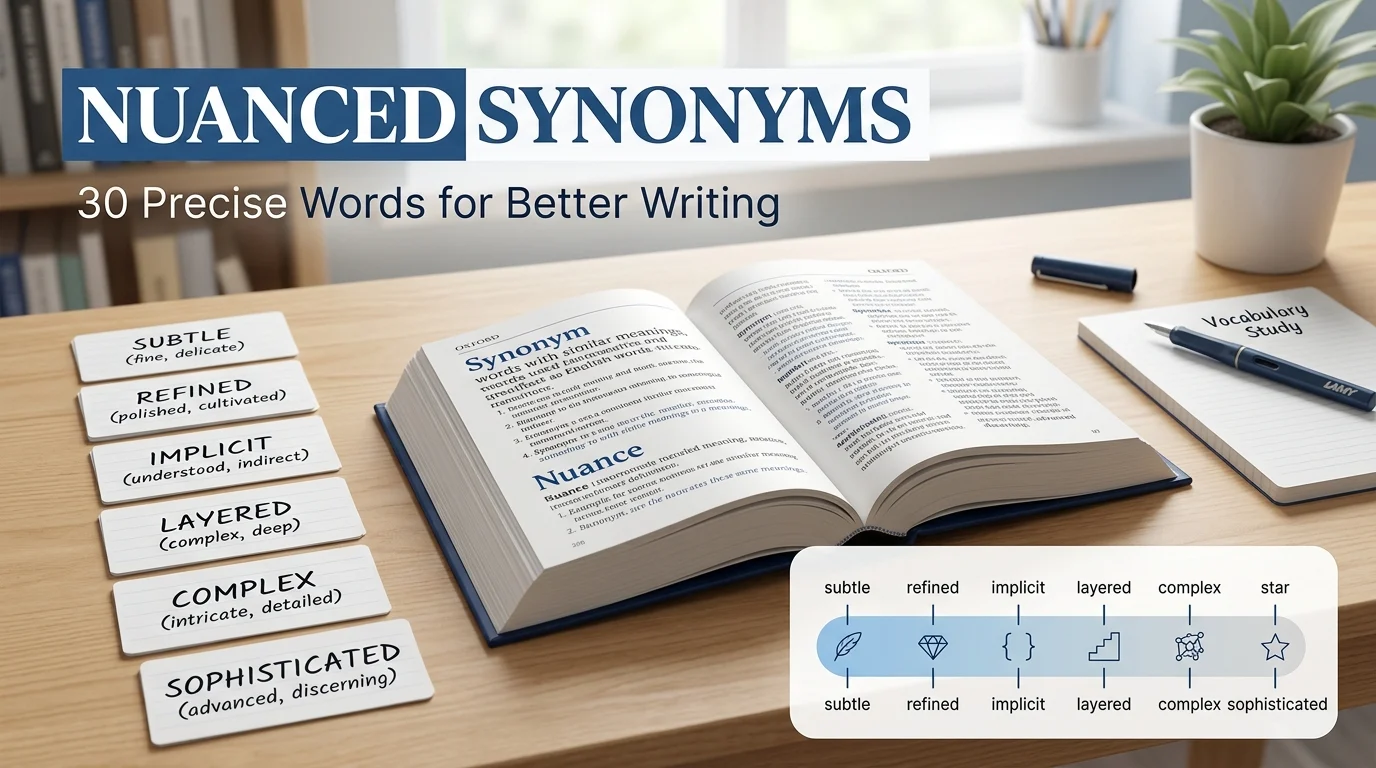
Finding the right word is not always about finding a word with the same dictionary definition. Sometimes, you need a word that carries a slightly different feeling, intensity, attitude, or context. This is where nuanced synonyms become especially useful.
For example, instead of repeatedly using subtle, you might choose delicate, understated, refined, implicit, or shaded, depending on exactly what you want to communicate. These words may be related, but they are not always interchangeable.
Understanding nuanced synonyms can make your writing more precise and natural. They are particularly useful for students, ESL learners, writers, journalists, bloggers, and content creators who want to communicate ideas clearly without sounding repetitive.
What Does “Nuanced” Mean in Simple English?
Nuanced means having small but important differences in meaning, feeling, tone, or detail.
When something is nuanced, it is not simply good or bad, easy or difficult, right or wrong. It may contain several shades of meaning that require careful understanding.
Simple definition
Nuanced: showing or involving small differences that are important to understand.
Examples
- Her answer was nuanced rather than simply positive or negative.
- The novel gives a nuanced picture of family relationships.
- He offered a nuanced explanation of the problem.
In these examples, nuanced suggests depth, complexity, and attention to subtle details.
Nuanced vs. subtle
These words are closely related, but they are not exactly the same.
Subtle usually describes something that is difficult to notice or recognize.
Nuanced usually describes something that contains fine distinctions or several layers of meaning.
For example:
There was a subtle change in her voice.
The change may have been difficult to hear.
She gave a nuanced explanation of the situation.
Her explanation included several different aspects rather than one simple conclusion.
30 Nuanced Synonyms and Related Words
Below are 30 useful alternatives and closely related expressions. Each one has a slightly different meaning, so the best choice depends on your context.
1. Subtle
Meaning: Not obvious or easy to notice; showing a small difference.
Example:
There was a subtle change in his attitude after the meeting.
Best usage: Use subtle when something is present but not immediately noticeable.
2. Delicate
Meaning: Fine, sensitive, or easily affected.
Example:
The negotiations required a delicate approach.
Best usage: Use delicate for sensitive situations, emotions, relationships, or things that need careful handling.
3. Sophisticated
Meaning: Complex, developed, or showing a high level of understanding.
Example:
The article presents a sophisticated analysis of modern culture.
Best usage: Use sophisticated when discussing advanced ideas, methods, systems, or tastes.
4. Refined
Meaning: Carefully developed, improved, or made more precise.
Example:
She developed a refined understanding of classical literature.
Best usage: Use refined for ideas, tastes, skills, methods, or judgments that have become more developed.
5. Implicit
Meaning: Suggested or understood without being directly stated.
Example:
There was an implicit criticism in his response.
Best usage: Use implicit when meaning is communicated indirectly.
6. Indirect
Meaning: Not expressed or communicated in a direct way.
Example:
She gave an indirect answer to the difficult question.
Best usage: Use indirect when someone communicates an idea without saying it plainly.
7. Understated
Meaning: Expressed in a restrained or less dramatic way than expected.
Example:
His understated humor made the speech especially effective.
Best usage: Use understated for writing, humor, emotions, fashion, performances, or reactions that deliberately avoid exaggeration.
8. Shaded
Meaning: Containing slight differences or variations in meaning, feeling, or quality.
Example:
The author gives a carefully shaded account of the historical event.
Best usage: Use shaded when describing fine variations within an idea or interpretation.
9. Sophisticate
Meaning: A person who is experienced, knowledgeable, or socially confident.
Example:
The audience included sophisticated readers who noticed the author’s references.
Best usage: Use sophisticate mainly as a noun when describing a knowledgeable or experienced person.
Note: Sophisticated is usually a better direct alternative to nuanced when describing an idea.
10. Complex
Meaning: Having many connected parts, ideas, or factors.
Example:
Climate change is a complex issue with no single solution.
Best usage: Use complex when an issue contains multiple parts or causes.
11. Layered
Meaning: Containing several levels, meanings, emotions, or ideas.
Example:
The film offers a layered portrayal of friendship and ambition.
Best usage: Use layered for books, films, characters, arguments, stories, and ideas with multiple levels of meaning.
12. Multifaceted
Meaning: Having many different aspects or features.
Example:
She is a multifaceted writer who works across several genres.
Best usage: Use multifaceted when something has many distinct sides or characteristics.
13. Fine-grained
Meaning: Very detailed and focused on small differences.
Example:
The study provides a fine-grained analysis of language use.
Best usage: Use fine-grained in academic, technical, analytical, and professional writing.
14. Detailed
Meaning: Including many specific facts or pieces of information.
Example:
The researcher provided a detailed explanation of the results.
Best usage: Use detailed when emphasizing the amount and specificity of information.
Important distinction: Something can be detailed without necessarily being nuanced.
15. Discerning
Meaning: Able to notice and understand important differences.
Example:
A discerning reader will recognize the difference between the two arguments.
Best usage: Use discerning when describing a person who can make careful judgments.
16. Perceptive
Meaning: Good at noticing and understanding things that others may miss.
Example:
Her perceptive comments revealed a deeper problem.
Best usage: Use perceptive for people, observations, comments, and analyses that show strong understanding.
17. Sophistical
Meaning: Characterized by complex reasoning or argumentation.
Example:
The philosopher developed a sophisticated argument about human behavior.
Best usage: In modern everyday English, sophisticated is much more natural than sophistical.
18. Intricate
Meaning: Complicated because of many connected details or parts.
Example:
The novel has an intricate plot involving several characters.
Best usage: Use intricate for complicated designs, systems, plots, patterns, and relationships.
19. Fine
Meaning: Very slight, precise, or difficult to distinguish.
Example:
The researcher identified a fine distinction between the two theories.
Best usage: Use fine in expressions such as fine distinction, fine difference, or fine detail.
20. Qualified
Meaning: Limited or modified by particular conditions or exceptions.
Example:
Her support for the proposal was qualified rather than complete.
Best usage: Use qualified when someone’s statement or opinion has important limitations.
21. Balanced
Meaning: Considering different sides or viewpoints fairly.
Example:
The journalist gave a balanced account of the controversy.
Best usage: Use balanced when an explanation considers competing perspectives.
22. Contextual
Meaning: Related to the situation or circumstances surrounding something.
Example:
The meaning of the phrase is contextual and depends on how it is used.
Best usage: Use contextual when meaning changes according to the surrounding situation.
23. Sophisticatedly
Meaning: In a sophisticated or advanced manner.
Example:
The topic was sophisticatedly presented to an academic audience.
Best usage: Although grammatically possible, this adverb is uncommon and often sounds unnatural. In most cases, rewrite the sentence using skillfully, carefully, or in a sophisticated way.
24. Modulated
Meaning: Adjusted or controlled in degree, tone, or intensity.
Example:
She used a carefully modulated tone during the discussion.
Best usage: Use modulated for voices, emotions, reactions, arguments, or levels of intensity.
25. Measured
Meaning: Carefully controlled, thoughtful, and not extreme.
Example:
The minister gave a measured response to the criticism.
Best usage: Use measured for speech, reactions, opinions, and decisions that are calm and carefully considered.
26. Restrained
Meaning: Controlled and not excessive or emotional.
Example:
The writer uses a restrained style to discuss a painful experience.
Best usage: Use restrained when something is deliberately controlled rather than dramatic.
27. Discriminating
Meaning: Able to recognize and appreciate small differences in quality or value.
Example:
The discriminating reader appreciated the author’s careful word choices.
Best usage: Use discriminating for people who make careful distinctions or judgments.
Note: Here, discriminating means showing good judgment, not unfair treatment of people.
28. Ambiguous
Meaning: Having more than one possible meaning or interpretation.
Example:
The final sentence is deliberately ambiguous.
Best usage: Use ambiguous when the intended meaning is unclear or open to multiple interpretations.
Important distinction: Ambiguous does not always mean nuanced. Something can be ambiguous because it is unclear, while something nuanced can be very clear but contain several layers.
29. Sophisticated in tone
Meaning: Expressed with maturity, complexity, or careful awareness of distinctions.
Example:
The essay takes a sophisticated approach to a controversial subject.
Best usage: This phrase works well when you want to emphasize maturity and depth rather than simply complexity.
30. Thoughtful
Meaning: Showing careful consideration and attention to different aspects of an issue.
Example:
She gave a thoughtful response to the criticism.
Best usage: Use thoughtful for comments, answers, arguments, decisions, and opinions that show careful consideration.
Quick Comparison: Nuanced Synonyms
Choosing the right synonym becomes easier when you understand the specific quality each word emphasizes.
| Word | Main idea | Best for |
|---|---|---|
| Subtle | Hard to notice | Changes, signals, differences |
| Delicate | Sensitive | Situations, emotions, relationships |
| Sophisticated | Advanced or developed | Ideas, methods, analysis |
| Refined | Carefully developed | Taste, skills, understanding |
| Implicit | Suggested, not stated | Messages, criticism, meanings |
| Indirect | Not direct | Communication, answers |
| Understated | Restrained | Humor, style, emotions |
| Complex | Many connected parts | Problems, systems, issues |
| Layered | Several levels | Stories, characters, ideas |
| Multifaceted | Many aspects | People, subjects, problems |
| Fine-grained | Very detailed | Research, analysis |
| Detailed | Lots of information | Explanations, reports |
| Discerning | Good at recognizing differences | People, readers |
| Perceptive | Insightful | People, observations |
| Intricate | Complicated details | Designs, plots, systems |
| Qualified | Limited by conditions | Opinions, statements |
| Balanced | Considers different sides | Arguments, reports |
| Contextual | Dependent on circumstances | Meaning, interpretation |
| Measured | Carefully controlled | Responses, statements |
| Restrained | Not excessive | Style, emotions, reactions |
| Ambiguous | More than one interpretation | Statements, endings |
| Thoughtful | Carefully considered | Answers, opinions, decisions |
Nuanced vs. Subtle vs. Complex
These three words are often confused.
Nuanced
Focuses on small distinctions and different shades of meaning.
The professor gave a nuanced explanation of the theory.
The explanation recognizes that the subject is not simple.
Subtle
Focuses on something that is not obvious.
There was a subtle change in her expression.
The change was difficult to notice.
Complex
Focuses on something with many interconnected parts.
The legal system is complex.
There are many rules, relationships, and factors involved.
A subject can be subtle, nuanced, and complex at the same time, but the words emphasize different qualities.
Nuanced Synonyms for Different Writing Situations
Not every synonym works equally well in every situation. Your audience and purpose should influence your choice.
For Academic Writing
Good choices include:
- nuanced
- fine-grained
- sophisticated
- complex
- contextual
- multifaceted
- detailed
- qualified
Example
Basic:
The study gives a detailed explanation of social behavior.
More precise:
The study provides a nuanced analysis of social behavior across different cultural contexts.
The second version suggests not only detail but also an understanding of differences.
For Creative Writing
Useful choices include:
- subtle
- layered
- delicate
- understated
- intricate
- refined
- shaded
Example
Basic:
The character was complicated.
More expressive:
The character was layered, with conflicting emotions and motivations.
The word layered gives the reader a stronger sense that the character has multiple dimensions.
For Professional Writing
Consider:
- measured
- balanced
- thoughtful
- sophisticated
- qualified
- contextual
- refined
Example
Basic:
The company gave a careful response.
More precise:
The company gave a measured response to the criticism.
Measured suggests that the response was controlled and carefully considered.
For Describing Communication
When someone does not say something directly, these words can be useful:
- implicit
- indirect
- understated
- qualified
- subtle
- ambiguous
For example:
His criticism was implicit.
means the criticism was suggested rather than directly stated.
His criticism was indirect.
means he communicated it without openly addressing the person or issue.
His criticism was understated.
means he expressed it in a restrained way.
These differences may seem small, but they can significantly change the meaning of a sentence.
Nuanced Synonyms for “A Nuanced Opinion”
If you want to describe an opinion that recognizes different sides of an issue, try:
- balanced opinion
- thoughtful opinion
- qualified opinion
- sophisticated view
- multifaceted perspective
- contextual perspective
- refined judgment
Example
She offered a nuanced opinion on the debate.
Possible alternatives:
She offered a balanced perspective on the debate.
She offered a thoughtful view of the issue.
She offered a qualified opinion based on the available evidence.
Each sentence communicates something slightly different.
Nuanced Synonyms for “Nuanced Understanding”
Depending on what you mean, you could use:
- sophisticated understanding
- refined understanding
- deep understanding
- contextual understanding
- perceptive understanding
- detailed understanding
- comprehensive understanding
However, these expressions are not identical.
Sophisticated understanding emphasizes maturity and complexity.
Refined understanding emphasizes development and precision.
Contextual understanding emphasizes surrounding circumstances.
Detailed understanding emphasizes specific information.
Comprehensive understanding emphasizes breadth.
Nuanced Synonyms for “Nuanced Writing”
When describing high-quality writing, these alternatives may work:
- sophisticated writing
- subtle writing
- layered writing
- refined writing
- thoughtful writing
- understated writing
- complex writing
For example:
The author uses nuanced writing to explore grief.
Could become:
The author uses understated writing to explore grief.
This suggests emotional control.
Or:
The author uses layered writing to explore grief.
This suggests several meanings or emotional levels.
How to Choose the Right Nuanced Synonym
The easiest way to choose the correct word is to ask yourself what specific quality you want to emphasize.
1. If you mean “not obvious”
Choose:
- subtle
- understated
- implicit
- indirect
Example:
The message was subtle.
2. If you mean “many different aspects”
Choose:
- multifaceted
- layered
- complex
- sophisticated
Example:
The issue is multifaceted.
3. If you mean “very detailed”
Choose:
- detailed
- fine-grained
- intricate
Example:
The researcher conducted a fine-grained analysis.
4. If you mean “carefully developed”
Choose:
- refined
- sophisticated
- thoughtful
Example:
She has a refined understanding of the subject.
5. If you mean “carefully controlled”
Choose:
- measured
- restrained
- modulated
- understated
Example:
He gave a measured response.
6. If you mean “considering different perspectives”
Choose:
- balanced
- qualified
- contextual
- thoughtful
Example:
The article provides a balanced perspective.
7. If you mean “able to notice differences”
Choose:
- discerning
- perceptive
- discriminating
Example:
She is a discerning reader who notices small details.
Common Mistakes When Using Nuanced Synonyms
Knowing synonyms is useful, but replacing one word with another without considering context can make writing less accurate.
Mistake 1: Treating all synonyms as exact replacements
The words subtle, nuanced, complex, and ambiguous are related, but they have different meanings.
For example:
The instructions were nuanced.
This could mean the instructions contained important distinctions.
But:
The instructions were ambiguous.
means the instructions could be understood in more than one way.
If the instructions are actually unclear, ambiguous may be the better word.
Mistake 2: Assuming “detailed” means “nuanced”
A detailed explanation contains many pieces of information.
A nuanced explanation recognizes fine distinctions.
An explanation can be extremely detailed but still lack nuance.
Compare:
The report contains 50 pages of detailed information.
versus:
The report offers a nuanced interpretation of the findings.
The first emphasizes quantity and specificity. The second emphasizes interpretation and distinctions.
Mistake 3: Using sophisticated words just to sound intelligent
Good writing is not about choosing the most complicated word.
It is about choosing the most accurate word.
For example, if you simply mean that something is hard to understand, complex may be better than multifaceted.
If you mean that something is difficult to notice, subtle may be better than nuanced.
Simple and accurate language is usually stronger than unnecessarily complicated language.
Why Nuanced Vocabulary Matters
A strong vocabulary gives you more than a collection of impressive words. It gives you control over meaning.
Consider these sentences:
He was angry.
He was frustrated.
He was irritated.
He was resentful.
He was furious.
All of these words are connected to negative emotion, but they are not identical.
The same principle applies to words related to nuance. Choosing the right term allows you to communicate the exact shade of meaning you intend.
This is especially important in:
- academic essays
- professional reports
- creative writing
- journalism
- content writing
- presentations
- emails
- research papers
- English language exams
- everyday conversations
Nuanced Synonyms for ESL Learners
For English learners, learning synonyms in groups is more useful than memorizing isolated vocabulary.
Here is a simple way to remember them:
“Not obvious”
subtle, implicit, indirect, understated
“Many sides”
complex, layered, multifaceted, sophisticated
“Very detailed”
detailed, fine-grained, intricate
“Carefully controlled”
measured, restrained, modulated
“Good judgment”
discerning, perceptive, discriminating
“Different circumstances matter”
contextual, qualified, balanced
Learning vocabulary this way helps you understand the relationship between words instead of treating every synonym as identical.
Examples of Nuanced Language in Everyday English
You do not need to use complicated vocabulary to express nuance.
Instead of:
The movie was good.
Try:
The movie was thoughtful and emotionally layered.
Instead of:
She disagreed.
Try:
She expressed a qualified disagreement.
Instead of:
His answer was unclear.
Try:
His answer was deliberately ambiguous.
Instead of:
He responded carefully.
Try:
He gave a measured response.
Instead of:
The situation was complicated.
Try:
The situation was multifaceted and required a contextual approach.
These alternatives make your writing more specific because they explain how or why something is a certain way.
Frequently Asked Questions About Nuanced Synonyms
What is a synonym for “nuanced”?
Depending on the context, possible alternatives include subtle, sophisticated, refined, layered, multifaceted, complex, fine-grained, thoughtful, balanced, contextual, and delicate.
However, these are not perfect substitutes in every sentence.
What is the closest synonym for nuanced?
Subtle is often one of the closest everyday alternatives, but the best choice depends on the intended meaning. Nuanced focuses particularly on fine distinctions and different shades of meaning.
Is “complex” the same as “nuanced”?
No. Complex means something has many interconnected parts. Nuanced means something recognizes or contains fine distinctions. Something can be complex without being nuanced.
What is the opposite of nuanced?
Depending on context, possible opposites include simplistic, blunt, straightforward, absolute, or black-and-white.
For example:
The issue requires a nuanced discussion.
The opposite idea might be:
The issue was presented in a simplistic, black-and-white way.
Is “subtle” a synonym for nuanced?
Sometimes. Both words can describe fine distinctions that are not immediately obvious. However, subtle emphasizes lack of obviousness, while nuanced emphasizes shades of meaning or careful distinctions.
What is a good synonym for nuanced in academic writing?
Sophisticated, fine-grained, contextual, multifaceted, and qualified can work well, depending on the sentence.
For example:
The paper presents a nuanced analysis.
could become:
The paper presents a sophisticated analysis.
But if the emphasis is on very precise distinctions, fine-grained analysis may be more appropriate.
Final Thoughts on Nuanced Synonyms
Learning nuanced synonyms is really about learning how to communicate with greater precision.
Words such as subtle, sophisticated, refined, implicit, layered, multifaceted, fine grained, balanced, measured, perceptive, and thoughtful all connect to the idea of nuance, but each highlights something different.
The most important lesson is not to replace nuanced with a more complicated word simply because it sounds impressive. Instead, think about the exact meaning you want to communicate.
If something is difficult to notice, choose subtle. If it has several dimensions, choose multifaceted or layered. If it is carefully controlled, choose measured or restrained.
If a message is suggested rather than directly stated, choose implicit. If an explanation considers several sides, balanced or qualified may be better.
That small attention to word choice can make your essays clearer, your vocabulary stronger, and your writing much more natural.
For students, ESL learners, and writers, understanding these fine differences is one of the best ways to move from simply knowing English words to using them with confidence and precision.

I am Derek Thomas, a passionate word enthusiast and writer. I enjoy exploring synonyms, expanding vocabulary, and helping readers find clear, accurate, and meaningful words for better writing.