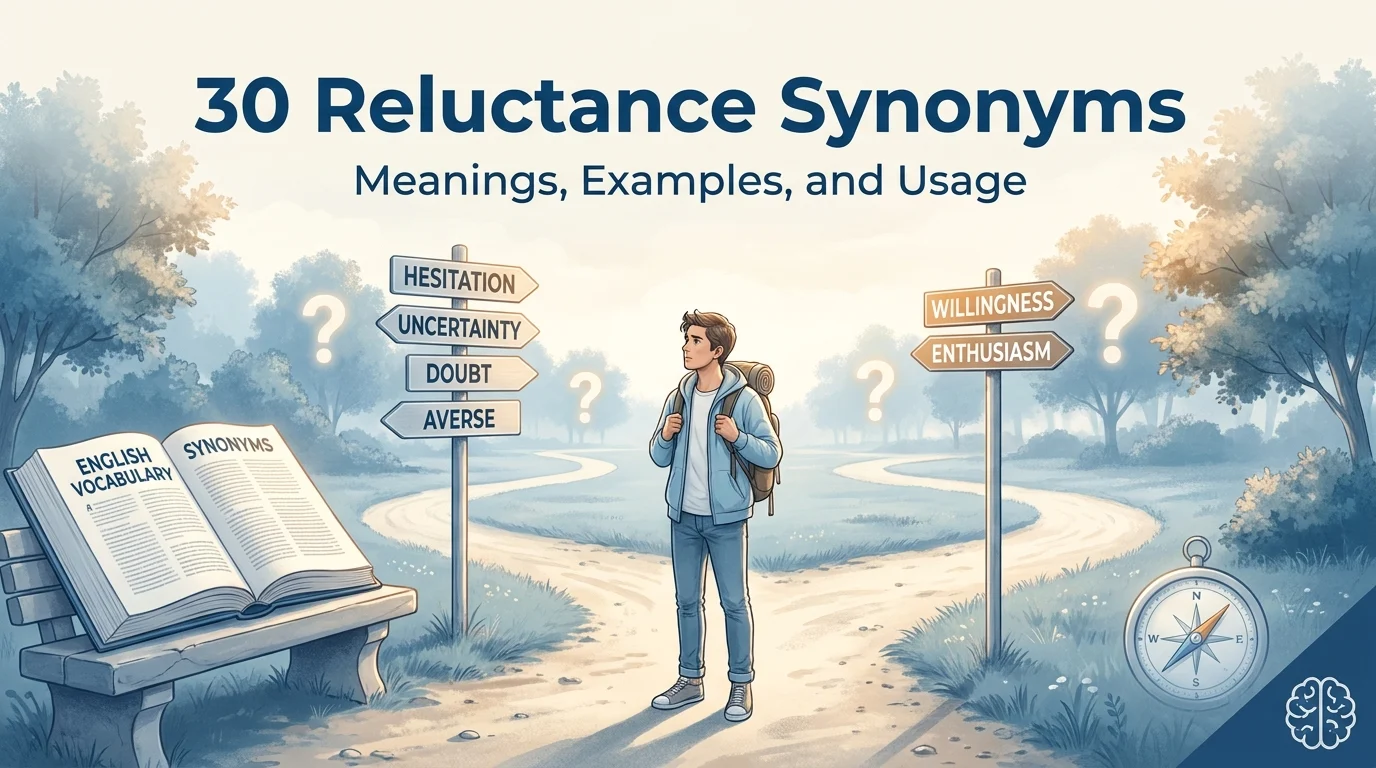
Reluctance synonyms help you express hesitation, unwillingness, doubt, or a lack of enthusiasm in different ways. The word reluctance describes the feeling of not wanting to do something or being uncertain about taking action.
Learning its synonyms can help students, ESL learners, writers, and content creators communicate their ideas more clearly.
Although words such as hesitation, unwillingness, and resistance are closely related to reluctance, they do not always have exactly the same meaning. Some describe a moment of uncertainty, while others suggest a stronger refusal or opposition.
In this guide, you will discover 30 synonyms for reluctance, their simple meanings, example sentences, and the situations in which each word works best. You will also learn how to choose the right synonym for essays, everyday conversations, professional writing, and creative content.
What Does Reluctance Mean?
Reluctance is a noun that means an unwillingness or hesitation to do something. A reluctant person may agree to take action but feel uncertain, uncomfortable, or unwilling to do it.
For example:
- She showed reluctance to speak in front of the class.
- His reluctance to accept help surprised his friends.
- Despite her initial reluctance, she agreed to join the project.
Reluctance does not always mean a complete refusal. Someone may eventually agree to do something even if they are not comfortable with it at first.
The word is commonly used in conversations about decisions, responsibilities, relationships, work, and personal feelings.
30 Synonyms for Reluctance With Meanings and Examples
Here are 30 useful words and expressions related to reluctance. Each has a slightly different meaning, so consider the context before choosing one.
1. Hesitation
Meaning: A pause or uncertainty before taking action.
Example: His hesitation before answering suggested that he was unsure.
Best usage: Use hesitation when someone pauses because they are uncertain or nervous.
2. Unwillingness
Meaning: The state of not wanting to do something.
Example: Her unwillingness to cooperate delayed the project.
Best usage: Ideal for direct, clear explanations of someone’s lack of desire to act.
3. Resistance
Meaning: Opposition to an action, idea, or change.
Example: The employees showed resistance to the new rules.
Best usage: Use it when someone actively opposes something rather than simply feeling unsure.
4. Disinclination
Meaning: A lack of desire or interest in doing something.
Example: He had little disinclination to attend the crowded event.
Best usage: This word is formal, but note that the sentence above is awkward because little disinclination means little lack of desire. A more natural example is: He showed a disinclination to attend the crowded event.
5. Indecision
Meaning: Difficulty choosing between options.
Example: Her indecision made it difficult to finalize the travel plans.
Best usage: Choose it when reluctance comes from an inability to make a decision.
6. Doubt
Meaning: A feeling of uncertainty about something.
Example: He expressed doubt about accepting the unfamiliar role.
Best usage: Useful when a person questions whether an action is right or worthwhile.
7. Apprehension
Meaning: Worry or fear about something that may happen.
Example: She approached the interview with apprehension.
Best usage: Use it when reluctance is connected to nervousness or concern about the future.
8. Reservation
Meaning: A concern or doubt that makes someone hesitate.
Example: I have some reservations about signing the agreement.
Best usage: Particularly useful in professional discussions and decision-making.
9. Reluctancy
Meaning: A less common noun form related to being reluctant.
Example: His reluctancy to participate was clear to everyone.
Best usage: Understandable, but reluctance is the more natural and widely preferred choice in modern English.
10. Discomfort
Meaning: A feeling of uneasiness or lack of comfort.
Example: She showed discomfort when asked to discuss the personal matter.
Best usage: Use it when a person hesitates because a situation feels awkward or unpleasant.
11. Aversion
Meaning: A strong dislike of something.
Example: He has an aversion to speaking in large crowds.
Best usage: Appropriate when reluctance comes from a clear dislike or strong negative feeling.
12. Opposition
Meaning: Disagreement with or resistance to an idea or action.
Example: The proposal faced opposition from several team members.
Best usage: Best for situations involving disagreement, debate, or conflicting opinions.
13. Resistance to Change
Meaning: Unwillingness to accept a new situation or approach.
Example: The company encountered resistance to change during the transition.
Best usage: Common in workplace communication, business writing, and discussions of new policies.
14. Disinclination
Meaning: A lack of willingness or desire to do something.
Example: Her disinclination to travel during winter was understandable.
Best usage: Suitable for formal writing and situations where someone simply lacks interest.
15. Uncertainty
Meaning: A lack of confidence or knowledge about what to do.
Example: His uncertainty about the outcome made him hesitate.
Best usage: Use it when a person does not know what to expect or which choice to make.
16. Misgiving
Meaning: A feeling of doubt or concern about a decision.
Example: She had misgivings about leaving her secure job.
Best usage: Especially useful when someone suspects that a decision may lead to problems.
17. Reluctant Attitude
Meaning: A manner that shows someone does not really want to participate.
Example: His reluctant attitude was noticeable during the meeting.
Best usage: Helpful when describing a person’s general behavior rather than a single decision.
18. Backwardness
Meaning: A lack of readiness or willingness to move forward in a particular situation.
Example: His backwardness in accepting new responsibilities concerned his manager.
Best usage: This is not a common direct synonym for reluctance in everyday English. Use hesitation or unwillingness in most situations.
19. Fear
Meaning: An unpleasant feeling caused by a possible danger or unwanted outcome.
Example: Her fear of failure made her reluctant to apply for the position.
Best usage: Choose it when anxiety or a perceived threat is the reason for reluctance.
20. Timidity
Meaning: Shyness or a lack of confidence.
Example: His timidity prevented him from asking questions during class.
Best usage: Appropriate when reluctance comes from shyness or a lack of self-confidence.
21. Inhibition
Meaning: A feeling that prevents someone from acting freely.
Example: Her inhibitions made it difficult to speak openly.
Best usage: Useful when social pressure, embarrassment, or self-consciousness holds someone back.
22. Avoidance
Meaning: The act of staying away from something.
Example: His avoidance of difficult conversations frustrated his colleagues.
Best usage: Use it when reluctance leads someone to evade a task, person, or situation.
23. Withdrawal
Meaning: The act of stepping away from participation or involvement.
Example: Her withdrawal from the discussion surprised the group.
Best usage: Best when someone stops participating rather than merely hesitating.
24. Distrust
Meaning: A lack of confidence in someone’s honesty or reliability.
Example: His distrust of the offer made him reluctant to sign the contract.
Best usage: Use it when suspicion or a lack of trust explains someone’s unwillingness.
25. Skepticism
Meaning: Doubt about whether something is true, useful, or reliable.
Example: The audience expressed skepticism about the proposed solution.
Best usage: Particularly useful in analytical, academic, and professional writing.
26. Reluctant Compliance
Meaning: Doing something despite not wanting to do it.
Example: He accepted the assignment with reluctant compliance.
Best usage: Use it when someone follows instructions but does not genuinely agree or feel enthusiastic.
27. Demur
Meaning: To raise an objection or politely express disagreement.
Example: She did not demur when asked to take responsibility.
Best usage: A formal verb often used when someone objects or raises concerns. The example shows the absence of objection, so a direct synonym would be: She demurred when asked to take responsibility.
28. Qualm
Meaning: A feeling of uneasiness or doubt about doing something.
Example: He had no qualms about accepting the challenge.
Best usage: Commonly used in the expression have qualms about something.
29. Disapproval
Meaning: A feeling that something is wrong or unacceptable.
Example: Her disapproval of the plan made the team reconsider it.
Best usage: Use it when reluctance is connected to a negative judgment or lack of agreement.
30. Lack of Enthusiasm
Meaning: A feeling of low interest or excitement.
Example: His lack of enthusiasm for the project was obvious.
Best usage: Ideal for everyday English when someone is not excited about doing something.
Comparison Table: Which Reluctance Synonym Should You Use?
Different synonyms communicate different reasons for reluctance. This table can help you select the most appropriate word.
| Synonym | Main meaning | Best situation |
|---|---|---|
| Hesitation | A pause or uncertainty | Before answering or acting |
| Unwillingness | Not wanting to act | Refusing or avoiding a task |
| Resistance | Active opposition | Disagreeing with change |
| Apprehension | Worry or nervousness | Facing an unfamiliar situation |
| Misgiving | Concern about a decision | Evaluating a choice |
| Reservation | Doubt or concern | Professional discussions |
| Aversion | Strong dislike | Avoiding something unpleasant |
| Indecision | Difficulty choosing | Making a difficult decision |
| Skepticism | Doubt about a claim | Evaluating an argument |
| Timidity | Shyness or low confidence | Speaking in public |
| Avoidance | Staying away | Escaping a difficult task |
| Lack of enthusiasm | Little excitement | Describing low interest |
How to Choose the Right Synonym for Reluctance
The best synonym depends on why someone does not want to do something. Consider the feeling, situation, and tone you want to communicate.
1. When someone is unsure
Choose hesitation, doubt, uncertainty, or indecision.
Example: Her hesitation showed that she needed more time to think.
These words are useful when a person has not made a firm decision.
2. When someone does not want to participate
Choose unwillingness, disinclination, or lack of enthusiasm.
Example: His unwillingness to help created difficulties for the team.
These expressions emphasize a lack of desire rather than fear.
3. When someone feels nervous or afraid
Choose apprehension, fear, timidity, or inhibition.
Example: Her apprehension about the presentation disappeared after practice.
These terms work well when emotions prevent someone from acting confidently.
4. When someone disagrees or pushes back
Choose resistance, opposition, disapproval, or demur.
Example: Several employees expressed resistance to the proposed changes.
These choices are more appropriate when reluctance involves disagreement.
5. When someone suspects a problem
Choose misgiving, reservation, qualm, or skepticism.
Example: I have reservations about investing in an untested product.
These words communicate caution and concern rather than simple unwillingness.
6. When someone avoids an activity
Choose avoidance, withdrawal, or aversion, depending on the situation.
Example: His avoidance of difficult conversations prevented the team from resolving the issue.
These expressions describe actions or patterns of behavior that may result from reluctance.
Reluctance Synonyms in Everyday Sentences
Here are additional examples showing how closely related expressions can change the tone of a sentence.
- Simple: She was reluctant to answer.
- Focused on uncertainty: She hesitated to answer.
- Focused on fear: She felt apprehensive about answering.
- Focused on unwillingness: She was unwilling to answer.
- Focused on doubt: She had reservations about answering.
- Focused on opposition: She resisted answering the question.
Although these sentences share a similar idea, each emphasizes a different reason for not responding.
Common Mistakes When Using Reluctance Synonyms
Learning synonyms is not only about finding similar words. It is also about understanding how they differ.
Mistake 1: Treating every synonym as an exact replacement.
Hesitation often describes a brief pause, while resistance can suggest active opposition. They are related, but their meanings are not identical.
Mistake 2: Using formal words in casual conversations.
Words such as disinclination and demur may sound overly formal in everyday speech. In casual situations, not wanting to or hesitating may sound more natural.
Mistake 3: Confusing reluctance with refusal.
A reluctant person may eventually agree. A refusal means that the person declines. Reluctance describes a feeling; refusal describes an action or decision.
Mistake 4: Ignoring the reason behind the feeling.
Someone may hesitate because of fear, disagree because of principle, or resist because of inconvenience. Choosing a word that explains the reason makes your writing more precise.
Frequently Asked Questions
What is the closest synonym for reluctance?
Unwillingness is one of the closest synonyms because both words describe not wanting to do something. Hesitation is another good choice when the main idea is uncertainty before taking action.
What is a simple word for reluctance?
A simple alternative is hesitation. You can also say not wanting to do something, depending on the sentence.
What is the opposite of reluctance?
Common opposites include willingness, eagerness, readiness, enthusiasm, and enthusiastic participation. The best choice depends on whether you mean being prepared, willing, or excited.
Is reluctance a noun or an adjective?
Reluctance is a noun. The adjective is reluctant.
- Noun: Her reluctance was understandable.
- Adjective: She was reluctant to participate.
Can reluctance be positive?
Yes. Reluctance can reflect careful thinking, caution, or a desire to avoid unnecessary risks. For example, a person may be reluctant to sign a contract until they understand all its terms.
Conclusion
Reluctance describes a feeling of unwillingness, hesitation, or uncertainty about doing something. Its synonyms include hesitation, unwillingness, resistance, apprehension, misgiving, reservation, and many other words that express different shades of meaning.
The key is to choose a synonym that matches the situation. Use hesitation for uncertainty, unwillingness for a lack of desire, resistance for opposition, and apprehension for worry about what may happen.
By understanding these differences and practicing them in sentences, you can improve your vocabulary, write more precisely, and communicate more naturally in everyday English, academic work, and professional settings.

I am Connor James, Administrator at SynoHut. I enjoy exploring synonyms, improving vocabulary, and helping readers discover clear, useful, and engaging word alternatives for everyday writing and communication.