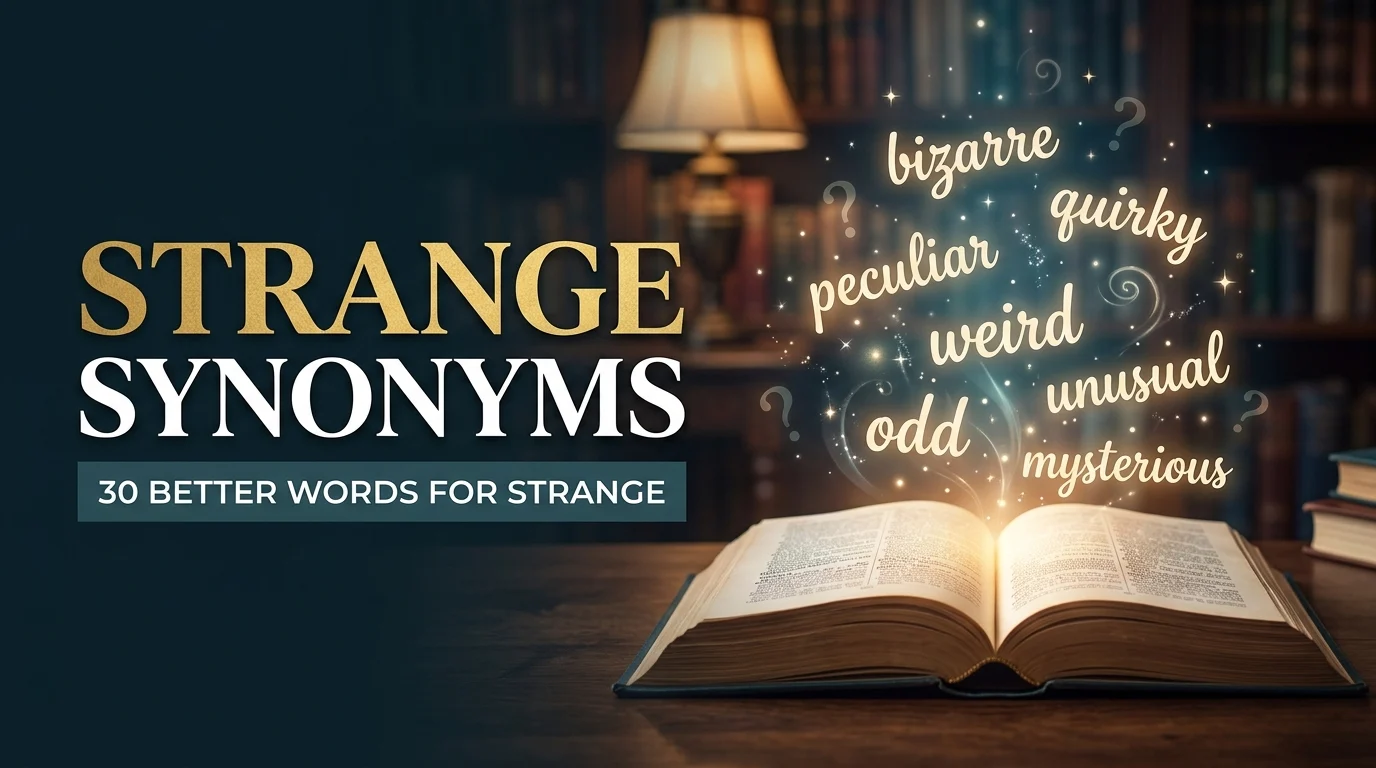
Finding the right strange synonyms can make your writing clearer, more expressive, and more natural. The word strange is useful, but it can describe many different ideas: something unusual, unfamiliar, bizarre, mysterious, awkward, or even frightening.
For students, ESL learners, writers, and content creators, understanding these subtle differences is important. Choosing a more precise synonym helps readers understand exactly what you mean and gives your writing a stronger voice.
Note: Your prompt contains a mismatch: it asks for the keyword “strange synonyms” but then asks for the meaning and 30 synonyms of “demure.” I’ve corrected the article to focus on strange synonyms, since that is the target keyword.
What Does “Strange” Mean?
Strange usually means unusual, unfamiliar, unexpected, or different from what is normal. The exact meaning depends on the situation.
For example, you might say, “I heard a strange noise outside.” Here, strange means unusual or unfamiliar. In “He has a strange sense of humor,” it may mean unusual or unconventional.
Because strange has several meanings, using a more specific synonym can make your sentence more accurate.
30 Strange Synonyms
1. Unusual
Meaning: Different from what is normal or expected.
Example: She had an unusual way of solving the problem.
Best usage: Everyday writing and general descriptions.
2. Odd
Meaning: Different, unexpected, or slightly strange.
Example: There was something odd about his story.
Best usage: Casual conversation and informal writing.
3. Bizarre
Meaning: Extremely unusual or difficult to understand.
Example: The artist created a bizarre sculpture.
Best usage: Strong descriptions of unusual situations.
4. Peculiar
Meaning: Unusual in a noticeable or distinctive way.
Example: He has a peculiar habit of talking to himself.
Best usage: Formal or descriptive writing.
5. Weird
Meaning: Very unusual or difficult to explain.
Example: That was a weird dream.
Best usage: Casual and conversational English.
6. Unfamiliar
Meaning: Not known or recognized because you have not experienced it before.
Example: The city looked unfamiliar after so many years.
Best usage: Places, people, experiences, and situations.
7. Abnormal
Meaning: Different from what is considered normal.
Example: The doctor noticed an abnormal result in the test.
Best usage: Medical, scientific, and technical contexts.
8. Eccentric
Meaning: Unusual, especially in someone’s personality, behavior, or style.
Example: The eccentric professor wore brightly colored suits every day.
Best usage: People with unconventional habits or personalities.
9. Quirky
Meaning: Unusually different in an interesting or amusing way.
Example: She decorated her apartment with quirky furniture.
Best usage: Positive or playful descriptions.
10. Outlandish
Meaning: Extremely unusual or unreasonable.
Example: He made an outlandish claim about discovering a hidden city.
Best usage: Exaggerated ideas, claims, clothing, or behavior.
11. Peculiar
Meaning: Noticeably unusual or distinctive.
Example: A peculiar smell filled the room.
Best usage: Descriptive writing and observations.
12. Mysterious
Meaning: Difficult to explain, understand, or identify.
Example: A mysterious light appeared in the distance.
Best usage: Unknown events, people, or situations.
13. Uncanny
Meaning: Strange in a way that feels unsettling or strangely familiar.
Example: The empty house had an uncanny atmosphere.
Best usage: Suspense, fiction, and unsettling situations.
14. Alien
Meaning: Completely unfamiliar or unlike what is known.
Example: The customs of the remote village felt alien to him.
Best usage: Figurative descriptions or science-fiction contexts.
15. Foreign
Meaning: Unfamiliar or belonging to another place or culture.
Example: The unfamiliar customs initially seemed foreign to her.
Best usage: Cultures, places, languages, and unfamiliar experiences.
16. Abnormal
Meaning: Not typical or normal.
Example: The unusually high temperature was considered abnormal.
Best usage: Scientific, medical, and technical contexts.
17. Unorthodox
Meaning: Different from traditional or accepted methods.
Example: The coach used an unorthodox training method.
Best usage: Methods, opinions, strategies, and approaches.
18. Unconventional
Meaning: Different from traditional or commonly accepted ways.
Example: She chose an unconventional career path.
Best usage: Ideas, lifestyles, careers, and methods.
19. Curious
Meaning: Unusual or interesting enough to attract attention.
Example: There was a curious mark on the old door.
Best usage: Formal or literary descriptions.
20. Strange
Meaning: Unusual or unexpected.
Example: We heard a strange sound during the night.
Best usage: General situations where no stronger nuance is needed.
21. Surreal
Meaning: So strange that it seems unreal or dreamlike.
Example: Standing alone in the empty stadium felt surreal.
Best usage: Dreamlike, emotional, artistic, or unbelievable experiences.
22. Grotesque
Meaning: Extremely strange, ugly, or disturbing.
Example: The painting contained grotesque images.
Best usage: Horror, art, and disturbing descriptions.
23. Freakish
Meaning: Very unusual or abnormal.
Example: The storm produced freakish weather conditions.
Best usage: Extreme or abnormal situations.
24. Perplexing
Meaning: Confusing or difficult to understand.
Example: The sudden change in his behavior was perplexing.
Best usage: Problems, behavior, events, and mysteries.
25. Unusual
Meaning: Not common or ordinary.
Example: It is unusual to see snow here in April.
Best usage: Neutral descriptions.
26. Remarkable
Meaning: Unusual enough to deserve attention or admiration.
Example: She made remarkable progress in just three months.
Best usage: Positive descriptions of unusual achievements.
27. Unexpected
Meaning: Not anticipated or predicted.
Example: We received an unexpected visit from our old teacher.
Best usage: Events, results, news, and surprises.
28. Rare
Meaning: Not common or occurring infrequently.
Example: Seeing this type of bird in the city is rare.
Best usage: Events, objects, animals, and occurrences that are uncommon.
29. Enigmatic
Meaning: Mysterious and difficult to understand.
Example: The author’s enigmatic message sparked many theories.
Best usage: People, messages, stories, and mysterious situations.
30. Astonishing
Meaning: Extremely surprising or unusual.
Example: The scientist made an astonishing discovery.
Best usage: Strong positive or surprising situations.
Strange Synonyms Comparison Table
| Synonym | Main Meaning | Tone | Best Used For |
|---|---|---|---|
| Unusual | Not normal or common | Neutral | General situations |
| Odd | Slightly strange | Casual | Everyday conversation |
| Weird | Very unusual | Informal | Casual descriptions |
| Bizarre | Extremely strange | Strong | Unusual events |
| Peculiar | Noticeably different | Neutral/Formal | People, things, behavior |
| Quirky | Unusual and amusing | Positive | Personality and style |
| Eccentric | Unconventional | Neutral | People and behavior |
| Mysterious | Difficult to explain | Intriguing | Events and situations |
| Uncanny | Strange and unsettling | Dark | Atmosphere and experiences |
| Surreal | Dreamlike and unreal | Artistic | Experiences and scenes |
| Unorthodox | Against tradition | Formal | Methods and ideas |
| Unconventional | Different from tradition | Neutral | Choices and lifestyles |
| Grotesque | Strange and disturbing | Negative | Art and horror |
| Enigmatic | Mysterious and unclear | Formal | People, messages, stories |
| Astonishing | Extremely surprising | Positive | Achievements and discoveries |
How to Choose the Right Synonym for “Strange”
The best synonym depends on why something seems strange.
For Something Simply Different
Use:
- unusual
- odd
- peculiar
- uncommon
Example:
“The museum displayed several unusual objects.”
For Something Very Strange
Use:
- bizarre
- weird
- outlandish
- freakish
Example:
“He told us a bizarre story about his trip.”
For Something Mysterious
Use:
- mysterious
- enigmatic
- perplexing
- uncanny
Example:
“The disappearance remains a mysterious event.”
For Something Positive or Interesting
Use:
- quirky
- remarkable
- astonishing
- unconventional
Example:
“She has a quirky personality that makes her memorable.”
For Something Frightening or Unsettling
Use:
- uncanny
- grotesque
- bizarre
- disturbing
Example:
“The abandoned building had an uncanny atmosphere.”
For Formal Writing
Consider:
- peculiar
- unconventional
- unorthodox
- abnormal
- enigmatic
These words can sound more precise than weird or odd in academic or professional writing.
Strange vs. Weird
Strange and weird are close in meaning, but their tone is different.
Strange is more neutral and can work in formal writing.
“The researchers observed a strange pattern.”
Weird is more casual and conversational.
“That was a weird experience.”
When writing an essay, report, or professional article, strange, unusual, peculiar, or unconventional may be better choices than weird.
Strange vs. Unusual
These words are often interchangeable, but unusual is generally more neutral.
- Strange: suggests something feels unfamiliar or unexpected.
- Unusual: simply means something is not common.
For example:
“She heard a strange noise.”
“It is unusual to see snow here.”
The first sentence suggests uncertainty or unfamiliarity, while the second simply describes something uncommon.
Why Using the Right Synonym Matters
Using different synonyms for strange can make your writing more precise.
Compare:
“He had a strange personality.”
with:
“He had a quirky personality.”
The second sentence suggests that the person’s unusual personality is interesting or amusing rather than negative.
Similarly:
“The house had a strange atmosphere.”
could become:
“The house had an eerie atmosphere.”
The second version creates a much stronger feeling of fear or discomfort.
Frequently Asked Questions
What is the best synonym for strange?
Unusual is one of the best general synonyms for strange. Other choices include odd, peculiar, weird, bizarre, and unconventional, depending on the context.
What is a positive synonym for strange?
Quirky, unconventional, and sometimes remarkable can describe something unusual in a positive way.
What is a strong synonym for strange?
Bizarre is a strong synonym when something is extremely unusual.
What is a formal synonym for strange?
Peculiar, unconventional, unorthodox, and enigmatic can work well in formal writing, depending on the meaning.
What is a synonym for strange that means mysterious?
Mysterious, enigmatic, uncanny, and perplexing can express different forms of mystery.
Conclusion
There are many useful strange synonyms, but they do not all have exactly the same meaning. Words such as unusual and odd are useful for general situations, while bizarre and outlandish describe something much more extreme.
For positive or interesting situations, quirky, remarkable, and unconventional may be better choices. For mysterious or unsettling situations, words such as enigmatic, uncanny, and surreal can create a stronger impression.
The key is to choose a synonym based on the context, tone, and exact feeling you want to communicate. This makes your writing more precise, natural, and engaging for readers.

I am Derek Thomas, a passionate word enthusiast and writer. I enjoy exploring synonyms, expanding vocabulary, and helping readers find clear, accurate, and meaningful words for better writing.