Finding the right synonyms for funny can make your writing more interesting, expressive, and natural. While funny is one of the most common English words for describing humor, it does not always express exactly what you mean.
Something can be hilarious, amusing, witty, comical, ridiculous, playful, or even absurd and each word creates a slightly different feeling.
Learning these alternatives is especially useful for students, ESL learners, writers, bloggers, and content creators. Instead of repeatedly using funny in essays, conversations, stories, captions, or articles, you can choose a word that more precisely describes the type of humor involved.
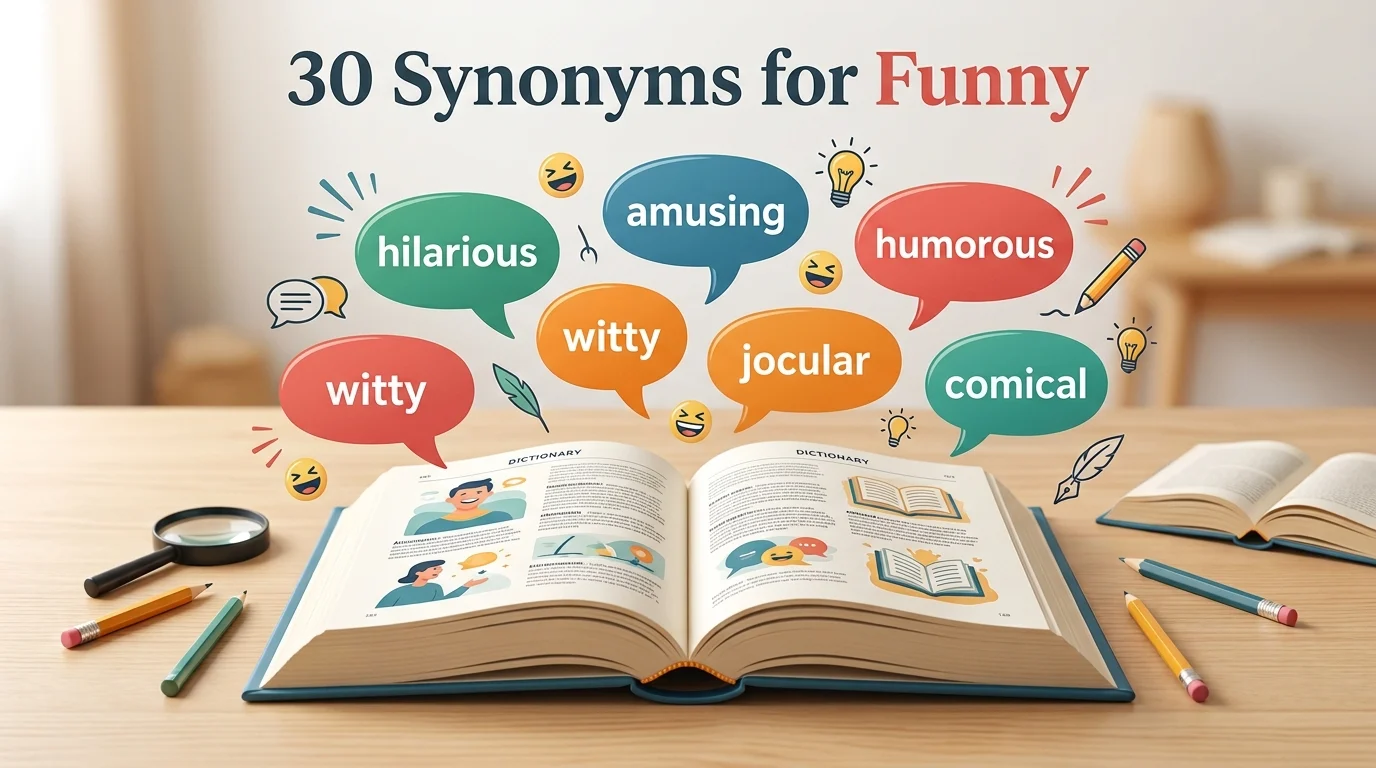
In this guide, you’ll find 30 useful synonyms for funny, along with simple meanings, example sentences, and explanations of when each word works best. You’ll also learn how these words differ in tone and how to choose the right alternative depending on the situation.
What Does “Funny” Mean?
The word funny usually means something that makes people laugh, smile, or feel amused.
For example:
My brother told a funny story at dinner.
Here, funny means entertaining or humorous.
However, funny has another common meaning: strange, unusual, or unexpected.
For example:
There is a funny smell coming from the kitchen.
In this sentence, funny does not mean humorous. It means unusual or suspicious.
Because funny can have several meanings, choosing the right synonym depends on the context. If you mean “makes people laugh,” words such as hilarious, amusing, humorous, witty, and comical may work well. If you mean “strange,” alternatives such as odd, peculiar, unusual, or bizarre may be more appropriate.
30 Synonyms for Funny
Here are 30 useful alternatives to funny, organized with simple definitions and practical examples.
1. Hilarious
Meaning: Extremely funny; something that makes people laugh a lot.
Example:
The comedian’s hilarious performance had everyone in the audience laughing.
Best usage: Use hilarious when something is much funnier than ordinary.
Tone: Strong and enthusiastic.
2. Amusing
Meaning: Entertaining or mildly funny.
Example:
She shared an amusing story about her first day at college.
Best usage: Good for situations that are pleasant and make you smile without necessarily making you laugh loudly.
Tone: Polite and moderate.
3. Humorous
Meaning: Containing or showing humor.
Example:
The writer used a humorous example to explain the difficult concept.
Best usage: Excellent for essays, articles, presentations, and formal writing.
Tone: Neutral to formal.
4. Comical
Meaning: Funny in a way that makes something seem amusing or ridiculous.
Example:
His comical attempt to dance made everyone laugh.
Best usage: Useful for describing people, actions, appearances, or situations that look funny.
Tone: Light and descriptive.
5. Hysterical
Meaning: Extremely funny in informal English.
Example:
That video of the dog trying to catch its tail was hysterical.
Best usage: Common in casual conversation when something is exceptionally funny.
Tone: Very informal and enthusiastic.
Note: Hysterical can have other meanings, so context matters.
6. Hilarious
Meaning: Very, very funny.
Example:
His hilarious imitation of the teacher made the entire class laugh.
Best usage: Use it when funny does not seem strong enough.
Tone: Informal and expressive.
Note: Because hilarious already means extremely funny, avoid saying “very hilarious” in careful writing.
7. Witty
Meaning: Clever and funny, especially through quick or intelligent remarks.
Example:
Her witty response made everyone at the table smile.
Best usage: Ideal for clever comments, dialogue, speeches, and intelligent humor.
Tone: Intelligent and polished.
8. Humorous
Meaning: Designed to entertain or make people laugh.
Example:
The article has a humorous style that keeps readers interested.
Best usage: Particularly useful in formal or semi formal writing.
Tone: Neutral and professional.
9. Droll
Meaning: Amusing in a quiet, unusual, or slightly strange way.
Example:
He has a droll sense of humor that often catches people by surprise.
Best usage: Use when humor is subtle rather than loud or obvious.
Tone: Literary and sophisticated.
10. Comedic
Meaning: Related to comedy or intended to produce laughter.
Example:
The actor is famous for his comedic timing.
Best usage: Common when discussing movies, television, theater, performers, or comedy.
Tone: Neutral and professional.
11. Entertaining
Meaning: Enjoyable, interesting, or amusing.
Example:
The speaker gave an entertaining presentation.
Best usage: Use when something is enjoyable, even if it is not specifically designed to make people laugh.
Tone: Positive and versatile.
12. Playful
Meaning: Lighthearted, fun, and not serious.
Example:
The children exchanged playful jokes during the game.
Best usage: Great for friendly teasing, language, behavior, and light humor.
Tone: Warm and friendly.
13. Lighthearted
Meaning: Cheerful, relaxed, and not serious.
Example:
The movie is a lighthearted comedy about friendship.
Best usage: Useful when describing a cheerful atmosphere, conversation, story, or piece of entertainment.
Tone: Warm and positive.
14. Jovial
Meaning: Cheerful, friendly, and full of good humor.
Example:
The jovial host kept the guests laughing throughout the evening.
Best usage: Often describes cheerful people or a happy social atmosphere.
Tone: Positive and slightly formal.
15. Laughable
Meaning: So silly, unreasonable, or ridiculous that it deserves laughter.
Example:
The claim that he could run faster than a professional athlete was laughable.
Best usage: Often used critically rather than simply to praise something as funny.
Tone: Can be sarcastic or dismissive.
16. Ridiculous
Meaning: Extremely silly, unreasonable, or absurd.
Example:
He looked ridiculous wearing a winter coat on such a hot day.
Best usage: Use when something is funny because it is obviously silly or unreasonable.
Tone: Informal; sometimes negative.
17. Absurd
Meaning: Completely unreasonable, illogical, or silly.
Example:
The movie follows an absurd story about a talking refrigerator.
Best usage: Excellent for strange or impossible situations that create humor.
Tone: Neutral, literary, or critical depending on context.
18. Silly
Meaning: Playfully foolish or lacking seriousness.
Example:
We spent the afternoon taking silly pictures together.
Best usage: Common for children, playful behavior, jokes, mistakes, and friendly situations.
Tone: Informal and often affectionate.
19. Goofy
Meaning: Silly, awkward, or amusing in a lovable way.
Example:
He made a goofy face when the camera came out.
Best usage: Especially common in American English for people, expressions, and behavior.
Tone: Informal and friendly.
20. Zany
Meaning: Unusual, energetic, and amusingly silly.
Example:
The show is famous for its zany characters and unpredictable jokes.
Best usage: Good for wild comedy, unusual behavior, and exaggerated characters.
Tone: Playful and informal.
21. Waggish
Meaning: Playfully humorous or fond of making jokes.
Example:
His waggish comments kept the meeting from becoming too serious.
Best usage: Useful when describing someone who enjoys playful jokes.
Tone: Literary and somewhat old fashioned.
22. Facetious
Meaning: Treating a serious subject with inappropriate or deliberately playful humor.
Example:
He made a facetious remark about the difficult situation.
Best usage: Use carefully because facetious can suggest that the humor is not appropriate.
Tone: Often critical or sarcastic.
23. Sarcastic
Meaning: Using irony or mocking language to make fun of someone or something.
Example:
Her sarcastic comment made it clear that she did not believe his excuse.
Best usage: Use when humor involves mockery or saying the opposite of what you really mean.
Tone: Can be humorous but also sharp or negative.
24. Satirical
Meaning: Using humor, irony, or exaggeration to criticize people, society, politics, or institutions.
Example:
The newspaper published a satirical article about modern workplace culture.
Best usage: Best for social commentary, literature, journalism, television, and political humor.
Tone: Intelligent and analytical.
25. Tongue-in-cheek
Meaning: Humorously pretending to be serious.
Example:
The advertisement made a tongue in cheek suggestion that nobody should ever leave the house.
Best usage: Common when something is intentionally humorous but presented as though it were serious.
Tone: Informal and clever.
26. Whimsical
Meaning: Playfully unusual, imaginative, or charming.
Example:
The children’s book has a whimsical sense of humor.
Best usage: Great for stories, art, writing, characters, and imaginative humor.
Tone: Gentle, creative, and positive.
27. Absurdist
Meaning: Based on intentionally illogical, strange, or meaningless situations.
Example:
The play uses absurdist humor to challenge the audience’s expectations.
Best usage: Particularly useful when discussing theater, literature, films, and sophisticated forms of comedy.
Tone: Literary and intellectual.
28. Peculiar
Meaning: Strange or unusual rather than necessarily humorous.
Example:
There was something peculiar about the way he answered the question.
Best usage: Choose this when funny means “strange,” not “humorous.”
Tone: Neutral or slightly formal.
29. Odd
Meaning: Strange, unusual, or unexpected.
Example:
It was odd that nobody noticed the bright red umbrella in the room.
Best usage: One of the simplest alternatives when funny means strange.
Tone: Neutral and everyday.
30. Bizarre
Meaning: Very strange, unusual, or difficult to understand.
Example:
We witnessed a bizarre scene outside the restaurant.
Best usage: Use when something is unusually strange or surprising.
Tone: Stronger than odd or peculiar.
Quick Comparison: Synonyms for Funny
Not every synonym for funny can be used interchangeably. The best choice depends on what kind of humor or meaning you want to communicate.
| Synonym | Main Meaning | Tone | Best For |
|---|---|---|---|
| Hilarious | Extremely funny | Informal | Strong laughter |
| Amusing | Pleasantly funny | Neutral | Mild humor |
| Humorous | Full of humor | Formal/neutral | Writing |
| Comical | Funny looking or acting | Neutral | Actions and situations |
| Witty | Clever and funny | Polished | Smart remarks |
| Playful | Light and fun | Friendly | Teasing and behavior |
| Lighthearted | Cheerful and relaxed | Warm | Stories and conversations |
| Silly | Playfully foolish | Informal | Casual situations |
| Goofy | Lovably silly | Informal | People and expressions |
| Zany | Wildly silly | Informal | Comedy and characters |
| Ridiculous | Extremely silly | Critical | Absurd situations |
| Absurd | Illogical or unreasonable | Neutral/formal | Strange humor |
| Sarcastic | Mocking or ironic | Sharp | Remarks and criticism |
| Satirical | Humor used for criticism | Sophisticated | Society and politics |
| Whimsical | Imaginative and charming | Gentle | Creative writing |
| Bizarre | Extremely strange | Strong | Unusual situations |
Funny vs. Hilarious
These words are related, but they are not equally strong.
Funny means something makes you laugh or smile.
Hilarious means something is extremely funny.
Compare:
- The movie was funny.
- The movie was hilarious.
The second sentence tells the reader that the movie produced a much stronger reaction.
Funny vs. Amusing
Amusing usually describes something that gives you mild pleasure or makes you smile.
For example:
The teacher told an amusing story.
This does not necessarily mean the students were laughing uncontrollably. It simply means the story was entertaining.
Therefore, amusing is often a softer alternative to funny.
Funny vs. Witty
The difference between these words is important.
Funny focuses mainly on the ability to make people laugh.
Witty emphasizes intelligence, cleverness, or quick thinking.
For example:
He is funny.
This simply means he makes people laugh.
He is witty.
This suggests that his humor comes from clever observations, wordplay, or intelligent comments.
Funny vs. Comical
Comical often describes something that looks or behaves in a funny way.
For example:
The actor’s comical expression made the audience laugh.
You can also describe a situation as comical when it becomes funny because of what happens.
Funny vs. Ridiculous
These words overlap, but ridiculous is often more negative.
Funny: Something makes you laugh.
Ridiculous: Something seems extremely silly, unreasonable, or absurd.
For example:
His joke was funny.
This is positive.
His excuse was ridiculous.
This may mean the excuse was so unreasonable that it deserved to be laughed at.
Funny vs. Sarcastic
Sarcastic describes a particular style of humor.
A sarcastic speaker may say something that sounds positive while actually meaning the opposite.
For example:
“Great job arriving two hours late,” she said sarcastically.
The speaker does not really think the person did a great job.
So, sarcastic is a type of humor, while funny is a much broader description.
Funny vs. Strange
Remember that funny has two major meanings.
Funny = humorous
That was a funny joke.
Funny = strange
This milk tastes funny.
In the second example, you probably mean the milk tastes unusual or possibly spoiled.
Depending on the situation, alternatives include:
- Odd
- Peculiar
- Strange
- Unusual
- Bizarre
- Suspicious
This distinction is especially important for ESL learners because context determines the meaning.
Types of Funny: Which Synonym Should You Choose?
Instead of searching for one synonym that works everywhere, think about why something is funny.
If something is extremely funny
Choose:
- Hilarious
- Hysterical
Example:
That comedy show was hilarious.
If something is mildly funny
Choose:
- Amusing
- Entertaining
Example:
She told an amusing story about her vacation.
If something is clever and funny
Choose:
- Witty
- Droll
Example:
His witty response surprised everyone.
If something is silly and playful
Choose:
- Silly
- Goofy
- Playful
- Zany
Example:
The children made goofy faces for the camera.
If something is funny because it is unreasonable
Choose:
- Ridiculous
- Absurd
- Laughable
Example:
The idea that nobody needs sleep is ridiculous.
If humor is used to criticize
Choose:
- Sarcastic
- Satirical
- Facetious
Example:
The program uses satirical humor to criticize consumer culture.
If something is strange rather than humorous
Choose:
- Odd
- Peculiar
- Bizarre
Example:
There was a bizarre noise coming from upstairs.
How to Choose the Right Synonym for Funny
Choosing the right synonym is easier when you ask yourself a few simple questions.
1. How strong is the humor?
If something is slightly funny, use amusing.
If it is extremely funny, use hilarious.
2. Is the humor intelligent?
Use witty when clever language, observations, or quick thinking create the humor.
3. Is the humor playful?
Words such as silly, goofy, playful, and zany work well for friendly and light situations.
4. Is the humor critical?
Use sarcastic when someone is mocking something.
Use satirical when humor is used to criticize society, politics, organizations, or cultural behavior.
5. Is “funny” actually supposed to mean strange?
If you mean unusual rather than humorous, choose odd, peculiar, or bizarre.
This is one of the most important distinctions to remember.
Synonyms for Funny in Formal Writing
In academic or professional writing, simply replacing funny with a random synonym is not always the best strategy.
Instead, consider:
- Humorous
- Amusing
- Comical
- Entertaining
- Satirical
- Whimsical
For example:
Less precise:
The author uses funny examples.
More polished:
The author uses humorous examples to make the concept easier to understand.
The second version sounds more appropriate for an essay or academic discussion.
Synonyms for Funny in Casual Conversation
Everyday conversations often use more informal vocabulary.
Good choices include:
- Funny
- Hilarious
- Silly
- Goofy
- Ridiculous
- Hysterical
- Zany
For example:
That video was hilarious!
or:
You look so goofy in that picture.
These words sound natural in conversations with friends and family.
Synonyms for Funny in Creative Writing
Writers can choose more descriptive alternatives depending on the mood they want.
For gentle humor:
Whimsical, playful, lighthearted
For clever humor:
Witty, droll
For exaggerated humor:
Comical, ridiculous, zany
For strange humor:
Absurd, absurdist, bizarre
For example:
The story had a whimsical tone that made even its strangest moments feel charming.
This creates a more specific image than simply saying:
The story was funny.
Synonyms for a Funny Person
If you want to describe someone who regularly makes other people laugh, several words can work.
Humorous
A person who naturally uses humor.
She is a humorous and engaging speaker.
Witty
Someone who makes clever remarks.
He is known for his witty observations.
Comical
Someone whose behavior or appearance is amusing.
His comical personality made him popular with the audience.
Jovial
Someone cheerful and good-natured.
The jovial host welcomed everyone with a smile.
Waggish
Someone who enjoys playful jokes.
His waggish personality made every conversation entertaining.
Synonyms for a Funny Situation
When describing a situation, you might use:
- Amusing
- Comical
- Ridiculous
- Absurd
- Hilarious
- Bizarre
- Peculiar
- Unusual
The best choice depends on the situation.
Amusing suggests gentle humor.
Comical emphasizes something that looks funny.
Ridiculous suggests silliness or unreasonableness.
Absurd emphasizes something illogical.
Bizarre emphasizes something extremely strange.
Common Mistakes When Using Synonyms for Funny
Mistake 1: Treating every synonym as identical
Words that are synonyms do not always have exactly the same meaning.
For example, witty means clever and funny, while silly means playfully foolish.
They cannot always replace each other.
Mistake 2: Using “hilarious” for every situation
Hilarious is a strong word. It suggests something is extremely funny.
If something only makes you smile, amusing may be better.
Mistake 3: Confusing funny with strange
Consider:
The food tastes funny.
This usually means the food tastes strange, not that it makes you laugh.
Using hilarious here would completely change the meaning.
Mistake 4: Using informal words in formal writing
Words such as goofy and zany can sound too casual in an academic essay.
In formal writing, humorous, amusing, or comical may be more suitable.
Mistake 5: Assuming sarcasm is always friendly
Sarcasm can be funny, but it can also sound insulting or hostile.
Use sarcastic carefully when describing someone’s communication.
10 Best Synonyms for Funny at a Glance
If you only need a quick list, these are some of the most useful choices:
- Hilarious — extremely funny
- Amusing — mildly entertaining
- Humorous — containing humor
- Witty — clever and funny
- Comical — amusing or funny-looking
- Entertaining — enjoyable and engaging
- Playful — light and fun
- Silly — foolish in a playful way
- Ridiculous — extremely silly or unreasonable
- Absurd — illogical and strange
Frequently Asked Questions About Synonyms for Funny
What is the best synonym for funny?
There is no single best synonym because the meaning depends on context. Hilarious works for something extremely funny, amusing for mild humor, witty for clever humor, and humorous for general or formal descriptions.
What is a stronger word for funny?
Hilarious is one of the strongest common alternatives to funny. It suggests that something is extremely amusing.
What is a professional word for funny?
Humorous is usually a good professional or formal alternative. Depending on the context, amusing, comical, or entertaining may also work.
What is a fancy word for funny?
Depending on the type of humor, words such as witty, droll, whimsical, waggish, and absurdist can provide a more sophisticated alternative.
What is a synonym for funny that means strange?
When funny means strange rather than humorous, useful alternatives include odd, peculiar, unusual, bizarre, and absurd.
What is the difference between funny and humorous?
Funny is the more common everyday word. Humorous is slightly more formal and means containing or expressing humor.
What is the difference between funny and hilarious?
Hilarious is much stronger. Something funny makes you laugh or smile, while something hilarious makes you laugh very strongly.
Final Thoughts on Synonyms for Funny
The word funny is simple and useful, but English offers many more precise ways to describe humor. The best synonym depends on the kind of humor, the strength of the reaction, the situation, and the tone of your writing.
Use hilarious when something is extremely funny, amusing when the humor is mild, and witty when cleverness creates the humor.
Choose silly, goofy, or playful for friendly and lighthearted situations. When humor comes from something unreasonable or illogical, ridiculous and absurd can be more accurate.
It is also important to remember that funny can mean strange. In that case, words such as odd, peculiar, and bizarre may be better choices.
Ultimately, learning synonyms is not just about memorizing a longer vocabulary list. It is about understanding meaning, tone, strength, and context.
Once you understand these differences, your essays, stories, conversations, social media posts, and everyday English can become much more precise and engaging.

I am Derek Thomas, a passionate word enthusiast and writer. I enjoy exploring synonyms, expanding vocabulary, and helping readers find clear, accurate, and meaningful words for better writing.