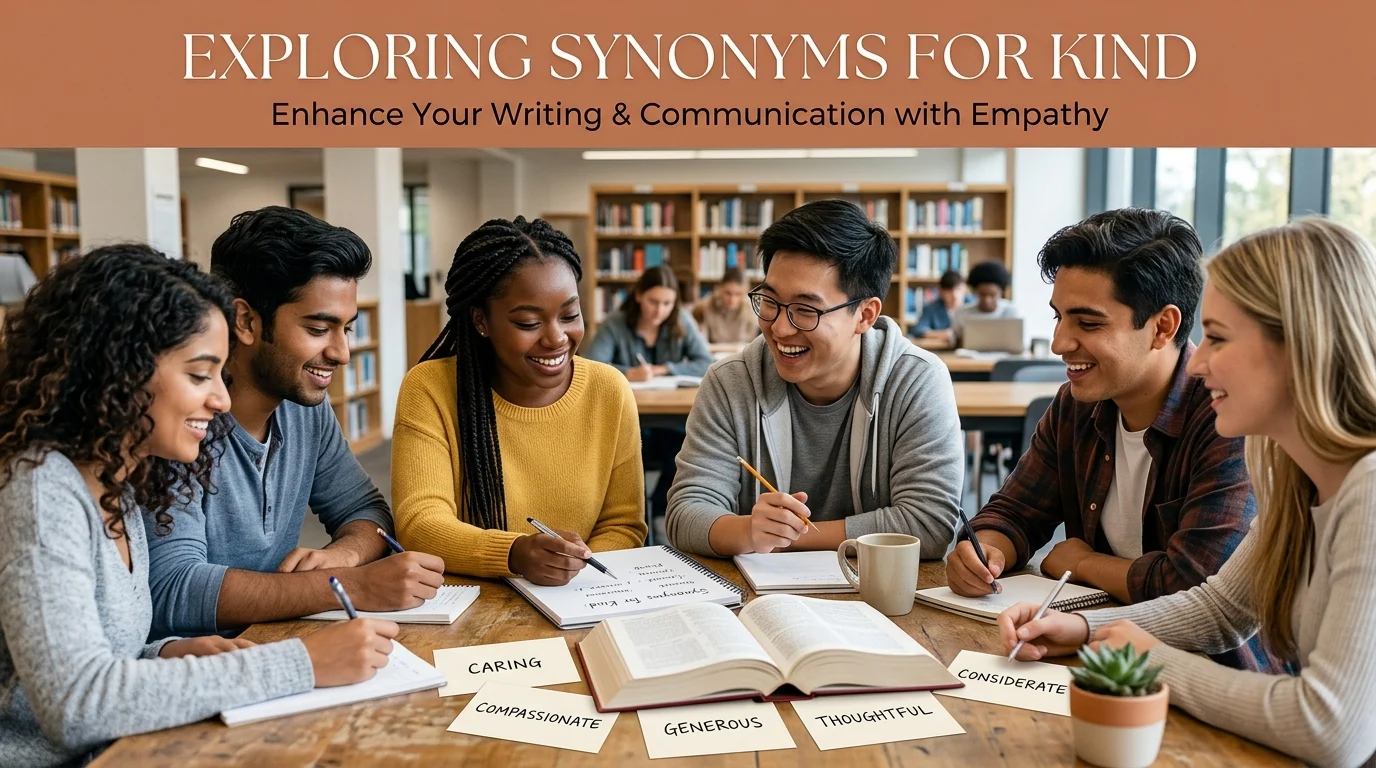
When you want to describe someone who treats others with care, respect, and understanding, the word kind is one of the most useful choices in English.
However, using the same word repeatedly can make your writing sound predictable. Learning different synonyms for kind can help you express more specific shades of meaning.
For students and ESL learners, understanding these alternatives is especially helpful because words that appear similar do not always carry exactly the same feeling.
Someone can be generous with money, compassionate toward someone who is suffering, courteous in conversation, or thoughtful when considering another person’s needs.
This guide explores 30 useful synonyms for kind, with simple meanings, examples, and practical usage notes. If you are writing an essay, improving your vocabulary, creating content, or simply trying to sound more natural in English, these alternatives can help you choose the right word for the situation.
What Does “Kind” Mean?
Kind means being caring, friendly, considerate, helpful, or willing to treat other people well.
For example:
She was kind to the new student and helped her find the classroom.
The word can describe a person’s character, behavior, words, or actions. It is generally positive and works well in both everyday and formal English.
Depending on the situation, however, you may want a more precise word. Kind is broad, while words such as compassionate, generous, gentle, and considerate highlight different aspects of kindness.
30 Synonyms for Kind
Here are 30 useful alternatives to kind, ranging from common everyday vocabulary to more advanced words.
1. Caring
Meaning: Showing concern for another person’s happiness, safety, or well-being.
Example:
My aunt is very caring and always checks on her family.
Best usage: Use caring when someone regularly shows concern and emotional support.
2. Compassionate
Meaning: Showing sympathy and a desire to help someone who is suffering.
Example:
The compassionate nurse stayed with the frightened patient.
Best usage: Especially useful when talking about suffering, hardship, illness, or emotional pain.
3. Considerate
Meaning: Thinking about other people’s feelings, needs, or comfort.
Example:
It was considerate of him to keep the music quiet while his neighbors were sleeping.
Best usage: Excellent for describing polite behavior that shows awareness of others.
4. Thoughtful
Meaning: Showing that you have carefully considered another person’s needs or feelings.
Example:
She gave me a thoughtful gift that matched my interests perfectly.
Best usage: Use it for considerate actions, gifts, messages, or gestures.
5. Caring-hearted
Meaning: Naturally caring and concerned about other people.
Example:
He is a caring hearted person who often helps elderly neighbors.
Best usage: Suitable for warm, personal descriptions, although kind-hearted is more common in everyday English.
6. Kind-hearted
Meaning: Having a naturally warm, caring, and generous character.
Example:
Our kind-hearted teacher stayed after school to help struggling students.
Best usage: One of the closest alternatives to kind when describing someone’s character.
7. Generous
Meaning: Willing to give time, money, help, or resources to others.
Example:
The generous donor provided books for the local school.
Best usage: Best when kindness involves giving or sharing.
8. Benevolent
Meaning: Wanting to do good and help others.
Example:
The benevolent organization provides meals to families in need.
Best usage: More formal than kind; common in academic, professional, or literary writing.
9. Helpful
Meaning: Willing or able to assist someone.
Example:
The receptionist was helpful and showed us where to go.
Best usage: Ideal when someone’s kindness takes the form of practical assistance.
10. Friendly
Meaning: Pleasant, welcoming, and easy to talk to.
Example:
The friendly staff made us feel comfortable immediately.
Best usage: Use friendly for social behavior and welcoming attitudes.
11. Warm
Meaning: Friendly, affectionate, and welcoming.
Example:
She gave us a warm welcome when we arrived.
Best usage: Great for describing someone’s personality, welcome, smile, or manner.
12. Gentle
Meaning: Calm, soft, and careful rather than harsh or aggressive.
Example:
The gentle teacher spoke patiently to the nervous child.
Best usage: Use it when kindness is connected with softness, patience, or careful treatment.
13. Tender
Meaning: Showing gentle care, affection, or sympathy.
Example:
He gave his injured dog tender care.
Best usage: Often used for emotional, affectionate, or sensitive situations.
14. Amiable
Meaning: Pleasant, friendly, and easy to like.
Example:
Our amiable neighbor always greets everyone with a smile.
Best usage: A slightly more advanced word for describing a pleasant personality.
15. Affectionate
Meaning: Showing love, warmth, or fondness toward someone.
Example:
The affectionate grandmother hugged her grandchildren.
Best usage: Best when kindness includes love or emotional closeness.
16. Sympathetic
Meaning: Understanding and caring about another person’s problems or feelings.
Example:
My manager was sympathetic when I explained my difficult situation.
Best usage: Useful when someone listens to or understands another person’s difficulties.
17. Understanding
Meaning: Patiently accepting someone’s situation, mistakes, or feelings.
Example:
Our teacher was understanding when several students struggled with the assignment.
Best usage: Especially useful for situations involving mistakes, problems, or personal difficulties.
18. Supportive
Meaning: Giving encouragement, help, or emotional assistance.
Example:
Her friends were supportive when she started her new job.
Best usage: Use it when kindness involves encouragement or standing by someone.
19. Courteous
Meaning: Polite and respectful toward others.
Example:
The receptionist was courteous and answered all my questions.
Best usage: A good choice when kindness is expressed through polite manners.
20. Polite
Meaning: Showing good manners and respect.
Example:
The polite student thanked the librarian for her help.
Best usage: Best when focusing on manners, respectful language, or social behavior.
21. Gracious
Meaning: Pleasant, polite, and generous in attitude.
Example:
The host was gracious and made every guest feel welcome.
Best usage: Particularly useful in formal or social situations.
22. Neighborly
Meaning: Friendly and helpful toward people who live nearby or are part of your community.
Example:
Our neighborly community often helps families during difficult times.
Best usage: Best for community relationships and helpful behavior between neighbors.
23. Altruistic
Meaning: Caring about the well being of others without expecting personal benefit.
Example:
Her altruistic efforts have helped hundreds of disadvantaged children.
Best usage: A strong choice for academic or formal writing about selfless behavior.
24. Selfless
Meaning: Putting other people’s needs before your own.
Example:
The volunteer made a selfless decision to spend her weekend helping families in need.
Best usage: Use when someone sacrifices their own time, comfort, or advantage for others.
25. Charitable
Meaning: Willing to give help, money, or resources to people in need.
Example:
The charitable businessman donated supplies to the shelter.
Best usage: Particularly appropriate for donations, organizations, fundraising, and social causes.
26. Merciful
Meaning: Showing forgiveness or compassion instead of punishment or cruelty.
Example:
The judge was merciful and gave the young offender a lighter sentence.
Best usage: Useful when kindness involves forgiveness, mercy, or avoiding harsh treatment.
27. Benevolent minded
Meaning: Having a strong desire to do good for others.
Example:
The benevolent minded leader focused on improving conditions for vulnerable families.
Best usage: More literary or formal; use benevolent in most everyday and professional contexts.
28. Big hearted
Meaning: Generous, caring, and willing to help others.
Example:
Her big hearted nature made her popular with everyone in the neighborhood.
Best usage: Informal and warm; excellent for personal descriptions.
29. Good-natured
Meaning: Naturally pleasant, cheerful, and easygoing.
Example:
Despite the difficult situation, he remained good-natured and patient.
Best usage: Best for describing someone’s generally pleasant personality.
30. Humanitarian
Meaning: Concerned with improving people’s lives and reducing suffering.
Example:
The humanitarian worker spent years providing assistance after natural disasters.
Best usage: Best for large-scale efforts to help people, especially in humanitarian or social work.
Quick Comparison: Which Synonym for Kind Should You Use?
| Synonym | Main Idea | Tone | Example Situation |
|---|---|---|---|
| Caring | Shows concern | Warm | Caring parent |
| Compassionate | Understands suffering | Emotional/Formal | Compassionate nurse |
| Considerate | Thinks about others | Neutral | Considerate neighbor |
| Thoughtful | Carefully considers others | Warm | Thoughtful gift |
| Generous | Gives freely | Positive | Generous donation |
| Friendly | Pleasant and welcoming | Casual | Friendly coworker |
| Gentle | Soft and careful | Warm | Gentle manner |
| Supportive | Gives encouragement | Positive | Supportive friend |
| Courteous | Shows good manners | Formal | Courteous employee |
| Gracious | Polite and welcoming | Formal | Gracious host |
| Selfless | Puts others first | Strong/Positive | Selfless volunteer |
| Altruistic | Helps without personal gain | Formal | Altruistic behavior |
| Big hearted | Warm and generous | Informal | Big hearted person |
| Benevolent | Wants to do good | Formal | Benevolent organization |
| Humanitarian | Works to reduce suffering | Formal | Humanitarian worker |
Kind vs. Similar Words: Understanding the Differences
Although these words are related, they are not always interchangeable.
Kind vs. Caring
Kind is a broad word for good and considerate behavior. Caring emphasizes concern for another person’s well-being.
- She is kind to everyone.
- She is caring toward her elderly parents.
Kind vs. Generous
Generous specifically focuses on giving.
- He is kind to his coworkers.
- He is generous with his time.
A person can be kind without giving money or possessions.
Kind vs. Compassionate
Compassionate usually involves recognizing someone’s suffering and wanting to help.
- The teacher was kind to the student.
- The doctor was compassionate toward the patient’s family.
Kind vs. Polite
Polite focuses mainly on good manners, while kind can involve deeper care and helpfulness.
Someone can be polite without necessarily being especially kind.
Kind vs. Thoughtful
Thoughtful suggests that someone has carefully considered another person’s feelings or needs.
- She was kind to me.
- She was thoughtful enough to remember my birthday.
Kind vs. Gentle
Gentle describes a soft, calm, or non-harsh manner.
- He is kind to animals.
- He is gentle with animals.
The second sentence emphasizes how carefully he treats them.
How to Choose the Right Synonym for Kind
The best synonym depends on what kind of kindness you want to describe.
For Emotional Kindness
Choose:
- Caring
- Compassionate
- Sympathetic
- Tender
- Affectionate
- Understanding
These words work well when someone responds to another person’s emotions or difficulties.
Example:
The counselor was compassionate and understanding.
For Generosity
Choose:
- Generous
- Selfless
- Charitable
- Big-hearted
- Altruistic
These words are useful when kindness involves giving resources, time, attention, or personal sacrifice.
Example:
The generous volunteer donated her time every weekend.
For Politeness
Choose:
- Polite
- Courteous
- Gracious
- Friendly
- Amiable
These words work well when describing social interactions.
Example:
The courteous receptionist answered every question patiently.
For Gentle Behavior
Choose:
- Gentle
- Tender
- Warm
- Caring
These alternatives are particularly useful when describing how someone treats children, animals, vulnerable people, or loved ones.
Example:
The veterinarian was gentle with the frightened puppy.
For Formal or Academic Writing
Consider:
- Compassionate
- Benevolent
- Altruistic
- Humanitarian
- Charitable
- Considerate
These words can make formal writing more precise, but always choose the word that accurately matches your intended meaning.
Example:
Instead of writing:
The organization is kind to poor communities.
You could write:
The organization provides humanitarian assistance to vulnerable communities.
The second sentence is more precise because it explains the type of help being provided.
Synonyms for Kind in Different Contexts
Kind Person
- Kind-hearted
- Caring
- Compassionate
- Warm
- Good-natured
- Big-hearted
Example:
Everyone remembers her as a kind hearted and caring person.
Kind Words
- Gentle
- Supportive
- Encouraging
- Sympathetic
- Thoughtful
Example:
His supportive words helped me feel more confident.
Kind Action
- Helpful
- Considerate
- Thoughtful
- Generous
- Selfless
Example:
It was thoughtful of her to bring dinner when I was busy.
Kind Treatment
- Gentle
- Compassionate
- Merciful
- Caring
- Respectful
Example:
The staff provided compassionate treatment to the elderly residents.
Kind Community
- Friendly
- Neighborly
- Supportive
- Caring
- Welcoming
Example:
We live in a friendly and supportive community.
Why Learning Synonyms for Kind Matters
Knowing alternatives to kind is more than a vocabulary exercise. It helps you communicate more accurately.
Consider these sentences:
She is kind.
This tells us something positive, but it is quite general.
Compare it with:
She is compassionate toward people experiencing hardship.
Now we know exactly what kind of kindness she demonstrates.
Or:
He is generous with his time.
This tells us that his kindness involves giving time to others.
Using precise vocabulary makes writing clearer and more engaging. It is especially valuable in school essays, professional communication, creative writing, and content creation.
Common Mistakes When Using Synonyms for Kind
1. Treating Every Synonym as Exactly the Same
Words may have similar meanings but different contexts.
For example, generous usually involves giving, while courteous focuses on manners. Replacing one with the other can change the meaning of a sentence.
2. Choosing a Formal Word for a Casual Situation
Words such as altruistic and benevolent are useful, but they may sound too formal in everyday conversation.
Instead of:
My altruistic friend helped me carry my bags.
A natural choice would be:
My helpful friend helped me carry my bags.
3. Using “Kind” When a More Specific Word Is Better
If someone gives money, generous may be more accurate.
If someone understands your difficult situation, sympathetic or understanding may be better.
If someone behaves softly, gentle may be the best choice.
Frequently Asked Questions About Synonyms for Kind
What is the best synonym for kind?
There is no single best synonym because the right word depends on the context. Caring, kind hearted, compassionate, considerate, and thoughtful are among the closest choices.
What is a stronger word for kind?
Words such as compassionate, selfless, altruistic, and benevolent can express stronger or more specific forms of kindness.
What is a simple synonym for kind?
Easy alternatives include nice, friendly, caring, helpful, gentle, and thoughtful.
What is a synonym for kind in formal writing?
Depending on the context, you can use compassionate, considerate, benevolent, altruistic, charitable, or humanitarian.
What is the opposite of kind?
Common opposites include unkind, cruel, mean, harsh, heartless, and insensitive. The appropriate opposite depends on the specific behavior being described.
Final Thoughts
The word kind is simple, positive, and extremely useful, but it does not describe every form of kindness in exactly the same way. Learning its synonyms allows you to express your ideas with greater accuracy and variety.
Use caring when someone shows concern, compassionate when they respond to suffering, generous when they freely give, considerate when they think about other people’s needs, and courteous when their kindness appears through good manners.
For formal writing, words such as benevolent, altruistic, and humanitarian can provide greater precision when they genuinely fit the context.
The most important lesson is simple: do not choose a synonym just because it looks similar in a dictionary. Choose it because it communicates the exact meaning, tone, and situation you have in mind. This approach will make your English more natural, expressive, and effective.

I am Derek Thomas, a passionate word enthusiast and writer. I enjoy exploring synonyms, expanding vocabulary, and helping readers find clear, accurate, and meaningful words for better writing.