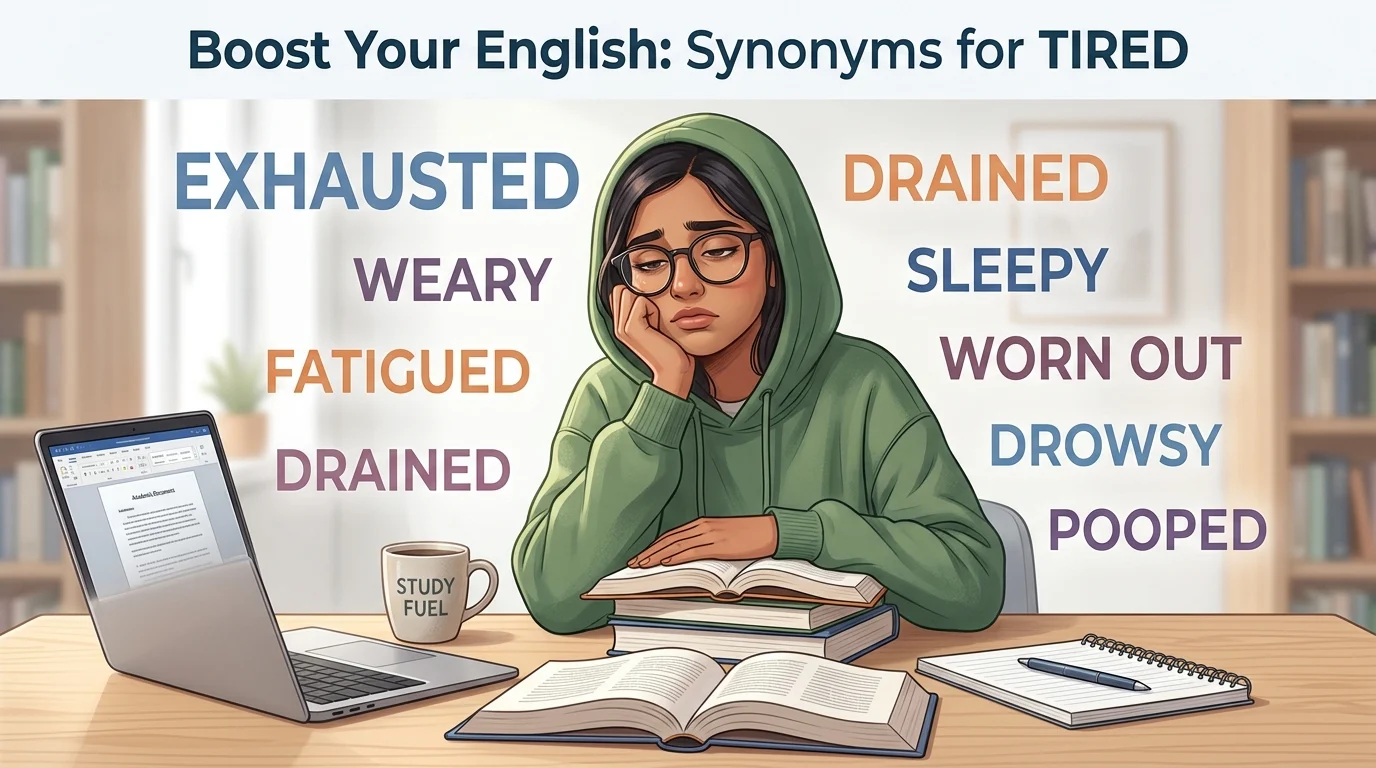
Feeling tired is a common part of everyday life. You may feel tired after a long day at work, a difficult exam, intense exercise, poor sleep, or a stressful situation. But the word tired does not always express exactly how you feel.
Sometimes you are simply sleepy. Other times, you are completely exhausted, mentally drained, worn out, or physically fatigued. Learning different synonyms for tired can help you describe these situations more accurately and make your speaking and writing more interesting.
For students, ESL learners, writers, and content creators, knowing the difference between similar words is especially useful. Although many synonyms for tired have related meanings, their tone, strength, and context can be different.
What Does “Tired” Mean?
The adjective tired generally means having less energy than usual because of physical activity, lack of sleep, mental effort, illness, stress, or another demanding situation.
For example:
I was tired after walking for three hours.
Here, “tired” means the person had less energy because of physical activity.
The word can also describe mental or emotional exhaustion:
She felt tired after dealing with problems all day.
“Tired” is a neutral and very common word. It works in casual conversations, school assignments, emails, stories, and everyday writing.
However, choosing a more precise synonym can communicate the exact level or type of tiredness.
30 Synonyms for Tired
Below are 30 useful alternatives to tired, with simple meanings, examples, and guidance on when to use each word.
1. Exhausted
Meaning: Extremely tired and having very little energy left.
Example:
After working a twelve-hour shift, he was completely exhausted.
Best usage: Use exhausted when someone is much more tired than usual.
2. Fatigued
Meaning: Feeling physically or mentally tired, often after prolonged effort.
Example:
The athletes felt fatigued after several hours of training.
Best usage: Common in formal, medical, fitness, and professional contexts.
3. Sleepy
Meaning: Feeling like you want to sleep.
Example:
I felt sleepy after staying awake late last night.
Best usage: Use this when tiredness is specifically connected to wanting to sleep.
4. Weary
Meaning: Very tired, especially after a long period of work, difficulty, or stress.
Example:
The weary travelers finally reached the hotel.
Best usage: Good for formal writing, literature, and situations involving prolonged difficulty.
5. Worn Out
Meaning: Extremely tired because of hard work, activity, or stress.
Example:
I was completely worn out after moving all the furniture.
Best usage: Natural in everyday conversation.
6. Drained
Meaning: Having very little physical or mental energy left.
Example:
After the long meeting, I felt mentally drained.
Best usage: Particularly useful for emotional or mental tiredness.
7. Spent
Meaning: Having used up all or almost all of your energy.
Example:
After the race, she was completely spent.
Best usage: Informal and useful for describing physical exhaustion.
8. Fatigued
Meaning: Experiencing tiredness or reduced energy.
Example:
He felt fatigued after several days of poor sleep.
Best usage: Formal or professional writing.
Note: “Fatigued” is repeated conceptually here because it is one of the strongest standard alternatives to “tired”; if building a strict 30-word vocabulary list, treat it as a core synonym rather than a separate word.
9. Weakened
Meaning: Having less strength or energy than before.
Example:
She felt weakened after several days of hard work.
Best usage: Use when tiredness is connected with a loss of physical strength.
10. Lethargic
Meaning: Feeling unusually lacking in energy or enthusiasm.
Example:
I felt lethargic after spending the entire weekend indoors.
Best usage: Useful when someone feels slow, inactive, and low in energy.
11. Listless
Meaning: Having little energy, interest, or enthusiasm.
Example:
The students seemed listless after the difficult examination.
Best usage: Best when tiredness is accompanied by low motivation.
12. Sluggish
Meaning: Moving or thinking more slowly than usual because of low energy.
Example:
I felt sluggish after eating a very heavy meal.
Best usage: Informal and useful for describing slow physical or mental activity.
13. Enervated
Meaning: Feeling weak, tired, or lacking energy.
Example:
The intense heat left everyone feeling enervated.
Best usage: Formal or literary writing.
14. Run-Down
Meaning: Feeling tired, weak, or unhealthy, usually over a period of time.
Example:
I’ve been feeling run-down because I haven’t been sleeping well.
Best usage: Everyday English, especially when tiredness continues for several days.
15. Beat
Meaning: Very tired or exhausted.
Example:
I’m beat after cleaning the entire house.
Best usage: Casual spoken English.
16. Knackered
Meaning: Extremely tired.
Example:
I was absolutely knackered after the long journey.
Best usage: Informal British English.
17. Dead Tired
Meaning: Extremely tired.
Example:
By the time I got home, I was dead tired.
Best usage: Informal conversation when you want to strongly emphasize tiredness.
18. Dog-Tired
Meaning: Extremely tired.
Example:
After hiking all afternoon, we were dog tired.
Best usage: Informal and expressive English.
19. Bone-Tired
Meaning: Extremely tired, often with a feeling of deep physical exhaustion.
Example:
After weeks of physical work, he was bone tired.
Best usage: Informal, descriptive, and especially effective in storytelling.
20. Spent
Meaning: Completely out of energy.
Example:
The runners were spent after completing the marathon.
Best usage: Informal and often used for physical exhaustion.
21. Sleep-Deprived
Meaning: Tired because you have not had enough sleep.
Example:
The sleep-deprived student struggled to concentrate in class.
Best usage: Use when lack of sleep is specifically responsible for the tiredness.
22. Drowsy
Meaning: Feeling sleepy and having difficulty staying fully alert.
Example:
The medicine made him feel drowsy.
Best usage: Useful when someone is close to falling asleep or struggling to remain alert.
23. Somnolent
Meaning: Sleepy or strongly inclined to sleep.
Example:
The warm room made everyone feel somnolent.
Best usage: Formal or literary writing; less common in everyday conversation.
24. Torpid
Meaning: Physically or mentally inactive, slow, or lacking energy.
Example:
The heat left him feeling torpid and unmotivated.
Best usage: Literary or formal contexts.
25. Inactive
Meaning: Not physically active or energetic.
Example:
After several days of illness, he remained inactive and weak.
Best usage: Use when tiredness results in reduced activity.
26. Weakened
Meaning: Reduced in physical strength or power.
Example:
The long illness left her weakened and exhausted.
Best usage: Appropriate when a person’s tiredness is related to physical weakness.
27. Overworked
Meaning: Extremely tired because of having too much work or responsibility.
Example:
The overworked employee needed a few days of rest.
Best usage: Use when excessive work is the main cause of tiredness.
28. Burned Out
Meaning: Physically or emotionally exhausted after prolonged stress or excessive work.
Example:
After months of working without a break, she felt burned out.
Best usage: Especially useful for work, study, stress, and long-term mental exhaustion.
29. Drained of Energy
Meaning: Having almost no energy remaining.
Example:
The stressful week left me drained of energy.
Best usage: Useful when emphasizing severe mental or emotional tiredness.
30. Tuckered Out
Meaning: Very tired after physical activity.
Example:
The children were tuckered out after playing outside all afternoon.
Best usage: Casual, friendly, and often used when talking about children or pets.
Quick Comparison of Synonyms for Tired
Not every synonym for tired means exactly the same thing. Some describe sleepiness, while others emphasize physical exhaustion, mental stress, or lack of motivation.
| Synonym | Main Idea | Strength | Common Context |
|---|---|---|---|
| Tired | General lack of energy | Mild | Everyday use |
| Sleepy | Wanting to sleep | Mild | Sleep |
| Drowsy | Struggling to stay awake | Mild moderate | Medicine, sleep |
| Fatigued | Physical or mental tiredness | Moderate | Formal/professional |
| Weary | Tired after prolonged effort | Moderate strong | Formal/literary |
| Drained | Energy emotionally or mentally used up | Strong | Stress, work |
| Exhausted | Extremely tired | Very strong | Everyday/formal |
| Worn out | Very tired from activity | Strong | Casual |
| Lethargic | Low energy and motivation | Moderate | Health/general |
| Sluggish | Slow and lacking energy | Mild moderate | Casual |
| Burned out | Long-term emotional exhaustion | Strong | Work/study |
| Overworked | Tired from too much work | Strong | Workplace |
| Dead tired | Extremely tired | Very strong | Informal |
| Knackered | Extremely tired | Very strong | British English |
| Tuckered out | Very tired after activity | Strong | Casual |
Synonyms for Tired Based on Different Situations
Choosing the right word becomes easier when you identify why someone is tired.
Tired Because of Physical Activity
Use:
- Exhausted
- Worn out
- Spent
- Weary
- Bone-tired
- Dog-tired
- Tuckered out
Example:
After climbing the mountain, we were exhausted.
Tired Because of Lack of Sleep
Use:
- Sleepy
- Drowsy
- Sleep-deprived
- Somnolent
Example:
I was sleep deprived after studying until three in the morning.
Tired Because of Stress
Use:
- Drained
- Weary
- Burned out
- Run-down
- Enervated
Example:
After dealing with stressful deadlines for weeks, she felt burned out.
Tired Because of Too Much Work
Use:
- Overworked
- Exhausted
- Worn out
- Drained
- Fatigued
Example:
The overworked staff needed additional time to rest.
Tired and Unmotivated
Use:
- Lethargic
- Listless
- Sluggish
- Torpid
Example:
He felt listless and couldn’t concentrate on his homework.
How to Choose the Right Synonym for Tired
The best synonym depends on the type, cause, and intensity of the tiredness.
For Mild Tiredness
Choose words such as:
- Tired
- Sleepy
- Sluggish
- Drowsy
These are appropriate when someone still has enough energy to continue normal activities.
Example:
“I’m a little sleepy.”
This sounds much less serious than:
“I’m completely exhausted.”
For Strong Physical Tiredness
Choose:
- Exhausted
- Worn out
- Spent
- Bone-tired
- Dead tired
These words communicate that someone has very little energy left.
Example:
“After running 20 kilometers, I was completely exhausted.”
For Mental Tiredness
Choose:
- Drained
- Fatigued
- Weary
- Burned out
These are useful when studying, working, solving problems, or dealing with stress has consumed your mental energy.
Example:
“After five hours of studying, I felt mentally drained.”
For Long-Term Tiredness
Choose:
- Run-down
- Weary
- Burned out
- Fatigued
These words can suggest that the tiredness has continued for some time rather than appearing after one short activity.
Example:
“Working seven days a week left him feeling burned out.”
For Informal Conversation
Natural choices include:
- Beat
- Worn out
- Dead tired
- Knackered
- Dog-tired
- Tuckered out
For example:
“I’m beat. Let’s go home.”
This sounds natural in casual conversation but would usually be inappropriate in a formal academic essay.
Formal vs. Informal Synonyms for Tired
Understanding formality is important for ESL learners and writers.
Formal or Professional
Use:
- Fatigued
- Weary
- Enervated
- Lethargic
- Somnolent
Example:
“The participants reported feeling fatigued after the extended session.”
Neutral
Use:
- Tired
- Exhausted
- Sleepy
- Drained
- Worn out
- Drowsy
These words work in many everyday and professional situations.
Informal
Use:
- Beat
- Knackered
- Dead tired
- Dog-tired
- Tuckered out
These are best suited to conversations, informal messages, and creative writing.
“Tired” vs. “Exhausted”
These two words are closely related, but exhausted is much stronger.
Tired means you have less energy than usual.
I was tired after work.
Exhausted means you are extremely tired and have very little energy remaining.
I was exhausted after working all night.
A useful way to remember the difference is:
Tired → low energy
Exhausted → almost no energy
“Tired” vs. “Sleepy”
These words are also easy to confuse.
Tired means you lack energy.
Sleepy means you feel like sleeping.
For example:
I am tired after exercising.
You may be physically tired but not want to sleep immediately.
On the other hand:
I am sleepy because I stayed up late.
Here, the main feeling is the desire to sleep.
“Tired” vs. “Fatigued”
Fatigued is more formal than tired.
Compare:
I was tired after the long journey.
with:
The patients reported feeling fatigued after the procedure.
In everyday conversation, tired is usually more natural. In professional, scientific, medical, or formal writing, fatigued may be more appropriate depending on the context.
“Tired” vs. “Weary”
Weary often suggests tiredness caused by something continuing for a long time.
The travelers were weary after their long journey.
It can also describe emotional tiredness:
She was weary of dealing with the same problems every day.
This makes weary especially useful in literature and descriptive writing.
“Tired” vs. “Drained”
Drained often focuses on energy being completely used up.
The meeting made me tired.
is a general statement.
The stressful meeting left me emotionally drained.
This second sentence gives more information. It tells the reader that the tiredness was emotional or mental.
Common Phrases With “Tired”
Learning common expressions can make your English sound more natural.
Tired of Something
Means you no longer want to deal with something because it has become annoying or repetitive.
I’m tired of hearing the same excuse.
Tired Out
Means extremely tired after activity.
The children were tired out after playing all day.
Sick and Tired
Means extremely annoyed or frustrated with something.
I’m sick and tired of waiting.
Notice that sick and tired does not necessarily mean physically tired. It often expresses frustration.
Dead Tired
Means extremely tired.
I was dead tired when I got home.
Tired but Happy
This phrase describes someone who has little energy but feels positive about what they accomplished.
I was tired but happy after finishing the project.
Synonyms for Tired in Writing
Using synonyms can make your writing more descriptive, but replacing every instance of “tired” is not necessary.
For example, instead of repeatedly writing:
Sarah was tired. She was tired after work. She was tired when she arrived home.
You could write:
Sarah was exhausted after work. By the time she arrived home, she felt completely drained.
This gives the reader a better sense of the character’s condition.
However, avoid using complicated words simply to sound intelligent. The best synonym is the one that communicates your intended meaning clearly.
Synonyms for Tired for Students
Students can use different alternatives depending on the writing situation.
Simple English
- Tired
- Sleepy
- Exhausted
- Worn out
- Sleep deprived
Academic Writing
- Fatigued
- Weary
- Drained
- Lethargic
Creative Writing
- Weary
- Bone-tired
- Drained
- Spent
- Exhausted
Casual Conversation
- Beat
- Worn out
- Dead tired
- Knackered
- Tuckered out
For ESL learners, it is better to master common words such as tired, sleepy, exhausted, fatigued, drained, and worn out before using less common terms.
How to Avoid Repeating “Tired”
If you are writing an essay, story, blog post, or article, repeated use of the same adjective can make your writing feel flat.
Instead of:
The runner was tired.
You might write:
The runner was exhausted after completing the final lap.
Instead of:
She was tired from work.
You might write:
She felt drained after a stressful day at work.
Instead of:
He was tired because he didn’t sleep.
You might write:
He was sleep deprived after staying awake all night.
The goal is not simply to replace “tired.” The goal is to provide more precise information.
Frequently Asked Questions About Synonyms for Tired
What is the best synonym for tired?
Exhausted is one of the best synonyms when you want to express very strong tiredness. However, the best word depends on the situation. Sleepy works for a desire to sleep, while drained is often better for mental or emotional exhaustion.
What is a stronger word than tired?
Common stronger alternatives include exhausted, worn out, spent, dead tired, bone-tired, and knackered.
What is a formal word for tired?
Fatigued and weary are useful formal alternatives. Enervated and somnolent are more advanced and less common.
What is a synonym for tired and sleepy?
Drowsy is a particularly useful word when someone is tired and having difficulty staying awake.
What is a synonym for mentally tired?
Good choices include drained, fatigued, weary, and burned out, depending on the situation.
What is a synonym for extremely tired?
You can use exhausted, spent, worn out, dead tired, bone-tired, or knackered.
Is “fatigued” the same as “tired”?
They have similar meanings, but fatigued is generally more formal and can suggest physical or mental exhaustion.
Is “sleepy” the same as “tired”?
Not exactly. Sleepy specifically means that you feel like sleeping, while tired has a broader meaning.
Final Takeaway: Choosing the Best Synonym for Tired
There are many useful synonyms for tired, but they are not interchangeable in every situation.
If you simply lack energy, tired is the safest and most natural choice. If you are extremely tired, try exhausted or worn out.
If you want to sleep, sleepy or drowsy may be more accurate. For mental or emotional exhaustion, drained and burned out can communicate the feeling more precisely.
For formal writing, fatigued and weary are useful choices. In casual conversation, expressions such as beat, dead tired, knackered, and tuckered out sound more natural.
The key is to choose a synonym based on intensity, cause, tone, and context. Learning these distinctions will help students and ESL learners expand their vocabulary while helping writers create clearer and more engaging descriptions.
Ultimately, a strong vocabulary is not about using the biggest or most unusual word. It is about choosing the right word for the meaning you want to express.

I am Scarlett Jane, a passionate language writer who loves exploring synonyms and word meanings. I create helpful content that makes vocabulary easier, clearer, and more enjoyable for everyone.