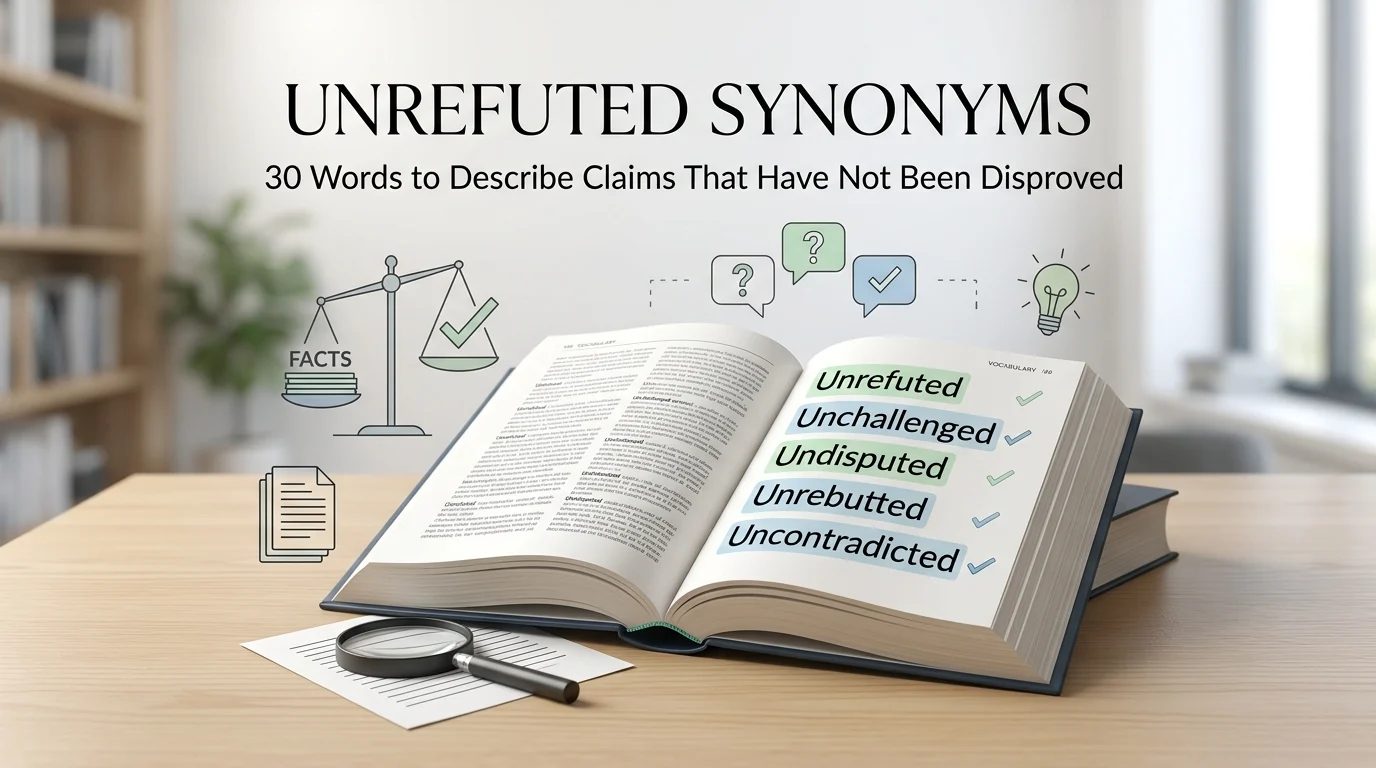
Finding the right word can make your writing clearer, more precise, and more persuasive. If you are looking for unrefuted synonyms, you are probably trying to describe a claim, statement, argument, fact, or idea that has not been successfully challenged or disproved.
The word unrefuted is useful in academic writing, journalism, debates, research, essays, and everyday communication. However, repeating the same word can make your writing feel limited.
Learning related words such as unchallenged, undisputed, uncontested, and unanswered can help you express slightly different shades of meaning.
This guide explains 30 useful synonyms and closely related alternatives to unrefuted. Each word includes a simple meaning, an example sentence, and guidance on when it works best.
What Does “Unrefuted” Mean?
Unrefuted means not successfully disproved, challenged, or shown to be false.
The word comes from refute, which means to prove that a statement, argument, or claim is wrong or false. Adding the prefix un creates the opposite meaning.
Simple definition
Unrefuted = not proven false or not successfully disproved.
Examples
- The researcher presented an unrefuted explanation for the unusual result.
- His claim remained unrefuted because no one provided convincing evidence against it.
- The witness gave an allegation that remained unrefuted during the hearing.
Tone and usage
Unrefuted usually has a formal or academic tone. It is especially appropriate when discussing:
- Arguments
- Claims
- Evidence
- Theories
- Allegations
- Statements
- Research findings
- Debates
- Legal or political discussions
One important point is that unrefuted does not necessarily mean proven true. A claim can remain unrefuted simply because nobody has successfully disproved it.
For example:
The theory remains unrefuted.
This means that no successful refutation has been presented. It does not automatically mean that the theory has been proven correct.
30 Unrefuted Synonyms and Related Words
Not every word below is a perfect synonym in every situation. Some are close alternatives that emphasize a particular aspect of being unrefuted.
1. Unchallenged
Meaning: Not questioned, opposed, or challenged.
Example:
The assumption remained unchallenged for many years.
Best usage context:
Use unchallenged when nobody has seriously questioned or opposed an idea.
2. Undisputed
Meaning: Not questioned or argued against.
Example:
Her expertise in the field is widely considered undisputed.
Best usage context:
Use undisputed when there is general agreement and no meaningful disagreement.
Note: Undisputed can be stronger than unrefuted because it often suggests that people accept something as established or uncontested.
3. Uncontested
Meaning: Not opposed or challenged.
Example:
The candidate’s leadership remained uncontested during the meeting.
Best usage context:
Useful for claims, positions, decisions, elections, arguments, and matters where no one has formally opposed something.
4. Unanswered
Meaning: Not given an answer or response.
Example:
Several important questions remained unanswered after the investigation.
Best usage context:
Use this when something has not received a response rather than specifically being disproved.
5. Unrebutted
Meaning: Not effectively argued against or contradicted.
Example:
The lawyer’s evidence remained unrebutted throughout the hearing.
Best usage context:
Especially useful in formal arguments, legal writing, debates, and academic discussions.
Why it is close to “unrefuted”:
Both words describe something that has not been successfully countered. However, unrebutted often emphasizes the absence of a counterargument.
6. Uncontradicted
Meaning: Not opposed by a statement or evidence showing the opposite.
Example:
The witness’s account remained uncontradicted by the available evidence.
Best usage context:
Use it when no evidence or statement directly conflicts with another statement.
7. Unopposed
Meaning: Not facing opposition.
Example:
The proposal passed after remaining unopposed during the discussion.
Best usage context:
Best for positions, proposals, candidates, decisions, or actions rather than scientific claims.
8. Unquestioned
Meaning: Not questioned or challenged.
Example:
The assumption was accepted as unquestioned for decades.
Best usage context:
Use this when an idea has not been examined critically or challenged.
9. Unchallenged
Meaning: Left without opposition or criticism.
Example:
The inaccurate assumption went unchallenged during the presentation.
Best usage context:
Useful when emphasizing that people failed to question something.
10. Unverified
Meaning: Not checked or confirmed as true.
Example:
The report contained several unverified claims.
Best usage context:
Use unverified when something has not been confirmed, rather than when it has specifically resisted refutation.
Important distinction:
An unverified claim has not been confirmed. An unrefuted claim has not been successfully disproved. These are not exactly the same.
11. Unproven
Meaning: Not established as true.
Example:
The scientist described the explanation as an interesting but unproven theory.
Best usage context:
Use it when evidence is insufficient to establish whether something is true.
12. Undemonstrated
Meaning: Not shown or proved through evidence.
Example:
The proposed connection between the two events remains undemonstrated.
Best usage context:
Useful in academic, scientific, and analytical writing.
13. Unsubstantiated
Meaning: Not supported by sufficient evidence.
Example:
The newspaper refused to publish the unsubstantiated allegation.
Best usage context:
Best when discussing claims that lack supporting evidence.
Important distinction:
Unsubstantiated often suggests a lack of supporting evidence, while unrefuted focuses on the lack of successful opposition or disproof.
14. Unconfirmed
Meaning: Not officially or independently established as true.
Example:
The report contained an unconfirmed account of the incident.
Best usage context:
Useful for news reports, rumors, announcements, reports, and developing situations.
15. Unchallenged by Evidence
Meaning: Not opposed or weakened by available evidence.
Example:
The explanation remained unchallenged by the evidence presented in the study.
Best usage context:
Useful when you want to emphasize evidence specifically.
16. Accepted
Meaning: Generally regarded as true, valid, or reasonable.
Example:
The explanation is widely accepted among researchers.
Best usage context:
Use this when there is positive acceptance, rather than simply an absence of refutation.
Caution:
Accepted is not always a direct synonym for unrefuted.
17. Sustained
Meaning: Continued or supported despite opposition or criticism.
Example:
The original argument was sustained after several rounds of discussion.
Best usage context:
Useful for arguments, positions, claims, or legal reasoning that continue to stand after examination.
18. Defensible
Meaning: Able to be supported or justified with reasonable arguments or evidence.
Example:
The researcher presented a defensible interpretation of the results.
Best usage context:
Use this when you want to emphasize that an argument can withstand criticism.
19. Tenable
Meaning: Able to be maintained or defended logically.
Example:
The theory remains tenable despite the new findings.
Best usage context:
A strong choice for academic, professional, and analytical writing.
20. Viable
Meaning: Capable of working, succeeding, or continuing to exist.
Example:
The proposal remains a viable explanation for the unexpected results.
Best usage context:
Useful when an idea or explanation is still possible and has not been eliminated.
21. Plausible
Meaning: Seeming reasonable or possible.
Example:
Her explanation remains plausible because no evidence has disproved it.
Best usage context:
Use this when an explanation appears believable or logically possible.
Important distinction:
Something can be plausible without being proven or unrefuted.
22. Credible
Meaning: Believable or worthy of being trusted.
Example:
The witness offered a credible account of what happened.
Best usage context:
Best for people, explanations, sources, evidence, and claims that appear trustworthy.
23. Valid
Meaning: Logically or factually sound.
Example:
The criticism raised an important issue, but the original argument remained valid.
Best usage context:
Use this when you want to say an argument or reasoning remains logically sound.
24. Intact
Meaning: Not damaged, weakened, or changed.
Example:
The central argument remained intact after the discussion.
Best usage context:
Useful metaphorically when an argument survives criticism without being weakened.
25. Standing
Meaning: Still accepted, effective, or in force.
Example:
The original explanation is still standing after further investigation.
Best usage context:
A more conversational choice for an idea, explanation, position, or argument that has survived examination.
26. Unassailed
Meaning: Not attacked, criticized, or challenged.
Example:
The basic assumption remained unassailed throughout the debate.
Best usage context:
Useful in formal or literary writing when emphasizing the absence of criticism.
27. Unimpugned
Meaning: Not challenged as false, dishonest, or improper.
Example:
The witness’s integrity remained unimpugned throughout the investigation.
Best usage context:
A formal word often used when discussing someone’s honesty, reputation, character, or credibility.
28. Unrefuted
Meaning: Not successfully disproved or shown to be false.
Example:
The central claim remained unrefuted after several rounds of debate.
Best usage context:
Use the original word when you specifically mean that no successful refutation has been made.
29. Unopposed in Argument
Meaning: Not met with an opposing argument.
Example:
The conclusion was left unopposed in the final discussion.
Best usage context:
Useful when describing debates, discussions, essays, or formal arguments.
30. Still Standing
Meaning: Still existing or remaining persuasive after criticism.
Example:
Despite several objections, the basic explanation is still standing.
Best usage context:
Use this informal expression in conversational writing or less formal explanations.
Quick Comparison of Unrefuted Synonyms
The best synonym depends on exactly what you want to communicate.
| Word | Main Idea | Tone | Common Use |
|---|---|---|---|
| Unrefuted | Not successfully disproved | Formal | Claims, arguments, theories |
| Unchallenged | Not questioned or opposed | Neutral | Ideas, assumptions, claims |
| Undisputed | Generally not disagreed with | Formal/neutral | Facts, achievements, positions |
| Uncontested | Not opposed | Formal/neutral | Decisions, positions, candidates |
| Unrebutted | Not effectively countered | Formal | Arguments, legal claims |
| Uncontradicted | Not contradicted | Formal | Statements, evidence |
| Unanswered | No response provided | Neutral | Questions, objections |
| Unverified | Not confirmed | Neutral/formal | Claims, reports, information |
| Unproven | Not established as true | Neutral | Theories, claims |
| Unsubstantiated | Lacking supporting evidence | Formal | Allegations, accusations |
| Unconfirmed | Not officially confirmed | Neutral | Reports, news, information |
| Defensible | Can be reasonably supported | Formal | Arguments, positions |
| Tenable | Can logically be maintained | Formal | Theories, explanations |
| Plausible | Seems possible or reasonable | Neutral | Explanations, theories |
| Credible | Believable or trustworthy | Neutral/formal | Sources, people, claims |
| Valid | Sound or logically acceptable | Formal | Arguments, reasoning |
| Unassailed | Not attacked or criticized | Formal | Arguments, positions |
| Unimpugned | Not challenged as improper | Formal | Character, integrity |
| Standing | Still accepted or effective | Neutral | Positions, arguments |
| Still standing | Survives criticism | Informal | Ideas, arguments |
Unrefuted vs. Undisputed
These words are closely related, but they are not always interchangeable.
Unrefuted means that nobody has successfully disproved something.
Undisputed usually means that there is no meaningful disagreement about something.
For example:
The claim remains unrefuted.
This tells us that no successful refutation has been presented.
But:
His expertise is undisputed.
This suggests that people generally agree about his expertise.
Therefore, unrefuted focuses on the absence of successful disproof, while undisputed focuses more on the absence of disagreement.
Unrefuted vs. Unproven
These two words are especially easy to confuse.
Unrefuted means:
Nobody has successfully shown it to be false.
Unproven means:
It has not been established as true.
A claim can be both unrefuted and unproven.
For example:
The theory remains unrefuted but unproven.
This is perfectly possible. No one has disproved the theory, but there is also not enough evidence to prove that it is correct.
Unrefuted vs. Unverified
Unverified means something has not been checked or confirmed.
Unrefuted means something has not been successfully disproved.
Consider these examples:
The report contains an unverified claim.
The claim has not been confirmed.
The claim remains unrefuted.
No convincing evidence has successfully disproved it.
These words describe different situations, so choosing between them depends on what you want to emphasize.
Unrefuted vs. Unsubstantiated
Unsubstantiated generally means that a claim does not have enough supporting evidence.
Unrefuted means that no successful counterargument or disproof has been presented.
For example:
The allegation was unsubstantiated.
This suggests that evidence supporting the allegation was lacking.
By contrast:
The allegation remained unrefuted.
This says that no successful rebuttal or disproof was presented.
The distinction can be important in academic, legal, and journalistic writing.
How to Choose the Right Unrefuted Synonym
Choosing a synonym is not simply about finding another word with a similar dictionary definition. The best word depends on your meaning, tone, and context.
For Academic Writing
Choose words such as:
- Unrefuted
- Unsubstantiated
- Unproven
- Unverified
- Tenable
- Defensible
- Undemonstrated
Example:
The hypothesis remains unrefuted, although additional research is necessary.
These choices work well because they communicate uncertainty carefully.
For Arguments and Debates
Good choices include:
- Unrefuted
- Unrebutted
- Unchallenged
- Uncontradicted
- Unassailed
- Defensible
Example:
The central argument remained unrebutted during the debate.
Use unrebutted when the focus is specifically on the lack of a counterargument.
For Legal or Formal Writing
Consider:
- Unrefuted
- Unrebutted
- Uncontradicted
- Uncontested
- Unimpugned
- Undisputed
Example:
The evidence remained uncontradicted during the proceedings.
These terms tend to fit formal contexts better than casual alternatives.
For Scientific Writing
Useful choices include:
- Unrefuted
- Unproven
- Unverified
- Unconfirmed
- Undemonstrated
- Tenable
- Plausible
Example:
The explanation remains plausible but unproven.
This wording avoids claiming more certainty than the evidence supports.
For Casual or Everyday Writing
You can use simpler expressions such as:
- Unchallenged
- Unanswered
- Still standing
- Not disproved
- Not contradicted
Example:
His explanation is still standing because nobody has shown it to be wrong.
These expressions are easier for general audiences to understand.
Stronger and Softer Alternatives
Different synonyms can communicate different levels of certainty.
More neutral
- Unrefuted
- Unchallenged
- Unanswered
- Unverified
- Unconfirmed
Suggesting general agreement
- Undisputed
- Uncontested
- Accepted
Suggesting logical strength
- Defensible
- Tenable
- Valid
- Credible
- Plausible
Suggesting lack of evidence
- Unproven
- Unsubstantiated
- Undemonstrated
This distinction helps writers avoid accidentally making a claim sound stronger than the evidence allows.
Examples of “Unrefuted” in Different Sentences
Academic example
The hypothesis remains unrefuted, although researchers continue to investigate alternative explanations.
Essay example
The author’s central argument remains unrefuted by the evidence discussed in the article.
Debate example
Her final point remained unrefuted after the opposing team responded.
Legal-style example
The testimony remained unrefuted during the proceedings.
Research example
The proposed explanation is currently unrefuted but requires further testing.
Everyday example
His explanation went unrefuted because nobody could provide evidence that it was wrong.
Common Mistakes When Using “Unrefuted”
Mistake 1: Treating “Unrefuted” as “Proven”
This is the most important distinction.
If something is unrefuted, it has not been successfully disproved. That does not automatically mean it has been proven true.
Better:
The claim remains unrefuted.
Avoid assuming:
The claim is therefore proven.
Mistake 2: Confusing “Unrefuted” with “Undisputed”
A claim can be unrefuted even when people disagree with it.
For example, several people may challenge a claim, but if none of their arguments successfully disproves it, the claim could still be described as unrefuted.
Mistake 3: Using “Unverified” When You Mean “Unrefuted”
These words answer different questions.
- Unverified: Has it been confirmed?
- Unrefuted: Has it been successfully disproved?
Choosing the correct word makes your writing much more precise.
Mistake 4: Assuming Every Synonym Has the Same Strength
Words that appear similar can carry different implications.
For example:
- Plausible suggests something seems reasonable.
- Credible suggests something is believable.
- Unrefuted emphasizes the lack of successful disproof.
- Undisputed suggests a lack of disagreement.
- Unproven emphasizes the lack of proof.
These differences matter in professional and academic writing.
Frequently Asked Questions About Unrefuted Synonyms
What is the closest synonym for “unrefuted”?
Depending on the context, unrebutted, unchallenged, uncontradicted, and uncontested can be close alternatives. However, unrefuted specifically emphasizes that something has not been successfully disproved.
What is an easy synonym for “unrefuted”?
For beginner-friendly English, not disproved or unchallenged may be easier to understand.
Is “undisputed” the same as “unrefuted”?
Not exactly. Undisputed generally means that something is not being meaningfully disputed, while unrefuted means that it has not been successfully disproved.
Is “unproven” the opposite of “unrefuted”?
No. They describe different things. Something can be unproven and unrefuted at the same time.
What is the opposite of “unrefuted”?
Possible opposites include refuted, disproved, contradicted, rebutted, or challenged successfully, depending on the sentence.
Is “unrebutted” a synonym for “unrefuted”?
They are very close. Unrebutted often emphasizes that no effective counterargument has been presented, while unrefuted focuses more broadly on the absence of successful disproof.
Can “unrefuted” be used in academic writing?
Yes. It is a formal and useful word for academic writing, especially when discussing theories, hypotheses, arguments, evidence, and claims. Writers should still be careful not to imply that an unrefuted claim has automatically been proven true.
Final Takeaway: Choosing the Best Unrefuted Synonym
The best unrefuted synonym depends on the exact idea you want to communicate.
Use unrefuted when you specifically mean that a claim or argument has not been successfully disproved. Choose unrebutted when you want to emphasize the lack of a counterargument.
Use unchallenged when something has not been questioned or opposed, and undisputed when there is little or no meaningful disagreement.For claims that have not been confirmed, unverified, unconfirmed, or unproven may be more accurate.
When you want to emphasize that an argument can withstand criticism, defensible or tenable may work better. For something that simply seems reasonable, plausible is often the natural choice.
The most important lesson is that synonyms are rarely identical in meaning. Understanding their subtle differences allows you to choose words that communicate your exact idea instead of simply replacing one word with another.
If you are writing an essay, research paper, article, report, debate, or everyday message, using the right alternative to unrefuted can make your writing more precise, natural, and effective.

I am Derek Thomas, a passionate word enthusiast and writer. I enjoy exploring synonyms, expanding vocabulary, and helping readers find clear, accurate, and meaningful words for better writing.