If you are looking for archaeology synonyms, you may be trying to find alternative words for archaeology, related terms for academic writing, or vocabulary that describes the study of ancient human life.
Although archaeology is a specific academic field, several words and phrases can be used to describe closely related ideas, activities, and areas of study.
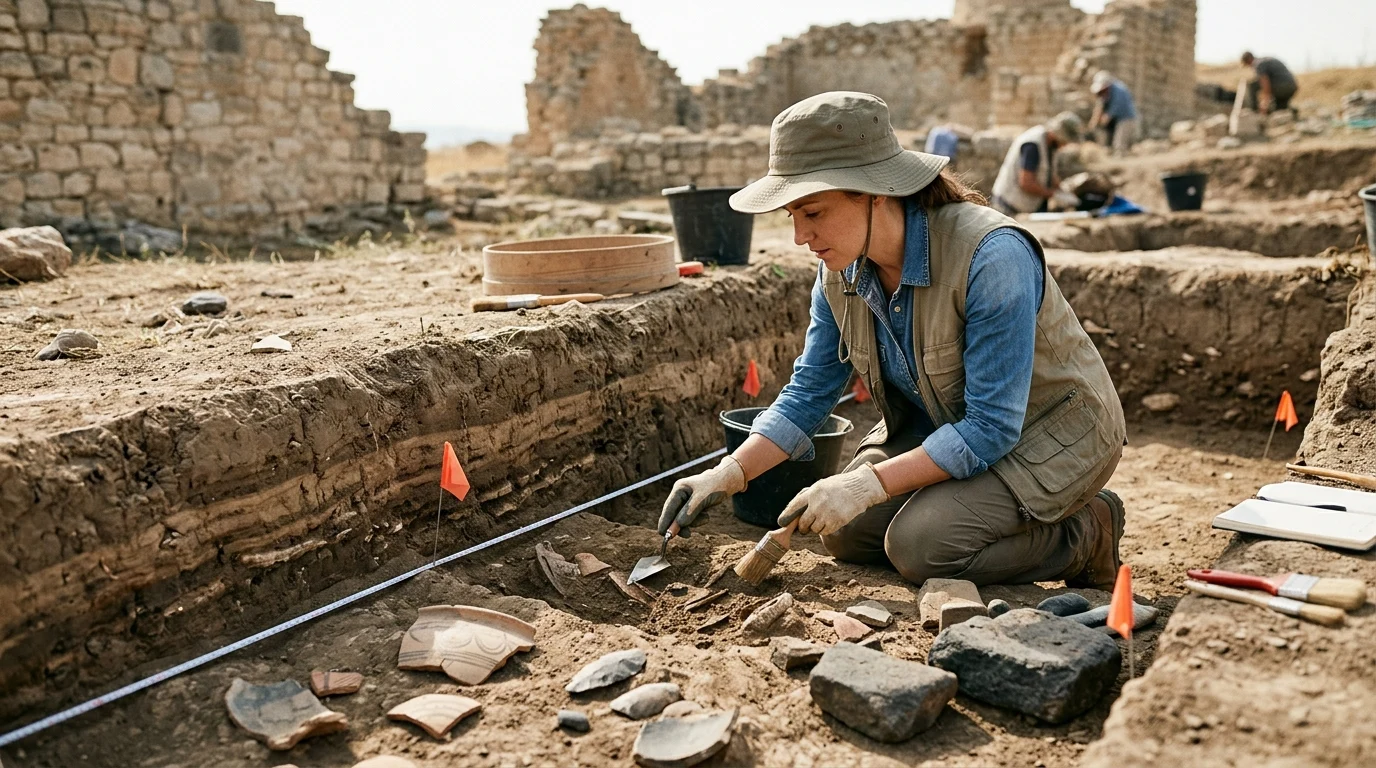
Archaeology is the study of past human societies through their physical remains. Archaeologists examine objects, buildings, tools, pottery, bones, monuments, landscapes, and other evidence to understand how people lived, worked, traded, worshiped, and interacted with their environment.
Finding the right related word depends on your context. Some terms refer to the study of ancient cultures, while others describe excavation, artifacts, ruins, heritage, or ancient history.
This guide explains 30 useful archaeology synonyms and related terms in simple English, with examples and notes on when each word works best.
What Does Archaeology Mean?
Archaeology is the systematic study of past human life and cultures through material evidence.
In simple English, archaeology helps us understand people who lived in the past by examining what they left behind.
For example, an archaeologist might study:
- Ancient pottery
- Stone tools
- Coins
- Human remains
- Old buildings
- Burial sites
- Temples
- Fortifications
- Ancient roads
- Written inscriptions
- Household objects
- Agricultural landscapes
The word archaeology is usually used as the name of an academic discipline rather than as an ordinary synonym based word. Therefore, some terms below are not exact synonyms. They are closely related words and expressions that can be useful when writing about archaeology.
30 Archaeology Synonyms and Related Words
1. Antiquarianism
Meaning: The study or collection of objects and information relating to the past, especially ancient objects.
Example:
His interest in antiquarianism led him to collect old manuscripts and coins.
Best usage context:
Useful when discussing historical interest and the collecting or study of ancient objects.
2. Ancient History
Meaning: The study of human societies and events from the distant past.
Example:
She studied ancient history to learn more about civilizations in Egypt and Mesopotamia.
Best usage context:
Best for academic discussions about ancient civilizations and historical events.
Note: Ancient history and archaeology overlap, but they are not identical. Archaeology focuses heavily on physical evidence, while ancient history may also rely on written records.
3. Anthropology
Meaning: The study of humans, human societies, cultures, and development.
Example:
Archaeology is often studied as part of anthropology.
Best usage context:
Useful in academic writing when discussing archaeology’s relationship with the broader study of humanity.
4. Cultural Anthropology
Meaning: The study of people’s cultures, beliefs, traditions, and ways of life.
Example:
Cultural anthropology can help researchers understand traditions represented in archaeological evidence.
Best usage context:
Useful when discussing culture and human behavior alongside archaeological research.
5. Excavation
Meaning: The process of carefully digging into the ground to uncover objects, structures, or other evidence from the past.
Example:
The archaeological excavation uncovered the remains of an ancient settlement.
Best usage context:
One of the most useful terms when talking about archaeological fieldwork.
6. Exploration
Meaning: The act of searching an unfamiliar area to discover something.
Example:
The team’s exploration of the valley revealed several previously unknown archaeological sites.
Best usage context:
Useful for describing discovery and investigation, although exploration is broader than archaeology.
7. Fieldwork
Meaning: Research carried out directly at a site rather than only in a laboratory or office.
Example:
The students spent six weeks doing archaeological fieldwork.
Best usage context:
Excellent for academic and professional writing about archaeological research conducted at sites.
8. Artifact Study
Meaning: The examination and interpretation of objects made or used by humans.
Example:
Artifact study helped researchers understand the community’s daily activities.
Best usage context:
Useful when discussing the analysis of tools, pottery, jewelry, weapons, and other objects.
9. Material Culture
Meaning: The physical objects and structures created, used, or modified by people.
Example:
Pottery and tools provide important evidence about the material culture of ancient communities.
Best usage context:
A strong academic term for discussing physical evidence of human life.
10. Heritage Studies
Meaning: The study of places, objects, traditions, and practices that are considered important to a community or society.
Example:
Heritage studies can help communities protect important archaeological sites.
Best usage context:
Useful when archaeology connects with preservation, identity, museums, and cultural heritage.
11. Historical Research
Meaning: The organized study of the past using available evidence.
Example:
The project combined archaeological evidence with historical research.
Best usage context:
Useful when archaeological evidence is being combined with documents, records, or other historical sources.
12. Historical Archaeology
Meaning: The study of relatively recent past societies using archaeological evidence together with written or other historical records.
Example:
Historical archaeology revealed new information about the early colonial settlement.
Best usage context:
Best when discussing archaeological research involving periods for which written records also exist.
13. Prehistory
Meaning: The period before written historical records were available in a particular society.
Example:
Archaeologists found stone tools dating to prehistoric times.
Best usage context:
Useful for discussing periods before written documentation.
14. Prehistoric Studies
Meaning: The study of human life and societies before written records.
Example:
Her research focuses on prehistoric studies and early human settlements.
Best usage context:
Useful in academic writing about ancient human communities that existed before written records.
15. Paleopathology
Meaning: The study of diseases and injuries found in ancient human or animal remains.
Example:
Paleopathology provided evidence that the ancient population suffered from several nutritional problems.
Best usage context:
Use this specialized term when discussing disease and injury in archaeological remains.
16. Bioarchaeology
Meaning: The study of human biological remains from archaeological sites to understand past populations.
Example:
Bioarchaeology helped researchers learn about the health and diet of the ancient population.
Best usage context:
Best for scientific discussions involving human skeletons, health, diet, activity, and population history.
17. Archaeometry
Meaning: The scientific analysis of archaeological materials using methods from science and technology.
Example:
Archaeometry helped determine the composition and origin of the ancient pottery.
Best usage context:
Useful when archaeology involves laboratory testing, chemical analysis, dating, or material science.
18. Egyptology
Meaning: The specialized study of ancient Egypt.
Example:
She pursued Egyptology because of her interest in ancient Egyptian temples and inscriptions.
Best usage context:
Use when specifically discussing the archaeology, history, language, and culture of ancient Egypt.
19. Assyriology
Meaning: The study of the languages, history, cultures, and archaeology of ancient Mesopotamia.
Example:
His research in Assyriology focuses on ancient Mesopotamian inscriptions.
Best usage context:
Best for specialized academic discussions of ancient Mesopotamia.
20. Classical Archaeology
Meaning: The study of the material remains of ancient Greek and Roman societies.
Example:
Classical archaeology has revealed much about ancient Roman architecture.
Best usage context:
Useful when discussing ancient Greece, Rome, and related Mediterranean cultures.
21. Underwater Archaeology
Meaning: Archaeological research conducted beneath water.
Example:
Underwater archaeology uncovered the remains of a shipwreck near the ancient harbor.
Best usage context:
Use when discussing submerged settlements, shipwrecks, ports, and underwater artifacts.
22. Maritime Archaeology
Meaning: The study of human interaction with oceans, seas, rivers, and other waterways through archaeological evidence.
Example:
Maritime archaeology revealed how ancient communities traded across the sea.
Best usage context:
Useful for research involving ships, ports, trade routes, and maritime activity.
23. Industrial Archaeology
Meaning: The study of past industries, factories, machines, workplaces, and industrial landscapes.
Example:
Industrial archaeology helped document the history of the abandoned textile factory.
Best usage context:
Best for studying the remains of industrial activity, particularly in more recent history.
24. Urban Archaeology
Meaning: The study of archaeological remains within towns and cities.
Example:
Urban archaeology uncovered medieval buildings beneath the modern city.
Best usage context:
Useful when archaeological research takes place in existing urban areas.
25. Landscape Archaeology
Meaning: The study of how people used, changed, and interacted with landscapes in the past.
Example:
Landscape archaeology revealed ancient farming patterns across the valley.
Best usage context:
Excellent for research involving settlements, agriculture, roads, fields, natural resources, and human-environment relationships.
26. Archaeological Research
Meaning: The systematic investigation of past human societies using archaeological evidence.
Example:
The archaeological research provided new evidence about ancient trade networks.
Best usage context:
A broad and natural phrase for academic and professional writing.
27. Archaeological Science
Meaning: The use of scientific methods to investigate archaeological materials and questions.
Example:
Archaeological science was used to determine the age and composition of the artifacts.
Best usage context:
Useful when archaeology involves chemistry, biology, physics, dating techniques, or laboratory analysis.
28. Cultural Heritage
Meaning: Important cultural places, objects, traditions, and practices passed down through generations.
Example:
The ancient temple is an important part of the region’s cultural heritage.
Best usage context:
Best for discussions about preservation, identity, monuments, traditions, and historically important sites.
29. Ruins
Meaning: The remaining parts of buildings or structures that have been damaged or destroyed over time.
Example:
Visitors explored the ruins of the ancient city.
Best usage context:
Useful in general writing when referring to remains of old buildings or settlements.
Note: Ruins are not a synonym for archaeology itself. They are one type of evidence that archaeologists may study.
30. Archaeological Study
Meaning: A detailed investigation of material evidence from the past.
Example:
The archaeological study of the settlement revealed evidence of long-distance trade.
Best usage context:
A flexible phrase for essays, research papers, reports, and general educational writing.
Archaeology Synonyms: Quick Comparison Table
Because archaeology is a specific field of study, many of its related terms describe particular parts of archaeological work rather than being exact synonyms.
| Word or Term | Main Meaning | Best Used For |
|---|---|---|
| Archaeology | Study of past human societies through material evidence | General use |
| Antiquarianism | Interest in ancient objects and the past | Historical collecting and study |
| Ancient history | Study of the ancient past | Ancient civilizations and events |
| Anthropology | Study of humans and cultures | Broader human studies |
| Excavation | Careful digging to uncover evidence | Fieldwork |
| Fieldwork | Research conducted at a site | Archaeological projects |
| Material culture | Physical things made or used by people | Objects and structures |
| Heritage studies | Study of cultural heritage | Preservation and cultural identity |
| Prehistory | Period before written records | Early human societies |
| Bioarchaeology | Study of human remains | Health, diet, and populations |
| Archaeometry | Scientific analysis of archaeological materials | Laboratory research |
| Egyptology | Study of ancient Egypt | Egyptian civilization |
| Classical archaeology | Study of Greek and Roman material remains | Classical civilizations |
| Underwater archaeology | Archaeology below water | Shipwrecks and submerged sites |
| Maritime archaeology | Study of human activity connected to waterways | Ships, ports, and trade |
| Urban archaeology | Archaeology in cities | Ancient and historic urban areas |
| Landscape archaeology | Study of past human use of landscapes | Agriculture and settlement patterns |
| Archaeological science | Scientific approaches to archaeology | Dating and material analysis |
| Cultural heritage | Important cultural places and objects | Preservation |
| Ruins | Remains of old structures | Ancient buildings and sites |
Exact Synonyms vs. Related Terms
One important point is that archaeology does not have 30 perfect synonyms.
This matters if you are writing an essay, research paper, or SEO article. Replacing archaeology with a completely different word can change the meaning.
For example:
Archaeology examines physical evidence from past human societies.
You could write:
Archaeological research examines physical evidence from past human societies.
The meaning remains very similar.
However, replacing archaeology with ancient history changes the emphasis. Ancient history can involve written records and historical events, while archaeology focuses strongly on material evidence.
Likewise, excavation is not another word for archaeology. Excavation is one method archaeologists may use during their research.
Understanding these differences helps you choose vocabulary accurately rather than simply replacing one word with another.
How to Choose the Right Archaeology Synonym
The best term depends on what you are trying to describe.
For General Archaeological Research
Use:
- Archaeology
- Archaeological research
- Archaeological study
- Archaeological science
These terms work well in essays, articles, reports, and educational content.
Example:
The project involved extensive archaeological research into the ancient settlement.
For Digging and Field Investigation
Use:
- Excavation
- Fieldwork
- Exploration
- Archaeological investigation
These terms are appropriate when describing activities conducted at archaeological sites.
Example:
The excavation uncovered several pottery fragments.
For Ancient Objects
Use:
- Artifact study
- Material culture
- Material evidence
- Archaeological remains
These expressions work when the focus is on physical objects.
Example:
The pottery provides valuable evidence of the community’s material culture.
For Ancient Civilizations
Use:
- Ancient history
- Prehistory
- Egyptology
- Assyriology
- Classical archaeology
Choose the more specific term when you know the civilization or historical period being discussed.
Example:
Her research focuses on Egyptology, particularly ancient Egyptian burial practices.
For Scientific Archaeological Research
Use:
- Archaeometry
- Archaeological science
- Bioarchaeology
- Paleopathology
These terms are better when scientific techniques or biological remains are central to the research.
Example:
Bioarchaeology provided evidence about the health and diet of the ancient population.
For Cultural Preservation
Use:
- Cultural heritage
- Heritage studies
- Archaeological heritage
- Historical preservation
These terms are especially useful when discussing the protection of monuments, archaeological sites, objects, and cultural traditions.
Example:
Protecting archaeological sites is an important part of cultural heritage management.
Archaeology Related Vocabulary for Students
If you are learning vocabulary related to archaeology, these additional words can help you understand academic texts:
Artifact: An object made or modified by humans.
Excavation: The process of digging to uncover archaeological evidence.
Site: A location where archaeological evidence is found.
Settlement: A place where people lived.
Ruins: The remains of old or damaged buildings.
Monument: A structure or site built to commemorate or represent something important.
Inscription: Writing carved, engraved, or marked on a surface.
Pottery: Objects made from clay and hardened by heat.
Stratigraphy: The study of layers of soil and deposits at an archaeological site.
Dating: Methods used to determine the age of an object or site.
Artifact assemblage: A group of artifacts found together and studied as a collection.
Excavation trench: A section of ground opened for archaeological investigation.
These terms are particularly useful for students reading archaeological articles and research papers.
Why Archaeology Has So Many Related Terms
Archaeology covers a large range of activities and specialties.
An archaeologist may work in the field, excavating a site. Another researcher may analyze ancient human bones in a laboratory. Someone else may study shipwrecks beneath the sea, while another specialist examines ancient cities.
Because the discipline is so broad, different terms describe different areas of archaeological work.
For example:
- Excavation focuses on digging.
- Bioarchaeology focuses on biological remains.
- Archaeometry focuses on scientific analysis.
- Landscape archaeology focuses on human interaction with landscapes.
- Underwater archaeology focuses on submerged evidence.
- Classical archaeology focuses on ancient Greek and Roman societies.
- Egyptology focuses specifically on ancient Egypt.
Using the correct term makes your writing more precise.
Archaeology Synonyms in Example Sentences
Here are several examples showing how related vocabulary can work naturally in sentences:
- Archaeology helps us understand ancient human societies.
- The team began an excavation near the ancient settlement.
- The students gained practical experience through archaeological fieldwork.
- The discovery contributed to research in ancient history.
- Material culture can reveal details about everyday life.
- Bioarchaeology can provide evidence about the health of ancient populations.
- Archaeometry was used to analyze the composition of the pottery.
- Landscape archaeology revealed evidence of ancient farming.
- Underwater archaeology has documented numerous shipwrecks.
- The site is now protected as an important part of the region’s cultural heritage.
Common Mistakes When Using Archaeology Synonyms
Mistake 1: Treating Every Related Word as an Exact Synonym
Words such as excavation, artifact, and ruins are related to archaeology, but they do not mean the same thing.
Better approach: Choose a word based on the specific idea you want to communicate.
Mistake 2: Using Ancient History and Archaeology Interchangeably
Although the two fields overlap, they are not identical.
Ancient history often focuses on historical events, societies, people, and written sources.
Archaeology primarily investigates material evidence.
Both can work together to create a fuller understanding of the past.
Mistake 3: Using Specialized Terms Without Context
Terms such as archaeometry, bioarchaeology, and paleopathology have specific meanings.
Using them simply as alternatives for archaeology can make your writing inaccurate.
Better approach: Use specialized vocabulary only when the subject matches the definition.
SEO and Writing Tips for Using Archaeology Synonyms
If you are creating an article, educational resource, or website page about archaeology, use related vocabulary naturally.
Instead of repeating archaeology in every sentence, you can discuss:
- Archaeological research
- Ancient civilizations
- Archaeological sites
- Material culture
- Excavation methods
- Ancient artifacts
- Cultural heritage
- Historical research
- Archaeological evidence
- Prehistoric societies
This creates richer and more informative writing while avoiding unnecessary repetition.
For SEO, the goal should not be to insert as many related terms as possible. Instead, use vocabulary where it genuinely helps answer the reader’s question.
Frequently Asked Questions About Archaeology Synonyms
What is another word for archaeology?
There is no single perfect synonym for archaeology. Depending on context, related expressions include archaeological research, archaeological study, and archaeological science.
What is a simple meaning of archaeology?
Archaeology is the study of past human life through physical evidence such as artifacts, buildings, tools, pottery, bones, and other remains.
Is excavation a synonym for archaeology?
No. Excavation is an important archaeological method, but it is not the same as archaeology. Archaeology includes many other activities, such as surveying, analyzing artifacts, interpreting evidence, dating materials, and studying past environments.
What is a synonym for archaeological?
Depending on the sentence, related words may include ancient, historical, prehistoric, or antiquarian. However, these words are not always interchangeable, so the context matters.
What is the difference between archaeology and anthropology?
Archaeology focuses heavily on past human societies through material evidence, while anthropology is the broader study of humans, cultures, societies, and human development. Archaeology is often considered one branch or subfield of anthropology, depending on the academic tradition.
What is archaeological evidence?
Archaeological evidence is physical evidence that helps researchers understand past human activity. It can include artifacts, structures, human remains, animal bones, plant remains, soil deposits, and modified landscapes.
Final Thoughts on Archaeology Synonyms
Understanding archaeology synonyms is really about understanding the different parts of archaeological research. Because archaeology is a specialized academic field, it does not have dozens of exact synonyms.
Instead, it has a rich vocabulary of closely related words that describe its methods, evidence, specialties, and areas of study.Terms such as excavation, fieldwork, and archaeological research are useful for describing the work archaeologists do.
Words such as material culture, artifacts, and archaeological remains describe the evidence they study. Specialized fields such as bioarchaeology, archaeometry, Egyptology, and underwater archaeology provide more precise vocabulary for particular types of research.
For students, ESL learners, writers, and content creators, the most important lesson is simple: choose the term that matches your exact meaning. Using precise vocabulary makes your writing clearer, more natural, and more informative.
If you are writing about an ancient civilization, an archaeological excavation, cultural heritage, or prehistoric communities, these related terms can help you communicate your ideas with greater accuracy and variety.

I am Derek Thomas, a passionate word enthusiast and writer. I enjoy exploring synonyms, expanding vocabulary, and helping readers find clear, accurate, and meaningful words for better writing.