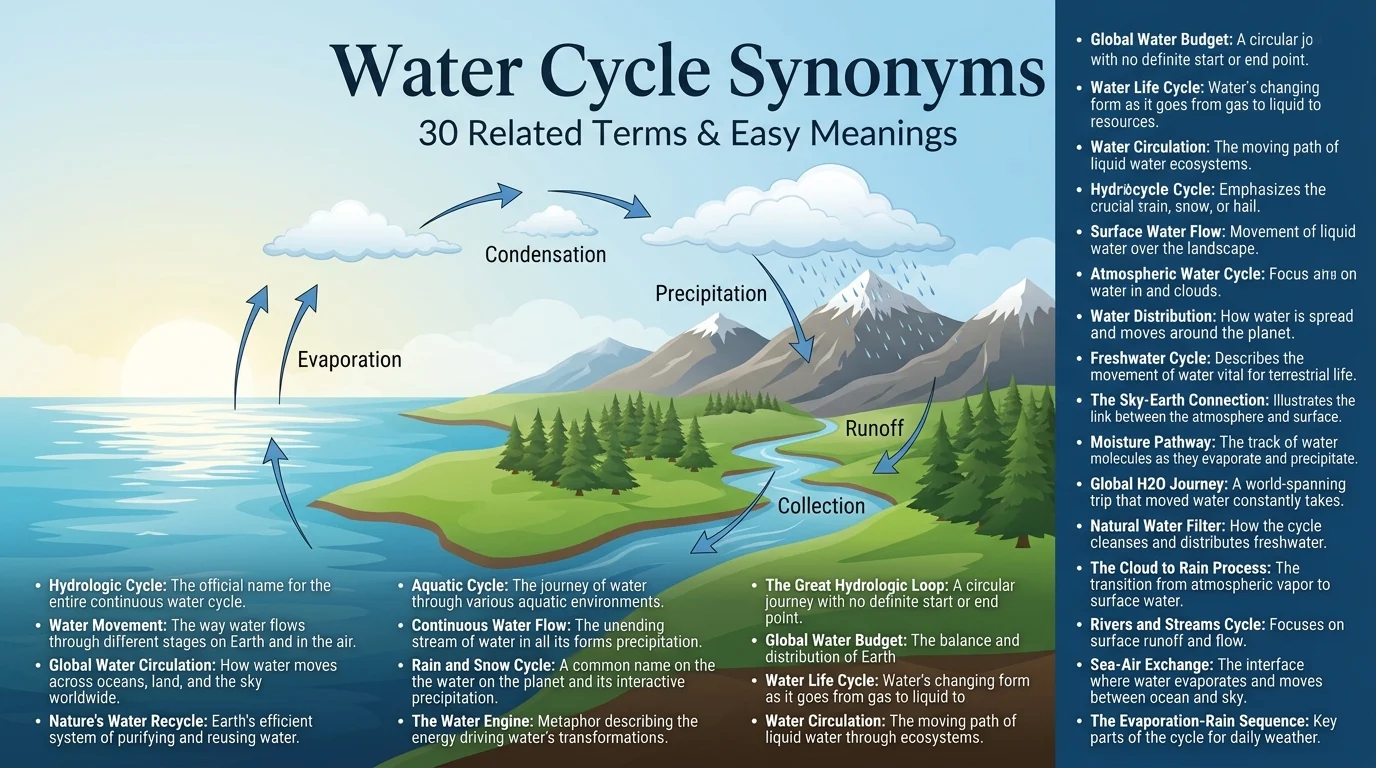
The water cycle is the continuous movement of water through the Earth’s atmosphere, land, oceans, rivers, lakes, soil, plants, and living organisms. Water changes form as it moves through processes such as evaporation, condensation, precipitation, infiltration, and collection.
If you are looking for water cycle synonyms, it is important to understand that water cycle is a scientific term with a specific meaning. There are not 30 perfect synonyms that can replace it in every sentence.
However, there are many related terms, alternative phrases, and descriptive expressions that can help you explain the same concept in different ways.
These alternatives are especially useful for students, ESL learners, teachers, writers, and content creators.
Knowing the right term can make a science explanation easier to understand and can help you avoid unnecessary repetition when writing about the movement of water on Earth.
What Does “Water Cycle” Mean?
The water cycle is the natural process through which water continually moves between the Earth’s surface and the atmosphere.
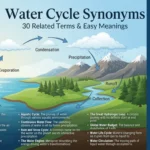
Water can exist as a liquid, solid, or gas. For example, liquid water from an ocean can evaporate into water vapor. The vapor rises, cools, and forms clouds through condensation. Eventually, water may fall back to Earth as rain, snow, sleet, or hail.
The main stages of the water cycle include:
- Evaporation – liquid water changes into water vapor.
- Transpiration – plants release water vapor into the atmosphere.
- Condensation – water vapor cools and forms tiny liquid droplets.
- Precipitation – water falls from clouds as rain, snow, sleet, or hail.
- Infiltration – water enters the soil.
- Runoff – water flows across the land into rivers, lakes, and oceans.
- Collection – water gathers in oceans, lakes, rivers, glaciers, and other reservoirs.
The water cycle has no true beginning or end. It is a continuous natural system.
30 Water Cycle Synonyms and Related Terms
Below are 30 useful alternatives and closely related expressions for water cycle. Some can be used as replacements in informal explanations, while others describe particular parts or characteristics of the cycle.
1. Hydrologic Cycle
Meaning: The scientific term for the continuous movement of water through Earth and its atmosphere.
Example:
The hydrologic cycle explains how water moves between oceans, land, and the atmosphere.
Best usage context: Scientific writing, textbooks, geography, and environmental studies.
2. Hydrological Cycle
Meaning: Another standard scientific expression for the water cycle.
Example:
Changes in temperature can affect the hydrological cycle.
Best usage context: Academic and scientific writing.
3. Water Circulation
Meaning: The continuous movement and circulation of water through different parts of the Earth system.
Example:
Water circulation helps distribute moisture around the planet.
Best usage context: General explanations and environmental discussions.
4. Water Movement
Meaning: The movement of water from one place or state to another.
Example:
The water cycle describes the natural movement of water around Earth.
Best usage context: Beginner friendly explanations.
5. Global Water Cycle
Meaning: The movement of water throughout the entire Earth system.
Example:
The global water cycle connects oceans, atmosphere, land, and living organisms.
Best usage context: Climate science and environmental studies.
6. Earth’s Water Cycle
Meaning: A simple phrase referring to the natural circulation of water around Earth.
Example:
The Earth’s water cycle helps maintain freshwater supplies.
Best usage context: School assignments and general educational writing.
7. Hydrologic Process
Meaning: A natural process involved in the movement or transformation of water.
Example:
Evaporation is an important hydrologic process.
Best usage context: Scientific explanations.
Note: This refers to an individual process rather than the entire water cycle.
8. Water Circulation System
Meaning: A system describing how water continuously moves through Earth’s environments.
Example:
The water circulation system connects the atmosphere with oceans and land.
Best usage context: Educational and explanatory writing.
9. Atmospheric Water Cycle
Meaning: The part of the water cycle involving water in the atmosphere.
Example:
Cloud formation is an important part of the atmospheric water cycle.
Best usage context: Meteorology and atmospheric science.
10. Natural Water Cycle
Meaning: The natural process through which water moves around the planet.
Example:
The natural water cycle helps replenish rivers and groundwater.
Best usage context: Beginner friendly and environmental writing.
11. Water Exchange
Meaning: The transfer of water between different parts of the Earth system.
Example:
Water exchange occurs between the ocean, atmosphere, and land.
Best usage context: Scientific and environmental contexts.
12. Hydrologic Circulation
Meaning: The continuous circulation of water through Earth’s natural systems.
Example:
Hydrologic circulation influences weather and freshwater availability.
Best usage context: Technical and academic writing.
13. Water Recycling in Nature
Meaning: The natural process of water repeatedly changing location and form.
Example:
The water cycle can be understood as water recycling in nature.
Best usage context: Children’s education and simple explanations.
14. Natural Water Circulation
Meaning: The continuous natural movement of water between Earth’s environments.
Example:
Natural water circulation moves moisture from oceans to the atmosphere and back again.
Best usage context: Educational articles and environmental discussions.
15. Atmospheric Moisture Cycle
Meaning: The movement of moisture through the atmosphere as part of the larger water cycle.
Example:
The atmospheric moisture cycle plays an important role in rainfall.
Best usage context: If and climate discussions.
16. Rainfall Cycle
Meaning: A simplified expression describing the recurring movement of water that contributes to rainfall.
Example:
The rainfall cycle helps explain how precipitation returns water to the land.
Best usage context: Basic educational explanations.
Note: This is not a complete scientific synonym for the water cycle.
17. Evaporation-Condensation Cycle
Meaning: A simplified description emphasizing evaporation and condensation.
Example:
Students can understand part of the water cycle through the evaporation-condensation cycle.
Best usage context: Introductory science lessons.
18. Precipitation Cycle
Meaning: A phrase focusing on the recurring movement of water through precipitation.
Example:
The precipitation cycle affects the amount of water entering rivers and lakes.
Best usage context: Weather and environmental explanations.
Note: It describes only part of the complete water cycle.
19. Freshwater Cycle
Meaning: A phrase describing the movement and renewal of freshwater through natural systems.
Example:
The freshwater cycle is important for ecosystems and human communities.
Best usage context: Environmental science.
Note: It is related to, but narrower than, the complete global water cycle.
20. Water Renewal Cycle
Meaning: The repeated natural movement and replenishment of water resources.
Example:
The water renewal cycle helps replenish some freshwater sources.
Best usage context: Environmental education and conservation topics.
21. Hydrological Circulation
Meaning: The continuous circulation of water through Earth’s atmosphere, surface, and underground systems.
Example:
Hydrological circulation is closely connected to climate patterns.
Best usage context: Academic, geographic, and environmental writing.
22. Moisture Cycle
Meaning: The movement of water or moisture through the atmosphere and Earth’s surface.
Example:
Changes in temperature can influence the moisture cycle.
Best usage context: Climate science and meteorology.
23. Water Transfer Cycle
Meaning: A descriptive phrase for the repeated transfer of water between different locations and states.
Example:
The water transfer cycle moves moisture between the ocean, atmosphere, and land.
Best usage context: General explanatory writing.
24. Water Transformation Cycle
Meaning: The repeated process in which water changes location and physical state.
Example:
The water transformation cycle includes changes between liquid water, ice, and vapor.
Best usage context: Science education.
25. Earth’s Hydrologic System
Meaning: The interconnected natural system through which water moves around Earth.
Example:
Earth’s hydrologic system is influenced by solar energy and gravity.
Best usage context: Advanced environmental and Earth science writing.
26. Atmospheric Water Movement
Meaning: The movement of water vapor and moisture through the atmosphere.
Example:
Atmospheric water movement contributes to cloud formation and rainfall.
Best usage context: If and climate explanations.
27. Water Conservation Cycle
Meaning: A phrase sometimes used when discussing the repeated movement, reuse, and replenishment of water.
Example:
Understanding the water conservation cycle can help students appreciate freshwater resources.
Best usage context: Educational and sustainability content.
Note: This is not a standard scientific synonym for the water cycle.
28. Natural Hydrological Cycle
Meaning: A descriptive expression for the natural circulation of water through Earth’s systems.
Example:
The natural hydrological cycle operates continuously across the planet.
Best usage context: Environmental and academic writing.
29. Global Hydrologic Cycle
Meaning: The worldwide movement of water among the atmosphere, oceans, land, and living systems.
Example:
The global hydrologic cycle connects water reservoirs across Earth.
Best usage context: Earth science, geography, and climate studies.
30. Continuous Water Cycle
Meaning: A simple phrase emphasizing that the movement of water is ongoing.
Example:
The continuous water cycle ensures that water is constantly moving between different parts of the environment.
Best usage context: Beginner friendly educational writing.
Water Cycle Synonyms: Quick Comparison Table
| Term | Meaning | Best Use |
|---|---|---|
| Hydrologic Cycle | Scientific name for the water cycle | Science and textbooks |
| Hydrological Cycle | Alternative scientific name | Academic writing |
| Water Circulation | Movement of water | General explanations |
| Water Movement | Water moving between places or states | Beginner writing |
| Global Water Cycle | Water movement across Earth | Climate science |
| Earth’s Water Cycle | Natural water movement on Earth | School writing |
| Hydrologic Process | An individual water related process | Scientific writing |
| Natural Water Cycle | Natural circulation of water | General education |
| Water Exchange | Transfer of water between systems | Environmental science |
| Hydrologic Circulation | Continuous water circulation | Technical writing |
| Water Recycling in Nature | Natural reuse and movement of water | Children’s education |
| Moisture Cycle | Movement of moisture | If and climate |
| Atmospheric Water Cycle | Water movement involving the atmosphere | Meteorology |
| Freshwater Cycle | Movement of freshwater | Environmental topics |
| Rainfall Cycle | Recurring precipitation-related movement | Basic explanations |
| Precipitation Cycle | Movement involving precipitation | Weather discussions |
| Water Renewal Cycle | Replenishment of water | Conservation |
| Hydrological Circulation | Scientific description of water circulation | Academic writing |
| Moisture Cycle | Movement of moisture through systems | Climate studies |
| Earth’s Hydrologic System | Earth’s interconnected water system | Advanced science |
Are These Really Synonyms for “Water Cycle”?
Not all 30 terms above are exact synonyms.
This distinction matters because water cycle has a precise scientific meaning. Terms such as hydrologic cycle and hydrological cycle are genuine alternatives. Other expressions, such as water movement, moisture cycle, and water circulation, describe related ideas but may not include every stage of the complete cycle.
For accurate scientific writing, it is usually better to use water cycle, hydrologic cycle, or hydrological cycle.
For beginner-friendly writing, descriptive expressions can make the concept easier to understand.
Main Stages of the Water Cycle
Understanding the stages of the water cycle makes its related vocabulary much easier to remember.
Evaporation
Evaporation happens when liquid water receives enough energy to become water vapor.
The Sun is the main energy source driving evaporation on Earth’s surface.
Example:
Water evaporates from oceans, lakes, and rivers.
Transpiration
Transpiration occurs when plants release water vapor into the atmosphere through tiny openings in their leaves.
Evaporation and transpiration are often considered together as evapotranspiration.
Condensation
Condensation occurs when water vapor cools and changes into tiny liquid droplets.
Clouds form when water vapor condenses around microscopic particles in the atmosphere.
Precipitation
Precipitation occurs when water falls from clouds to Earth’s surface.
It can take several forms, including:
- Rain
- Snow
- Sleet
- Hail
Infiltration
Infiltration happens when water enters the soil from the ground surface.
Some infiltrated water may eventually contribute to groundwater.
Runoff
Runoff is water that flows across the land surface.
It can enter streams, rivers, lakes, and eventually oceans.
Collection
Water collects in natural reservoirs such as oceans, lakes, rivers, glaciers, soil, and groundwater.
From these reservoirs, the cycle continues.
Water Cycle vs. Hydrologic Cycle
The terms water cycle and hydrologic cycle generally refer to the same overall natural system.
| Water Cycle | Hydrologic Cycle |
|---|---|
| Common term | Scientific term |
| Easy for beginners | Common in academic writing |
| Used in schools and general articles | Used in geography and Earth science |
| Simple and familiar | More technical |
| Refers to continuous water movement | Refers to continuous water movement |
For most general audiences, water cycle is the clearest choice.
For scientific or academic writing, hydrologic cycle or hydrological cycle may be more appropriate.
How to Choose the Right Water Cycle Synonym
The best alternative depends on what you are trying to communicate.
For Students
Use:
- Water cycle
- Earth’s water cycle
- Natural water cycle
- Water movement
- Water circulation
These expressions are easy to understand and work well in school assignments.
For Scientific Writing
Use:
- Hydrologic cycle
- Hydrological cycle
- Hydrologic circulation
- Hydrological circulation
- Global hydrologic cycle
These terms are more appropriate for academic and technical contexts.
For Climate and Weather Topics
Use:
- Moisture cycle
- Atmospheric moisture cycle
- Atmospheric water cycle
- Global water cycle
- Atmospheric water movement
These terms work particularly well when discussing rainfall, clouds, humidity, and climate.
For Environmental Writing
Use:
- Natural water cycle
- Freshwater cycle
- Water renewal cycle
- Water exchange
- Earth’s hydrologic system
These expressions can be useful when discussing freshwater resources, ecosystems, and environmental sustainability.
For Children and ESL Learners
Use simple expressions such as:
- Water movement
- Water circulation
- Water recycling in nature
- Natural water cycle
- Continuous water cycle
Avoid overly technical vocabulary unless you explain it first.
Why Does the Water Cycle Matter?
The water cycle is essential to life on Earth.
It helps move water between different parts of the planet and contributes to the availability of freshwater. It also plays an important role in weather, climate, ecosystems, agriculture, and natural landscapes.
Plants depend on water for growth. Animals and humans need water to survive. Rivers and lakes support ecosystems, while precipitation supplies water to many terrestrial environments.
The water cycle also connects different parts of the Earth system. What happens in the atmosphere can affect land and water, while changes on land can influence water movement.
Common Questions About Water Cycle Synonyms
What is another word for water cycle?
The most direct scientific alternative is hydrologic cycle or hydrological cycle.
Other related expressions include water circulation, natural water cycle, and global water cycle.
What is the scientific synonym for water cycle?
Hydrologic cycle and hydrological cycle are the standard scientific terms.
Is “hydrological cycle” the same as “water cycle”?
Yes. In most contexts, hydrological cycle refers to the same continuous movement of water through Earth’s atmosphere, surface, and subsurface environments.
What is another way to say water cycle?
Depending on the context, you can say:
- Hydrologic cycle
- Hydrological cycle
- Water circulation
- Natural water cycle
- Global water cycle
- Hydrological circulation
However, these terms do not all have exactly the same level of scientific precision.
What is the water cycle also called?
The water cycle is also commonly called the hydrologic cycle or hydrological cycle.
Is “water circulation” a synonym for water cycle?
It can be used as a descriptive alternative in general writing, but it is not always a precise scientific synonym. Water circulation emphasizes the movement of water rather than the complete set of processes involved in the water cycle.
Water Cycle Synonyms for Different Writing Situations
| Writing Situation | Recommended Term |
|---|---|
| School assignment | Water cycle |
| Science textbook | Hydrologic cycle |
| Academic paper | Hydrological cycle |
| Children’s explanation | Water movement |
| ESL lesson | Natural water cycle |
| Climate article | Global water cycle |
| Weather article | Moisture cycle |
| Environmental article | Freshwater cycle |
| Geography lesson | Hydrological cycle |
| General blog | Water cycle |
Tips for Writing About the Water Cycle
1. Prefer accuracy over forced variation
Do not replace water cycle with an unusual phrase simply to avoid repeating a keyword.
Scientific accuracy should come first.
2. Explain technical terms
If your audience is unfamiliar with hydrologic cycle, explain that it means the continuous movement of water around Earth.
3. Use specific stage names
Instead of repeatedly saying “water movement,” use precise terms such as evaporation, condensation, precipitation, infiltration, and runoff when appropriate.
4. Consider your audience
A young student may understand “water recycling in nature” more easily than “hydrological circulation.”
An environmental science student may prefer the technical term hydrologic cycle.
5. Do not treat related terms as exact synonyms
Words such as rainfall cycle and moisture cycle can describe specific aspects of water movement, but they should not automatically replace water cycle in scientific writing.
Related Water Cycle Vocabulary
If you are studying or writing about the water cycle, these related terms are also useful:
- Evaporation
- Condensation
- Precipitation
- Transpiration
- Infiltration
- Runoff
- Groundwater
- Water vapor
- Clouds
- Rainfall
- Snow
- Humidity
- Collection
- Surface water
- Freshwater
- Ocean
- River
- Lake
- Glacier
- Reservoir
- Evapotranspiration
- Watershed
- Soil moisture
- Groundwater recharge
- Water reservoir
Learning these terms can help you describe the water cycle more accurately instead of relying on one repeated phrase.
Final Takeaway: Choosing the Right Water Cycle Synonym
When searching for water cycle synonyms, remember that there are only a few true direct alternatives. Hydrologic cycle and hydrological cycle are the most accurate scientific equivalents.
Other phrases, including water circulation, natural water cycle, global water cycle, moisture cycle, and water movement, can be useful depending on the context.
However, many of these describe a particular aspect of the water cycle rather than replacing the term completely.
For students and ESL learners, simple phrases such as water movement and natural water cycle can make explanations easier. For academic and scientific writing, hydrologic cycle and hydrological cycle are usually the strongest choices.
The key is to choose a term that matches your audience, subject, and intended meaning. Good vocabulary is not about finding the most complicated alternative it is about choosing the clearest and most accurate expression for the situation.

I am Scarlett Jane, a passionate language writer who loves exploring synonyms and word meanings. I create helpful content that makes vocabulary easier, clearer, and more enjoyable for everyone.