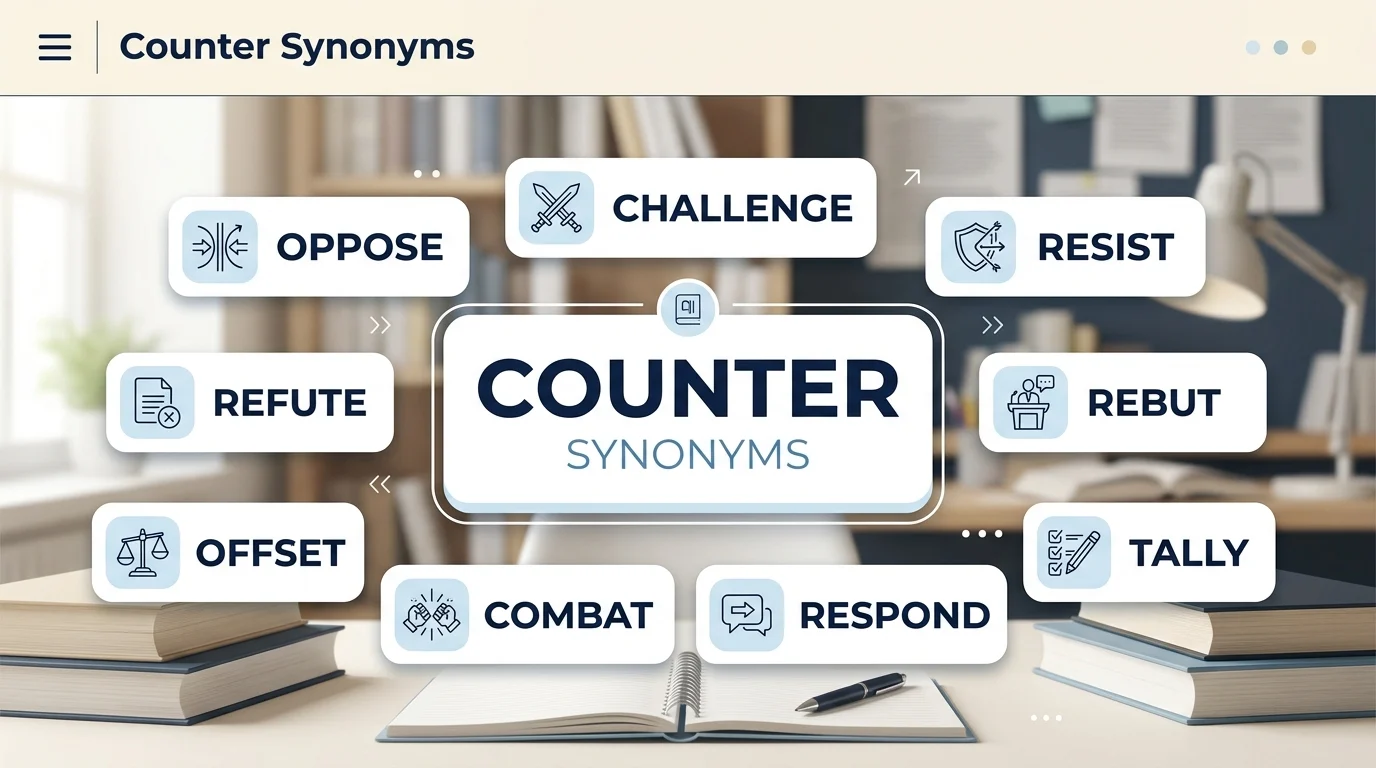
Finding the right counter synonyms can make your writing clearer, more precise, and more natural. The word counter has several meanings in English.
It can describe something that opposes an idea, a surface in a kitchen or shop, a device that records numbers, or an action taken in response to something.
Because of these different meanings, there is no single synonym that works in every situation. For example, oppose may replace counter when talking about an argument, while worktop may be a better choice when talking about a kitchen surface.
Choosing the correct alternative depends on the context and the meaning you intend.
This guide explains 30 useful synonyms for counter in simple English. Each word includes an easy definition, an example sentence, and a note explaining when it is most appropriate.
This makes the list useful for students, ESL learners, writers, and content creators who want to expand their vocabulary.
What Does “Counter” Mean?
The word counter can be used as a noun, verb, adjective, or part of a compound expression.
As a verb, counter usually means to act against something, respond to it, or try to reduce its effect.
Example:
The company introduced a new strategy to counter its competitor’s campaign.
Here, counter means to respond to or oppose something.
As a noun, counter can mean a flat surface used for serving, preparing food, or conducting business.
Example:
She placed the documents on the counter.
In another context, a counter can be something that records numbers, such as the number of visitors to a website.
Example:
The machine has a digital counter that records each item.
So, when looking for a synonym, it is important to identify which meaning of counter you need.
30 Counter Synonyms
Below are 30 useful alternatives, grouped around the different meanings of the word.
1. Oppose
Meaning: To disagree with, resist, or act against something.
Example:
The senator decided to oppose the proposed law.
Best usage context: Formal discussions, politics, arguments, and disagreements.
Why it works: Oppose is one of the closest alternatives to counter when you mean to act against something.
2. Resist
Meaning: To fight against something or refuse to accept its influence.
Example:
The workers resisted the company’s attempt to reduce their benefits.
Best usage context: Pressure, control, change, or unwanted influence.
Tone: Strong and active.
3. Challenge
Meaning: To question, dispute, or oppose something.
Example:
The lawyer challenged the accuracy of the evidence.
Best usage context: Arguments, claims, opinions, decisions, and evidence.
Tone: Neutral to assertive.
4. Contest
Meaning: To argue against something or try to prove that it is wrong.
Example:
The athlete decided to contest the referee’s decision.
Best usage context: Decisions, claims, competitions, and legal situations.
Tone: Formal.
5. Dispute
Meaning: To say that something is incorrect or untrue.
Example:
The researcher disputed the report’s conclusions.
Best usage context: Facts, claims, statements, research, and disagreements.
Tone: Formal and precise.
6. Contradict
Meaning: To say the opposite of what someone else has said.
Example:
His latest statement contradicts his earlier explanation.
Best usage context: Statements, opinions, facts, and arguments.
Tone: Direct and sometimes critical.
7. Refute
Meaning: To prove or show that an argument or claim is wrong.
Example:
The scientist used new evidence to refute the theory.
Best usage context: Academic writing, debates, research, and evidence.
Tone: Formal and academic.
8. Rebuke
Meaning: To criticize someone strongly.
Example:
The manager rebuked the employee for ignoring the safety rules.
Best usage context: Strong criticism of a person’s behavior.
Tone: Formal and strong.
9. Combat
Meaning: To take action against something harmful or unwanted.
Example:
The organization launched a campaign to combat misinformation.
Best usage context: Problems, threats, diseases, crime, and social issues.
Tone: Strong and action-oriented.
10. Defy
Meaning: To refuse to obey or accept something.
Example:
The community defied the order to leave the area.
Best usage context: Authority, rules, commands, or expectations.
Tone: Strong and bold.
11. Neutralize
Meaning: To make something ineffective or harmless.
Example:
The security team worked quickly to neutralize the threat.
Best usage context: Threats, risks, harmful effects, and strategic situations.
Tone: Formal and strategic.
12. Offset
Meaning: To reduce or balance the effect of something.
Example:
The company planted trees to offset its carbon emissions.
Best usage context: Costs, disadvantages, effects, losses, and environmental impact.
Tone: Neutral and practical.
13. Mitigate
Meaning: To make something less harmful, serious, or severe.
Example:
The new policy was designed to mitigate the effects of inflation.
Best usage context: Risks, problems, damage, and negative effects.
Tone: Formal and professional.
14. Thwart
Meaning: To prevent someone from successfully doing something.
Example:
The security system thwarted the attempted robbery.
Best usage context: Plans, attempts, attacks, and unwanted actions.
Tone: Strong and dramatic.
15. Foil
Meaning: To prevent a plan or attempt from succeeding.
Example:
The police foiled the criminals’ plan.
Best usage context: Plans, schemes, crimes, and deliberate attempts.
Tone: Often dramatic or journalistic.
16. Answer
Meaning: To respond to something, especially an argument, action, or criticism.
Example:
The team answered its opponent’s attack with an aggressive strategy.
Best usage context: Arguments, criticism, competition, and strategic responses.
Tone: Flexible and natural.
17. Respond
Meaning: To react or reply to something.
Example:
The government responded to the criticism with a detailed statement.
Best usage context: General situations where a reaction or reply is involved.
Tone: Neutral and widely useful.
18. React
Meaning: To behave or act in response to something.
Example:
The company reacted quickly to the sudden change in demand.
Best usage context: Events, situations, news, and unexpected changes.
Tone: Everyday and natural.
19. Retort
Meaning: To reply quickly and sometimes sharply.
Example:
“You don’t understand the situation,” she retorted.
Best usage context: Conversations, arguments, and sharp replies.
Tone: Strong and sometimes sarcastic.
20. Reply
Meaning: To answer someone or respond to something said.
Example:
He replied to the criticism with a calm explanation.
Best usage context: Conversations, emails, messages, and direct communication.
Tone: Neutral and everyday.
21. Rebut
Meaning: To argue against a statement or claim.
Example:
The attorney rebutted the opposing lawyer’s argument.
Best usage context: Debates, law, academic writing, and formal arguments.
Tone: Formal and intellectual.
Counter Synonyms for a Surface or Table
When counter is used as a noun to describe a flat surface, especially in a kitchen, shop, bank, or restaurant, completely different synonyms are needed.
22. Worktop
Meaning: A flat surface used for preparing food or doing work.
Example:
She left the vegetables on the kitchen worktop.
Best usage context: British English, kitchens, and food preparation.
Note: Worktop is especially common in British English.
23. Work surface
Meaning: A flat area used for doing practical work.
Example:
Keep the tools on the work surface.
Best usage context: Kitchens, workshops, laboratories, and offices.
Tone: Neutral and descriptive.
24. Table
Meaning: A piece of furniture with a flat surface supported by legs.
Example:
Please put the documents on the table.
Best usage context: General situations where a counter functions like a table.
Important: Table is not always an exact synonym for counter, because counters are often fixed in place and designed for specific purposes.
25. Bench
Meaning: A long, sturdy surface used for working or preparing things.
Example:
The mechanic placed the equipment on the workbench.
Best usage context: Workshops, laboratories, kitchens, and practical workspaces.
26. Bar
Meaning: A long surface where drinks, food, or services are provided.
Example:
He sat at the bar and ordered a coffee.
Best usage context: Restaurants, cafés, pubs, and service areas.
Note: Bar can replace counter in certain service-related contexts, but the words are not always interchangeable.
Counter Synonyms Related to Counting
In some situations, counter refers to something that records or keeps track of numbers.
27. Tally
Meaning: A record or count of how many things there are.
Example:
The teacher kept a tally of the students who attended the event.
Best usage context: Counting people, objects, votes, scores, or events.
Tone: Simple and practical.
28. Meter
Meaning: A device that measures or records an amount.
Example:
The electricity meter records how much power the house uses.
Best usage context: Measurement and technical situations.
Note: A meter is not a synonym for every meaning of counter, but it can work when the counter measures or records something.
29. Calculator
Meaning: A device or tool used to perform mathematical calculations.
Example:
She used a calculator to check the total.
Best usage context: Mathematics and numerical calculations.
Important: Calculator is only appropriate when counter refers to a calculation-related device, not when it means opposition or a surface.
30. Tally counter
Meaning: A device used to keep track of the number of things counted.
Example:
The researcher used a tally counter to record every visitor.
Best usage context: Events, research, attendance, inventory, and manual counting.
Tone: Specific and practical.
Counter Synonyms at a Glance
| Synonym | Main Meaning | Best Context | Tone |
|---|---|---|---|
| Oppose | Act against | Arguments, politics | Strong |
| Resist | Fight against | Pressure, control | Strong |
| Challenge | Question or dispute | Claims, decisions | Neutral |
| Contest | Dispute or compete | Decisions, legal matters | Formal |
| Dispute | Question truth | Facts, claims | Formal |
| Contradict | Say the opposite | Statements | Direct |
| Refute | Prove wrong | Academic arguments | Formal |
| Rebuke | Criticize strongly | Behavior | Strong |
| Combat | Fight against | Problems, threats | Strong |
| Defy | Refuse to obey | Authority | Strong |
| Neutralize | Make ineffective | Threats, risks | Strategic |
| Offset | Balance an effect | Costs, disadvantages | Neutral |
| Mitigate | Reduce severity | Risks, problems | Formal |
| Thwart | Prevent success | Plans, attempts | Strong |
| Foil | Prevent a plan | Schemes, attacks | Dramatic |
| Answer | Respond to | Arguments, criticism | Flexible |
| Respond | React or reply | General situations | Neutral |
| React | Act in response | Events, changes | Everyday |
| Retort | Reply sharply | Arguments | Sharp |
| Reply | Give an answer | Messages, conversations | Neutral |
| Rebut | Argue against | Debates, law | Formal |
| Worktop | Kitchen work surface | British English | Neutral |
| Work surface | Surface for work | Kitchens, workshops | Neutral |
| Table | Flat furniture surface | General use | Everyday |
| Bench | Work surface | Workshops, labs | Practical |
| Bar | Service counter | Restaurants, cafés | Everyday |
| Tally | A count or record | Counting | Practical |
| Meter | Measuring device | Measurement | Technical |
| Calculator | Calculation device | Mathematics | Everyday |
| Tally counter | Counting device | Manual counting | Specific |
How to Choose the Right Counter Synonym
The best synonym depends on what “counter” means in your sentence.
When “counter” means “oppose”
Use:
- Oppose for general disagreement.
- Resist when fighting pressure or control.
- Challenge when questioning an idea or decision.
- Dispute when questioning whether something is true.
- Refute when demonstrating that an argument is wrong.
- Combat when actively fighting a serious problem.
- Defy when refusing to obey.
- Thwart when preventing a plan from succeeding.
When “counter” means “respond”
Use:
- Respond for a general reaction.
- Reply for communication.
- Answer for a response to an argument or action.
- Retort for a quick or sharp reply.
- Rebut for a formal argument against another argument.
When “counter” means “reduce an effect”
Use:
- Offset when balancing one effect against another.
- Mitigate when making a problem less severe.
- Neutralize when making something ineffective.
When “counter” means a physical surface
Use:
- Worktop for a kitchen surface, especially in British English.
- Work surface for a practical working area.
- Bench for a sturdy work area.
- Bar for a food or drink service area.
- Table when the surface functions like ordinary table furniture.
When “counter” means counting
Use:
- Tally for a count or record.
- Tally counter for a device used to count items.
- Meter when the device measures an amount.
- Calculator when the device performs mathematical calculations.
Counter vs. Oppose
One of the most common questions about this word is whether oppose and counter mean exactly the same thing.
They are similar, but there is an important difference.
Oppose usually means to be against something.
The residents opposed the construction project.
Counter often suggests taking an action to respond to something.
The company introduced a new product to counter its competitor’s success.
In simple terms:
Oppose = be against something.
Counter = take action against something or respond to it.
Counter vs. Respond
These words can overlap, but they emphasize different ideas.
Respond is broad. It simply means to react or reply.
The company responded to customer complaints.
Counter often suggests a deliberate action intended to oppose, balance, or reduce something.
The company launched a new campaign to counter the negative publicity.
Therefore, use respond when you only want to describe a reaction. Use counter when the response is intended to challenge or offset something.
Counter vs. Refute
Refute is more specific than counter.
To counter an argument can simply mean to present another argument against it. To refute an argument usually means to show that the argument is wrong.
Counter:
The writer countered the criticism with another explanation.
Refute:
The scientist refuted the claim with experimental evidence.
For academic and evidence-based writing, refute is often the more precise choice.
Counter vs. Offset
These words are particularly useful when discussing effects.
Counter can mean to act against an effect.
Exercise can counter some of the negative effects of a sedentary lifestyle.
Offset means to balance or compensate for an effect.
The savings offset the additional cost.
If you are talking about compensation or balance, offset may be the better word.
Examples of Counter Synonyms in Real Sentences
Understanding synonyms becomes easier when you see them in realistic contexts.
Business
The company introduced a discount to counter falling sales.
Possible alternatives:
The company introduced a discount to combat falling sales.
The company introduced a discount to offset falling sales.
The best choice depends on the intended meaning.
Academic Writing
The researcher countered the criticism with additional evidence.
A more formal version could be:
The researcher rebutted the criticism with additional evidence.
Or, when proving a claim wrong:
The researcher refuted the criticism with additional evidence.
Politics
The opposition party countered the government’s proposal.
Possible alternatives include:
- opposed
- challenged
- disputed
- contested
- rebutted
The most suitable choice depends on if the party simply disagreed or actively presented an alternative.
Everyday Conversation
“That’s not what happened,” he retorted.
Here, retorted creates a stronger sense of a quick, sharp response than simply saying:
He replied.
Formal and Informal Counter Synonyms
Different situations call for different vocabulary.
More Formal
For essays, reports, and professional writing, consider:
- Refute
- Rebut
- Dispute
- Contest
- Mitigate
- Neutralize
- Offset
Neutral and Everyday
For general communication, use:
- Respond
- Reply
- React
- Oppose
- Challenge
- Resist
- Table
- Tally
Strong or Dramatic
For situations involving conflict or deliberate action, consider:
- Combat
- Defy
- Thwart
- Foil
- Rebuke
- Neutralize
Using a synonym with the appropriate tone can make your writing sound much more natural.
Why Context Matters When Using Synonyms
Synonyms are often described as words with similar meanings, but they are rarely identical in every situation.
For example, these sentences are not equally natural:
The scientist opposed the claim.
The scientist refuted the claim.
The scientist thwarted the claim.
The first suggests disagreement. The second suggests proving the claim wrong. The third is generally unnatural because thwart is normally used for an action, plan, or attempt.
This is why simply replacing counter with the first synonym you find can weaken your writing. Good vocabulary choices depend on meaning, grammar, tone, and context.
Tips for Using Counter Synonyms Correctly
1. Identify the meaning first
Ask yourself what counter means in the sentence.
Does it mean:
- oppose?
- respond?
- reduce?
- balance?
- work surface?
- counting device?
Once you know the meaning, selecting a synonym becomes much easier.
2. Consider the tone
For casual writing, reply or respond may sound natural.
For academic writing, rebut or refute may be more appropriate.
3. Check the grammar
Some alternatives cannot be used in exactly the same grammatical structure.
For example:
The team countered the attack.
But:
The team responded to the attack.
The preposition to is necessary with respond in this structure.
4. Do not replace words mechanically
A synonym should preserve the intended meaning.
Instead of asking, “What is another word for counter?” ask:
“What exactly do I mean by counter here?”
That small change can lead you to a much better vocabulary choice.
Frequently Asked Questions About Counter Synonyms
What is the best synonym for counter?
There is no single best synonym because counter has several meanings. For opposition, oppose, challenge, or resist may work well. For formal arguments, rebut or refute may be more precise. For reducing an effect, offset or mitigate may be better.
What is another word for counter an argument?
Useful alternatives include challenge, dispute, rebut, refute, contradict, and oppose. The best choice depends on whether you are simply disagreeing or actually proving an argument wrong.
What is a synonym for counter in a kitchen?
Depending on the type of English and context, alternatives include worktop and work surface. In some situations, bench may also be appropriate.
What is the opposite of counter?
The opposite depends on the meaning. If counter means oppose, an opposite could be support, assist, or encourage. If it means a physical surface, there is no simple opposite.
Is “oppose” the same as “counter”?
Not exactly. Oppose generally means to be against something, while counter often suggests taking action to oppose, answer, balance, or reduce something.
What is a formal synonym for counter?
Depending on context, formal alternatives include rebut, refute, dispute, contest, mitigate, neutralize, and offset.
Final Takeaway
The word counter is versatile, which is why choosing the right synonym requires attention to context. When it means to act against something, words such as oppose, resist, challenge, combat, and defy can be useful. When it refers to a formal response, rebut, refute, dispute, and contest may provide greater precision.
When counter describes a physical surface, alternatives such as worktop, work surface, bench, and bar may be appropriate. When it relates to counting or measurement, words such as tally, meter, and tally counter can fit better.
The most effective vocabulary choice is not always the closest dictionary synonym. Instead, choose the word that communicates your exact meaning, matches your intended tone, and sounds natural in the sentence.
By understanding these differences, you can use counter synonyms more accurately and make your English clearer, stronger, and more precise.

I am Joel Michael, an enthusiastic language writer and synonym enthusiast. I enjoy exploring words, finding their meanings, and discovering useful alternatives. I create clear, helpful content to make vocabulary learning simple and enjoyable for every reader.