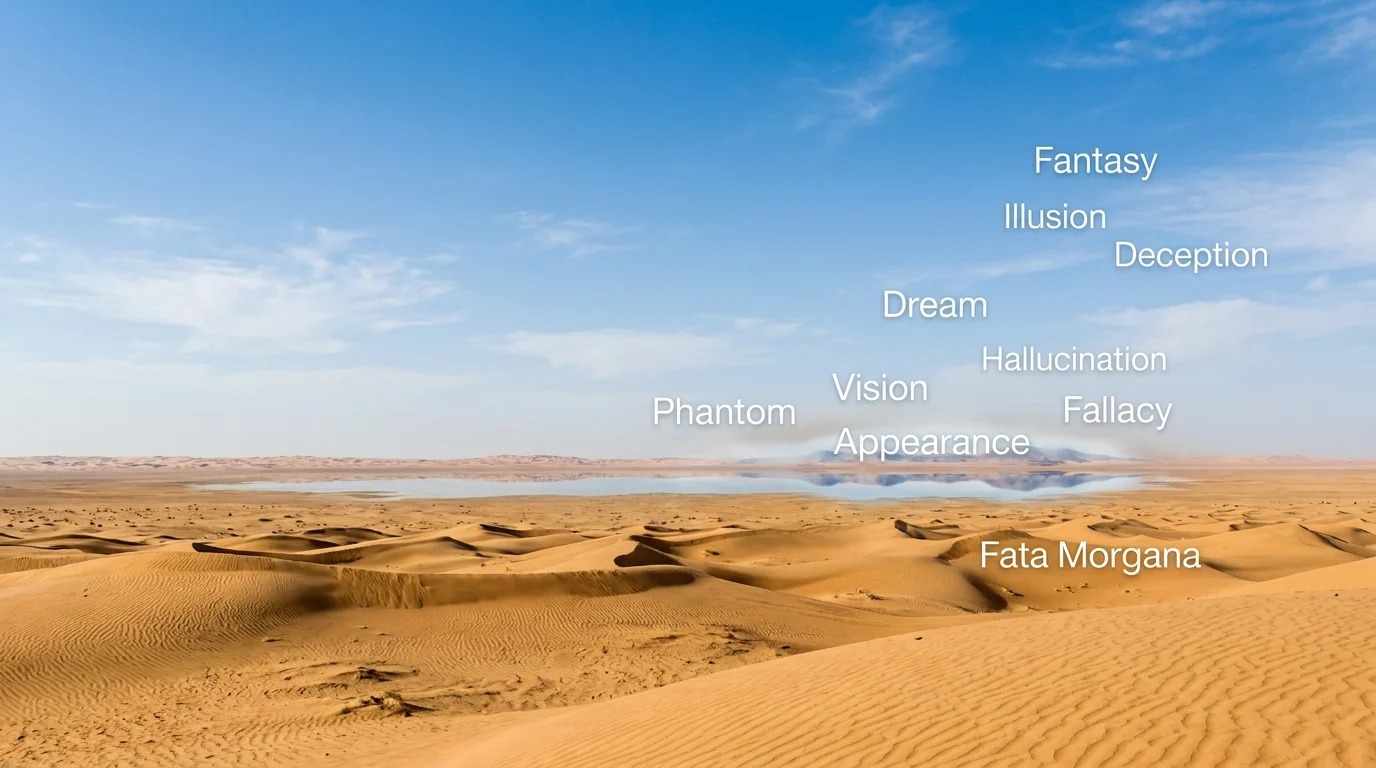
Have you ever seen something that looked real from a distance but disappeared or changed when you got closer? That is the basic idea behind a mirage.
The word is often used for a visual illusion, but it can also describe a hope, idea, or situation that seems real or achievable but is actually false or impossible.
Learning mirage synonyms can help you describe these situations more precisely. Instead of using “mirage” repeatedly, you can choose words such as illusion, hallucination, delusion, fantasy, or deception, depending on what you mean. Each synonym has a slightly different tone and usage.
This guide explains 30 useful synonyms for mirage in simple English. It is designed for students, ESL learners, writers, and content creators who want to improve their vocabulary and understand the subtle differences between similar words.
What Does “Mirage” Mean?
A mirage is an image that appears real but is actually caused by an optical illusion. It commonly happens when light bends through layers of air with different temperatures.
For example, on a very hot road, you may see what looks like a pool of water in the distance. When you move closer, the “water” disappears. That is a physical mirage.
The word can also be used figuratively. In this sense, a mirage is something that seems attractive, real, or possible but turns out to be false or unreachable.
Example:
His dream of becoming instantly wealthy was only a mirage.
Tone and Usage of “Mirage”
The word mirage usually has a slightly poetic or figurative tone. It is useful when describing something that looks promising but cannot be reached or does not really exist.
It can describe:
- A visual illusion
- A false appearance
- An unrealistic hope
- An unattainable goal
- Something that seems real but is not
- A misleading promise or expectation
30 Synonyms for Mirage
Below are 30 useful alternatives to the word mirage, with simple meanings and examples.
1. Illusion
Meaning: Something that appears real but is not actually real.
Example:
The reflection created an illusion that there was another doorway.
Best usage context: Use this as the closest general synonym for mirage, especially for something visually misleading.
2. Hallucination
Meaning: Seeing or experiencing something that is not actually present.
Example:
After walking for hours in the heat, he thought he saw a building, but it was a hallucination.
Best usage context: Best when the false image is experienced without a real external object creating it.
3. Delusion
Meaning: A false belief that someone strongly believes to be true.
Example:
His belief that everyone secretly admired him became a dangerous delusion.
Best usage context: Use when talking about a false belief rather than a physical visual effect.
4. Fantasy
Meaning: An imagined situation or idea that may not be realistic.
Example:
The idea of becoming rich overnight was merely a fantasy.
Best usage context: Useful for unrealistic dreams, hopes, or imagined situations.
5. Deception
Meaning: Something intended to make someone believe something false.
Example:
The attractive offer turned out to be a carefully planned deception.
Best usage context: Use when someone deliberately creates a false impression.
6. Appearance
Meaning: The way something seems or looks, which may differ from reality.
Example:
The appearance of water on the road was caused by heat.
Best usage context: Useful when discussing how something looks rather than what it really is.
7. Falsehood
Meaning: Something that is untrue.
Example:
The promise of unlimited success was a complete falsehood.
Best usage context: Best when the focus is on something being untrue.
8. Fiction
Meaning: Something invented or imagined rather than factual.
Example:
The story of instant success was closer to fiction than reality.
Best usage context: Useful when describing an invented story, claim, or situation.
9. Dream
Meaning: A desired or imagined situation that may not become reality.
Example:
For years, owning a private island remained a distant dream.
Best usage context: Good for an attractive but possibly unreachable hope.
10. Vision
Meaning: An imagined picture of something that may happen in the future.
Example:
His vision of a perfect future seemed increasingly unrealistic.
Best usage context: Useful for goals, plans, or imagined futures rather than physical illusions.
11. Fantasyland
Meaning: An unrealistic or imaginary world or situation.
Example:
Anyone who believes success comes without effort is living in fantasyland.
Best usage context: Informal writing and conversation.
12. Phantasm
Meaning: Something that seems to exist but is actually imaginary.
Example:
The mysterious figure turned out to be nothing more than a phantasm.
Best usage context: Literary, poetic, or formal writing.
13. Apparition
Meaning: A strange or ghostlike figure that appears suddenly.
Example:
The traveler thought he saw an apparition in the distance.
Best usage context: Best for mysterious, ghostlike, or supernatural appearances.
14. Specter
Meaning: A ghostlike figure or frightening imagined presence.
Example:
The abandoned building seemed haunted by the specter of its past.
Best usage context: Literary writing or figurative descriptions of something disturbing.
15. Phantom
Meaning: Something that seems to exist but cannot be physically found or proven.
Example:
The treasure proved to be a phantom that everyone had been chasing.
Best usage context: Good for something mysterious, imaginary, or impossible to capture.
16. Fata Morgana
Meaning: A complex optical illusion that can make distant objects appear distorted, elevated, or displaced.
Example:
The sailors believed they could see a distant city, but it was a Fata Morgana.
Best usage context: Scientific, geographical, or highly specific descriptions of optical mirages.
17. Misperception
Meaning: An incorrect understanding or perception of something.
Example:
What looked like a person in the distance was simply a misperception.
Best usage context: Useful in academic, scientific, and psychological contexts.
18. Misconception
Meaning: A wrong idea or belief about something.
Example:
The belief that success comes without hard work is a common misconception.
Best usage context: Best when the “mirage” is an incorrect idea rather than a visual illusion.
19. Misrepresentation
Meaning: A false or inaccurate presentation of something.
Example:
The advertisement was criticized for its misrepresentation of the product.
Best usage context: Formal writing, business, journalism, and legal contexts.
20. Pretense
Meaning: An attempt to make something seem true or real when it is not.
Example:
His confidence was only a pretense hiding his uncertainty.
Best usage context: Use when someone deliberately acts as though something is true.
21. Sham
Meaning: Something fake that is presented as genuine.
Example:
The supposed investment opportunity was a sham.
Best usage context: Informal or direct descriptions of something fake.
22. Fake
Meaning: Something that is not genuine or real.
Example:
The beautiful scene was a fake created for the advertisement.
Best usage context: Everyday English and informal communication.
23. Fabrication
Meaning: Something invented or made up, especially information or a story.
Example:
The claim about the missing treasure was a complete fabrication.
Best usage context: Formal writing when discussing invented information.
24. Make believe
Meaning: Something imaginary that is treated as though it were real.
Example:
The children created a make believe kingdom in the backyard.
Best usage context: Informal language, childhood imagination, and playful situations.
25. Imagination
Meaning: The ability to create ideas or pictures in your mind.
Example:
The strange creature existed only in his imagination.
Best usage context: Use when something comes from creative or mental activity.
26. Fancy
Meaning: An imagined idea, desire, or belief.
Example:
Her hope of becoming famous overnight was only a fancy.
Best usage context: Literary or somewhat old-fashioned English.
27. Chimera
Meaning: An unrealistic idea, hope, or dream that is difficult or impossible to achieve.
Example:
The promise of effortless success was a chimera.
Best usage context: Formal and literary writing, especially for impossible ambitions.
28. Reverie
Meaning: A pleasant state of being lost in your thoughts or dreams.
Example:
He spent the afternoon in a reverie about the life he wanted.
Best usage context: Poetic or literary writing about dreams and imagination.
29. Hoax
Meaning: A deliberately created false story or trick designed to deceive people.
Example:
The mysterious photograph was revealed to be a hoax.
Best usage context: Use when someone intentionally creates a false story or event.
30. Deceit
Meaning: Dishonest behavior intended to make someone believe something false.
Example:
The company’s promises were eventually exposed as deceit.
Best usage context: Useful when the false appearance involves dishonesty or deliberate misleading.
Quick Comparison of Mirage Synonyms
Not every synonym for mirage means exactly the same thing. Choosing the right word depends on whether you are describing a visual illusion, a false belief, an unrealistic dream, or deliberate deception.
| Synonym | Main Meaning | Tone | Best Used For |
|---|---|---|---|
| Illusion | False appearance | Neutral | Visual or general false impressions |
| Hallucination | Perception without a real object | Clinical | False sensory experiences |
| Delusion | False belief | Serious | Strongly held false beliefs |
| Fantasy | Unrealistic idea | Neutral | Dreams and imagination |
| Deception | Deliberate misleading | Serious | Intentional dishonesty |
| Phantom | Imaginary or elusive thing | Literary | Mysterious or unreachable things |
| Apparition | Ghostlike appearance | Literary | Supernatural-looking figures |
| Chimera | Impossible dream | Formal | Unrealistic ambitions |
| Reverie | Pleasant daydream | Poetic | Imagination and dreams |
| Hoax | Deliberate false story | Informal | Tricks and fabricated events |
| Sham | Fake thing | Direct | Fake products, situations, or claims |
| Misconception | Incorrect belief | Academic | Wrong ideas |
| Fabrication | Invented information | Formal | False stories or claims |
| Pretense | Pretending something is true | Neutral | False appearances or behavior |
| Misrepresentation | Inaccurate presentation | Formal | Business, legal, and professional contexts |
Mirage vs. Illusion: What’s the Difference?
Mirage and illusion are closely related, but they are not always interchangeable.
A mirage is specifically associated with an optical phenomenon caused by atmospheric conditions. For example, seeing what looks like water on a hot road is a classic mirage.
An illusion is a much broader term. It can describe anything that appears different from reality, including visual, psychological, or conceptual misunderstandings.
Example:
- The water on the road was a mirage.
- The magician created the illusion of a disappearing object.
So, illusion is usually the broader word, while mirage is more specific.
Mirage vs. Hallucination
A hallucination is different from a typical mirage.
A mirage is an optical effect caused by real physical conditions. A hallucination involves perceiving something that is not actually present.
For example:
Mirage:
The travelers saw what appeared to be water in the desert.
Hallucination:
The exhausted traveler believed he saw a person who was not there.
Use mirage for atmospheric optical phenomena and hallucination for false sensory experiences.
Mirage vs. Delusion
A delusion is primarily a false belief, not a visual effect.
For example:
Believing that you are guaranteed to become a billionaire without any realistic plan could be described as a delusion.
A mirage can be temporary and visual, while a delusion usually refers to a firmly held false belief.
Mirage vs. Fantasy
A fantasy is something imagined. It does not necessarily involve deception or confusion.
For example:
Owning a castle may be a fantasy.
The word mirage often suggests that something looked attainable or real but ultimately was not. Fantasy simply emphasizes imagination.
Mirage vs. Deception
The key difference is intention.
A mirage does not intentionally deceive anyone. It is a natural optical phenomenon.
Deception, however, usually involves someone intentionally creating a false impression.
Mirage: Natural optical effect.
Deception: Deliberate misleading.
How to Choose the Right Mirage Synonym
The best synonym depends on what you are trying to communicate.
For a Physical or Visual Illusion
Choose:
- Illusion
- Optical illusion
- Fata Morgana
- Misperception
These words work well when something appears visually different from reality.
Example:
The distant lake was actually an optical illusion.
For a False Belief
Choose:
- Delusion
- Misconception
- Falsehood
- Misperception
These words are useful when someone believes something that is not true.
Example:
The idea that money automatically brings happiness is a common misconception.
For an Unrealistic Dream
Choose:
- Fantasy
- Dream
- Chimera
- Vision
- Reverie
These words work especially well for hopes, ambitions, and imagined futures.
Example:
His plan to become successful without learning any skills was a fantasy.
For Something Fake
Choose:
- Sham
- Fake
- Fabrication
- Fiction
- Pretense
These are useful when something is presented as genuine but is not.
Example:
The investment scheme was exposed as a sham.
For Deliberate Dishonesty
Choose:
- Deception
- Deceit
- Hoax
- Misrepresentation
These words suggest that someone has intentionally created a false impression.
Example:
The entire story was a deliberate deception.
For Literary or Poetic Writing
Choose:
- Phantasm
- Phantom
- Specter
- Apparition
- Chimera
- Reverie
These alternatives can make creative writing more expressive and atmospheric.
Example:
His lost ambition remained a phantom haunting his memories.
The Best Synonyms for “Mirage” in Different Situations
When describing a desert
Use optical illusion or illusion.
The travelers saw an illusion of water in the distance.
When describing an impossible dream
Use chimera or fantasy.
His dream of instant success was a chimera.
When describing a false belief
Use delusion or misconception.
The belief that talent alone guarantees success is a misconception.
When describing a fake opportunity
Use sham or deception.
The investment opportunity turned out to be a sham.
When writing creatively
Use phantom, phantasm, or reverie.
The promise of a better life became a distant phantom.
When writing academically
Use misperception, misconception, or misrepresentation, depending on the context.
The study examined how environmental conditions can cause visual misperception.
10 Most Useful Mirage Synonyms for Everyday English
If you do not want to memorize all 30 words, start with these ten:
- Illusion — the best general alternative
- Fantasy — an unrealistic idea or dream
- Delusion — a strongly held false belief
- Deception — deliberate misleading
- Phantom — something imaginary or elusive
- Dream — an imagined or desired future
- Misconception — a wrong idea
- Sham — something fake
- Fabrication — an invented story or claim
- Hoax — a deliberate trick or false story
These words cover most situations in which you might want an alternative to mirage.
Common Mistakes When Using Mirage Synonyms
Mistake 1: Using “hallucination” for every visual illusion
Not every visual illusion is a hallucination. A mirage can be caused by atmospheric conditions, while a hallucination involves perceiving something that is not actually there.
Mistake 2: Treating “fantasy” and “delusion” as identical
A fantasy can be a harmless imagined idea. A delusion generally refers to a false belief that is seriously held as true.
Mistake 3: Using “deception” for a natural mirage
A mirage does not intentionally trick you. Therefore, deception is not an exact synonym when discussing the physical phenomenon.
Mistake 4: Using highly formal words in casual conversation
Words such as chimera, phantasm, and misrepresentation can sound formal. In everyday English, illusion, fantasy, fake, or dream may sound more natural.
Why Learning Mirage Synonyms Is Useful
Understanding synonyms is not simply about knowing more words. It is about choosing the word that communicates your exact meaning.
For students, learning these alternatives can improve essays and assignments. Instead of repeatedly using mirage, students can select more precise vocabulary based on context.
For ESL learners, studying related words helps build a stronger vocabulary and improves confidence in speaking and writing.
For writers, synonyms can add variety and emotional depth. A writer might use illusion for a neutral description, phantom for mystery, or chimera for an impossible ambition.
For content creators, choosing precise words can make explanations clearer and more engaging.
Frequently Asked Questions About Mirage Synonyms
What is the closest synonym for mirage?
Illusion is generally the closest broad synonym for mirage. However, the best alternative depends on the context.
What is a synonym for mirage in a figurative sense?
For figurative use, words such as illusion, fantasy, dream, chimera, phantom, and delusion can work depending on the intended meaning.
What is another word for a mirage in the desert?
Optical illusion is a common alternative. A more specific scientific term may be Fata Morgana for certain complex atmospheric optical phenomena.
Is “illusion” the same as “mirage”?
Not exactly. A mirage is a particular type of optical phenomenon, while illusion is a broader term for something that appears different from reality.
What is a synonym for an unrealistic dream?
Good choices include fantasy, chimera, and unrealistic vision.
What is a synonym for a false belief?
Depending on the context, you can use delusion, misconception, falsehood, or misperception.
What is a synonym for a fake appearance?
Possible choices include illusion, pretense, deception, sham, and misrepresentation, depending on whether the appearance is accidental or deliberate.
What is the opposite of a mirage?
There is no single perfect antonym in every context. Words such as reality, truth, fact, certainty, and genuine appearance can work depending on the sentence.
Final Thoughts on Mirage Synonyms
The word mirage is useful because it describes something that seems real but is not what it appears to be. Its meaning can be literal, such as a visual effect seen on a hot road or in a desert, or figurative, such as an unrealistic dream or unreachable hope.
The best mirage synonyms depend on the exact meaning you want to express. Use illusion for a broad false appearance, hallucination for an unreal sensory experience, delusion for a false belief, fantasy for an imagined idea, and deception when someone deliberately misleads another person.
For creative writing, words such as phantom, phantasm, specter, reverie, and chimera can add a more expressive tone. For academic or professional writing, misperception, misconception, fabrication, and misrepresentation may provide greater precision.
The key is not to replace mirage with any random synonym. Instead, consider the meaning, tone, and situation first. Choosing the right word will make your English clearer, more natural, and more powerful.

I am Derek Thomas, a passionate word enthusiast and writer. I enjoy exploring synonyms, expanding vocabulary, and helping readers find clear, accurate, and meaningful words for better writing.