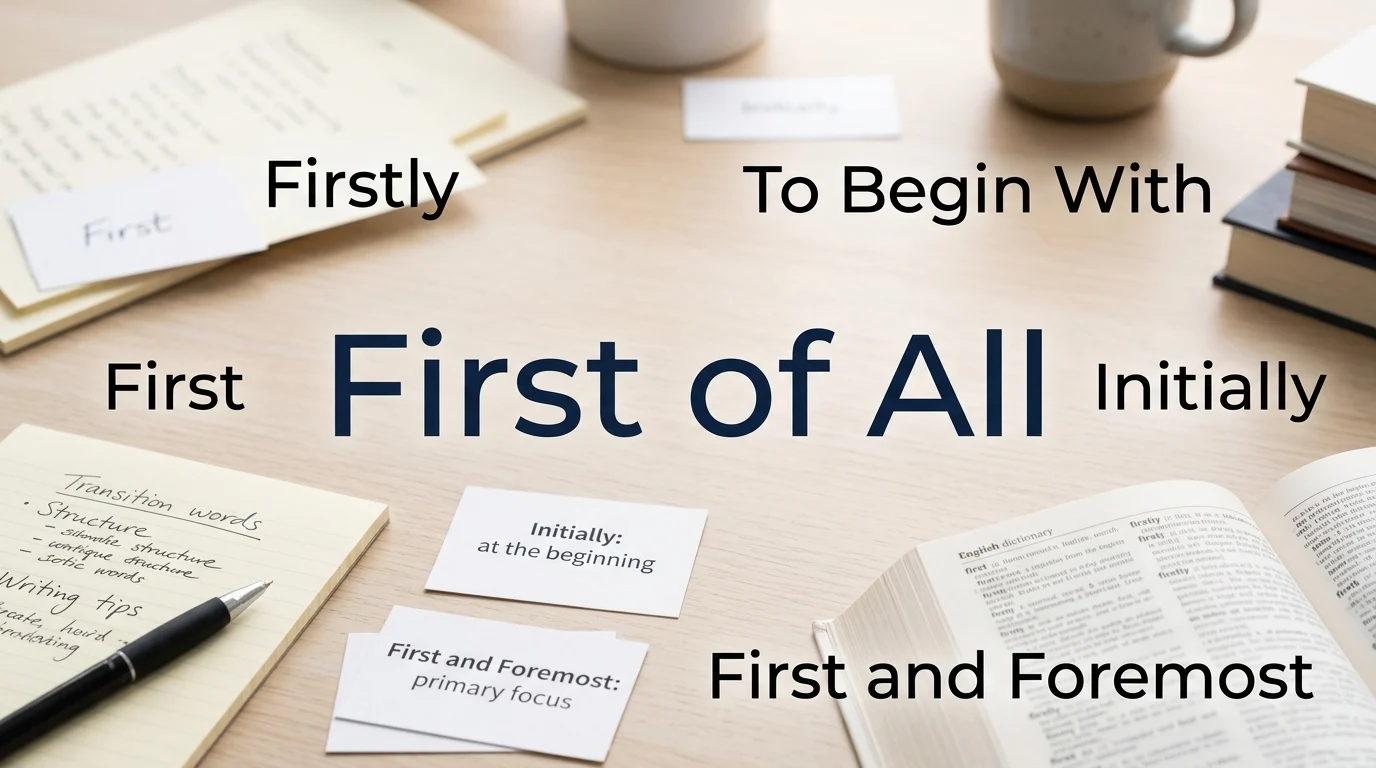
When you want to introduce the first point in a discussion, explanation, list, or argument, “first of all” is one of the most common phrases in English. It helps organize ideas and tells the reader or listener that the first point is about to be presented.
However, using “first of all” repeatedly can make your writing sound repetitive. Fortunately, English has many useful alternatives. Depending on the situation, you can use phrases such as firstly, to begin with, initially, before anything else, at the outset, for starters, and above all.
Understanding these alternatives can help students, ESL learners, writers, and content creators make their English more natural and varied. The important thing is to choose a synonym that matches the meaning and tone you want.
What Does “First of All” Mean?
“First of all” means before anything else or as the first point in a series of ideas.
It is commonly used when a person wants to introduce the first item, reason, instruction, or argument.
Simple definition
First of all = before anything else; as the first point
Examples
- First of all, we need to understand the problem.
- First of all, thank you for coming today.
- First of all, check that the computer is connected to the internet.
The phrase is especially useful in spoken English and informal-to-neutral writing. It creates a clear transition and helps readers follow the order of your ideas.
30 Synonyms and Alternatives for “First of All”
Not every alternative has exactly the same meaning. Some emphasize order, while others introduce a starting point, priority, or first consideration.
Here are 30 useful alternatives.
1. Firstly
Meaning: Used to introduce the first point in a series.
Example:
Firstly, we need to identify the main cause of the problem.
Best usage context: Formal writing, essays, reports, and presentations.
2. First
Meaning: Used to introduce the first thing that should be considered or done.
Example:
First, make sure you have all the necessary documents.
Best usage context: Everyday speech, instructions, and general writing.
3. To Begin With
Meaning: Used to introduce the starting point of an explanation or discussion.
Example:
To begin with, we should examine the basic facts.
Best usage context: Essays, explanations, discussions, and presentations.
4. To Start With
Meaning: Refers to the first thing in a process, explanation, or list.
Example:
To start with, let’s look at the advantages of this approach.
Best usage context: Conversational and informal English.
5. Initially
Meaning: At the beginning of a situation or process.
Example:
Initially, the team planned to complete the project in three months.
Best usage context: Formal and academic writing.
6. At First
Meaning: During the beginning stage of something.
Example:
At first, I found the new software difficult to use.
Best usage context: Stories, personal experiences, and descriptions of changing situations.
7. Before Anything Else
Meaning: Something should happen before other things.
Example:
Before anything else, we need to make sure everyone is safe.
Best usage context: Instructions, advice, and situations involving priority.
8. Before Everything Else
Meaning: Before considering or doing other things.
Example:
Before everything else, the organization must protect its customers.
Best usage context: Emphasizing an important first priority.
9. To Start
Meaning: Used to introduce the first step or idea.
Example:
To start, let’s review what we learned yesterday.
Best usage context: Conversation, teaching, meetings, and presentations.
10. For Starters
Meaning: As a beginning point or first example.
Example:
For starters, we don’t have enough information to make a decision.
Best usage context: Informal conversations and casual writing.
11. As a Starting Point
Meaning: Something used as the first step in an activity or discussion.
Example:
As a starting point, let’s examine the available evidence.
Best usage context: Academic, professional, and analytical writing.
12. At the Beginning
Meaning: During the first part of something.
Example:
At the beginning, the project seemed much easier than expected.
Best usage context: Narratives, explanations, and chronological descriptions.
13. At the Outset
Meaning: At the very beginning of a process, event, or situation.
Example:
At the outset, the company established clear goals for the project.
Best usage context: Formal and professional writing.
14. From the Start
Meaning: Beginning at the earliest stage.
Example:
From the start, everyone understood the importance of teamwork.
Best usage context: General, conversational, and narrative writing.
15. From the Beginning
Meaning: Starting from the earliest point of something.
Example:
From the beginning, she knew that the task would require careful planning.
Best usage context: Stories, explanations, and general writing.
16. At the Start
Meaning: At the beginning of an event, process, or activity.
Example:
At the start, we discussed the goals of the meeting.
Best usage context: Everyday and professional communication.
17. In the First Place
Meaning: Originally or as an initial reason or consideration.
Example:
Why did we choose this method in the first place?
Best usage context: Explaining an original reason rather than simply listing a first point.
18. First and Foremost
Meaning: More importantly than anything else; the highest priority.
Example:
First and foremost, we must consider the safety of the children.
Best usage context: Formal speech, persuasive writing, and situations involving priorities.
19. Above All
Meaning: More importantly than anything else.
Example:
Above all, remember to treat others with respect.
Best usage context: Advice, principles, speeches, and emphasis.
Important: “Above all” is not always a direct replacement for “first of all.” It focuses on importance, not simply chronological order.
20. Primarily
Meaning: Mainly or chiefly.
Example:
The program was primarily designed to help new students.
Best usage context: Formal writing when introducing the main purpose or reason.
21. Beforehand
Meaning: Before a particular event or action.
Example:
Please read the instructions beforehand.
Best usage context: Instructions and preparation.
Important: “Beforehand” means before something happens, so it cannot replace “first of all” in every sentence.
22. Prior to This
Meaning: Before the current event or situation.
Example:
Prior to this, the company had never operated internationally.
Best usage context: Formal and professional writing.
23. At the Beginning of the Process
Meaning: During the initial stage of a process.
Example:
At the beginning of the process, we collected information from several sources.
Best usage context: Reports, guides, academic writing, and technical explanations.
24. As a First Step
Meaning: The first action taken in a process.
Example:
As a first step, create an outline for your essay.
Best usage context: Instructions, tutorials, guides, and educational content.
25. As the First Step
Meaning: Identifies something as the first action or stage.
Example:
As the first step, students should read the question carefully.
Best usage context: Educational and instructional writing.
26. In the Beginning
Meaning: During the earliest period of something.
Example:
In the beginning, the small business had only two employees.
Best usage context: Stories, history, and descriptions of development.
27. At First Sight
Meaning: When something is seen for the first time.
Example:
At first sight, the problem appeared simple.
Best usage context: Describing an initial impression.
Important: This is not a general synonym for “first of all.” It specifically relates to an initial visual impression.
28. In the First Stage
Meaning: During the earliest stage of a process or development.
Example:
In the first stage, researchers collected basic information.
Best usage context: Processes, research, projects, and formal explanations.
29. First and Most Importantly
Meaning: Introduces the first point while emphasizing its importance.
Example:
First and most importantly, we need to understand what the customer actually needs.
Best usage context: Presentations, discussions, persuasive writing, and professional communication.
30. To Kick Things Off
Meaning: To begin an activity, event, discussion, or process.
Example:
To kick things off, let’s introduce everyone in the room.
Best usage context: Informal conversations, meetings, events, and presentations.
Quick Comparison: Which “First of All” Alternative Should You Use?
| Alternative | Main Meaning | Tone | Best For |
|---|---|---|---|
| First | First point or action | Neutral | Everyday English |
| Firstly | First point in a list | Formal | Essays and reports |
| To begin with | Starting point | Neutral | Explanations |
| To start with | First point | Casual | Conversation |
| Initially | At the beginning | Formal | Academic writing |
| At first | Early stage | Neutral | Experiences and stories |
| Before anything else | Highest initial priority | Neutral | Instructions |
| For starters | Beginning point | Informal | Conversation |
| At the outset | At the very beginning | Formal | Professional writing |
| First and foremost | Highest priority | Formal | Speeches and arguments |
| Above all | Most important consideration | Neutral/Formal | Advice and principles |
| As a first step | First action | Neutral | Guides and instructions |
| From the start | From the beginning | Neutral | Stories and explanations |
| In the first place | Original reason | Neutral | Explanations |
| To kick things off | Begin an activity | Informal | Meetings and events |
First of All vs. Firstly
These two expressions are closely related, but they are often used differently.
First of all is very common in everyday speech:
First of all, I’d like to thank everyone for coming.
Firstly is more common when organizing several formal points:
Firstly, we need to examine the evidence. Secondly, we need to consider the possible solutions.
For casual communication, first is often even more natural:
First, let’s look at the problem.
For academic writing, firstly can work well, although writers should not feel required to use “firstly” simply because they are writing formally.
First of All vs. First
In many situations, first is the simplest replacement for “first of all.”
First of all:
First of all, let’s discuss the main problem.
First:
First, let’s discuss the main problem.
Both sentences are grammatically correct. “First” is shorter and often sounds more direct.
For clear writing, especially in instructions, choosing the shorter option can make your sentence easier to read.
First of All vs. To Begin With
To begin with emphasizes the starting point of an explanation.
To begin with, we need to understand what caused the problem.
“First of all” can sound more like the beginning of a sequence, while “to begin with” can naturally introduce the initial idea or condition.
Both are useful, but the surrounding sentence should determine your choice.
First of All vs. First and Foremost
These expressions are not always interchangeable.
First of all generally introduces the first item.
First and foremost emphasizes the greatest importance or highest priority.
Compare:
First of all, let’s introduce the speakers.
This simply identifies the first action.
First and foremost, we must protect the children.
This emphasizes priority.
First of All vs. Above All
Above all means more importantly than anything else.
For example:
Above all, honesty is important in a successful relationship.
The sentence does not necessarily mean that honesty is the first item on a list. It means honesty is the most important consideration.
Therefore, use above all when you want to emphasize importance rather than sequence.
First of All Synonyms for Formal Writing
If you are writing an essay, report, research paper, or professional document, some alternatives are more suitable than others.
Consider:
- Firstly
- Initially
- At the outset
- As a starting point
- As a first step
- At the beginning
- In the first stage
- Primarily
Example
Instead of:
First of all, the study examines customer behavior.
You could write:
Initially, the study examines customer behavior.
Or:
As a starting point, the study examines customer behavior.
The best option depends on the exact meaning you want.
First of All Synonyms for Casual Conversation
In everyday English, natural and simple expressions usually work best.
Try:
- First
- To start
- To start with
- To begin with
- For starters
- From the start
- First of all
Example
Instead of:
First of all, let’s get some food.
You could say:
First, let’s get some food.
Or:
To start, let’s get some food.
Or, in a more casual situation:
For starters, let’s get some food.
First of All Synonyms for Essays
When writing an essay, you may need transitions that clearly organize your arguments.
Useful choices include:
Firstly
Firstly, education provides people with essential knowledge.
To begin with
To begin with, education can improve access to employment opportunities.
Initially
Initially, the discussion focuses on the economic effects of the policy.
First and foremost
First and foremost, every student needs access to a safe learning environment.
Remember that variety should serve clarity. You do not need to replace every occurrence of “first of all” simply to make your writing appear sophisticated.
First of All Synonyms for Presentations
Presentations often benefit from clear transitions.
Good choices include:
- First
- First of all
- To begin with
- To start with
- First and foremost
- To kick things off
- As a first step
Example
To begin with, let’s look at the current situation.
Then you can continue with:
Next, we’ll examine the main challenges.
And finally:
Finally, we’ll discuss possible solutions.
This creates an easy-to-follow structure for your audience.
How to Choose the Right Synonym for “First of All”
The best alternative depends on meaning, tone, and context.
For Simple and Natural English
Choose:
- First
- To start
- To begin with
- To start with
These are easy to understand and work well in everyday communication.
For Formal or Academic Writing
Choose:
- Firstly
- Initially
- At the outset
- As a starting point
- As a first step
These expressions can help organize formal explanations and arguments.
When You Mean “Most Important”
Choose:
- First and foremost
- Above all
- First and most importantly
These expressions emphasize priority or importance, not merely order.
When Talking About an Early Stage
Choose:
- At first
- In the beginning
- From the beginning
- From the start
- At the start
- Initially
These are especially useful when describing how something developed or changed over time.
For Informal Situations
Choose:
- For starters
- To kick things off
- To start with
- To start
These can make conversations and presentations sound more relaxed.
Common Mistakes When Using “First of All” Synonyms
1. Using “Above All” When You Only Mean “First”
Incorrect choice:
Above all, let’s open the meeting.
If you simply mean that opening the meeting is the first action, first or to begin with is clearer.
Better:
First, let’s open the meeting.
2. Using “At First” for Every Situation
“At first” usually describes an initial condition or experience, often followed by a change.
At first, I didn’t understand the lesson, but later it became easier.
It does not always work as a simple replacement for:
First of all, let’s discuss the lesson.
3. Confusing “Firstly” With “Initially”
“Firstly” normally introduces the first point in an organized sequence.
“Initially” means at the beginning of a situation or process.
Compare:
Firstly, we need to identify the problem.
and:
Initially, the project was expected to take six months.
The meanings overlap in some contexts, but they are not identical.
4. Overusing Formal Alternatives
Using words such as “at the outset” in every sentence can make simple writing unnecessarily formal.
For example:
At the outset, let’s have lunch.
This is grammatically possible, but:
First, let’s have lunch.
is much more natural.
Choose vocabulary according to the situation, not simply because it sounds sophisticated.
Examples of “First of All” in Different Contexts
In a classroom
First of all, read the instructions carefully.
Possible alternative:
First, read the instructions carefully.
In an essay
Firstly, social media has changed the way people communicate.
In a business meeting
To begin with, let’s review the goals for this quarter.
In a presentation
To start, I’d like to explain the main objective.
In an instruction guide
As a first step, create an account.
When emphasizing priority
First and foremost, customer safety must be protected.
In casual conversation
For starters, we need a better plan.
Related Words and Phrases
When learning alternatives to “first of all,” it is also useful to understand related transition words.
Sequence words
- First
- Firstly
- Second
- Secondly
- Next
- Then
- Finally
- Lastly
Beginning expressions
- To begin with
- To start with
- Initially
- At the outset
- In the beginning
- From the start
Priority expressions
- Above all
- First and foremost
- Most importantly
- Primarily
These expressions help writers connect ideas smoothly and make longer texts easier to follow.
Frequently Asked Questions About “First of All” Synonyms
What is the best synonym for “first of all”?
First is often the simplest and most natural alternative. In formal writing, firstly or initially may be appropriate depending on the sentence.
Is “firstly” the same as “first of all”?
They are similar when introducing the first point in a sequence. However, “first of all” is particularly common in everyday speech, while “firstly” is often associated with structured lists or formal writing.
What is a formal synonym for “first of all”?
Useful formal alternatives include firstly, initially, at the outset, as a starting point, and as a first step.
What is an informal synonym for “first of all”?
Depending on the context, you can use first, to start, to start with, for starters, or to kick things off.
Can I use “above all” instead of “first of all”?
Not always. “Above all” emphasizes the greatest importance, while “first of all” usually introduces the first point or action.
Is “to begin with” a synonym for “first of all”?
Yes, in many contexts. “To begin with” is especially useful when introducing the first part of an explanation, argument, or discussion.
What can I use instead of “first of all” in an essay?
Depending on your sentence, try firstly, initially, to begin with, as a starting point, or as a first step.
Final Thoughts on First of All Synonyms
Learning synonyms for “first of all” is not simply about replacing one phrase with another. The real goal is to understand the small differences between expressions and choose the one that communicates your meaning most clearly.
For everyday English, first, to begin with, and to start with are simple and natural choices. For formal writing, firstly, initially, and at the outset can help organize ideas.
When you want to emphasize importance rather than order, expressions such as first and foremost and above all may be more appropriate.
The key is to consider context, tone, and meaning before choosing a synonym. A good writer does not use complicated vocabulary simply to sound sophisticated. Instead, a good writer chooses the clearest expression for the reader and situation.
By understanding these 30 alternatives, you can make your essays, conversations, presentations, instructions, and professional writing more varied, precise, and natural.

I am Joel Michael, an enthusiastic language writer and synonym enthusiast. I enjoy exploring words, finding their meanings, and discovering useful alternatives. I create clear, helpful content to make vocabulary learning simple and enjoyable for every reader.