If you are looking for cytoplasm synonyms, it is important to understand that cytoplasm is a specific biological term. Unlike ordinary words such as “happy” or “large,” it does not have many perfect one-word synonyms.
However, biology uses several closely related terms to describe the cytoplasm, its components, and the material surrounding the cell nucleus.
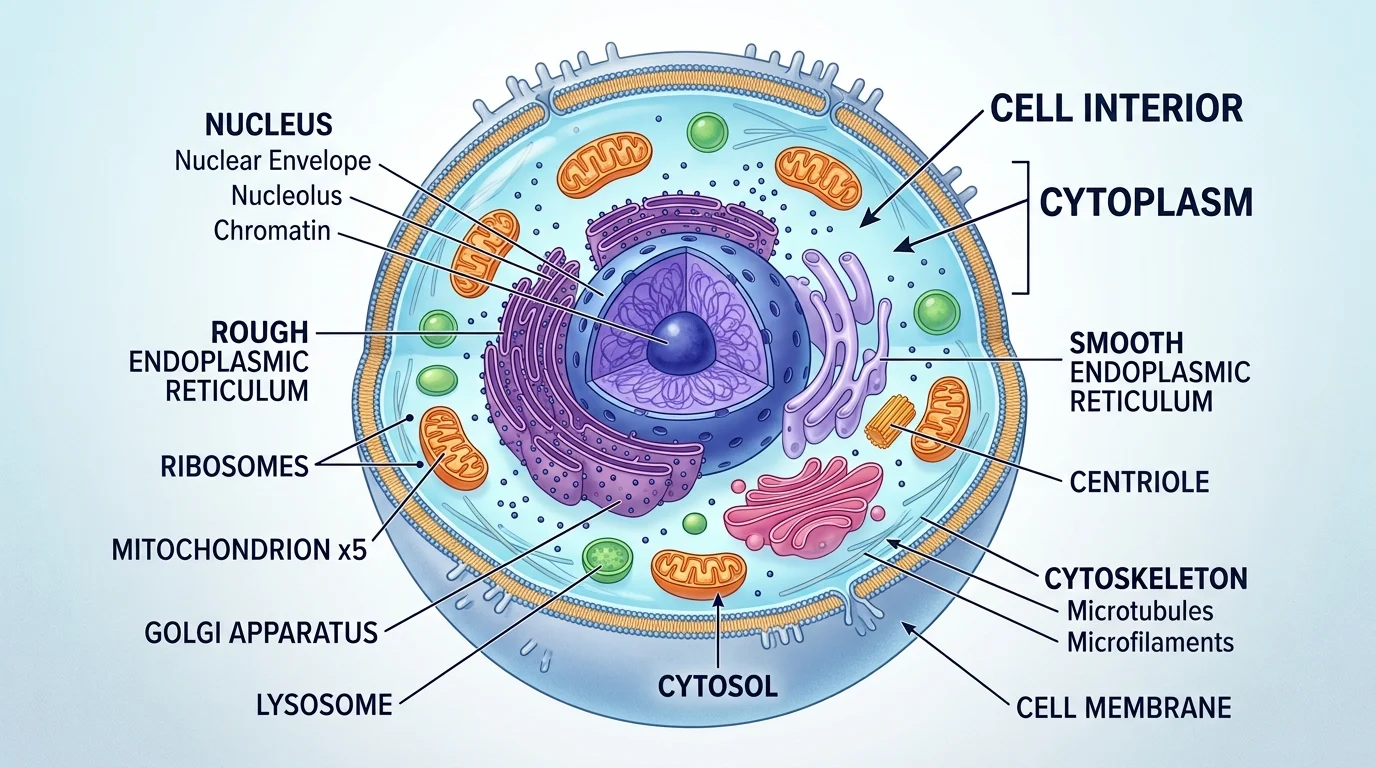
The cytoplasm is the material inside a cell but outside the nucleus. It includes the cytosol, organelles, and other cellular components. It plays an important role in supporting cell structure, transporting materials, and providing a place where many chemical reactions occur.
This guide explains 30 useful terms related to cytoplasm in simple English. It is designed for students, ESL learners, writers, and anyone studying biology who wants to understand the difference between cytoplasm, cytosol, cell contents, and other related vocabulary.
What Does Cytoplasm Mean?
Cytoplasm is the living material inside a cell that lies outside the nucleus.
In simple terms, imagine a cell as a small room. The cell membrane is the outer wall, the nucleus is like a control center, and the cytoplasm is the material filling the space between them.
Cytoplasm contains a watery substance called cytosol as well as structures such as mitochondria, ribosomes, the endoplasmic reticulum, and other organelles.
Simple definition
Cytoplasm: The material inside a cell and outside the nucleus.
Example sentence
The cytoplasm contains many structures that help the cell perform its functions.
Important distinction: Cytoplasm vs. Cytosol
These two words are often confused.
Cytosol refers mainly to the fluid portion of the cytoplasm.
Cytoplasm is broader. It includes the cytosol plus the organelles and other non-nuclear components within the cell.
Therefore, cytosol is part of the cytoplasm, but the two terms are not exact synonyms.
30 Cytoplasm Synonyms and Related Terms
Below are 30 terms that are useful when discussing cytoplasm. Some are close scientific alternatives, while others describe specific parts, contents, or concepts associated with cytoplasm.
1. Cytosol
Meaning: The fluid portion of the cell located inside the cell membrane and outside the nucleus.
Example:
Many important metabolic reactions take place in the cytosol.
Best usage context: Use cytosol when referring specifically to the liquid component of the cytoplasm.
2. Intracellular Fluid
Meaning: Fluid found inside a cell.
Example:
Nutrients and ions can move through intracellular fluid.
Best usage context: Useful in biology and physiology when discussing fluid inside cells.
3. Cell Contents
Meaning: The materials and structures contained within a cell.
Example:
The cell membrane controls the movement of substances into and out of the cell contents.
Best usage context: A broad, beginner friendly expression rather than a precise synonym for cytoplasm.
4. Cellular Contents
Meaning: The substances and structures located inside a cell.
Example:
The researchers examined the cellular contents under a microscope.
Best usage context: Useful in general scientific writing.
5. Intracellular Material
Meaning: Material located inside a cell.
Example:
The dye helped scientists identify intracellular material.
Best usage context: Formal scientific or laboratory writing.
6. Cell Interior
Meaning: The inside area or material of a cell.
Example:
Several organelles are located within the cell interior.
Best usage context: Simple explanations for beginners.
7. Cellular Interior
Meaning: The internal part of a cell.
Example:
The cellular interior contains specialized structures.
Best usage context: Educational and descriptive biology writing.
8. Protoplasm
Meaning: The living material of a cell, traditionally including the cytoplasm and nucleus.
Example:
Early biologists used the term protoplasm to describe living cell material.
Best usage context: Historical biology or older scientific terminology. It should not automatically be treated as an exact modern synonym for cytoplasm.
9. Cell Protoplasm
Meaning: A traditional term for the living substance of a cell.
Example:
The movement of cell protoplasm was studied in early cell biology.
Best usage context: Historical, educational, or older biological descriptions.
10. Cytoplasmic Material
Meaning: Material that forms or is located within the cytoplasm.
Example:
The researchers observed changes in the cytoplasmic material.
Best usage context: Scientific descriptions of material within cells.
11. Cytoplasmic Matrix
Meaning: The substance or internal medium in which cellular structures are suspended.
Example:
Organelles are surrounded by the cytoplasmic matrix.
Best usage context: Technical biology and cell-structure discussions.
12. Cytoplasmic Ground Substance
Meaning: The basic substance surrounding structures within the cytoplasm.
Example:
The cytoplasmic ground substance provides a medium for cellular activities.
Best usage context: Detailed or technical descriptions of cell structure.
13. Cytoplasmic Fluid
Meaning: The fluid component associated with the cytoplasm.
Example:
Molecules can move through the cytoplasmic fluid.
Best usage context: Informal or educational descriptions; use cytosol when greater scientific precision is needed.
14. Cytoplasmic Substance
Meaning: Material present in the cytoplasm.
Example:
The staining method revealed differences in cytoplasmic substance.
Best usage context: Microscopy and biological descriptions.
15. Cytoplasmic Contents
Meaning: The materials and structures found within the cytoplasm.
Example:
The cell’s cytoplasmic contents changed during the experiment.
Best usage context: General scientific and laboratory writing.
16. Intracellular Substance
Meaning: Any substance located within a cell.
Example:
The researchers measured the concentration of intracellular substances.
Best usage context: Scientific writing when discussing substances inside cells generally.
17. Intracellular Medium
Meaning: The internal environment in which cellular components exist.
Example:
Enzymes function within the intracellular medium.
Best usage context: Physiology and cell biology explanations.
18. Cellular Medium
Meaning: The internal environment or substance surrounding cellular components.
Example:
Changes in the cellular medium can affect enzyme activity.
Best usage context: General biological descriptions.
19. Cell Matrix
Meaning: A substance or internal framework associated with the structure of a cell.
Example:
Proteins interact with components of the cell matrix.
Best usage context: Use carefully because cell matrix can have different meanings depending on the biological context.
20. Cytoplasmic Environment
Meaning: The chemical and physical conditions within the cytoplasm.
Example:
Enzymes require a suitable cytoplasmic environment to function effectively.
Best usage context: Cell biology and discussions of cellular reactions.
21. Cytoplasmic Region
Meaning: An area of a cell occupied by or associated with cytoplasm.
Example:
The protein was found in a specific cytoplasmic region.
Best usage context: Microscopy and cellular localization.
22. Cytoplasmic Compartment
Meaning: A functional or structural area within the cytoplasm.
Example:
The molecule accumulates in a particular cytoplasmic compartment.
Best usage context: Advanced cell biology.
23. Cytoplasmic Space
Meaning: The internal space occupied by cytoplasmic material.
Example:
Vesicles move through the cytoplasmic space.
Best usage context: General descriptions of intracellular organization.
24. Cytoplasmic Component
Meaning: A structure or substance that forms part of the cytoplasm.
Example:
Ribosomes are important cytoplasmic components.
Best usage context: Scientific writing when discussing individual parts of cytoplasm.
25. Cellular Component
Meaning: A structural or functional part of a cell.
Example:
The mitochondrion is an important cellular component.
Best usage context: Broad biology terminology. It is not a direct synonym for cytoplasm.
26. Cell Substance
Meaning: Material found within a cell.
Example:
The microscope revealed changes in the cell substance.
Best usage context: General or educational descriptions rather than precise modern terminology.
27. Living Cell Material
Meaning: Living material that makes up or exists within a cell.
Example:
The movement of living cell material can sometimes be observed under a microscope.
Best usage context: Beginner friendly explanations.
28. Non Nuclear Cell Material
Meaning: Cell material located outside the nucleus.
Example:
The experiment focused on non-nuclear cell material.
Best usage context: Explanations that need to distinguish cytoplasm from the nucleus.
29. Non-Nuclear Cytoplasmic Material
Meaning: Material within the cell that is outside the nucleus and associated with the cytoplasm.
Example:
The researchers analyzed non nuclear cytoplasmic material separately from nuclear material.
Best usage context: Technical or explanatory scientific writing.
30. Cytoplasmic Fraction
Meaning: The portion of cellular material obtained from the cytoplasm during laboratory separation.
Example:
The scientists analyzed the cytoplasmic fraction for specific proteins.
Best usage context: Laboratory research, biochemistry, and cell fractionation.
Cytoplasm Synonyms: Quick Comparison Table
Because cytoplasm has no large set of perfect synonyms, choosing the right related term depends on what you are trying to describe.
| Term | What It Refers To | Best Context |
|---|---|---|
| Cytoplasm | Material inside the cell outside the nucleus | General cell biology |
| Cytosol | Fluid portion of cytoplasm | Precise cell biology |
| Intracellular fluid | Fluid inside cells | Physiology |
| Cell contents | Materials inside a cell | Beginner explanations |
| Cellular contents | Structures and substances inside cells | General science |
| Intracellular material | Material inside a cell | Scientific writing |
| Cell interior | Inside of a cell | Beginner-friendly writing |
| Protoplasm | Traditional term for living cell material | Historical biology |
| Cytoplasmic material | Material associated with cytoplasm | Scientific writing |
| Cytoplasmic matrix | Internal medium surrounding structures | Technical biology |
| Cytoplasmic fluid | Fluid associated with cytoplasm | Educational descriptions |
| Cytoplasmic contents | Materials and structures in cytoplasm | Laboratory writing |
| Cytoplasmic component | Individual part of cytoplasm | Cell biology |
| Cellular component | Part of a cell | General biology |
| Cytoplasmic environment | Conditions inside cytoplasm | Biochemistry |
| Cytoplasmic region | Specific area of cytoplasm | Microscopy |
| Cytoplasmic compartment | Functional area within cytoplasm | Advanced biology |
| Cytoplasmic space | Space occupied by cytoplasmic material | Cell structure |
| Cell substance | Material within a cell | General descriptions |
| Cytoplasmic fraction | Lab separated cytoplasmic material | Research |
Are These Really Synonyms for Cytoplasm?
This is an important question.
In everyday vocabulary, a synonym usually means a word that can replace another word without significantly changing the meaning. For example, big and large are close synonyms.
The situation is different with cytoplasm.
Many terms associated with cytoplasm have narrower or broader meanings. For example:
- Cytosol is only the fluid part of the cytoplasm.
- Protoplasm is an older term with a broader traditional meaning.
- Cell contents can include the nucleus and therefore may be broader than cytoplasm.
- Cytoplasmic component usually refers to one part of the cytoplasm rather than the whole.
- Intracellular material can refer to many different materials inside a cell.
For scientific accuracy, it is better to call these related terms, near-equivalents, or associated vocabulary rather than claiming that all 30 are perfect synonyms.
Cytoplasm vs. Cytosol
The most important distinction to remember is between cytoplasm and cytosol.
Cytoplasm
Cytoplasm includes the cytosol and the structures located outside the nucleus.
Cytosol
Cytosol is the fluid portion of the cytoplasm.
A simple way to remember the difference is:
Cytoplasm = cytosol + organelles and other non-nuclear components
This distinction is especially important in biology exams, laboratory reports, and scientific writing.
Cytoplasm vs. Protoplasm
Protoplasm is an older biological term.
Traditionally, it referred to the living substance of a cell and could include both the cytoplasm and the material of the nucleus.
Modern biology generally uses more specific terms such as cytoplasm, cytosol, and nucleoplasm.
Therefore, replacing cytoplasm with protoplasm may make a sentence scientifically less precise.
Cytoplasm vs. Cell Contents
The phrase cell contents is broader and less technical.
For example, if you say:
The cell contains several important structures.
You are discussing the cell contents generally.
But if you say:
The mitochondria are suspended within the cytoplasm.
You are referring specifically to the region outside the nucleus.
For school level explanations, cell contents may be useful. For scientific precision, cytoplasm is usually the better term.
How to Choose the Right Cytoplasm-Related Term
Choosing the right term depends on exactly what you mean.
When You Mean the Whole Region Outside the Nucleus
Use:
- Cytoplasm
- Cytoplasmic material
- Cytoplasmic contents
Example:
The cytoplasm contains many organelles.
When You Mean Only the Fluid
Use:
- Cytosol
- Intracellular fluid
- Cytoplasmic fluid
Example:
Many metabolic reactions occur in the cytosol.
For precise biology writing, cytosol is generally preferable to the broader phrase cytoplasmic fluid.
When You Want a Beginner-Friendly Expression
Use:
- Cell interior
- Cellular interior
- Cell contents
- Cellular contents
Example:
The cell interior contains specialized structures called organelles.
These terms are easy to understand but may be less precise than standard scientific terminology.
When Writing a Scientific or Laboratory Report
Use:
- Cytoplasm
- Cytosol
- Cytoplasmic material
- Cytoplasmic fraction
- Intracellular material
- Cytoplasmic component
These terms allow you to describe specific biological materials more accurately.
When Discussing Older Biology Terminology
Use:
- Protoplasm
- Cell protoplasm
- Cell substance
These terms may appear in older textbooks or historical scientific literature.
Examples of Cytoplasm in Sentences
Understanding how the word is used can make it easier to recognize appropriate alternatives.
Example 1: Basic biology
The cytoplasm surrounds the organelles inside the cell.
Example 2: Cell biology
Several metabolic reactions occur in the cytoplasm.
Example 3: Cytosol
The enzyme is dissolved in the cytosol.
Example 4: Laboratory research
The researchers isolated the cytoplasmic fraction from the cells.
Example 5: Microscopy
The stained cytoplasmic material was visible under the microscope.
Common Mistakes When Using Cytoplasm Synonyms
Mistake 1: Treating Cytosol and Cytoplasm as Identical
They are closely related, but they are not exactly the same.
Better: Use cytosol when you specifically mean the fluid component.
Mistake 2: Using Protoplasm as a Modern Exact Synonym
Protoplasm is an older term and can refer to living cell material more broadly.
Better: Use cytoplasm for modern general cell biology.
Mistake 3: Calling Every Cell Component Cytoplasm
Organelles such as mitochondria and ribosomes are located in or associated with the cytoplasm, but an individual organelle is not itself synonymous with cytoplasm.
Better: Say that an organelle is a cytoplasmic component.
Mistake 4: Using “Cell Contents” When Precision Matters
Cell contents may refer broadly to everything inside the cell.
Better: Use cytoplasm when you specifically mean the material outside the nucleus.
Why Understanding Cytoplasm Vocabulary Matters
Learning related biological terms is useful for more than memorizing definitions.
It helps students understand textbooks, laboratory instructions, research papers, diagrams, and exam questions.
It also prevents subtle mistakes. For example, knowing the difference between cytoplasm and cytosol can make a biology answer much more precise.
For ESL learners, learning these related terms also makes scientific English easier to understand because biology texts often use several words to describe closely connected concepts.
Frequently Asked Questions About Cytoplasm Synonyms
What is another word for cytoplasm?
There is no single perfect modern synonym for cytoplasm. Cytosol is closely related but refers specifically to the fluid portion of the cytoplasm. Terms such as cytoplasmic material and cell contents can sometimes be used depending on context.
Is cytosol a synonym for cytoplasm?
No. Cytosol is a component of cytoplasm, not a complete synonym. Cytoplasm includes cytosol along with organelles and other non-nuclear material.
Is protoplasm the same as cytoplasm?
Not exactly. Protoplasm is a traditional term that generally refers to the living substance of a cell and can include material associated with both the nucleus and cytoplasm.
What is the simplest way to define cytoplasm?
Cytoplasm is the material inside a cell but outside its nucleus.
What is the difference between cytoplasm and cell contents?
Cell contents is a broad expression for material inside a cell. Cytoplasm specifically refers to the material outside the nucleus.
What is the scientific synonym for cytoplasm?
There is not one universally interchangeable scientific synonym. Cytosol is the closest commonly encountered related term, but it refers only to the fluid part of the cytoplasm.
Can I use “cell interior” instead of cytoplasm?
You can use cell interior in a simple explanation, but it is broader and less precise. In scientific writing, cytoplasm is usually the better choice.
Final Takeaway: Understanding Cytoplasm Synonyms
When searching for cytoplasm synonyms, remember that biology does not provide 30 interchangeable words for this term. Instead, it has many closely related expressions that describe different aspects of the material, fluid, structures, and environment inside a cell.
The most important term to remember is cytosol. It refers specifically to the fluid portion of the cytoplasm. Cytoplasm is broader and includes the cytosol together with organelles and other non nuclear components.
Terms such as cell contents, intracellular material, cytoplasmic material, and cell interior can be useful in appropriate contexts, while protoplasm is mainly associated with traditional or historical biological terminology.
For accurate modern biology writing, choose the term that matches the exact concept you want to describe. Using precise vocabulary will make your essays, laboratory reports, study notes, and scientific explanations clearer and more reliable.

I am Derek Thomas, a passionate word enthusiast and writer. I enjoy exploring synonyms, expanding vocabulary, and helping readers find clear, accurate, and meaningful words for better writing.