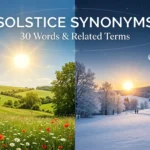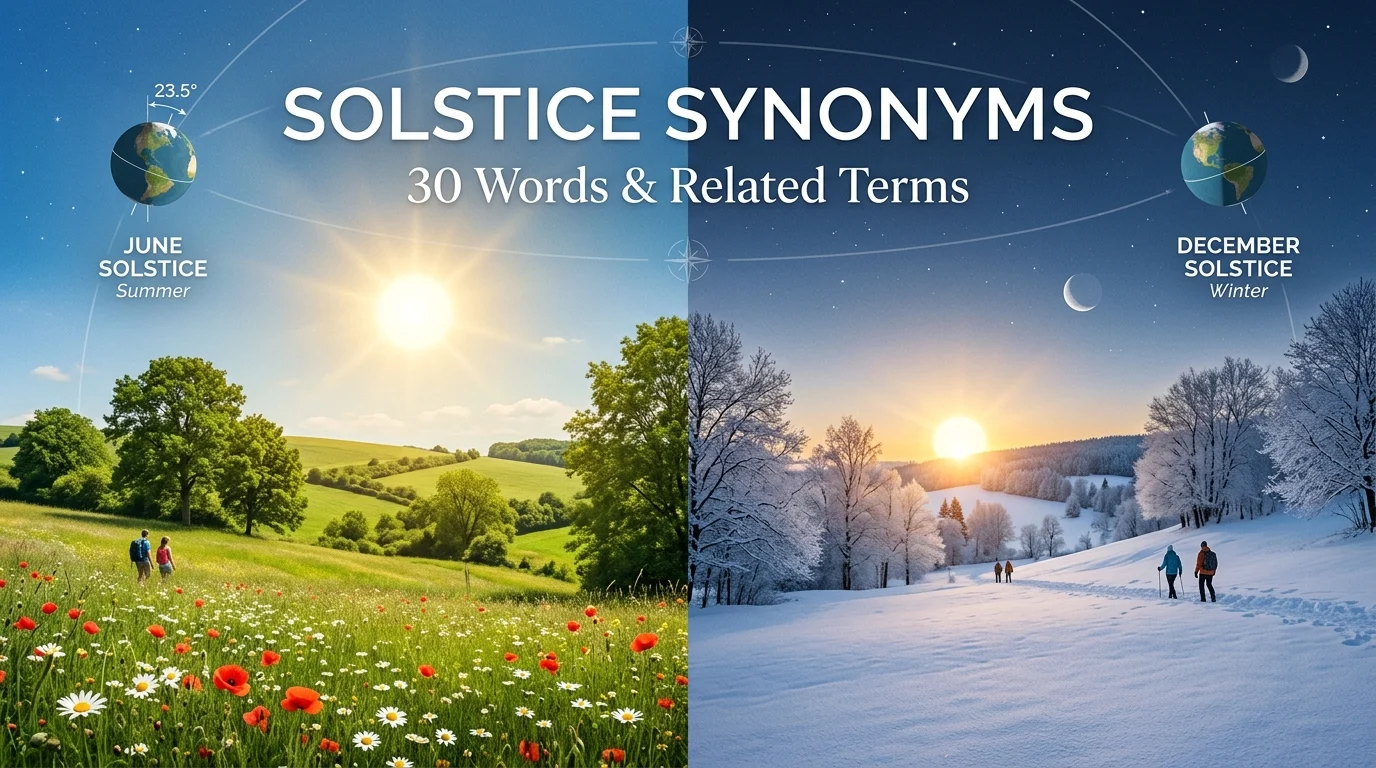
The word solstice refers to one of the two points in the year when the Sun reaches its northernmost or southernmost position relative to Earth’s equator.
These events mark the longest day and shortest night or the shortest day and longest night of the year, depending on the hemisphere. The two events are known as the summer solstice and winter solstice.
Finding exact solstice synonyms can be slightly challenging because solstice is a specific astronomical term. Unlike simple words such as “happy” or “large,” it does not have dozens of perfect one word replacements.
However, there are many related expressions, descriptive phrases, and astronomical terms that can be used when writing about the solstice.
This guide explains 30 useful solstice synonyms and related terms in simple English. It is designed for students, ESL learners, writers, bloggers, and content creators who want to understand the word clearly and choose the right expression for different situations.
What Does Solstice Mean?
A solstice is an astronomical event that happens twice each year.
The June solstice occurs when one hemisphere is tilted most strongly toward the Sun. In the Northern Hemisphere, this is the summer solstice, while in the Southern Hemisphere it is the winter solstice.
The December solstice produces the opposite situation. It is the winter solstice in the Northern Hemisphere and the summer solstice in the Southern Hemisphere.
In simple English:
Solstice means one of the two times each year when the Sun reaches its greatest distance north or south of the equator.
The word comes from Latin roots associated with the idea of the Sun appearing to stand still before changing direction in its apparent seasonal movement.
Are There Exact Synonyms for Solstice?
Not many.
Solstice is a precise astronomical word, so most alternatives are not perfect synonyms. Words such as sun-turning point, seasonal turning point, and solar turning point can describe the idea, but they may be less technically precise.
Other expressions, such as summer solstice, winter solstice, longest day, and shortest day, refer to specific aspects or types of a solstice.
For accurate writing, it is usually best to keep the word solstice and use related terms to avoid repetition.
30 Solstice Synonyms and Related Terms
Below are 30 useful words and phrases connected with solstice. Each entry includes a simple meaning, example sentence, and the best context for using it.
1. Solar Turning Point
Meaning: A point in the year when the Sun reaches an extreme position in its apparent annual movement.
Example:
The winter solstice is often described as a solar turning point.
Best usage:
Useful in general educational or explanatory writing.
2. Sun-Turning Point
Meaning: A point when the Sun appears to stop moving farther north or south and begins moving back in the opposite direction.
Example:
Ancient cultures often viewed the solstice as a sun-turning point.
Best usage:
Good for simple explanations and historical writing.
3. Seasonal Turning Point
Meaning: An important point marking a change from one seasonal phase to another.
Example:
The solstice is an important seasonal turning point.
Best usage:
Useful in general articles, blogs, and educational content.
4. Astronomical Turning Point
Meaning: An important point in the astronomical cycle that marks a seasonal change.
Example:
The June solstice is an important astronomical turning point.
Best usage:
Best for educational and astronomy-related writing.
5. Solar Event
Meaning: An event involving the position or movement of the Sun.
Example:
The solstice is a major solar event observed around the world.
Best usage:
Useful when writing about astronomy in simple language.
6. Astronomical Event
Meaning: A naturally occurring event involving objects or movements in space.
Example:
The winter solstice is an important astronomical event.
Best usage:
A broad term suitable for school assignments and science articles.
7. Celestial Event
Meaning: An event involving objects or movements in the sky.
Example:
People gathered to celebrate the celestial event.
Best usage:
Useful in literary, educational, and astronomy writing.
8. Seasonal Marker
Meaning: Something that identifies an important point in the seasonal cycle.
Example:
The summer solstice serves as an important seasonal marker.
Best usage:
Good for articles about seasons, calendars, and nature.
9. Solar Marker
Meaning: An event or point that helps identify a stage in the Sun’s annual cycle.
Example:
The solstice acts as a solar marker in the yearly calendar.
Best usage:
Useful in explanatory and astronomy focused writing.
10. Seasonal Milestone
Meaning: An important point reached during the yearly cycle of seasons.
Example:
The winter solstice is a significant seasonal milestone.
Best usage:
Good for blogs and general interest articles.
11. Summer Solstice
Meaning: The solstice associated with the longest day of the year in a particular hemisphere.
Example:
The summer solstice brings the longest daylight period of the year to the Northern Hemisphere.
Best usage:
Use when specifically discussing the June solstice or the summer season.
12. Winter Solstice
Meaning: The solstice associated with the shortest day of the year in a particular hemisphere.
Example:
Many cultures have traditions connected with the winter solstice.
Best usage:
Best when discussing the December solstice or winter traditions.
13. June Solstice
Meaning: The solstice that occurs around June.
Example:
The June solstice marks summer in the Northern Hemisphere.
Best usage:
Useful when you want a hemisphere neutral astronomical term.
14. December Solstice
Meaning: The solstice that occurs around December.
Example:
The December solstice marks the beginning of astronomical winter in the Northern Hemisphere.
Best usage:
Useful for scientifically precise writing.
15. Longest Day
Meaning: The day with the greatest amount of daylight in a particular hemisphere.
Example:
Many people call the summer solstice the longest day of the year.
Best usage:
Use for accessible, everyday explanations.
Note: The phrase describes a feature of the summer solstice rather than being an exact synonym for solstice.
16. Shortest Day
Meaning: The day with the least amount of daylight in a particular hemisphere.
Example:
The shortest day occurs around the winter solstice.
Best usage:
Good for simple explanations of the winter solstice.
17. Longest Day of the Year
Meaning: The day that receives the most daylight in a particular hemisphere.
Example:
Families gathered outdoors to enjoy the longest day of the year.
Best usage:
Ideal for lifestyle, travel, and seasonal content.
18. Shortest Day of the Year
Meaning: The day that receives the least daylight in a particular hemisphere.
Example:
The shortest day of the year occurs around the winter solstice.
Best usage:
Useful in educational and seasonal writing.
19. Longest Night
Meaning: The night with the greatest duration during the annual cycle.
Example:
The winter solstice is associated with the longest night of the year.
Best usage:
Good for winter themed, cultural, and descriptive writing.
20. Shortest Night
Meaning: The night with the least duration during the annual cycle.
Example:
The summer solstice is associated with the shortest night of the year.
Best usage:
Useful when describing summer daylight patterns.
21. Solar Extremum
Meaning: A point representing an extreme position in a solar cycle.
Example:
The solstice represents a solar extremum in the Sun’s apparent annual path.
Best usage:
Suitable for technical or advanced astronomical writing.
22. Solar Maximum Position
Meaning: A position where the Sun reaches its greatest apparent northern or southern distance from the celestial equator.
Example:
At the solstice, the Sun reaches its maximum northern or southern position relative to the celestial equator.
Best usage:
Best for scientific explanations.
23. Sun’s Extreme Position
Meaning: The Sun’s farthest apparent position north or south during its yearly cycle.
Example:
The solstice occurs when the Sun reaches an extreme position in its annual apparent motion.
Best usage:
Useful when explaining astronomy to beginners.
24. Seasonal Transition
Meaning: A change from one seasonal period to another.
Example:
The solstice is often associated with an important seasonal transition.
Best usage:
Useful for general audiences and educational content.
Note: This is a related expression, not an exact synonym.
25. Seasonal Changeover
Meaning: The change from one season to another.
Example:
The solstice has traditionally been viewed as a seasonal changeover.
Best usage:
Best for informal or general writing.
26. Annual Solar Cycle Marker
Meaning: An event that identifies an important stage in the yearly cycle of the Sun.
Example:
The solstice is an important annual solar cycle marker.
Best usage:
Useful in educational and astronomy related explanations.
27. Sun’s Turning
Meaning: A descriptive phrase for the apparent change in the Sun’s seasonal movement around the solstice.
Example:
The festival celebrates the Sun’s turning after the winter solstice.
Best usage:
Good for historical, cultural, and poetic writing.
28. Seasonal Peak
Meaning: A point representing an important extreme or high point in the seasonal cycle.
Example:
The summer solstice can be described as a seasonal peak of daylight.
Best usage:
Useful for creative and general-interest writing.
Note: This phrase does not technically mean solstice.
29. Solar Milestone
Meaning: An important point in the Sun’s yearly cycle.
Example:
The winter solstice represents an important solar milestone.
Best usage:
Good for blogs, educational articles, and accessible science writing.
30. Solstitial Point
Meaning: A technical term referring to either of the two points on the celestial sphere where the Sun reaches its maximum north or south declination.
Example:
The Sun reaches a solstitial point twice during its annual cycle.
Best usage:
Best for advanced astronomy and technical writing.
Solstice Synonyms Comparison Table
Because solstice is a technical astronomical term, it helps to understand which alternatives are exact, specific, descriptive, or simply related.
| Word or Phrase | Type | Simple Meaning | Best Use |
|---|---|---|---|
| Solstice | Exact term | One of two annual astronomical events | Scientific and general writing |
| Summer solstice | Specific term | Solstice associated with summer in a hemisphere | Seasonal writing |
| Winter solstice | Specific term | Solstice associated with winter in a hemisphere | Seasonal writing |
| June solstice | Specific term | Solstice occurring around June | Precise astronomy writing |
| December solstice | Specific term | Solstice occurring around December | Precise astronomy writing |
| Longest day | Related phrase | Day with the most daylight | Beginner-friendly writing |
| Shortest day | Related phrase | Day with the least daylight | Beginner-friendly writing |
| Longest night | Related phrase | Night with the greatest duration | Winter-related writing |
| Shortest night | Related phrase | Night with the least duration | Summer-related writing |
| Seasonal marker | Related term | Point marking a stage of the season | General writing |
| Solar event | Related term | Event involving the Sun | Astronomy writing |
| Celestial event | Related term | Event involving the sky or celestial bodies | General astronomy |
| Seasonal milestone | Related phrase | Important point in the seasonal cycle | Blogs and articles |
| Solar milestone | Related phrase | Important point in the solar cycle | Educational writing |
| Solstitial point | Technical term | One of the two astronomical solstice points | Advanced astronomy |
Direct Synonyms vs. Related Terms
One of the most important things to understand about solstice synonyms is that many commonly suggested alternatives are not technically interchangeable.
Exact or nearly exact alternatives
These can sometimes replace solstice depending on context:
- Solstitial point
- Solar turning point
- Sun turning point
- Astronomical turning point
Specific types of solstice
These refer to particular solstices:
- Summer solstice
- Winter solstice
- June solstice
- December solstice
Descriptive expressions
These explain what happens around a solstice:
- Longest day
- Shortest day
- Longest night
- Shortest night
- Seasonal turning point
- Seasonal marker
- Solar milestone
Using this distinction makes your writing more accurate and natural.
How to Choose the Right Solstice Synonym
Choosing an alternative depends on your audience and the purpose of your sentence.
For Scientific Writing
Use precise terms such as:
- Solstice
- June solstice
- December solstice
- Solstitial point
- Astronomical event
- Solar turning point
Example:
The June solstice occurs when the Sun reaches its maximum northern declination.
This style is appropriate for science textbooks, research-based articles, and educational websites.
For Beginner Friendly Writing
Choose familiar phrases such as:
- Longest day
- Shortest day
- Longest night
- Shortest night
- Seasonal marker
- Seasonal milestone
Example:
The summer solstice is often called the longest day of the year because it brings the greatest amount of daylight to that hemisphere.
These expressions make astronomy easier for ESL learners and younger students to understand.
For General Blog Writing
You can use descriptive expressions such as:
- Seasonal turning point
- Solar event
- Solar milestone
- Seasonal changeover
- Celestial event
Example:
The winter solstice is an important seasonal turning point celebrated in many parts of the world.
These phrases help you avoid repeating solstice while keeping the meaning clear.
For Historical and Cultural Writing
Consider expressions such as:
- Sun turning point
- Sun’s turning
- Seasonal milestone
- Celestial event
- Seasonal marker
Example:
Ancient communities often treated the winter solstice as an important seasonal milestone.
These expressions work particularly well when discussing traditional celebrations and historical interpretations.
Solstice Synonyms for Different Writing Situations
If you want to sound scientific:
Use solstice, June solstice, December solstice, or solstitial point.
If you want to sound simple:
Use longest day, shortest day, longest night, or shortest night, depending on what you are describing.
If you want to avoid repetition:
Try seasonal marker, solar event, seasonal milestone, or solar milestone.
If you are writing about culture:
Use seasonal turning point, sun’s turning, or celestial event where appropriate.
If you are writing for children or ESL learners:
Prefer familiar descriptions such as longest day of the year and shortest day of the year.
Examples of Solstice in Sentences
Understanding the word in context is one of the best ways to learn it.
Example 1: Scientific
The summer solstice occurs when the Sun reaches its greatest northern declination.
Example 2: Everyday
We celebrated the summer solstice by spending the evening outside.
Example 3: Educational
The winter solstice produces the shortest daylight period of the year in the Northern Hemisphere.
Example 4: Cultural
The community holds an annual festival near the winter solstice.
Example 5: Descriptive
The summer solstice marks the longest day of the year in the Northern Hemisphere.
Example 6: Historical
Ancient societies developed traditions around the changing position of the Sun.
Common Mistakes When Using Solstice Synonyms
Mistake 1: Treating Every Related Phrase as an Exact Synonym
“Longest day” is not a perfect synonym for solstice. It describes an effect associated with the summer solstice in a particular hemisphere.
Similarly, “seasonal change” is broader than solstice.
Better approach: Use the exact word solstice when scientific precision matters.
Mistake 2: Confusing Summer and Winter Solstices
The summer solstice and winter solstice depend on the hemisphere.
When it is summer in the Northern Hemisphere, it is winter in the Southern Hemisphere.
Better approach: Mention the hemisphere or use June solstice and December solstice when you need a globally precise description.
Mistake 3: Assuming the Solstice Is the Same as an Equinox
A solstice and an equinox are different astronomical events.
The solstices occur when the Sun reaches its greatest north or south declination. Equinoxes occur when the Sun crosses the celestial equator.
Better approach: Keep solstice and equinox separate in scientific writing.
Mistake 4: Using “Longest Day” Without Explaining the Hemisphere
The longest day is associated with the summer solstice, but the summer solstice occurs at different times for the Northern and Southern Hemispheres.
Better approach: Specify the hemisphere when clarity is important.
Solstice vs. Equinox
These two words are often confused.
| Solstice | Equinox |
|---|---|
| Occurs twice each year | Occurs twice each year |
| Marks the Sun’s greatest north or south declination | Occurs when the Sun crosses the celestial equator |
| Associated with the longest or shortest daylight period | Associated approximately with equal day and night |
| Includes summer and winter solstices | Includes spring and autumn equinoxes |
Both are important parts of Earth’s annual astronomical cycle, but they describe different events.
Solstice Synonyms for Students and ESL Learners
If you are learning English, you do not need to memorize all 30 expressions.
Start with these common terms:
- Solstice — an astronomical event marking an extreme position of the Sun.
- Summer solstice — the solstice associated with summer in a hemisphere.
- Winter solstice — the solstice associated with winter in a hemisphere.
- Longest day — the day with the most daylight.
- Shortest day — the day with the least daylight.
- Seasonal turning point — an important point in the seasonal cycle.
- Solar event — an event involving the Sun.
- Seasonal marker — something that marks an important seasonal point.
These terms cover most everyday situations.
Why Solstice Synonyms Matter in Writing
Learning related words is useful because repeating the same word too often can make writing feel monotonous.
For example:
The solstice is an important astronomical event. The solstice has been observed by cultures for thousands of years. The solstice also marks an important seasonal point.
This is grammatically correct, but repetitive.
A smoother version could be:
The solstice is an important astronomical event. This seasonal milestone has been observed by cultures for thousands of years. As a major solar event, it continues to attract scientific and cultural interest.
The alternatives should still be used carefully. Accuracy is more important than simply avoiding repetition.
Frequently Asked Questions About Solstice Synonyms
What is another word for solstice?
There is no single perfect everyday synonym for solstice. Depending on context, alternatives include solar turning point, seasonal turning point, astronomical event, and solstitial point.
What is a simple word for solstice?
For beginners, phrases such as seasonal turning point or important solar event can help explain the concept. However, solstice remains the standard astronomical term.
Is “longest day” a synonym for solstice?
Not exactly. The longest day describes the daylight condition associated with the summer solstice in a particular hemisphere. It is a related descriptive phrase rather than a perfect synonym.
Is “winter solstice” a synonym for solstice?
It is a specific type of solstice. The term solstice includes both the summer and winter solstices.
What is the opposite of solstice?
There is not a simple linguistic “opposite” of solstice. In astronomy, equinox refers to a different type of seasonal astronomical event.
What are the two types of solstice?
The two types are the summer solstice and winter solstice. Their seasonal meaning depends on which hemisphere you are in.
How many solstices are there each year?
There are two solstices each year: one around June and one around December.
Why is the solstice important?
The solstices mark major points in Earth’s annual seasonal cycle and are important in astronomy, calendars, cultural traditions, and the study of daylight patterns.
Final Takeaway: Understanding Solstice Synonyms
The word solstice is a specialized astronomical term, so finding 30 perfect one-word synonyms is not realistic. Instead, effective vocabulary building involves understanding the difference between true alternatives, specific types, and related descriptive expressions.
Terms such as solar turning point, seasonal turning point, and solstitial point can help explain the concept. Expressions such as longest day, shortest day, longest night, and shortest night describe particular effects associated with the solstices.
For precise scientific writing, solstice, June solstice, December solstice, summer solstice, and winter solstice are usually the best choices. For beginner friendly writing, descriptive phrases can make the concept easier to understand.
The most important lesson is simple: choose a solstice-related term based on what you actually want to describe.
Accuracy should always come before forcing an alternative word into a sentence. When used thoughtfully, these related expressions can make your writing clearer, more varied, and easier for readers to understand.

I am Joel Michael, an enthusiastic language writer and synonym enthusiast. I enjoy exploring words, finding their meanings, and discovering useful alternatives. I create clear, helpful content to make vocabulary learning simple and enjoyable for every reader.