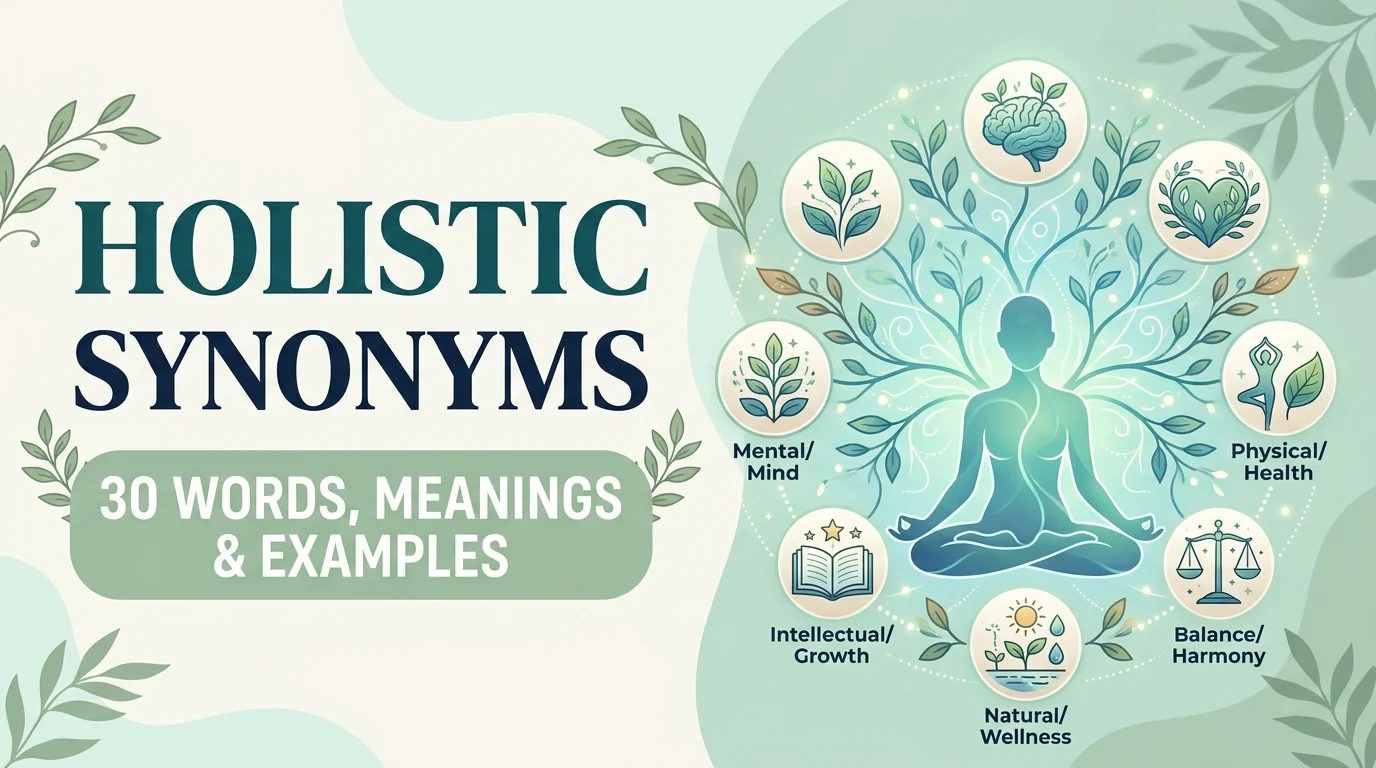
The word holistic describes an approach that considers the whole of something rather than focusing on only one part. It emphasizes how different elements work together to create a complete picture.
The term is commonly used in healthcare, education, business, personal development, wellness, and problem-solving.
Finding the right holistic synonyms can make your writing clearer, more professional, and more engaging.
Depending on the context, words such as comprehensive, whole, integrated, complete, and all inclusive may communicate a similar idea. However, each alternative has a slightly different meaning and usage.
If you are a student, ESL learner, writer, blogger, or content creator, understanding these alternatives will help you express ideas more accurately.
This guide explores 30 useful synonyms for holistic, including simple definitions, example sentences, and practical usage tips.
What Does Holistic Mean?
Holistic means considering something as a complete system instead of examining its individual parts separately.
It focuses on the relationship between different elements and how they influence one another.
For example, a holistic approach to health considers physical fitness, mental well-being, emotional balance, nutrition, and lifestyle rather than focusing only on physical symptoms.
The word comes from the idea of a whole. It is often used in professional, academic, and everyday English.
Examples:
- The school follows a holistic approach to student development.
- Holistic healthcare considers both physical and emotional well-being.
- The company developed a holistic strategy for improving customer satisfaction.
Tone and usage: Holistic is a neutral to professional word. It is especially useful when discussing complete approaches, interconnected systems, and overall well-being.
30 Best Holistic Synonyms With Meanings and Examples
Below are 30 alternatives to holistic. Some are close synonyms, while others are suitable replacements in particular contexts.
1. Comprehensive
Meaning: Including all or nearly all important parts of something.
Example: The doctor created a comprehensive treatment plan for the patient.
Best usage: Reports, healthcare, education, research, and planning.
2. Complete
Meaning: Having all the necessary parts; nothing important is missing.
Example: We need a complete understanding of the problem before making a decision.
Best usage: General writing, instructions, and explanations.
3. Whole
Meaning: Considering something as one complete unit rather than separate pieces.
Example: A healthy lifestyle supports the whole person, not just the body.
Best usage: General discussions about overall health and well-being.
4. Integrated
Meaning: Combining different parts into one connected system.
Example: The school introduced an integrated learning program.
Best usage: Education, healthcare, technology, and business.
5. All Inclusive
Meaning: Covering everything or including all important elements.
Example: The organization developed an all inclusive wellness program.
Best usage: Services, programs, plans, and policies.
6. Overall
Meaning: Considering everything together rather than focusing on individual details.
Example: We must examine the overall impact of the new policy.
Best usage: General writing, business, and evaluations.
7. Universal
Meaning: Applying to everyone or covering a wide range of situations.
Example: The organization believes in universal access to education.
Best usage: Broad principles, policies, and general concepts.
8. Extensive
Meaning: Covering a large amount or involving many details.
Example: The researcher conducted extensive research into the issue.
Best usage: Research, investigations, and detailed studies.
9. Broad Based
Meaning: Including many different areas, groups, or aspects.
Example: The government introduced a broad based development strategy.
Best usage: Business, economics, education, and social development.
10. Unified
Meaning: Joined together to form one connected or organized whole.
Example: The team created a unified approach to solving the problem.
Best usage: Teamwork, management, planning, and organizational strategies.
11. Coordinated
Meaning: Organized so that different parts work together effectively.
Example: The hospital provided coordinated care for its patients.
Best usage: Healthcare, teamwork, and project management.
12. Systematic
Meaning: Following an organized method that considers different steps or elements.
Example: The researcher used a systematic approach to investigate the issue.
Best usage: Research, problem-solving, and professional writing.
13. Multidimensional
Meaning: Having several different aspects or dimensions.
Example: Mental health is a multidimensional subject that requires careful attention.
Best usage: Psychology, education, research, and social sciences.
14. Well Rounded
Meaning: Developed in several important areas rather than just one.
Example: The school aims to develop well rounded students.
Best usage: Education, personality, personal development, and skills.
15. All Round
Meaning: Including or considering many different aspects.
Example: Exercise and healthy eating support round development.
Best usage: Personal development, education, and general wellness.
16. Inclusive
Meaning: Taking different people, perspectives, or elements into consideration.
Example: The organization adopted an inclusive approach to decision-making.
Best usage: Education, workplace culture, communities, and policies.
17. Extensive Range
Meaning: Covering a wide variety of subjects or elements.
Example: The course offers an extensive range of learning opportunities.
Best usage: Describing broad coverage or variety. This is a descriptive phrase rather than a direct synonym.
18. All-Encompassing
Meaning: Including or covering every important aspect of something.
Example: The company developed an all-encompassing strategy for long-term growth.
Best usage: Strategies, plans, explanations, and policies.
19. Connected
Meaning: Linked together or related in some way.
Example: The study examines how connected factors influence human behavior.
Best usage: Relationships, systems, and social issues.
20. Interconnected
Meaning: Having different parts that depend on or influence one another.
Example: Environmental and economic issues are closely interconnected.
Best usage: Science, business, environmental studies, and systems thinking.
21. Collective
Meaning: Involving several people or things working or acting together.
Example: The team made a collective effort to improve workplace conditions.
Best usage: Teamwork, communities, and shared responsibilities.
22. Extensive
Meaning: Broad in scope or covering many areas.
Example: The organization offers extensive support for student development.
Best usage: Professional writing, services, and research.
23. Thorough
Meaning: Carefully considering all important details.
Example: The consultant conducted a thorough review of the business strategy.
Best usage: Reviews, assessments, investigations, and explanations.
24. Far Reaching
Meaning: Having a wide influence or affecting many different areas.
Example: The new education policy had far reaching effects on students.
Best usage: Policies, decisions, changes, and consequences.
25. Multi Faceted
Meaning: Having several different sides, features, or aspects.
Example: Education is a multifaceted process that involves more than classroom learning.
Best usage: Complex topics, personalities, problems, and research.
26. Holistic Oriented
Meaning: Focused on understanding or treating something as a whole.
Example: The clinic follows a holistic-oriented approach to patient care.
Best usage: Healthcare and wellness discussions. This is a descriptive expression, not a standard single word synonym.
27. Encompassing
Meaning: Including a wide variety of elements or subjects.
Example: The project takes an encompassing view of community development.
Best usage: Reports, academic writing, and professional discussions.
28. Combined
Meaning: Joined together or brought into one group.
Example: The combined approach improved the effectiveness of the program.
Best usage: Strategies, methods, resources, and efforts.
29. Integrated Wide
Meaning: Describing an approach that connects several areas across a larger system.
Example: The organization introduced an integrated wide development framework.
Best usage: Not a standard English expression; use integrated approach or organization-wide approach instead.
30. All Sided
Meaning: Considering different sides or viewpoints of an issue.
Example: The committee conducted an all sided examination of the proposal.
Best usage: Discussions and evaluations. In natural English, use well rounded or comprehensive for greater clarity.
Holistic Synonyms Comparison Table
Choosing the correct alternative depends on what you want to communicate. Some words emphasize completeness, while others highlight connections between different elements.
| Synonym | Main meaning | Best context |
|---|---|---|
| Comprehensive | Covers all important parts | Reports |
| Complete | Nothing is missing | General writing |
| Integrated | Parts work together | Healthcare |
| All-inclusive | Includes everything | Programs |
| Overall | Considers everything | Evaluations |
| Multidimensional | Has many aspects | Research |
| Well rounded | Developed in many areas | Education |
| Inclusive | Considers different perspectives | Communities |
| Interconnected | Parts influence one another | Science |
| Thorough | Carefully examines details | Assessments |
| All encompassing | Covers a wide scope | Strategies |
| Multi faceted | Has several dimensions | Complex topics |
Different Types of Holistic Approaches
The meaning of holistic can change slightly depending on the subject. Understanding these contexts helps you choose the most appropriate synonym.
1. Holistic Healthcare
Holistic healthcare considers the complete well-being of a person.
It recognizes that physical health, emotional balance, mental well-being, and lifestyle can influence one another.
Example: A holistic healthcare provider considers nutrition, sleep, physical activity, and emotional well-being when discussing a patient’s health.
Useful synonyms:
- Comprehensive
- Integrated
- Whole person
- All inclusive
- Well rounded
2. Holistic Education
Holistic education focuses on developing students in several areas, including academic knowledge, creativity, emotional intelligence, social skills, and personal responsibility.
Example: The school uses a holistic educational approach to support students’ overall development.
Useful synonyms:
- Well rounded
- Comprehensive
- Inclusive
- Multidimensional
- All round
3. Holistic Business Strategy
A holistic business strategy considers how different departments, employees, customers, and business operations work together.
Example: The company adopted a holistic strategy to improve productivity and customer satisfaction.
Useful synonyms:
- Integrated
- Unified
- Comprehensive
- Coordinated
- All encompassing
4. Holistic Personal Development
Holistic personal development focuses on improving different areas of life rather than concentrating on only one skill or goal.
These areas may include physical health, emotional intelligence, communication, relationships, and professional development.
Example: A holistic approach to personal development encourages people to improve their overall quality of life.
Useful synonyms:
- Well rounded
- Multidimensional
- Comprehensive
- Overall
- Balanced
5. Holistic Problem-Solving
Holistic problem-solving examines the causes, effects, and relationships connected to a problem.
Instead of treating only one visible issue, it considers the wider situation.
Example: The manager used a comprehensive approach to identify the root causes of the problem.
Useful synonyms:
- Systematic
- Thorough
- Integrated
- All encompassing
- Interconnected
How to Choose the Right Holistic Synonym
The best synonym depends on your sentence, audience, and intended meaning.
Here is a simple guide to choosing the right word.
For formal and academic writing
Use:
- Comprehensive
- Multidimensional
- Integrated
- Systematic
- All encompassing
Example: The research provides a comprehensive analysis of environmental challenges.
For healthcare and wellness
Use:
- Whole person
- Integrated
- Comprehensive
- Well rounded
- Inclusive
Example: The clinic provides integrated care that considers patients’ different needs.
For education and personal development
Use:
- Well rounded
- All round
- Multidimensional
- Overall
- Inclusive
Example: The program supports the well-rounded development of students.
For business and management
Use:
- Coordinated
- Unified
- Integrated
- Broad based
- Comprehensive
Example: The company introduced an integrated business strategy.
For general everyday English
Use:
- Complete
- Whole
- Overall
- Thorough
- Combined
Example: We need to understand the whole situation before making a decision.
Holistic vs. Comprehensive: What Is the Difference?
Holistic and comprehensive are closely related, but they do not always mean exactly the same thing.
Holistic focuses on understanding how different parts connect and influence the whole.
Comprehensive focuses on including all or nearly all important information, details, or elements.
Consider these examples:
- Holistic approach: The doctor considers physical, mental, and emotional health together.
- Comprehensive approach: The doctor examines all relevant symptoms, medical history, and treatment options.
In simple terms, holistic emphasizes the relationship between parts, while comprehensive emphasizes complete coverage.
How to Use Holistic Synonyms in Sentences
Here are some additional examples to help you use these alternatives naturally.
- The organization developed a comprehensive plan for community improvement.
- A well-rounded education prepares students for different challenges.
- The company introduced an integrated approach to customer service.
- The researcher conducted a thorough investigation.
- A multidimensional perspective can help explain complex social issues.
- The healthcare provider believes in whole-person care.
- The team created a unified strategy for achieving its goals.
- The project requires coordinated efforts from different departments.
- The new policy had far-reaching effects on the community.
- A systematic approach can make problem-solving more effective.
Frequently Asked Questions About Holistic Synonyms
1. What is another word for holistic?
Some common alternatives include comprehensive, integrated, whole, complete, all inclusive, well rounded, and all encompassing.
The best alternative depends on the context in which you are using the word.
2. What is a more professional word for holistic?
Comprehensive, integrated, multidimensional, and all-encompassing are useful professional alternatives.
They are suitable for academic papers, business reports, healthcare discussions, and formal presentations.
3. What is the simplest synonym for holistic?
The simplest alternatives are whole, complete, and overall.
These words are easy to understand and work well in everyday conversations.
4. What is the opposite of holistic?
Possible opposites include:
- Fragmented
- Partial
- Narrow
- Limited
- Isolated
- Segmented
These words describe approaches that focus on separate parts rather than considering the complete system.
5. What does holistic mean in simple words?
Holistic means looking at the whole picture instead of focusing on just one part.
For example, a holistic approach to education considers academic performance, creativity, social skills, and emotional development.
6. What is a holistic approach?
A holistic approach is a way of understanding or solving something by considering all its important parts and how they are connected.
It is commonly used in healthcare, education, business, and personal development.
7. Is holistic a formal word?
Yes. Holistic is a neutral and professional word frequently used in academic, medical, business, and educational writing.
It can also appear in everyday conversations.
8. What is the difference between holistic and integrated?
Holistic describes an approach that considers the whole system. Integrated describes different parts that are combined or connected to work together.
For example, holistic healthcare considers the complete person, while integrated healthcare combines different healthcare services.
Conclusion
Understanding holistic synonyms can help you communicate ideas more clearly and choose words that match your intended meaning.
Alternatives such as comprehensive, integrated, complete, well rounded, multidimensional, and all encompassing can be useful in different situations.
However, these words are not always interchangeable. Holistic emphasizes the complete picture and the connections between different parts, while comprehensive focuses on covering all important details.
When writing about healthcare, education, business, or personal development, choose an alternative that accurately expresses your message. Learning these words will strengthen your vocabulary, improve your writing, and help you communicate more effectively.
Ultimately, the best synonym is not simply the most sophisticated word. It is the one that communicates your meaning naturally and accurately.

I am Derek Thomas, a passionate word enthusiast and writer. I enjoy exploring synonyms, expanding vocabulary, and helping readers find clear, accurate, and meaningful words for better writing.