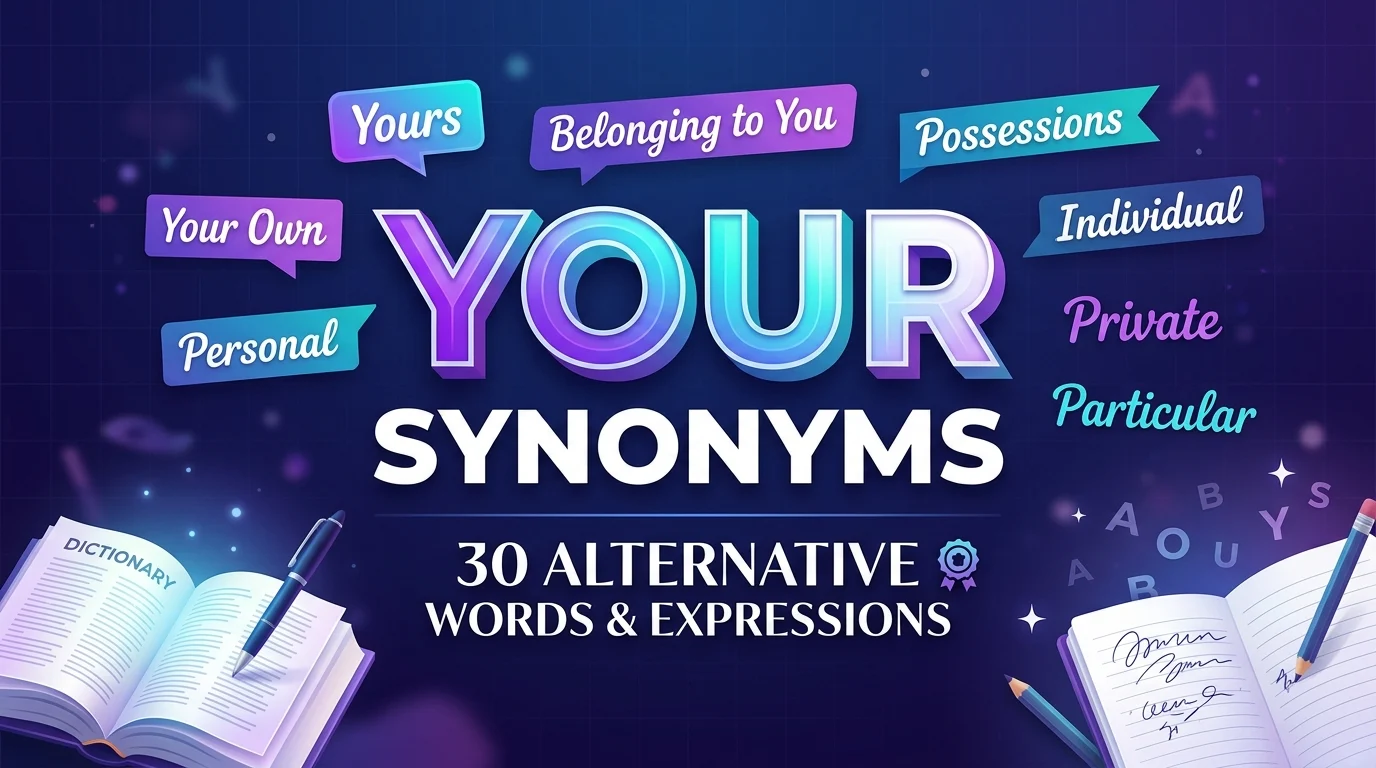
The word your is one of the most commonly used words in the English language. It helps show that something belongs to, relates to, or is connected with the person being spoken to.
If you are writing an email, having a conversation, creating content, or learning English, understanding alternatives to “your” can help improve your vocabulary and sentence structure.
Although “your” is a simple word, finding suitable alternatives can sometimes be challenging. Depending on the context, you might want to express ownership, refer to someone’s belongings, address a reader directly, or make your writing sound more formal and professional.
Learning your synonyms can help students, ESL learners, writers, bloggers, and content creators communicate more effectively.
However, it is important to understand that not every alternative can replace “your” in every sentence. Some expressions work only in specific grammatical situations.
In this guide, you will discover 30 alternative words and expressions for “your,” along with simple meanings, example sentences, and practical usage tips.
What Does Your Mean?
Your is a possessive determiner used to show that something belongs to or is associated with the person or people being addressed.
It is the possessive form of the pronoun “you.”
For example:
- Your book is on the table.
- I appreciate your help.
- Please submit your assignment tomorrow.
- Your ideas are very creative.
The word “your” is used in both formal and informal English. It can refer to one person or multiple people.
Tone and usage: Your is neutral, direct, and suitable for almost every type of communication, including conversations, academic writing, professional emails, and online content.
30 Synonyms and Alternatives for Your
Here are 30 useful alternatives and related expressions. Remember that some are direct possessive alternatives, while others are contextual phrases that express ownership or association.
1. Yours
Meaning: Something that belongs to you.
Example: This beautiful notebook is yours.
Best usage: Showing ownership when the noun is not repeated.
2. Your Own
Meaning: Something that belongs personally to you.
Example: You should always follow your own dreams.
Best usage: Emphasizing personal ownership or independence.
3. Belonging to You
Meaning: Something that is owned by or connected with you.
Example: Is this phone belonging to you?
Best usage: Explaining ownership in descriptive sentences. A more natural question is “Does this phone belong to you?”
4. Of Yours
Meaning: Something associated with or owned by you.
Example: A friend of yours called me yesterday.
Best usage: Talking about people, belongings, or things associated with someone.
5. Your Personal
Meaning: Something specifically connected with you as an individual.
Example: Your personal information should remain private.
Best usage: Privacy, identity, and individual matters.
6. Your Individual
Meaning: Referring to something specific to each person.
Example: Your individual progress matters more than comparing yourself with others.
Best usage: Personal development and individual achievements.
7. Your Own Personal
Meaning: Something belonging specifically and personally to you.
Example: You deserve your own personal space.
Best usage: Emphasizing independence, privacy, and ownership.
8. Your Private
Meaning: Something intended to remain personal or confidential.
Example: Protect your private information online.
Best usage: Privacy and confidential matters. This is a contextual alternative, not a direct replacement.
9. Your Belongings
Meaning: The personal things that you own.
Example: Please collect your belongings before leaving.
Best usage: Referring to someone’s possessions.
10. Your Property
Meaning: Something that legally or personally belongs to you.
Example: Please take care of your property.
Best usage: Legal, financial, and ownership-related writing.
11. Your Possessions
Meaning: Things that belong to you.
Example: Keep your possessions in a safe place.
Best usage: Everyday conversations and formal descriptions of ownership.
12. Your Assets
Meaning: Valuable things or resources that belong to you.
Example: Protect your assets with proper financial planning.
Best usage: Business, finance, and legal contexts.
13. Your Items
Meaning: Objects or things that belong to you.
Example: Please check your items before leaving the hotel.
Best usage: Shopping, travel, and everyday communication.
14. Your Things
Meaning: Personal objects or belongings associated with you.
Example: You should organize your things before moving.
Best usage: Casual conversations.
15. Your Stuff
Meaning: An informal expression for the things that belong to you.
Example: Please put your stuff away.
Best usage: Informal speech and friendly conversations.
16. Your Own Property
Meaning: Something that belongs exclusively or personally to you.
Example: You have the right to protect your own property.
Best usage: Legal and ownership-related discussions.
17. Your Side
Meaning: The position, perspective, or area associated with you.
Example: I would like to understand your side of the story.
Best usage: Discussions, disagreements, and personal perspectives.
18. Your Perspective
Meaning: The way you see or understand something.
Example: Your perspective helped me understand the situation differently.
Best usage: Academic writing, discussions, and communication.
19. Your Viewpoint
Meaning: Your personal opinion or way of thinking.
Example: I respect your viewpoint on this subject.
Best usage: Debates, professional discussions, and essays.
20. Your Opinion
Meaning: What you personally think about something.
Example: I would love to hear your opinion.
Best usage: Conversations, surveys, and discussions.
21. Your Choice
Meaning: A decision that you make.
Example: Choosing your career path is your choice.
Best usage: Decisions, independence, and personal freedom.
22. Your Decision
Meaning: A conclusion or choice made by you.
Example: I respect your decision to start a new business.
Best usage: Professional and personal conversations.
23. Your Responsibility
Meaning: Something that you are expected or required to take care of.
Example: Completing your assignment is your responsibility.
Best usage: Education, workplace communication, and accountability.
24. Your Role
Meaning: The position or responsibility you have in a particular situation.
Example: Your role in this project is very important.
Best usage: Business, teamwork, and professional writing.
25. Your Contribution
Meaning: Something that you provide or do to help achieve a result.
Example: Your contribution made the project successful.
Best usage: Workplace communication, teamwork, and appreciation.
26. Your Effort
Meaning: The energy or hard work you put into something.
Example: Your effort will help you achieve your goals.
Best usage: Motivation, education, and personal development.
27. Your Achievement
Meaning: Something successful that you have accomplished.
Example: Your achievement deserves recognition.
Best usage: Celebrations, professional writing, and encouragement.
28. Your Identity
Meaning: The qualities and characteristics that make you who you are.
Example: Your identity should never be defined by other people’s opinions.
Best usage: Personal development and social discussions.
29. Your Advantage
Meaning: A benefit or favorable position that you have.
Example: Your experience gives you an advantage in this competition.
Best usage: Business, education, and competitive situations.
30. Your Own Choice
Meaning: A decision that you make independently.
Example: Following your passion is your own choice.
Best usage: Personal freedom, independence, and decision-making.
Comparison Table: Different Alternatives for Your
The following table helps you understand which expression works best in different situations.
| Alternative | Main meaning | Best context |
|---|---|---|
| Yours | Belongs to you | Ownership |
| Your own | Personally yours | Independence |
| Of yours | Associated with you | Relationships |
| Your belongings | Personal possessions | Everyday English |
| Your property | Owned by you | Legal contexts |
| Your assets | Valuable resources | Finance |
| Your stuff | Personal things | Informal speech |
| Your perspective | Your way of thinking | Discussions |
| Your viewpoint | Your opinion | Formal writing |
| Your choice | Your decision | Personal freedom |
| Your responsibility | Your duty | Professional writing |
| Your contribution | Your input | Teamwork |
| Your effort | Your hard work | Motivation |
How to Choose the Right Synonym for Your
Choosing an appropriate alternative depends on the meaning you want to communicate. Here are some useful categories.
1. For Ownership and Possession
Use these expressions when discussing something that belongs to someone:
- Yours
- Your own
- Belonging to you
- Your belongings
- Your possessions
- Your property
Example: Your belongings are safely stored in the office.
2. For Personal Identity and Privacy
Use these expressions when discussing someone’s individual information or identity:
- Your personal
- Your private
- Your individual
- Your identity
- Your own personal
Example: Your personal information should always be protected.
3. For Opinions and Perspectives
Use these expressions when talking about someone’s thoughts or beliefs:
- Your perspective
- Your viewpoint
- Your opinion
- Your side
Example: I appreciate your perspective on this issue.
4. For Decisions and Independence
Use these expressions when discussing personal decisions:
- Your choice
- Your decision
- Your own choice
- Your own
Example: Choosing a different career is your own choice.
5. For Work and Responsibilities
Use these expressions when discussing someone’s duties and contributions:
- Your responsibility
- Your role
- Your contribution
- Your effort
- Your achievement
Example: Your contribution has made a positive difference to the team.
Is Your a Possessive Pronoun or Possessive Adjective?
One common English grammar question is whether “your” is a possessive pronoun or a possessive adjective.
The correct grammatical term is possessive determiner (traditionally called a possessive adjective).
It comes before a noun to show ownership.
Examples:
- Your house is beautiful.
- Your teacher is helpful.
- Your ideas are interesting.
In contrast, “yours” is a possessive pronoun. It replaces a noun phrase.
Examples:
- This house is yours.
- The blue bag is yours.
- That decision is yours.
Easy rule: Use “your” before a noun and “yours” when the noun does not need to be repeated.
Common Mistakes When Using Your Synonyms
Even though “your” is a simple English word, some learners confuse it with similar expressions.
Here are common mistakes to avoid.
Mistake 1: Using your instead of yours
Incorrect: This book is your.
Correct: This book is yours.
Mistake 2: Using you’re instead of your
Incorrect: You’re phone is new.
Correct: Your phone is new.
Remember that “you’re” means “you are.”
Mistake 3: Replacing your with an unsuitable expression
Incorrect: Yours phone is expensive.
Correct: Your phone is expensive.
“Yours” cannot normally be placed directly before a noun.
Mistake 4: Using unnecessary expressions
Incorrect: Your own personal individual opinion is important.
Better: Your opinion is important.
Simple and clear language is usually more effective.
Frequently Asked Questions About Your Synonyms
1. What are the best synonyms for your?
Some useful alternatives and related expressions include yours, your own, belonging to you, of yours, and your personal. The right choice depends on the sentence.
2. What is another word for your?
“Yours” is a closely related possessive form. Other expressions include “your own” and “belonging to you,” depending on the grammatical structure.
3. What is a formal alternative to your?
There is no universal formal replacement for “your.” In professional writing, it is often best to keep “your” or use a more specific expression such as “the recipient’s” when appropriate.
4. What is the difference between your and yours?
“Your” comes before a noun, while “yours” replaces a noun phrase.
Examples:
- Your car is beautiful.
- The beautiful car is yours.
5. Can I use your in formal writing?
Yes. Your is appropriate in formal emails, business communication, academic instructions, and professional documents.
6. What is the opposite of your?
There is no single direct opposite of “your.” Depending on the context, alternatives such as “my,” “his,” “her,” “our,” and “their” refer to different owners.
7. Is your singular or plural?
Your can refer to one person or several people. Its form stays the same in both situations.
Examples:
- Your book is here. (One person)
- Your books are here. (Several people)
Conclusion
Understanding different alternatives for your can improve your English vocabulary, writing style, and communication skills.
Expressions such as yours, your own, belonging to you, your belongings, and your personal can help communicate ownership and personal connections in different situations.
However, remember that these expressions are not all direct synonyms. Some are grammatical alternatives, while others are related phrases that work in specific contexts.
The most important thing is to understand the meaning and grammatical structure of each expression before using it.
If you are writing an academic assignment, professional email, blog post, or everyday message, choosing the correct words will make your English clearer and more natural.

I am Connor James, Administrator at SynoHut. I enjoy exploring synonyms, improving vocabulary, and helping readers discover clear, useful, and engaging word alternatives for everyday writing and communication.