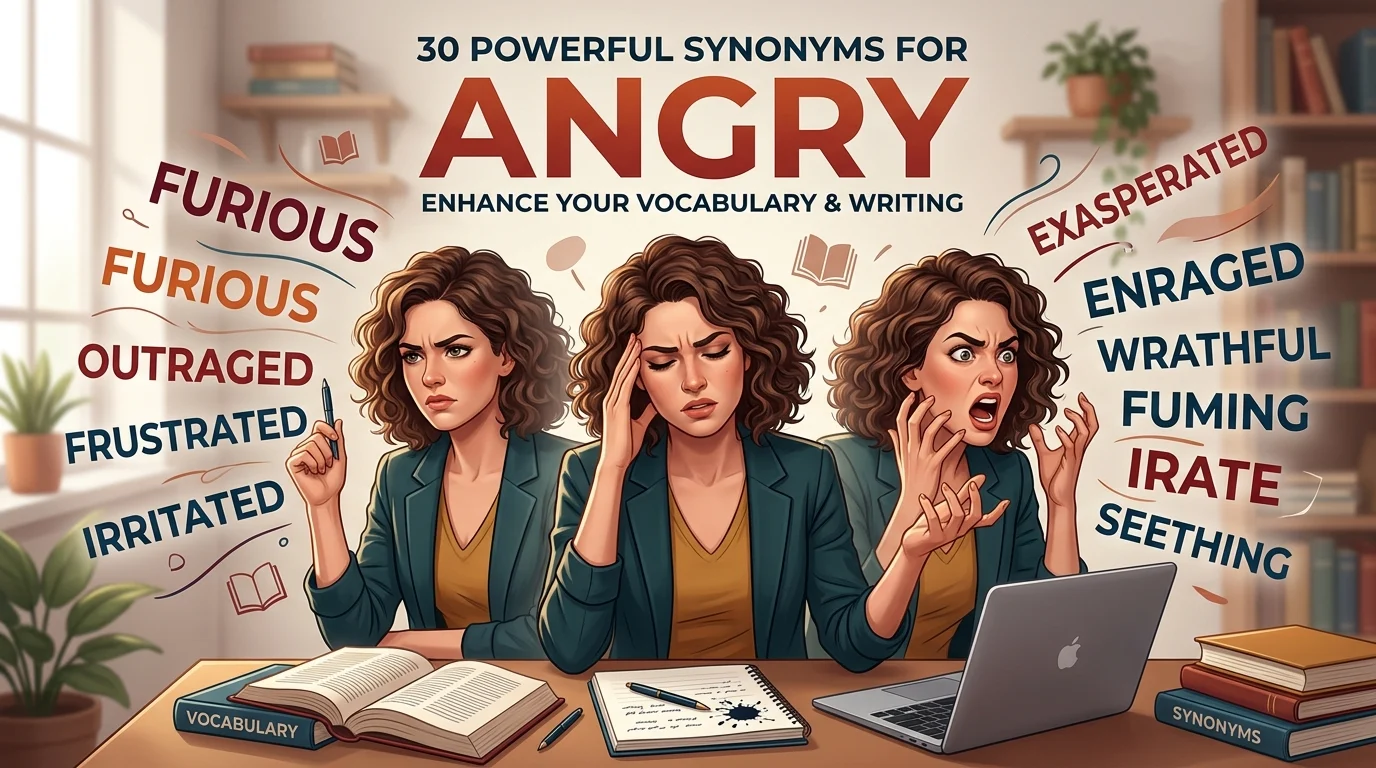
Feeling angry is a normal human emotion, but using the same word repeatedly can make your writing sound dull.
If you’re writing an essay, creating content, learning English, or simply trying to express yourself more precisely, knowing different synonyms for angry can help you communicate the exact level and type of emotion you mean.
The word angry can describe anything from mild irritation to intense fury. However, words such as annoyed, irritated, frustrated, outraged, and furious carry different levels of intensity and slightly different meanings. Choosing the right word makes your writing clearer and more natural.
This guide explains 30 useful synonyms for angry in simple English. Each word includes its meaning, an example sentence, and the situation where it works best. The goal is not simply to give you a long vocabulary list, but to help you understand which synonym for angry fits your context.
What Does “Angry” Mean?
Angry means feeling strong displeasure, frustration, or annoyance because something unpleasant, unfair, or upsetting has happened.
For example:
Maria was angry when her coworker took credit for her idea.
The word angry is common and flexible. It can describe a small emotional reaction or a very strong one depending on the situation.
For example:
- I was slightly angry about the delay. — mild anger
- He was furious about what happened. — very strong anger
- The customers were outraged by the unfair charges. — anger caused by something considered unacceptable
Understanding these differences is especially useful for students, ESL learners, writers, and content creators.
30 Synonyms for Angry
Here are 30 alternatives to angry, arranged from relatively mild feelings to stronger forms of anger.
1. Annoyed
Meaning: Slightly angry because something is bothering you.
Example:
I was annoyed by the constant noise outside my window.
Best usage: Use annoyed for everyday, relatively mild anger.
2. Irritated
Meaning: Slightly angry or bothered by something unpleasant.
Example:
She felt irritated when the computer kept freezing.
Best usage: Good for situations involving repeated problems or minor frustrations.
3. Frustrated
Meaning: Angry or upset because you cannot achieve something or solve a problem.
Example:
He became frustrated after trying to fix the machine for an hour.
Best usage: Best when anger comes from difficulty, failure, or obstacles.
4. Cross
Meaning: Slightly angry or displeased.
Example:
Dad was cross when I forgot to lock the door.
Best usage: Common in British English and often describes mild anger.
5. Vexed
Meaning: Annoyed, worried, or frustrated by something.
Example:
She was vexed by the complicated instructions.
Best usage: Useful in formal or literary writing.
6. Displeased
Meaning: Unhappy or dissatisfied with something.
Example:
The manager was displeased with the team’s performance.
Best usage: Appropriate for professional and formal situations.
7. Upset
Meaning: Emotionally unhappy, disturbed, or angry because of something that happened.
Example:
He was upset when his friend canceled their plans.
Best usage: Use when anger is mixed with sadness, disappointment, or hurt.
8. Agitated
Meaning: Very bothered, restless, or emotionally disturbed.
Example:
The customer became agitated after waiting for nearly an hour.
Best usage: Good when anger is visible through restless or emotional behavior.
9. Exasperated
Meaning: Extremely annoyed because something frustrating keeps happening.
Example:
After explaining the same instructions five times, she felt exasperated.
Best usage: Perfect for repeated problems that test someone’s patience.
10. Resentful
Meaning: Angry or bitter because you believe you have been treated unfairly.
Example:
He felt resentful after being overlooked for the promotion.
Best usage: Use when anger lasts over time and is connected to perceived unfairness.
11. Bitter
Meaning: Angry and unhappy because of a past disappointment or unfair experience.
Example:
She became bitter after years of being ignored by her family.
Best usage: Best for long-lasting anger and emotional disappointment.
12. Hostile
Meaning: Extremely unfriendly, aggressive, or angry toward someone.
Example:
The discussion became hostile after both sides refused to compromise.
Best usage: Useful when anger creates an unfriendly or threatening atmosphere.
13. Indignant
Meaning: Angry because you believe something is unfair, insulting, or wrong.
Example:
She was indignant when the accusation was made against her.
Best usage: Strong choice for anger caused by injustice or an insult.
14. Offended
Meaning: Angry or hurt because someone’s words or actions were disrespectful.
Example:
He was offended by the rude comment.
Best usage: Use when someone feels insulted or disrespected.
15. Provoked
Meaning: Made angry because someone deliberately or unintentionally caused a reaction.
Example:
The repeated insults provoked him.
Best usage: Useful when something directly causes anger.
16. Enraged
Meaning: Extremely angry.
Example:
The unfair decision left the workers enraged.
Best usage: Use for very intense anger.
17. Furious
Meaning: Extremely angry.
Example:
She was furious when she discovered that someone had damaged her car.
Best usage: One of the most common strong alternatives to angry.
18. Infuriated
Meaning: Made extremely angry.
Example:
The constant delays infuriated the passengers.
Best usage: Use when something causes intense anger.
19. Outraged
Meaning: Extremely angry because something is considered shocking, unfair, or unacceptable.
Example:
Residents were outraged by the sudden increase in fees.
Best usage: Particularly useful for social, political, professional, or ethical issues.
20. Incensed
Meaning: Extremely angry, especially because of something unfair or offensive.
Example:
The judge was incensed by the lawyer’s disrespectful behavior.
Best usage: Strong and somewhat formal; useful in journalism and serious writing.
21. Livid
Meaning: Extremely angry.
Example:
He was livid when he learned that his confidential information had been shared.
Best usage: Informal or dramatic descriptions of intense anger.
22. Fuming
Meaning: Extremely angry and visibly showing your anger.
Example:
She was fuming after waiting three hours for the delayed flight.
Best usage: Great for informal writing and vivid descriptions.
23. Seething
Meaning: Feeling intense anger that you are trying to control or hide.
Example:
He sat quietly, seething with anger.
Best usage: Excellent for describing hidden or controlled anger.
24. Wrathful
Meaning: Full of strong anger or rage.
Example:
The king gave the messenger a wrathful look.
Best usage: Mostly literary, dramatic, or historical writing.
25. Irate
Meaning: Very angry.
Example:
An irate customer demanded to speak with the manager.
Best usage: Common in formal writing, journalism, and descriptions of angry customers or officials.
26. Raging
Meaning: Extremely angry or filled with powerful anger.
Example:
The raging customer refused to leave the store.
Best usage: Use for dramatic descriptions of uncontrolled anger.
27. Seething with anger
Meaning: Filled with powerful anger that may not be openly expressed.
Example:
She was seething with anger after hearing the false accusation.
Best usage: Useful when describing intense but controlled emotions.
28. Wrathful
Meaning: Showing or feeling great anger.
Example:
The character gave a wrathful response to the betrayal.
Best usage: Best suited to dramatic, literary, or elevated language.
Note: Wrathful appears twice conceptually in vocabulary lists because it can function as a strong adjective for intense anger, but if you need 30 completely distinct everyday synonyms, alternatives such as rabid, choleric, or ireful may be used in specialized contexts. For ordinary modern English, wrathful is generally more natural than those rare alternatives.
29. Ireful
Meaning: Full of anger or showing great anger.
Example:
The leader gave an ireful response to the criticism.
Best usage: Literary or formal writing; uncommon in everyday conversation.
30. Choleric
Meaning: Easily made angry or having an angry temperament.
Example:
The choleric professor was known for his short temper.
Best usage: Formal, literary, or descriptive writing about someone’s personality.
Quick Comparison: Synonyms for Angry by Intensity
Not every synonym has the same emotional strength. Choosing a word based on intensity can make your writing much more precise.
| Synonym | Approximate intensity | Common context |
|---|---|---|
| Annoyed | Mild | Everyday problems |
| Irritated | Mild | Minor frustrations |
| Cross | Mild | Casual/British English |
| Frustrated | Mild medium | Obstacles or failure |
| Displeased | Mild medium | Formal situations |
| Upset | Mild medium | Emotional disappointment |
| Agitated | Medium | Visible emotional disturbance |
| Exasperated | Medium strong | Repeated frustration |
| Resentful | Medium strong | Long-term unfairness |
| Indignant | Strong | Injustice or insult |
| Hostile | Strong | Aggressive relationships |
| Furious | Very strong | Extreme anger |
| Enraged | Very strong | Intense anger |
| Outraged | Very strong | Serious injustice |
| Incensed | Very strong | Serious offense |
| Livid | Very strong | Extreme anger |
| Seething | Very strong | Controlled or hidden anger |
| Fuming | Very strong | Visible intense anger |
| Wrathful | Very strong | Literary/dramatic contexts |
How to Choose the Right Synonym for Angry
The best synonym depends on why someone is angry, how intense the feeling is, and the tone of your writing.
For Mild Anger
Choose:
- Annoyed
- Irritated
- Cross
- Vexed
- Displeased
Example:
I’m annoyed because the bus is late.
These words work well for ordinary situations where the anger is not extreme.
For Frustration
Choose:
- Frustrated
- Exasperated
- Agitated
- Vexed
Example:
The student became frustrated after repeatedly getting the answer wrong.
These words are particularly useful when a person wants to achieve something but encounters difficulties.
For Anger Caused by Unfairness
Choose:
- Resentful
- Indignant
- Outraged
- Incensed
Example:
The community was outraged by the unfair decision.
These words are stronger and often appear in formal writing.
For Very Strong Anger
Choose:
- Furious
- Enraged
- Infuriated
- Livid
- Fuming
- Seething
Example:
He was furious when he discovered what had happened.
These alternatives communicate much stronger emotions than ordinary angry.
For Literary or Formal Writing
Choose:
- Wrathful
- Ireful
- Choleric
- Incensed
- Vexed
These words can give writing a more dramatic, formal, or literary tone.
Angry vs. Annoyed: What’s the Difference?
Angry is generally stronger than annoyed.
Compare:
I was annoyed because my internet stopped working.
This suggests mild frustration.
I was angry because my personal information was exposed.
This suggests a more serious emotional reaction.
So, annoyed is usually better for small problems, while angry works for more significant situations.
Angry vs. Furious: What’s the Difference?
Furious is much stronger than angry.
- She was angry about the mistake.
- She was furious about the betrayal.
The second sentence suggests a much more intense emotional response.
Use furious when ordinary angry does not communicate enough emotional intensity.
Angry vs. Frustrated: What’s the Difference?
These words are related but not identical.
Frustrated usually describes anger caused by difficulty, failure, or an obstacle.
Angry is broader and can have many causes.
For example:
I was frustrated because I couldn’t solve the problem.
But:
I was angry because someone lied to me.
The first focuses on difficulty. The second focuses on wrongdoing.
Angry vs. Outraged: What’s the Difference?
Outraged usually involves strong anger about something considered deeply wrong, unfair, offensive, or unacceptable.
For example:
The customer was angry about the delay.
versus:
The public was outraged by the corruption scandal.
Outraged is especially useful when discussing serious social, ethical, or political issues.
Angry vs. Resentful: What’s the Difference?
Resentful often describes anger that continues over time.
For example:
She felt resentful after being repeatedly excluded from important meetings.
The emotion is not simply a moment of anger. It has developed because of repeated perceived unfairness.
Synonyms for Angry in Different Writing Situations
Academic Writing
For essays and academic work, consider:
- Frustrated
- Indignant
- Resentful
- Displeased
- Outraged
Avoid overly dramatic choices unless the subject genuinely requires them.
Creative Writing
For stories and novels, vivid words can create stronger imagery:
- Seething
- Fuming
- Livid
- Enraged
- Wrathful
- Hostile
For example:
He stood silently, seething as he listened to the accusation.
This gives the reader a clearer emotional picture than simply saying he was angry.
Professional Writing
In workplace communication, softer words are often more appropriate:
- Concerned
- Displeased
- Frustrated
- Dissatisfied
- Irritated
Instead of:
The client was furious.
A professional report might say:
The client was extremely dissatisfied with the service.
Everyday Conversation
Natural choices include:
- Annoyed
- Angry
- Upset
- Frustrated
- Mad
- Irritated
- Furious
These are easy for most English speakers to understand.
Common Phrases Related to Anger
Learning phrases alongside individual synonyms can make your English sound more natural.
Lose your temper
To suddenly become very angry.
He lost his temper during the argument.
See red
To become extremely angry.
She saw red when she discovered the truth.
Blow up
To suddenly become very angry.
He blew up when he heard the accusation.
Fume
To remain visibly angry.
She was still fuming after the meeting.
Hold a grudge
To continue feeling angry or resentful toward someone.
He still holds a grudge against his former business partner.
Be boiling mad
To be extremely angry.
She was boiling mad after the unfair decision.
Why Using the Right Synonym Matters
Using different words for anger is not just about avoiding repetition. Each synonym can communicate a different cause, intensity, duration, or tone.
Compare these sentences:
- Tom was annoyed.
- Tom was frustrated.
- Tom was resentful.
- Tom was indignant.
- Tom was furious.
All five sentences describe negative emotion, but they create different impressions.
Annoyed suggests a minor problem.
Frustrated suggests an obstacle.
Resentful suggests long-term bitterness.
Indignant suggests anger about unfair treatment.
Furious suggests extreme anger.
This distinction is particularly important in storytelling, essays, professional communication, and vocabulary development.
Frequently Asked Questions About Synonyms for Angry
What is the best synonym for angry?
There is no single best synonym. Annoyed works for mild anger, frustrated for anger caused by difficulty, indignant for anger about unfairness, and furious or enraged for extreme anger.
What is a stronger word for angry?
Some strong alternatives include furious, enraged, livid, infuriated, outraged, incensed, fuming, and seething.
What is a mild synonym for angry?
Common mild alternatives include annoyed, irritated, displeased, vexed, and cross.
What is a formal synonym for angry?
Depending on the context, indignant, incensed, irate, displeased, and outraged can work well in formal writing.
What is a synonym for angry and upset?
Upset, frustrated, irritated, resentful, and agitated can describe emotions that overlap with both anger and distress.
What is the difference between angry and irritated?
Irritated generally suggests a lower level of anger caused by something bothersome. Angry is broader and can describe a stronger emotional response.
Final Takeaway: Choosing the Best Synonym for Angry
There are many useful synonyms for angry, but the right choice depends on the situation.
For mild anger, use words such as annoyed, irritated, or displeased. For frustration, frustrated and exasperated are more precise.
When anger comes from unfair treatment, indignant, resentful, or outraged may be better choices. For extreme anger, words such as furious, enraged, livid, and incensed communicate much greater intensity.
The key is to think about why the person is angry, how strong the emotion is, and what tone your writing requires. Once you understand these differences, your vocabulary becomes more precise, expressive, and natural.
For students and ESL learners, mastering these distinctions is especially valuable because it helps you move beyond basic vocabulary and express emotions with greater accuracy.

I am Derek Thomas, a passionate word enthusiast and writer. I enjoy exploring synonyms, expanding vocabulary, and helping readers find clear, accurate, and meaningful words for better writing.