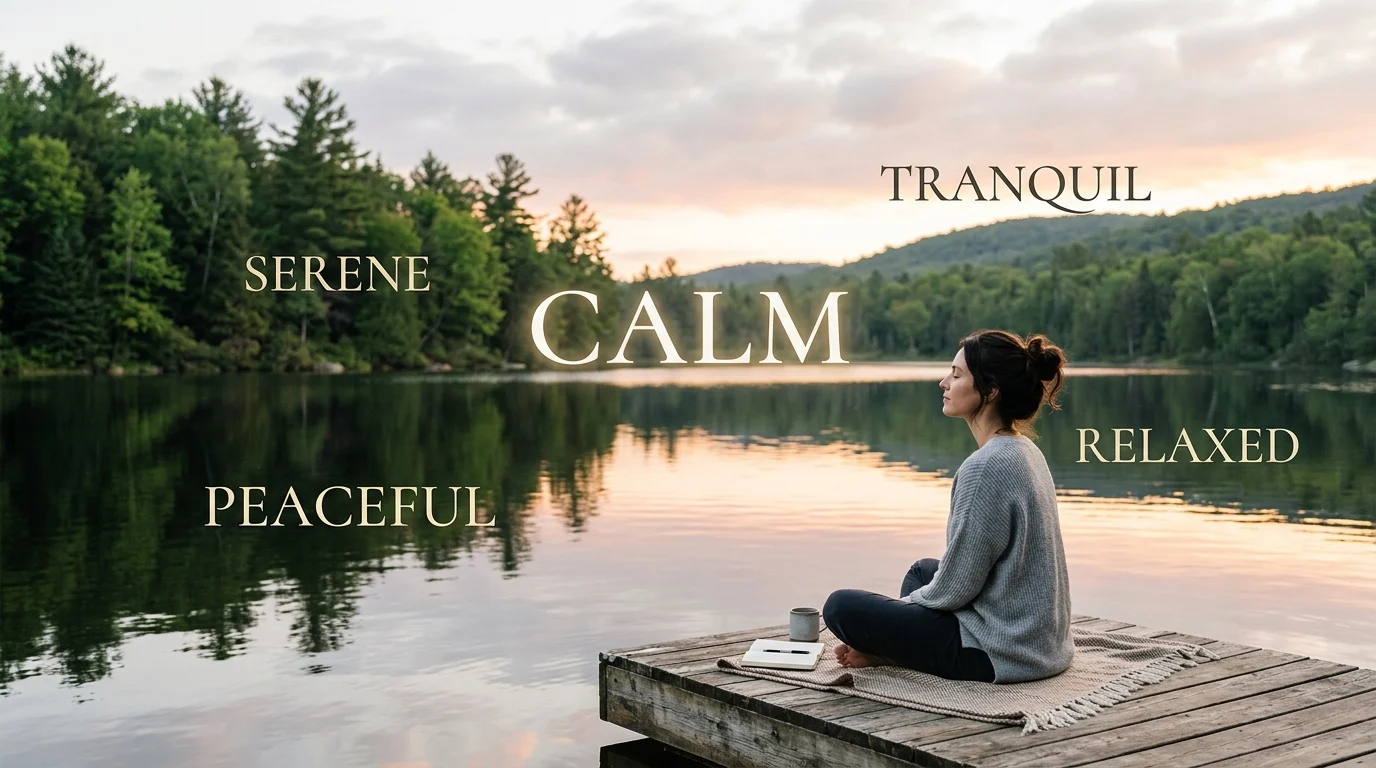
Finding the right word can make your writing clearer, more natural, and more expressive. The word calm is common and useful, but using the same word repeatedly can make writing feel predictable.
Learning different synonyms for calm allows you to describe peaceful emotions, quiet environments, controlled behavior, and relaxed situations with greater accuracy.
The best synonym depends on what you mean. A person may be composed during a stressful situation, serene while enjoying a quiet morning, tranquil in a peaceful place, or unruffled when something goes wrong.
These words are related to calm, but each carries a slightly different meaning and tone.
This guide explains 30 synonyms for calm in simple English. Each word includes its meaning, an example sentence, and the situation where it works best.
If you are a student, ESL learner, writer, or content creator, these alternatives can help you communicate with more variety and precision.
What Does “Calm” Mean?
Calm means being peaceful, relaxed, and free from strong worry, excitement, anger, or nervousness.
It can describe a person, emotion, place, situation, voice, or even weather.
For example:
- She remained calm during the interview.
- The lake was calm in the early morning.
- He spoke in a calm voice.
- The situation became calm after everyone talked.
The word can work as an adjective, verb, or noun. As an adjective, it describes a peaceful state. As a verb, calm means to make someone or something less upset or excited.
30 Synonyms for Calm
Not every synonym has exactly the same meaning as calm. Some describe a person’s behavior, while others are better for emotions, environments, voices, or difficult situations.
1. Peaceful
Meaning: Free from noise, conflict, stress, or disturbance.
Example:
The small village was peaceful at sunset.
Best usage: Use peaceful for places, situations, relationships, or general feelings of harmony.
2. Relaxed
Meaning: Free from tension, pressure, or worry.
Example:
After finishing her exams, Maya finally felt relaxed.
Best usage: Best for people who are comfortable and not under stress.
3. Serene
Meaning: Extremely peaceful, quiet, and undisturbed.
Example:
The garden looked serene in the early morning.
Best usage: Ideal for peaceful scenery, moods, and elegant or descriptive writing.
4. Tranquil
Meaning: Very quiet and peaceful.
Example:
They spent the weekend beside a tranquil lake.
Best usage: Commonly used for places, natural settings, and peaceful atmospheres.
5. Composed
Meaning: Calm and in control of your emotions.
Example:
Despite the difficult questions, the speaker remained composed.
Best usage: Excellent for professional, academic, or stressful situations involving people.
6. Collected
Meaning: Calm and able to think clearly, especially under pressure.
Example:
The manager stayed collected when the project suddenly changed.
Best usage: Useful when someone remains mentally controlled during a difficult situation.
7. Unruffled
Meaning: Not upset, worried, or disturbed by something.
Example:
She remained unruffled despite the unexpected criticism.
Best usage: Best when describing someone who stays calm despite problems or pressure.
8. Placid
Meaning: Quiet, gentle, and peaceful.
Example:
The placid river moved slowly through the valley.
Best usage: Often describes water, animals, places, or gentle personalities.
9. Still
Meaning: Quiet and without movement or disturbance.
Example:
The forest was completely still after the rain.
Best usage: Best for physical surroundings, silence, or lack of movement.
10. Quiet
Meaning: Making little or no noise; peaceful or not active.
Example:
The library was quiet in the afternoon.
Best usage: Use for places, people, voices, or situations with little noise or activity.
11. Cool
Meaning: Calm and controlled, especially in a difficult or exciting situation.
Example:
He kept his cool when the computer suddenly stopped working.
Best usage: Informal English, especially when talking about emotional control.
12. Level-headed
Meaning: Sensible, practical, and able to remain calm when making decisions.
Example:
Her level-headed approach helped the team solve the problem.
Best usage: Great for describing someone’s personality, judgment, or decision-making.
13. Self-possessed
Meaning: Confident and calm, especially when facing pressure.
Example:
The young lawyer appeared self-possessed during the trial.
Best usage: More formal; useful for professional or sophisticated writing.
14. Equable
Meaning: Calm and steady, especially in mood.
Example:
His equable personality made him easy to work with.
Best usage: Formal writing when describing a person with a consistently calm temperament.
15. Untroubled
Meaning: Free from worry, difficulty, or emotional disturbance.
Example:
She enjoyed an untroubled afternoon in the countryside.
Best usage: Useful when emphasizing the absence of stress or problems.
16. Unperturbed
Meaning: Not worried, frightened, or upset by something.
Example:
He seemed unperturbed by the sudden change in plans.
Best usage: Formal or neutral writing, especially when someone remains calm after unexpected events.
17. Unflappable
Meaning: Unable to be easily upset or frightened.
Example:
The nurse was unflappable during the emergency.
Best usage: Excellent for people who remain calm under intense pressure.
18. Sedate
Meaning: Quiet, serious, and relaxed rather than energetic or excited.
Example:
The hotel had a sedate atmosphere.
Best usage: Formal descriptions of quiet lifestyles, environments, or behavior.
19. Restful
Meaning: Helping you relax or recover from stress and tiredness.
Example:
The quiet countryside provided a restful escape from the city.
Best usage: Commonly used for places, activities, sleep, and environments.
20. Soothing
Meaning: Having a calming or comforting effect.
Example:
The soothing sound of rain helped her relax.
Best usage: Use for sounds, music, words, experiences, colors, or things that reduce stress.
21. Mellow
Meaning: Relaxed, gentle, and pleasantly calm.
Example:
The café had a mellow atmosphere in the evening.
Best usage: Informal and conversational; especially useful for moods, music, people, and atmospheres.
22. Reassuring
Meaning: Making someone feel less worried or afraid.
Example:
The doctor’s calm and reassuring voice made the patient feel better.
Best usage: Best when something or someone creates a feeling of safety and confidence.
23. Gentle
Meaning: Kind, soft, mild, or not aggressive.
Example:
He answered the angry customer in a gentle voice.
Best usage: Use when calmness is combined with kindness or softness.
24. Patient
Meaning: Able to wait or deal with difficulties without becoming angry or upset.
Example:
The teacher was patient with the students’ questions.
Best usage: Best when calmness involves tolerance and self-control.
25. Controlled
Meaning: Managed carefully without showing excessive emotion.
Example:
She gave a controlled response to the criticism.
Best usage: Useful in formal writing when describing restrained emotions or behavior.
26. Balanced
Meaning: Emotionally stable and able to consider things reasonably.
Example:
He gave a balanced response instead of reacting emotionally.
Best usage: Useful for opinions, personalities, decisions, and responses.
27. Cool-headed
Meaning: Able to remain calm and think clearly in stressful situations.
Example:
We need a cool-headed person to lead the team during the crisis.
Best usage: Great for leadership, emergencies, arguments, and high-pressure situations.
28. Unexcited
Meaning: Not emotionally excited, enthusiastic, or agitated.
Example:
She remained unexcited by the rumors and waited for reliable information.
Best usage: Use when someone does not become emotionally stirred by something.
29. Restful
Meaning: Peaceful and relaxing, especially after stress or activity.
Example:
The weekend at home was quiet and restful.
Best usage: Best for sleep, weekends, vacations, rooms, and relaxing experiences.
Note: Because restful is particularly useful for describing relaxing experiences, it is often a better choice than simply saying “calm” in those contexts.
30. Harmonious
Meaning: Peaceful and free from conflict or disagreement.
Example:
The team developed a harmonious working relationship.
Best usage: Best for relationships, groups, communities, sounds, and situations where different parts work peacefully together.
Quick Comparison of Synonyms for Calm
| Synonym | Main Idea | Best For | Tone |
|---|---|---|---|
| Peaceful | Free from conflict or disturbance | Places, situations | Neutral |
| Relaxed | Free from tension | People, moods | Casual |
| Serene | Deeply peaceful | Places, moods | Elegant |
| Tranquil | Quiet and peaceful | Nature, places | Descriptive |
| Composed | Emotionally controlled | People | Formal |
| Collected | Calm under pressure | People | Neutral/Formal |
| Unruffled | Not disturbed | People | Neutral |
| Placid | Quiet and gentle | Nature, people | Descriptive |
| Quiet | Little noise or activity | Places, people | Neutral |
| Cool | Calm under pressure | People | Informal |
| Level-headed | Sensible and calm | Personalities | Neutral |
| Self-possessed | Confidently controlled | People | Formal |
| Untroubled | Free from worry | People, situations | Neutral |
| Unperturbed | Not upset by events | People | Formal |
| Unflappable | Very difficult to upset | People | Strong |
| Sedate | Quiet and restrained | Atmospheres, lifestyles | Formal |
| Restful | Promotes relaxation | Places, activities | Neutral |
| Soothing | Creates calm | Sounds, words, experiences | Neutral |
| Mellow | Pleasantly relaxed | Moods, music, people | Informal |
| Reassuring | Reduces worry | Voices, actions, people | Neutral |
| Gentle | Soft and kind | People, voices | Neutral |
| Patient | Calm while waiting | People | Neutral |
| Controlled | Emotionally restrained | Responses, behavior | Formal |
| Balanced | Emotionally stable | Opinions, people | Neutral |
| Cool-headed | Calm during problems | Leaders, decisions | Informal/Neutral |
| Harmonious | Free from conflict | Relationships, groups | Formal |
Calm Synonyms for Different Situations
Choosing the right synonym depends heavily on context. Here are some practical examples.
For a calm person
Use:
- Composed
- Collected
- Level-headed
- Cool-headed
- Unflappable
- Self-possessed
- Unperturbed
Example:
Instead of saying:
She was calm during the interview.
You could write:
She remained composed during the interview.
The second sentence emphasizes her ability to control her emotions under pressure.
For a calm place
Use:
- Peaceful
- Serene
- Tranquil
- Placid
- Quiet
- Restful
Example:
We found a tranquil beach away from the busy tourist areas.
Here, tranquil gives the reader a stronger sense of peacefulness than the general word “calm.”
For a calm voice
Use:
- Soothing
- Gentle
- Reassuring
- Quiet
- Controlled
Example:
She spoke in a soothing voice.
This suggests that her voice actively helped someone feel relaxed.
For a calm response
Use:
- Composed
- Controlled
- Balanced
- Measured
- Level-headed
- Unperturbed
Example:
He gave a measured response instead of reacting angrily.
For calm weather or water
Use:
- Still
- Placid
- Peaceful
- Tranquil
Example:
The sea was remarkably still that morning.
In this situation, still may be more natural than “calm” because it specifically describes a lack of movement.
Formal Synonyms for Calm
If you are writing an academic essay, report, professional article, or formal piece of content, these words can be useful:
- Composed
- Self-possessed
- Unperturbed
- Unruffled
- Equable
- Controlled
- Level-headed
- Harmonious
- Sedate
Example
Basic:
The manager stayed calm during the disagreement.
More formal:
The manager remained composed during the disagreement.
The second version sounds more appropriate for professional or academic writing.
Informal Synonyms for Calm
For everyday conversation, some simpler choices sound more natural:
- Relaxed
- Quiet
- Cool
- Mellow
- Patient
- Easygoing
- Cool-headed
Example
Don’t worry. Just stay cool.
This is much more conversational than:
Remain self-possessed.
The meaning is related, but the tone is very different.
Positive Synonyms for Calm
When calmness is presented as a positive personality quality, consider:
- Composed
- Level headed
- Cool headed
- Patient
- Self possessed
- Unflappable
- Reassuring
- Balanced
These words often suggest maturity, confidence, emotional intelligence, or good judgment.
Calm Synonyms for Writing and Creative Description
Writers often need stronger vocabulary to make descriptions more vivid.
Instead of:
It was a calm morning.
Try:
It was a serene morning.
Or:
The village woke beneath a tranquil sky.
Or:
A peaceful silence covered the valley.
These alternatives create a more specific image for the reader.
How to Choose the Right Synonym for Calm
The easiest way to select the right synonym is to ask yourself what kind of calmness you want to describe.
1. Calm because there is no noise or activity
Choose:
- Quiet
- Still
- Peaceful
- Tranquil
2. Calm because someone controls their emotions
Choose:
- Composed
- Collected
- Controlled
- Unruffled
- Unflappable
3. Calm because someone is relaxed
Choose:
- Relaxed
- Mellow
- Restful
- Untroubled
4. Calm because something reduces stress
Choose:
- Soothing
- Reassuring
- Restful
- Gentle
5. Calm because someone thinks clearly
Choose:
- Level-headed
- Cool-headed
- Balanced
- Collected
6. Calm because there is no conflict
Choose:
- Peaceful
- Harmonious
- Tranquil
- Untroubled
Calm vs. Peaceful
Calm and peaceful are closely related, but they are not always interchangeable.
Calm often focuses on a person’s emotions, behavior, or the absence of agitation.
She stayed calm during the argument.
Peaceful often focuses on an environment or situation without conflict.
The neighborhood was peaceful at night.
You can use “calm” for a person and “peaceful” for a place, although both words can have wider uses.
Calm vs. Relaxed
Calm means free from agitation, worry, or strong emotion.
Relaxed usually means free from tension or stress.
Compare:
The firefighter remained calm during the emergency.
This emphasizes emotional control.
I felt relaxed after the massage.
This emphasizes physical and mental comfort.
Calm vs. Serene
Serene is stronger and more descriptive than ordinary “calm.”
Compare:
The garden was calm.
with:
The garden was serene.
Serene suggests a deep, beautiful, almost undisturbed sense of peace. It is especially effective in descriptive and creative writing.
Calm vs. Tranquil
Tranquil usually describes a place, atmosphere, or environment that is extremely peaceful and quiet.
We stayed at a tranquil mountain retreat.
It is especially common when describing nature, landscapes, lakes, gardens, beaches, and peaceful surroundings.
Calm vs. Composed
Composed is specifically useful for people.
She remained composed during the presentation.
It means she successfully controlled her emotions and behavior.
You would generally not say:
The composed lake looked beautiful.
For a lake, calm, still, or tranquil would be more natural.
Why Learning Synonyms for Calm Matters
Learning synonyms is not simply about replacing one word with another. Good vocabulary helps you express small differences in meaning.
For example:
- Calm = peaceful or not agitated
- Relaxed = free from tension
- Serene = deeply peaceful
- Composed = emotionally controlled
- Unflappable = very difficult to upset
- Soothing = creating a calming effect
- Tranquil = extremely peaceful and quiet
- Level-headed = calm and sensible when making decisions
Understanding these differences can make your writing more precise.
For ESL learners, this is particularly important because English synonyms often overlap without being completely interchangeable.
Common Mistakes When Using Synonyms for Calm
Mistake 1: Treating every synonym as identical
Not every synonym works in every sentence.
For example:
The tranquil manager handled the crisis.
This is possible, but composed or level-headed would usually communicate the intended meaning more naturally.
Mistake 2: Using formal words in casual conversations
Words such as self-possessed and equable can sound formal.
In everyday conversation, relaxed, calm, or cool may sound more natural.
Mistake 3: Choosing a synonym only because it sounds sophisticated
A complicated word is not automatically a better word.
The best synonym is the one that communicates your exact meaning clearly.
Mistake 4: Ignoring tone
Compare:
The beach was quiet.
The beach was serene.
The beach was tranquil.
All three can work, but the final two create a more descriptive and literary feeling.
Frequently Asked Questions About Synonyms for Calm
What is the best synonym for calm?
There is no single best synonym. Peaceful, relaxed, serene, tranquil, composed, and level-headed are excellent choices depending on context.
What is a strong synonym for calm?
Unflappable, composed, unperturbed, and cool-headed can strongly describe someone who remains calm during difficult situations.
What is a simple synonym for calm?
For beginners, peaceful, quiet, and relaxed are some of the easiest alternatives to understand and use.
What is a formal synonym for calm?
Composed, self-possessed, unperturbed, equable, and controlled can work well in formal writing.
What is a synonym for calm and peaceful?
Serene, tranquil, placid, and peaceful are especially useful when you want to communicate a strong sense of quietness and peace.
What is a synonym for calm under pressure?
Composed, cool-headed, level-headed, collected, and unflappable are strong choices.
What is a synonym for a calm person?
Depending on the meaning, you can use composed, relaxed, patient, level-headed, self-possessed, unflappable, or unruffled.
Final Thoughts on Synonyms for Calm
The word calm is simple and versatile, but its synonyms allow you to communicate much more precise meanings. A relaxed person is free from tension, while a composed person controls their emotions.
A serene landscape feels deeply peaceful, while a tranquil environment is quiet and undisturbed. Someone who is unflappable stays calm even when facing serious pressure.
The key is to choose a synonym based on context, tone, and intended meaning rather than simply looking for a more complicated word.
For everyday English, words such as peaceful, relaxed, quiet, and patient are easy and natural. For formal or professional writing, composed, level headed, unperturbed, and self possessed may be more precise.
For creative descriptions, serene, tranquil, placid, and soothing can make your writing more vivid.
By understanding these differences, you can use synonyms for calm naturally and make your English more varied, accurate, and expressive.

I am Joel Michael, an enthusiastic language writer and synonym enthusiast. I enjoy exploring words, finding their meanings, and discovering useful alternatives. I create clear, helpful content to make vocabulary learning simple and enjoyable for every reader.