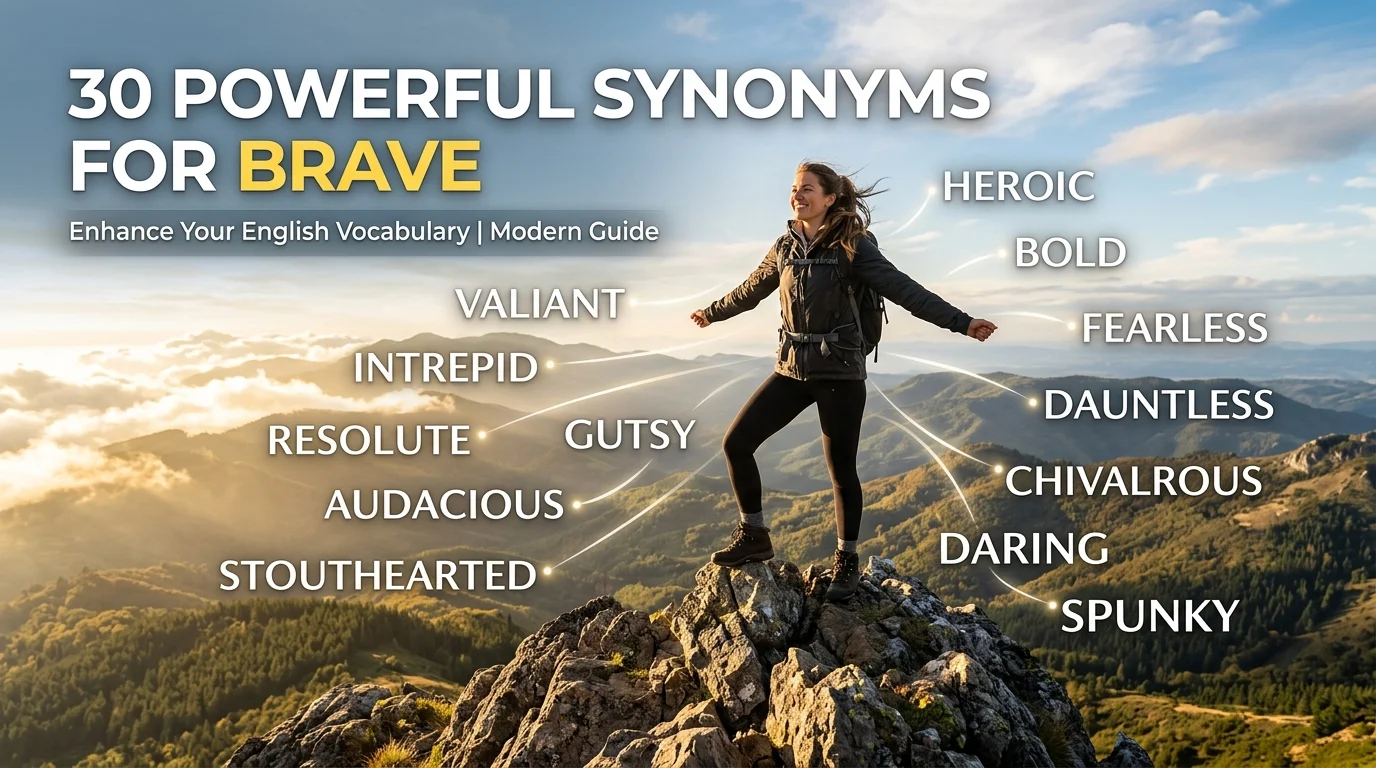
Finding the right word can make your writing clearer, stronger, and more expressive. The word brave is useful in everyday English, but it does not always describe every kind of courage.
Someone can be brave in a dangerous situation, courageous when facing a difficult decision, fearless when confronting danger, or bold when taking a risky step.
Learning synonyms for brave helps you choose words that match the exact situation and tone you want. This is especially useful for students, ESL learners, writers, speakers, and content creators who want to expand their vocabulary without making their English sound unnatural.
In this guide, you’ll find 30 synonyms for brave, along with simple meanings, example sentences, and notes about when each word works best. Some words describe physical courage, while others focus on confidence, determination, or the ability to face difficult situations.
What Does “Brave” Mean?
Brave is an adjective that describes someone who is willing to face danger, difficulty, fear, or uncertainty without giving up.
Being brave does not necessarily mean that a person feels no fear. In many situations, bravery means feeling afraid but choosing to act anyway.
For example:
Maria was brave enough to speak in front of hundreds of people.
Here, Maria may have felt nervous, but she did not allow her fear to stop her.
The word brave can describe people, actions, decisions, or behavior.
- A brave firefighter — a person who faces danger.
- A brave decision — a difficult decision made despite possible problems.
- A brave attempt — an effort made even when success is uncertain.
- A brave response — a strong response to a difficult situation.
30 Synonyms for Brave
Here are 30 useful alternatives to brave, arranged with their meanings, examples, and best usage contexts.
1. Courageous
Meaning: Having the courage to face fear, danger, or difficulty.
Example:
The courageous nurse stayed with the patients during the emergency.
Best usage: Formal writing, speeches, journalism, and serious situations.
Courageous is one of the closest and most widely useful synonyms for brave. It works especially well when describing admirable actions.
2. Fearless
Meaning: Not easily frightened or unwilling to let fear stop you.
Example:
The fearless climber continued toward the mountain’s highest point.
Best usage: Strong descriptions, adventure writing, sports, and dramatic situations.
Fearless sounds stronger than brave because it suggests a person is not easily intimidated.
3. Bold
Meaning: Willing to take risks or act confidently.
Example:
She made a bold decision to start her own business.
Best usage: Decisions, ideas, actions, business, creativity, and confident behavior.
Unlike brave, bold does not always involve physical danger. A bold idea or bold decision can simply be unusual or risky.
4. Daring
Meaning: Willing to do something difficult, dangerous, or risky.
Example:
The rescue team made a daring attempt to save the trapped hikers.
Best usage: Adventures, dangerous actions, exciting stories, and heroic situations.
Daring often suggests excitement and risk.
5. Courageous
Meaning: Showing strong courage when facing fear or difficulty.
Example:
He was courageous enough to admit his mistake publicly.
Best usage: Formal and serious contexts.
Note: Because this word is already listed as the closest synonym, writers should normally use it only once in a synonym list. Other alternatives such as valiant or gallant can provide more variety.
5. Valiant
Meaning: Showing great courage, especially during a difficult struggle.
Example:
The soldiers made a valiant effort to protect the village.
Best usage: Formal, historical, literary, or heroic writing.
Valiant has a noble and somewhat traditional tone.
6. Audacious
Meaning: Extremely bold and willing to take risks.
Example:
The company made an audacious attempt to enter an entirely new market.
Best usage: Formal writing, business, ambitious plans, and dramatic descriptions.
Audacious can be positive, but it may sometimes suggest that an action is unusually bold or even reckless.
7. Intrepid
Meaning: Fearless and determined when facing difficult or dangerous situations.
Example:
The intrepid explorer traveled across the remote desert alone.
Best usage: Formal, literary, travel, adventure, and descriptive writing.
Intrepid is a sophisticated alternative to brave and is especially useful when you want your writing to sound polished.
8. Dauntless
Meaning: Not discouraged by danger, difficulty, or fear.
Example:
The dauntless athlete continued training despite repeated injuries.
Best usage: Inspirational, formal, literary, and motivational writing.
The word emphasizes persistence and strength in the face of difficulties.
9. Heroic
Meaning: Extremely brave or showing qualities associated with a hero.
Example:
The firefighter’s heroic actions saved several lives.
Best usage: Emergencies, public recognition, storytelling, and dramatic writing.
Heroic is stronger than ordinary brave because it often suggests exceptional courage.
10. Gallant
Meaning: Brave, noble, and honorable, especially in difficult circumstances.
Example:
The gallant soldier protected his companions during the attack.
Best usage: Literary, historical, traditional, or formal writing.
This word can also describe polite or gentlemanly behavior, depending on context.
11. Plucky
Meaning: Brave and determined, especially despite being small, young, inexperienced, or disadvantaged.
Example:
The plucky young player refused to give up against the stronger team.
Best usage: Informal English, stories, sports, and descriptions of determined people.
Plucky often has a warm, positive, and slightly informal tone.
12. Spirited
Meaning: Full of energy, confidence, and determination.
Example:
The spirited student confidently defended her opinion during the debate.
Best usage: People, competitions, discussions, and positive descriptions.
Spirited does not mean brave in every situation, but it can describe someone who confidently stands up for themselves.
13. Resolute
Meaning: Very determined and unwilling to change your decision.
Example:
Despite the criticism, she remained resolute in her decision.
Best usage: Formal writing, leadership, difficult decisions, and serious situations.
Resolute focuses more on determination than physical courage.
14. Stouthearted
Meaning: Strong in courage and able to face difficult situations.
Example:
The stouthearted volunteers continued helping the community after the disaster.
Best usage: Literary, formal, and inspirational writing.
This is less common in everyday conversation but can add character to descriptive writing.
15. Hardy
Meaning: Strong enough to survive or cope with difficult conditions.
Example:
The hardy travelers continued their journey through the cold mountains.
Best usage: Difficult environments, travel, physical challenges, and nature writing.
Hardy emphasizes toughness and endurance rather than courage alone.
16. Strong-willed
Meaning: Determined and not easily influenced by other people.
Example:
She was strong-willed enough to continue pursuing her goals despite criticism.
Best usage: Personal development, character descriptions, education, and everyday writing.
A strong-willed person may be brave, but the word mainly emphasizes determination.
17. Adventurous
Meaning: Willing to try new, exciting, or risky experiences.
Example:
His adventurous personality encouraged him to explore unfamiliar places.
Best usage: Travel, hobbies, lifestyles, experiences, and personality descriptions.
Adventurous is related to bravery but focuses more on a willingness to explore and take risks.
18. Unflinching
Meaning: Remaining calm and determined without showing fear or hesitation.
Example:
The doctor gave an unflinching response to the difficult question.
Best usage: Serious situations, journalism, formal writing, and emotional descriptions.
This word is useful when you want to emphasize emotional strength.
19. Undaunted
Meaning: Not discouraged or frightened by problems.
Example:
Undaunted by the failure, the team tried again.
Best usage: Challenges, setbacks, motivational writing, and formal English.
Undaunted is especially useful when someone continues after experiencing failure or difficulty.
20. Fearless
Meaning: Showing little or no fear.
Example:
The fearless journalist investigated the dangerous story.
Best usage: Journalism, adventure, sports, storytelling, and strong character descriptions.
Because fearless has already been introduced above, avoid unnecessary repetition when creating a polished vocabulary list. Other alternatives such as undaunted may provide better variety.
20. Gutsy
Meaning: Brave, confident, and willing to take risks.
Example:
It was a gutsy move to challenge the team’s most experienced player.
Best usage: Informal conversations, sports, business, and casual writing.
Gutsy is an informal synonym and should usually be avoided in highly formal academic writing.
21. Nerveful
Meaning: Showing courage and confidence in a difficult or risky situation.
Example:
The nerveful performer continued despite the unexpected problem.
Best usage: Rare or creative usage.
Important: Nerveful is uncommon in modern standard English. In most situations, brave, courageous, bold, or fearless will sound more natural.
22. Heroic
Meaning: Extremely brave or worthy of admiration because of courageous actions.
Example:
Her heroic efforts helped the injured passengers escape.
Best usage: Emergencies, historical writing, stories, and public praise.
Heroic is particularly effective when someone’s bravery produces an important result.
23. Lionhearted
Meaning: Extremely brave and determined.
Example:
The lionhearted captain refused to abandon his team.
Best usage: Literary, motivational, sports, and dramatic writing.
The expression comes from the traditional association of the lion with courage and strength.
24. Valiant
Meaning: Showing courage and determination, especially during a struggle.
Example:
The team made a valiant effort to overcome its difficult circumstances.
Best usage: Formal, historical, literary, and inspirational contexts.
Valiant often describes an effort, struggle, attempt, or person.
25. Boldhearted
Meaning: Courageous, confident, and willing to face challenges.
Example:
The boldhearted young leader inspired others to keep moving forward.
Best usage: Creative and literary writing.
This expression is uncommon in everyday English, so bold, courageous, or brave will usually be more natural.
26. Adventurous
Meaning: Willing to experience unfamiliar or risky things.
Example:
Her adventurous spirit led her to travel across several countries.
Best usage: Travel, personality, lifestyle, and creative writing.
Use adventurous when bravery involves exploring, experimenting, or trying something new.
27. Daring
Meaning: Willing to take significant risks.
Example:
The pilot performed a daring rescue in difficult weather.
Best usage: Dangerous actions, adventure stories, sports, and dramatic writing.
Daring is a strong choice when the action involves obvious risk.
28. Intrepid
Meaning: Very brave and determined, especially during a dangerous experience.
Example:
The intrepid researchers traveled deep into the remote forest.
Best usage: Formal writing, journalism, travel writing, and adventure stories.
It is an excellent advanced vocabulary word for students who want to make their writing more sophisticated.
29. Unafraid
Meaning: Not frightened or not allowing fear to control you.
Example:
She was unafraid to ask difficult questions.
Best usage: Everyday English, personal statements, speeches, and simple writing.
Unafraid is straightforward and easy for ESL learners to understand.
30. Determined
Meaning: Having a strong intention to achieve something despite difficulties.
Example:
He remained determined to finish the project despite several setbacks.
Best usage: Goals, education, careers, challenges, and personal development.
Determined is not an exact synonym for brave, but it often describes the quality behind brave behavior.
Quick Comparison: Synonyms for Brave
Different synonyms for brave carry different meanings. Choosing the right one depends on the situation.
| Synonym | Main Idea | Tone | Best Used For |
|---|---|---|---|
| Brave | Willing to face fear or danger | Neutral | General situations |
| Courageous | Strong courage | Formal/positive | Serious situations |
| Fearless | Little or no fear | Strong | Danger and adventure |
| Bold | Confidence and risk-taking | Neutral/strong | Decisions and ideas |
| Daring | Willing to take risks | Dramatic | Dangerous actions |
| Valiant | Noble courage | Formal | Struggles and heroic efforts |
| Audacious | Extremely bold | Strong/formal | Risky plans |
| Intrepid | Fearless and determined | Formal | Adventure and exploration |
| Dauntless | Not discouraged | Formal | Challenges |
| Heroic | Exceptional courage | Strong | Rescue and sacrifice |
| Gallant | Brave and noble | Literary | Historical or heroic contexts |
| Plucky | Brave despite disadvantages | Informal | Young or underdog characters |
| Resolute | Firm and determined | Formal | Decisions and leadership |
| Hardy | Tough and enduring | Neutral | Difficult conditions |
| Adventurous | Willing to explore and take risks | Positive | Travel and experiences |
| Unflinching | Calm despite fear | Formal | Serious situations |
| Undaunted | Not discouraged by problems | Formal | Setbacks |
| Gutsy | Brave and willing to take risks | Informal | Casual speech |
| Lionhearted | Extremely courageous | Literary | Inspirational writing |
| Unafraid | Not frightened | Neutral | Everyday English |
| Determined | Persistent despite difficulty | Neutral | Goals and challenges |
Brave vs. Courageous: What’s the Difference?
Brave and courageous are extremely close in meaning.
However, courageous often sounds slightly more formal and emphasizes the quality of courage.
Compare:
- She was brave enough to tell the truth.
- She was courageous enough to tell the truth despite the consequences.
Both sentences are correct. The second sentence has a slightly more formal and serious tone.
For everyday English, brave is usually the easier choice. For essays, speeches, articles, or formal descriptions, courageous can sound more polished.
Brave vs. Fearless
These words are related but not identical.
Brave means you face fear or danger despite the fear.
Fearless suggests that you show little or no fear.
For example:
The firefighter was brave because he entered the burning building despite the danger.
The fearless firefighter seemed completely unafraid of the flames.
The first focuses on overcoming fear. The second emphasizes the absence of fear.
Brave vs. Bold
Bold usually focuses on confidence and willingness to take risks.
For example:
- A brave soldier faces danger.
- A bold entrepreneur takes a major business risk.
- A brave student speaks up against unfair treatment.
- A bold designer creates an unusual new style.
So, use brave when fear or danger is important. Use bold when confidence, originality, or risk-taking is the main idea.
Brave vs. Daring
Daring suggests taking a significant risk.
For example:
The rescue team made a daring attempt to reach the climbers.
This sounds more dramatic than:
The rescue team made a brave attempt to reach the climbers.
Use daring when you want to highlight the risky or exciting nature of an action.
Brave vs. Determined
These words describe different qualities.
Brave focuses on facing fear.
Determined focuses on continuing toward a goal despite difficulties.
For example:
She was brave enough to speak publicly about the problem.
She was determined to solve the problem.
A person can be determined without being brave, and a brave person does not always need to be persistent.
How to Choose the Right Synonym for Brave
The best synonym depends on what you are trying to communicate.
For General Courage
Choose:
- Brave
- Courageous
- Unafraid
These are the safest choices for everyday English.
For Facing Danger
Choose:
- Fearless
- Daring
- Intrepid
- Dauntless
- Unflinching
These words work well when danger or fear is central to the situation.
For Risk-Taking
Choose:
- Bold
- Audacious
- Daring
- Gutsy
These are useful for business decisions, creative ideas, competitions, and ambitious actions.
For Heroic Actions
Choose:
- Heroic
- Valiant
- Gallant
- Lionhearted
These words are especially effective when someone performs an admirable or extraordinary act.
For Determination
Choose:
- Resolute
- Undaunted
- Strong-willed
- Determined
These words emphasize persistence and mental strength.
For Adventure and Exploration
Choose:
- Adventurous
- Intrepid
- Fearless
- Daring
These are useful in travel writing, adventure stories, and descriptions of explorers.
For Informal English
Choose:
- Gutsy
- Plucky
- Bold
These can make casual writing sound more natural and lively.
Synonyms for Brave in Different Situations
The word you choose can change depending on the situation.
Brave Person
Instead of saying:
He is a brave person.
You could say:
- He is a courageous person.
- He is fearless.
- He is intrepid.
- He is dauntless.
- He is lionhearted.
Brave Decision
Instead of:
She made a brave decision.
You could write:
- She made a bold decision.
- She made a courageous decision.
- She made a daring decision.
- She made an audacious decision.
For a business or creative context, bold is often the most natural choice.
Brave Action
Instead of:
It was a brave action.
You could say:
- It was a courageous act.
- It was a heroic act.
- It was a daring act.
- It was a valiant effort.
Brave Student
Instead of:
The brave student asked a difficult question.
You could say:
The courageous student asked a difficult question.
Or:
The bold student challenged the commonly accepted idea.
The best option depends on whether you want to emphasize courage or confidence.
Synonyms for Brave in Writing
Writers should avoid replacing brave with a complicated word simply to make a sentence sound sophisticated.
The best synonym is the one that communicates the intended meaning naturally.
For example, in a children’s story:
The brave little girl entered the dark forest.
sounds more natural than:
The intrepid little girl entered the dark forest.
But in a formal travel article:
The intrepid explorers crossed the remote mountain range.
may sound much more appropriate.
Good vocabulary is not about using the most difficult word. It is about choosing the most accurate word for the context.
Synonyms for Brave in Academic Writing
For essays and academic assignments, consider using:
- Courageous
- Resolute
- Determined
- Daring
- Audacious
- Undaunted
However, always check the exact meaning before replacing brave.
For example, audacious can sometimes suggest that an action is excessively bold, while determined focuses on persistence rather than courage.
A sentence such as:
The activist made a courageous decision to speak publicly.
is appropriate for a serious academic discussion.
Synonyms for Brave in Creative Writing
Creative writers have more freedom to choose expressive vocabulary.
Words such as:
- Lionhearted
- Dauntless
- Gallant
- Valiant
- Intrepid
- Daring
can create a stronger image of a character.
For example:
The dauntless captain stood at the front of the ship as the storm approached.
The word dauntless gives the sentence a more dramatic feeling than simply saying:
The brave captain stood at the front of the ship.
Common Phrases With Brave
Learning common expressions can also help ESL learners use the word naturally.
Brave Enough to
Used when someone has enough courage to do something.
Example:
She was brave enough to admit that she was wrong.
Brave the Storm
Means to face a difficult or dangerous situation.
Example:
The rescue workers braved the storm to reach the village.
Put on a Brave Face
Means to appear calm or positive during a difficult situation.
Example:
He put on a brave face even though he was worried.
Brave New World
An expression referring to a new or unfamiliar situation, often with uncertainty about the future.
Example:
Artificial intelligence is creating a brave new world of possibilities.
Antonyms of Brave
Understanding opposites can make the meaning of brave clearer.
Common antonyms include:
- Cowardly
- Fearful
- Afraid
- Timid
- Frightened
- Hesitant
- Nervous
- Faint-hearted
- Chicken-hearted
- Craven
The appropriate antonym depends on the context.
For example, timid often describes someone who lacks confidence, while cowardly is a much stronger and more negative judgment.
Frequently Asked Questions About Synonyms for Brave
What is the best synonym for brave?
Courageous is one of the closest and most versatile synonyms for brave. Other choices include fearless, bold, daring, valiant, and intrepid, depending on the context.
What is a strong word for brave?
Strong alternatives include fearless, dauntless, intrepid, lionhearted, heroic, and valiant.
What is a simple synonym for brave?
For ESL learners and everyday English, courageous, bold, fearless, and daring are useful alternatives.
What is a synonym for brave in formal writing?
Good formal choices include courageous, valiant, resolute, intrepid, dauntless, and undaunted.
What is a synonym for brave in informal English?
Gutsy, plucky, and bold can work well in informal contexts.
Is “fearless” the same as “brave”?
Not exactly. Fearless suggests having little or no fear, while brave often means facing fear despite being afraid.
Is “bold” a synonym for brave?
Yes, in some contexts. Bold emphasizes confidence and willingness to take risks, while brave more directly relates to facing fear or danger.
Is “strong” a synonym for brave?
Not usually. A person can be physically or mentally strong without being brave. However, strength and bravery can be related qualities.
Is “confident” a synonym for brave?
Not exactly. Confident means believing in your abilities, while brave means being willing to face fear, danger, or difficulty.
Final Thoughts on Synonyms for Brave
The word brave is simple, powerful, and useful, but English gives you many ways to express different types of courage.
Use courageous when you want a close and slightly more formal alternative. Choose fearless when you want to emphasize the absence of fear. Use bold for confident risk taking, daring for risky actions, and intrepid for adventurous courage.
For heroic situations, words such as valiant, heroic, and lionhearted can add a stronger emotional effect. When persistence matters more than physical danger, resolute, undaunted, and determined may be better choices.
The most important lesson is that synonyms are not always interchangeable. Each word has its own tone, strength, and context. By understanding these small differences, you can make your English more precise, natural, and expressive.
If you are writing an essay, learning English, creating content, or developing a story, choosing the right synonym for brave can make your writing much more effective.

I am Joel Michael, an enthusiastic language writer and synonym enthusiast. I enjoy exploring words, finding their meanings, and discovering useful alternatives. I create clear, helpful content to make vocabulary learning simple and enjoyable for every reader.