Feeling scared is a natural human reaction. We use the word scared when someone feels afraid, worried, nervous, or threatened. It is one of the most common words for describing fear, but using the same word repeatedly can make writing sound simple or repetitive.
If you are a student writing an essay, an ESL learner building vocabulary, or a writer creating a story, knowing different synonyms for scared can help you express exactly how someone feels.
For example, a person might be nervous before an exam, frightened by a sudden noise, terrified during a dangerous situation, or panicked when they cannot find their child.
The important thing is that these words are not always interchangeable. Each synonym has a slightly different meaning, emotional strength, or usage context. This guide explains 30 useful alternatives to “scared” in simple English, with examples and practical guidance for choosing the right word.
What Does “Scared” Mean?
Scared means feeling fear or being afraid because you believe something may be dangerous, unpleasant, or harmful.
For example:
“The child was scared when he heard a strange noise.”
The word scared is common, natural, and informal. It works well in everyday conversations and general writing.
Depending on the situation, however, you may want a stronger, softer, or more specific word. Someone who feels mild concern is not experiencing the same emotion as someone who is completely overwhelmed by fear.
Scared can describe different levels of fear
- Mild fear: uneasy, nervous, apprehensive
- General fear: afraid, frightened, fearful
- Strong fear: alarmed, horrified, terrified
- Extreme or sudden fear: panicked, petrified, terrified
- Fear mixed with uncertainty: apprehensive, worried, anxious
Understanding these differences makes your vocabulary more precise.
30 Synonyms for Scared
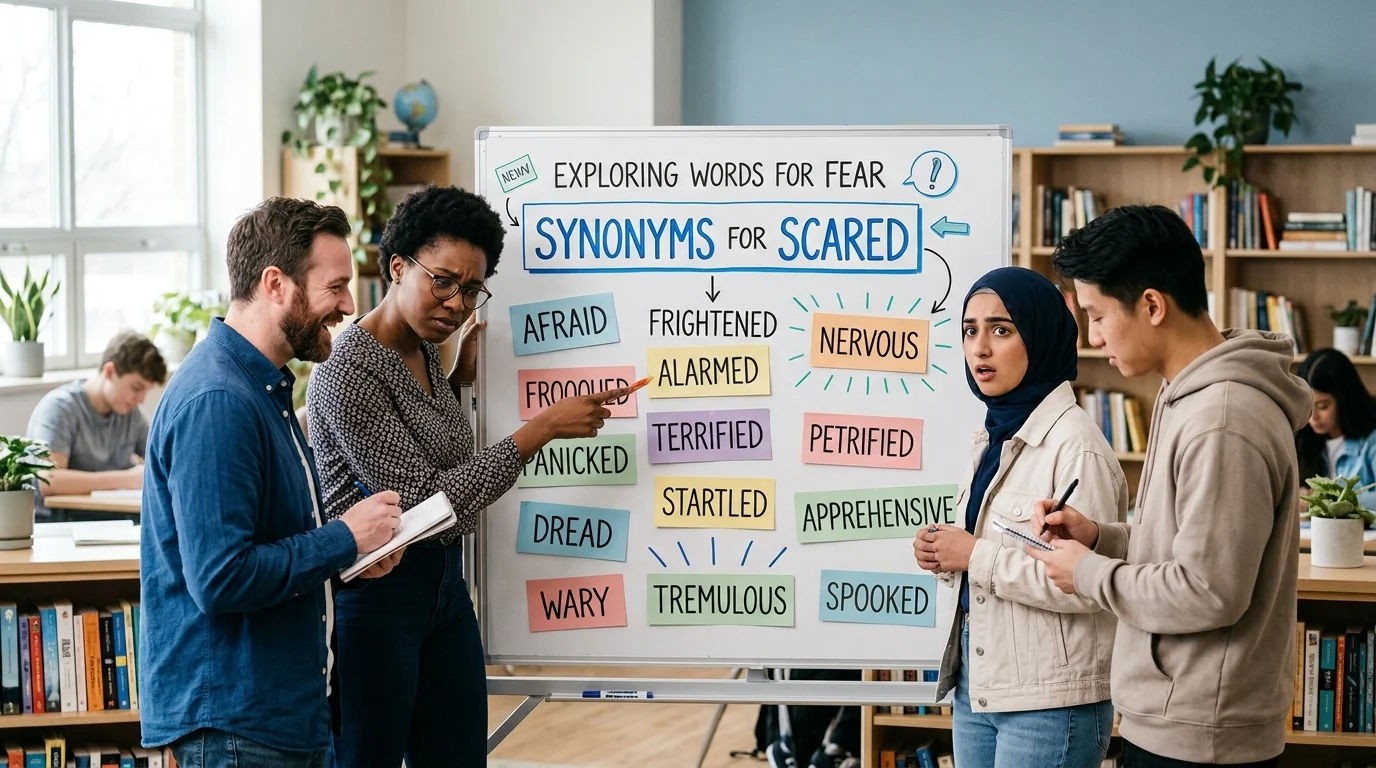
Here are 30 useful synonyms and related words for scared, arranged with their meanings, examples, and best uses.
1. Afraid
Meaning: Feeling fear or believing that something bad may happen.
Example:
“She was afraid to walk home alone at night.”
Best usage: Everyday English and general writing. “Afraid” is one of the closest and most natural synonyms for “scared.”
2. Frightened
Meaning: Feeling fear because of something dangerous, surprising, or threatening.
Example:
“The frightened dog ran under the table.”
Best usage: General writing, storytelling, and situations involving a noticeable feeling of fear.
Scared vs. frightened: Both have nearly the same basic meaning. “Frightened” can sometimes sound slightly more descriptive or formal.
3. Fearful
Meaning: Feeling or showing fear, especially because you expect something unpleasant or dangerous.
Example:
“The fearful traveler hesitated before entering the dark building.”
Best usage: Formal writing, literature, and descriptions of someone’s emotional state.
4. Terrified
Meaning: Extremely scared.
Example:
“She was terrified when she realized she was lost.”
Best usage: Use this when the fear is very strong.
Intensity: ★★★★★
“Terrified” is much stronger than ordinary “scared.”
5. Frightened
Meaning: Afraid or startled by something.
Example:
“The loud thunder frightened the children.”
Best usage: Everyday descriptions, stories, and situations involving sudden or noticeable fear.
6. Alarmed
Meaning: Suddenly worried or frightened because something seems dangerous or wrong.
Example:
“Everyone became alarmed when smoke began filling the room.”
Best usage: Emergencies, unexpected problems, news, or situations that require immediate attention.
7. Panicked
Meaning: So frightened or worried that you have difficulty thinking calmly.
Example:
“He panicked when he could not find his passport.”
Best usage: Sudden fear that causes confusion, rushed decisions, or loss of control.
Important distinction: Being scared does not always mean being panicked. Panic usually suggests a stronger emotional reaction.
8. Petrified
Meaning: Extremely frightened, sometimes to the point of being unable to move or react normally.
Example:
“She was petrified when she saw the snake beside her.”
Best usage: Strong fear, especially in dramatic or descriptive writing.
Intensity: ★★★★★
“Petrified” is an expressive word and can make storytelling more vivid.
9. Horrified
Meaning: Extremely shocked, frightened, or upset by something terrible or disturbing.
Example:
“The residents were horrified by the damage caused by the storm.”
Best usage: Situations involving something shocking, disturbing, cruel, or terrible.
Note: “Horrified” often combines fear with shock or disgust.
10. Apprehensive
Meaning: Worried or nervous about something that may happen in the future.
Example:
“She felt apprehensive about starting her new job.”
Best usage: Formal or academic writing and situations involving uncertainty about the future.
Scared vs. apprehensive: “Apprehensive” usually involves anticipation, while “scared” can happen in response to something happening right now.
11. Nervous
Meaning: Worried, uneasy, or afraid about what might happen.
Example:
“I felt nervous before giving my presentation.”
Best usage: Exams, interviews, presentations, meetings, social situations, and other uncertain events.
Important: “Nervous” often describes mild fear or anxiety rather than serious danger.
12. Anxious
Meaning: Worried or uneasy about something that may happen.
Example:
“He was anxious about the results of his exam.”
Best usage: Worry about future events, uncertainty, or possible negative outcomes.
Note: “Anxious” can mean worried, but in some contexts it can also mean very eager for something.
13. Uneasy
Meaning: Slightly worried, uncomfortable, or unsure.
Example:
“I felt uneasy walking through the empty building.”
Best usage: Mild fear or discomfort when something does not feel right.
Intensity: ★★☆☆☆
“Uneasy” is a softer alternative to “scared.”
14. Worried
Meaning: Thinking about a problem or possible danger with concern or fear.
Example:
“Her parents were worried when she did not come home on time.”
Best usage: Everyday situations involving concern about people, events, or possible problems.
Scared vs. worried: Fear often focuses on danger, while worry commonly focuses on uncertainty or possible future problems.
15. Startled
Meaning: Suddenly surprised or frightened by something unexpected.
Example:
“I was startled by the sudden crash.”
Best usage: Sudden noises, movements, surprises, or unexpected events.
Note: Being startled is usually brief.
16. Shaken
Meaning: Emotionally disturbed or upset after a frightening or shocking experience.
Example:
“The driver was shaken after the accident.”
Best usage: Describing how someone feels after something frightening has already happened.
Important distinction: “Shaken” usually describes the emotional effect of fear rather than the immediate moment of becoming scared.
17. Intimidated
Meaning: Feeling afraid or less confident because someone or something seems powerful, threatening, or difficult.
Example:
“She felt intimidated by the experienced competitors.”
Best usage: Social situations, competition, authority figures, difficult tasks, or powerful people.
18. Daunted
Meaning: Feeling worried or discouraged because something seems very difficult.
Example:
“He was daunted by the amount of work required for the project.”
Best usage: Difficult challenges rather than physical danger.
Note: “Daunted” is closer to feeling overwhelmed or discouraged than simply frightened.
19. Timid
Meaning: Shy and lacking confidence, especially because you are afraid of doing something.
Example:
“The timid student hesitated before answering the question.”
Best usage: Describing a person’s general personality or behavior.
Note: “Timid” usually describes a continuing tendency rather than a sudden moment of fear.
20. Cowardly
Meaning: Showing a lack of courage because of fear.
Example:
“His cowardly decision surprised everyone.”
Best usage: Describing behavior that is considered weak or lacking courage.
Caution: “Cowardly” is judgmental and should not be used as a neutral synonym for “scared.”
21. Skittish
Meaning: Easily frightened or nervous, especially about sudden movements or unfamiliar situations.
Example:
“The skittish horse became nervous when it heard the fireworks.”
Best usage: Animals, nervous people, or situations involving sudden movements and uncertainty.
22. Spooked
Meaning: Suddenly frightened or made nervous.
Example:
“The horse was spooked by the loud noise.”
Best usage: Informal conversations and storytelling.
“Spooked” is particularly natural when something unexpected causes a sudden feeling of fear.
23. Trepidatious
Meaning: Feeling nervous or fearful about something that is going to happen.
Example:
“She was trepidatious about moving to a new city.”
Best usage: Formal, literary, or sophisticated writing.
Note: “Trepidatious” is less common in everyday conversation than “nervous” or “apprehensive.”
24. Dreadful
Meaning: Extremely unpleasant or causing fear.
Example:
“He had a dreadful feeling that something had gone wrong.”
Best usage: Describing an unpleasant feeling, situation, or expectation.
Note: “Dreadful” does not always directly mean “scared.” It can also mean very bad or unpleasant.
25. Dreading
Meaning: Feeling strong fear or worry about something that you expect to happen.
Example:
“She was dreading the difficult conversation with her manager.”
Best usage: Fear or anxiety about an upcoming event.
Scared vs. dreading: “Scared” can describe an immediate emotional response, while “dreading” usually looks toward something expected in the future.
26. Horror-stricken
Meaning: Extremely shocked and frightened by something terrible.
Example:
“The horror-stricken witnesses struggled to understand what had happened.”
Best usage: Dramatic, literary, or highly descriptive writing.
27. Fear-stricken
Meaning: Strongly affected or overwhelmed by fear.
Example:
“The fear-stricken passengers waited for help.”
Best usage: Literary writing, journalism, and dramatic descriptions.
28. Frantic
Meaning: Extremely worried, frightened, or excited and unable to remain calm.
Example:
“The frantic parents searched everywhere for their missing child.”
Best usage: Situations where fear or worry causes urgent, uncontrolled activity.
Note: “Frantic” emphasizes behavior as much as emotion.
29. Chilled
Meaning: Suddenly made afraid or uncomfortable, especially by something disturbing.
Example:
“The strange story chilled everyone in the room.”
Best usage: Descriptive and literary writing, particularly for eerie or disturbing situations.
30. Scared stiff
Meaning: Extremely frightened.
Example:
“The sudden scream scared me stiff.”
Best usage: Informal speech and storytelling.
This is an idiomatic expression rather than a single-word synonym. It is useful when you want to emphasize intense fear in a conversational way.
Quick Comparison: Synonyms for Scared by Strength
Not every synonym has the same emotional intensity. Here is a simple guide:
| Word | Approximate Fear Level | Main Idea | Best Context |
|---|---|---|---|
| Uneasy | ★★☆☆☆ | Slight discomfort | Something feels wrong |
| Nervous | ★★☆☆☆ | Mild worry | Exams, interviews |
| Apprehensive | ★★☆☆☆ | Fear about the future | Formal writing |
| Worried | ★★☆☆☆ | Concern about a problem | Everyday situations |
| Startled | ★★☆☆☆ | Sudden surprise | Unexpected events |
| Afraid | ★★★☆☆ | General fear | Everyday English |
| Scared | ★★★☆☆ | General fear | Everyday English |
| Frightened | ★★★☆☆ | Noticeable fear | General writing |
| Alarmed | ★★★☆☆ | Sudden concern | Emergencies |
| Shaken | ★★★☆☆ | Emotional effect after fear | Accidents, shocks |
| Intimidated | ★★★☆☆ | Fear caused by power or difficulty | Social situations |
| Spooked | ★★★☆☆ | Sudden informal fear | Casual speech |
| Fearful | ★★★☆☆ | Showing fear | Formal/literary writing |
| Panicked | ★★★★☆ | Fear causing loss of calm | Emergencies |
| Horrified | ★★★★☆ | Fear plus shock | Disturbing events |
| Petrified | ★★★★★ | Extreme fear | Dramatic situations |
| Terrified | ★★★★★ | Extreme fear | Strong emotional reactions |
| Scared stiff | ★★★★★ | Extremely frightened | Informal speech |
Scared vs. Afraid vs. Frightened
These three words are among the most common alternatives to “scared.”
Scared
“Scared” is very common and natural.
Example:
“I was scared when the lights suddenly went out.”
Afraid
“Afraid” is equally common but can sound slightly more neutral in some sentences.
Example:
“She was afraid of heights.”
Frightened
“Frightened” often sounds a little more descriptive and works well in narrative writing.
Example:
“The frightened child held tightly onto her mother’s hand.”
For everyday conversation, all three can often work. Your choice depends mostly on style and context.
Scared vs. Terrified
The biggest difference is intensity.
Scared:
“The boy was scared when he heard the thunder.”
Terrified:
“The boy was terrified when he became trapped in the burning building.”
Both words describe fear, but “terrified” communicates a much stronger emotional reaction.
Use scared for ordinary fear and terrified when the fear is extreme.
Scared vs. Nervous
These words are related but not identical.
Scared usually means you feel fear because something seems dangerous or threatening.
Nervous usually means you feel worried or uncomfortable because you are uncertain about what will happen.
Compare:
- “I was scared when I saw the snake.”
- “I was nervous before my job interview.”
A job interview may not be dangerous, so “nervous” is more natural.
Scared vs. Anxious
“Anxious” commonly describes worry about something that might happen.
For example:
“She was anxious about her test results.”
“Scared” can be more direct:
“She was scared that she might fail.”
In many situations, both words work, but “anxious” often emphasizes uncertainty and anticipation.
Scared vs. Panicked
Panic is stronger than ordinary fear.
Someone can be scared while remaining calm enough to make a sensible decision. A person who is panicked may struggle to think clearly.
For example:
“I was scared when I lost my phone.”
But:
“I panicked when I realized I had lost my passport at the airport.”
Use panicked when fear leads to an urgent or uncontrolled reaction.
How to Choose the Right Synonym for Scared
Choosing the best synonym depends on how strong the fear is, what caused it, and how the person reacts.
For mild fear
Use:
- Uneasy
- Nervous
- Apprehensive
- Worried
- Anxious
Example:
“She felt uneasy about walking through the unfamiliar neighborhood.”
These words work well when there is concern but not overwhelming terror.
For ordinary fear
Use:
- Scared
- Afraid
- Frightened
- Fearful
These are good general-purpose choices.
Example:
“The children were frightened by the storm.”
For sudden fear
Use:
- Startled
- Alarmed
- Spooked
These words are useful when something unexpected happens.
Example:
“He was startled by someone knocking loudly on the door.”
For extreme fear
Use:
- Terrified
- Petrified
- Horror-stricken
- Fear-stricken
- Scared stiff
These words create a much stronger emotional effect.
Example:
“She was petrified when she discovered that she was alone in the dark.”
For fear about the future
Use:
- Apprehensive
- Anxious
- Nervous
- Dreading
- Trepidatious
These words are especially useful when the feared event has not happened yet.
Example:
“He was apprehensive about starting college.”
For fear caused by a powerful person or difficult situation
Use:
- Intimidated
- Daunted
- Timid
These words are better when the fear is connected to confidence, ability, authority, or difficulty.
Example:
“The new employee felt intimidated by the senior executives.”
For fear that causes frantic behavior
Use:
- Panicked
- Frantic
These words emphasize how fear affects someone’s actions.
Example:
“She became frantic when she realized her child was missing.”
Synonyms for Scared in Different Writing Situations
For essays and academic writing
In formal writing, avoid repeating “scared” too often. Depending on the meaning, consider:
- Fearful
- Apprehensive
- Anxious
- Concerned
- Alarmed
Example:
Instead of:
“The citizens were scared about the new situation.”
You could write:
“The citizens were apprehensive about the new situation.”
The second version is more precise for formal writing.
For creative writing
Writers can use stronger and more descriptive words such as:
- Terrified
- Petrified
- Horror-stricken
- Fear-stricken
- Shaken
- Spooked
You can also describe the physical effects of fear rather than simply naming the emotion.
For example:
“She was scared.”
could become:
“Her hands trembled as she stared at the dark doorway.”
The second sentence shows fear instead of simply telling the reader that the character is scared.
For everyday conversation
The most natural choices include:
- Scared
- Afraid
- Nervous
- Worried
- Frightened
- Spooked
- Panicked
These words are easy for most English speakers to understand.
How to Use Fear Synonyms More Naturally
Simply replacing “scared” with a more complicated word does not automatically improve your writing. The replacement should match the situation.
Consider this sentence:
“I was petrified before my English exam.”
Grammatically, this is possible. However, “nervous” may be more natural because an exam usually creates worry rather than extreme terror.
A better sentence would be:
“I was nervous before my English exam.”
On the other hand:
“I was petrified when the car suddenly lost control.”
Here, “petrified” makes sense because the situation involves an immediate and serious threat.
Think about three questions:
1. How strong is the fear?
Is it mild, moderate, or extreme?
2. What caused the fear?
Is it danger, uncertainty, surprise, pressure, or another person?
3. How does the person react?
Do they hesitate, worry, freeze, panic, or run away?
Answering these questions will help you choose a more accurate synonym.
Common Phrases With Scared
The word “scared” appears in many useful English expressions.
Scared of
Used to describe something that causes fear.
“She is scared of spiders.”
Scared to
Used before an action someone is afraid to perform.
“He was scared to speak in front of the audience.”
Scared that
Used when someone fears that something may happen.
“I was scared that we would miss the train.”
Scared stiff
An informal expression meaning extremely frightened.
“The horror movie scared me stiff.”
Scared out of my wits
An informal expression meaning extremely frightened.
“That noise scared me out of my wits.”
Why Learning Synonyms for Scared Matters
Learning alternatives to “scared” is not only about memorizing a vocabulary list. It helps you communicate more accurately.
For students, a wider vocabulary can make essays and assignments more precise.
For ESL learners, understanding the difference between words such as nervous, afraid, terrified, and apprehensive makes everyday English easier to understand.
For writers, precise fear words help create believable characters and stronger emotional scenes.
For content creators, varied vocabulary can make articles, stories, scripts, and social media content more engaging without sounding repetitive.
The key is not to use the most sophisticated word available. The best word is the one that communicates the intended emotion clearly.
Frequently Asked Questions About Synonyms for Scared
What is the best synonym for scared?
Afraid is one of the closest general synonyms for “scared.” Other choices include frightened, fearful, nervous, anxious, terrified, and alarmed, depending on the situation.
What is a stronger word for scared?
Terrified and petrified are strong alternatives. They describe extreme fear.
What is a mild synonym for scared?
Words such as uneasy, nervous, apprehensive, and worried can describe milder forms of fear or concern.
What is a formal word for scared?
Fearful, apprehensive, and alarmed can work well in formal writing, depending on the context.
What is a synonym for scared in creative writing?
Creative writers can use words such as petrified, terrified, horrified, shaken, fear-stricken, or horror-stricken when the context supports them.
Is “anxious” a synonym for scared?
Sometimes. “Anxious” often describes worry or fear about a future event, while “scared” can describe a more immediate response to danger.
Is “nervous” the same as “scared”?
Not exactly. “Nervous” usually describes mild worry or discomfort, particularly about an uncertain event. “Scared” generally indicates fear.
What is the difference between scared and terrified?
“Terrified” means extremely scared. It is much stronger than the everyday word “scared.”
Final Takeaway
There are many useful synonyms for scared, but they do not all communicate exactly the same emotion. Afraid, frightened, and fearful are useful general alternatives, while nervous, uneasy, and apprehensive work better for mild fear or worry.
For intense fear, words such as terrified, petrified, and horrified create a much stronger impression.The best synonym depends on the situation.
If something happens suddenly, startled or alarmed may be appropriate. If fear causes someone to lose control, panicked or frantic may be more accurate. If someone is worried about a future event, anxious, apprehensive, or dreading may be better choices.
Instead of simply searching for a complicated replacement for “scared,” focus on the exact feeling you want to describe. Choosing the right word will make your English more natural, precise, and expressive.

I am Derek Thomas, a passionate word enthusiast and writer. I enjoy exploring synonyms, expanding vocabulary, and helping readers find clear, accurate, and meaningful words for better writing.