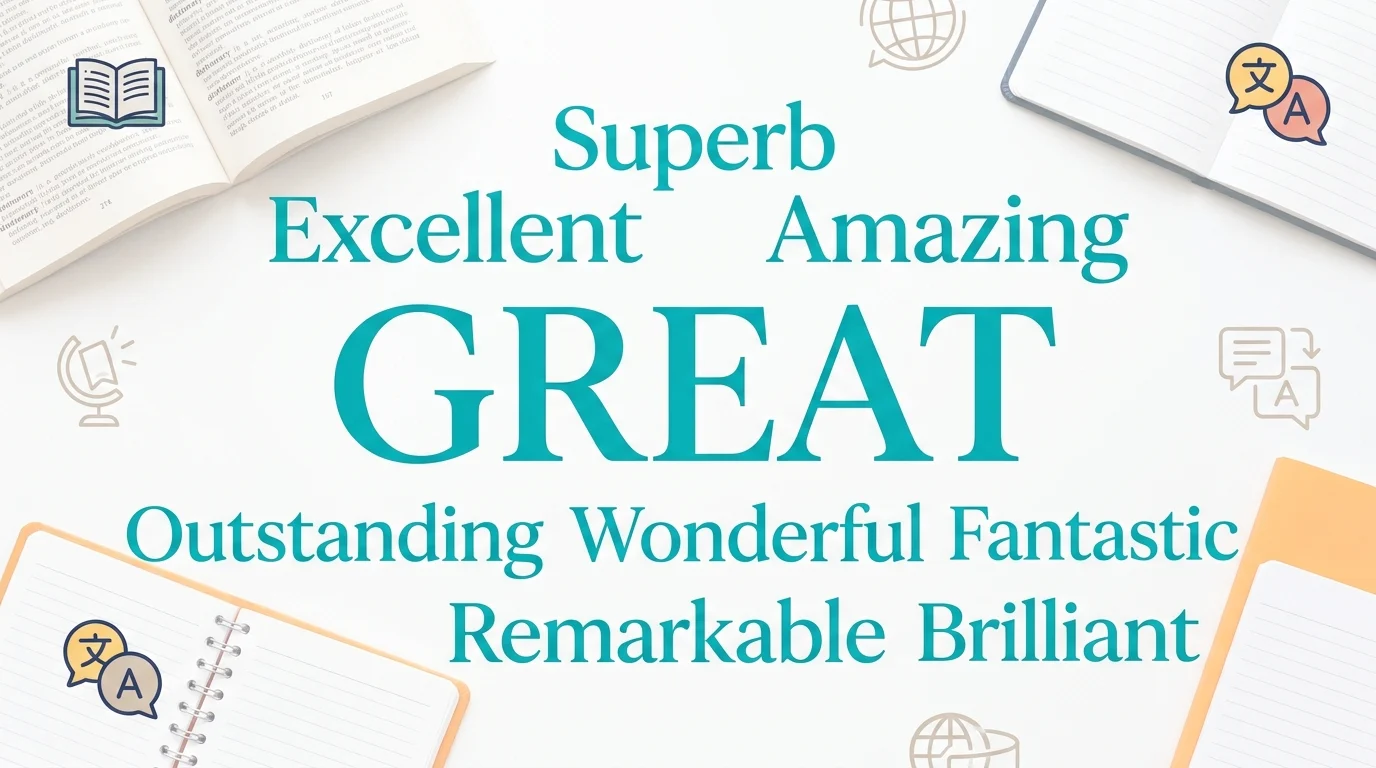
The word great is one of the most common and useful words in English. We use it to describe something excellent, impressive, enjoyable, important, successful, or even large in size.
Because it can fit so many situations, it is easy to use “great” repeatedly. However, using different words can make your English more precise, interesting, and natural.
Learning synonyms for great is especially helpful for students, ESL learners, writers, and content creators. Instead of saying “That was a great movie,” you might say “That was an excellent movie,” “an outstanding movie,” or “an impressive movie.”
Each alternative adds a slightly different feeling or meaning.The best synonym depends on what you want to express.
Some words emphasize quality, while others suggest importance, size, success, or admiration. This guide explains 30 useful alternatives to “great” in simple English, with examples and practical advice on when to use each word.
What Does “Great” Mean?
Great generally means very good, excellent, important, impressive, or larger than usual. Its exact meaning depends on the context.
For example:
- She is a great teacher. — She is an excellent teacher.
- We had a great time. — We enjoyed ourselves very much.
- He showed great courage. — His courage was remarkable.
- A great number of people attended. — A large number of people attended.
Tone and Usage of “Great”
“Great” is usually positive, friendly, and flexible. It works well in casual conversations, professional writing, reviews, essays, and everyday English.
However, because it is so common, repeating it too often can make writing feel less specific. Choosing a more precise synonym can help readers understand exactly what you mean.
30 Synonyms for Great
Below are 30 useful synonyms for “great,” including simple meanings, example sentences, and the situations where each word works best.
1. Excellent
Meaning: Extremely good or of very high quality.
Example:
The restaurant provided excellent service.
Best usage context:
Use “excellent” when you want to describe very high quality in a clear, professional way.
2. Wonderful
Meaning: Very enjoyable, pleasing, or impressive.
Example:
We had a wonderful evening together.
Best usage context:
Best for experiences, people, events, and things that create a strong positive feeling.
3. Fantastic
Meaning: Extremely good, exciting, or impressive.
Example:
You did a fantastic job on the presentation.
Best usage context:
Useful in enthusiastic and informal communication.
4. Amazing
Meaning: Very surprising, impressive, or enjoyable.
Example:
The view from the mountain was amazing.
Best usage context:
Use it when something creates a strong feeling of surprise or admiration.
5. Outstanding
Meaning: Much better than usual or better than others.
Example:
She gave an outstanding performance.
Best usage context:
Excellent for academic, professional, artistic, or performance-related situations.
6. Exceptional
Meaning: Unusually excellent or far above average.
Example:
The student demonstrated exceptional creativity.
Best usage context:
Use “exceptional” when something stands clearly above normal standards.
7. Superb
Meaning: Extremely good or excellent.
Example:
The chef prepared a superb meal.
Best usage context:
Useful for praising quality, skill, food, performances, or craftsmanship.
8. Magnificent
Meaning: Extremely impressive, beautiful, or grand.
Example:
The palace looked magnificent at sunset.
Best usage context:
Best for impressive sights, buildings, achievements, and grand experiences.
9. Brilliant
Meaning: Extremely clever, successful, or impressive.
Example:
That was a brilliant solution to the problem.
Best usage context:
Often used for ideas, decisions, performances, and intelligent work. In British English, it is also common as a general way to say “excellent.”
10. Remarkable
Meaning: Unusual or impressive enough to deserve attention.
Example:
She made remarkable progress in just three months.
Best usage context:
Use it when something is noticeably impressive or unusual.
11. Impressive
Meaning: Something that causes admiration because of its quality, size, skill, or achievement.
Example:
His presentation was very impressive.
Best usage context:
Ideal when you want to emphasize the effect something has on an observer.
12. Superb
Meaning: Exceptionally good or high in quality.
Example:
The hotel offers superb facilities.
Best usage context:
Good for formal or semi-formal praise of quality and service.
13. Terrific
Meaning: Extremely good, exciting, or enjoyable.
Example:
We had a terrific time at the concert.
Best usage context:
Common in friendly and conversational English.
14. Marvelous
Meaning: Wonderful, excellent, or very pleasing.
Example:
She gave us some marvelous advice.
Best usage context:
Useful for expressing strong admiration, especially in conversational or descriptive writing.
15. Phenomenal
Meaning: Extremely impressive or unusually successful.
Example:
The company experienced phenomenal growth.
Best usage context:
Best when describing unusually strong results, success, talent, or performance.
16. Spectacular
Meaning: Very impressive, beautiful, or exciting to see.
Example:
The fireworks display was spectacular.
Best usage context:
Use it for visual experiences, events, achievements, or dramatic situations.
17. First-rate
Meaning: Of the highest quality.
Example:
The university provides first-rate educational facilities.
Best usage context:
Useful for describing high-quality services, products, education, or professional work.
18. Top-notch
Meaning: Excellent and of very high quality.
Example:
The company is known for its top-notch customer service.
Best usage context:
Best for informal or semi-formal conversations about quality.
19. Stellar
Meaning: Exceptionally good or impressive.
Example:
She has had a stellar career in journalism.
Best usage context:
Often used for achievements, careers, performances, records, and results.
20. Glorious
Meaning: Wonderful, beautiful, or deserving admiration.
Example:
It was a glorious summer morning.
Best usage context:
Works particularly well in descriptive and expressive writing.
21. Grand
Meaning: Impressive, important, large, or ambitious.
Example:
They made grand plans for the future.
Best usage context:
Use it for large ideas, celebrations, buildings, ambitions, or impressive occasions.
22. Significant
Meaning: Important or meaningful.
Example:
The discovery was a significant achievement for the research team.
Best usage context:
Use “significant” when “great” means important rather than simply excellent.
23. Important
Meaning: Having considerable value, influence, or meaning.
Example:
She played an important role in the project.
Best usage context:
Best when “great” refers to importance or influence.
24. Major
Meaning: Very important, serious, or large in effect.
Example:
The company made a major investment in technology.
Best usage context:
Useful in business, academic, news, and professional writing.
25. Huge
Meaning: Very large in size, amount, or degree.
Example:
The project was a huge success.
Best usage context:
Use it when “great” means very large or substantial. It is common in everyday English.
26. Enormous
Meaning: Extremely large in size, amount, or degree.
Example:
The new stadium attracted an enormous crowd.
Best usage context:
Best when describing physical size, quantity, impact, or scale.
27. Vast
Meaning: Extremely large or extensive.
Example:
The organization has vast experience in international markets.
Best usage context:
Useful for areas, amounts, knowledge, experience, resources, and other large-scale concepts.
28. Noble
Meaning: Morally good, honorable, or worthy of respect.
Example:
Helping vulnerable people is a noble cause.
Best usage context:
Use “noble” when “great” refers to admirable character, intentions, or actions.
29. Admirable
Meaning: Worthy of respect or approval.
Example:
Her dedication to helping others is admirable.
Best usage context:
Good for describing people’s qualities, behavior, effort, courage, or decisions.
30. Accomplished
Meaning: Highly skilled or successful in a particular area.
Example:
She is an accomplished writer with several published books.
Best usage context:
Use it for people who have achieved a high level of skill or success.
Quick Comparison: Synonyms for Great
Different synonyms communicate different shades of meaning. This table can help you select the right word.
| Synonym | Main Meaning | Tone | Best Used For |
|---|---|---|---|
| Excellent | Very high quality | Neutral/Formal | Work, service, results |
| Wonderful | Very pleasing | Warm | Experiences, people |
| Fantastic | Extremely good | Enthusiastic | Everyday conversation |
| Amazing | Very impressive | Casual | Experiences, sights |
| Outstanding | Far above average | Formal | Performance, achievement |
| Exceptional | Unusually excellent | Formal | Skills, quality, results |
| Superb | Extremely good | Formal/Neutral | Food, service, quality |
| Magnificent | Grand or beautiful | Expressive | Places, sights, achievements |
| Brilliant | Clever or excellent | Casual/Neutral | Ideas, solutions, work |
| Remarkable | Worth noticing | Neutral/Formal | Progress, achievements |
| Impressive | Creates admiration | Neutral | Skills, results, achievements |
| Terrific | Very enjoyable | Casual | Experiences |
| Marvelous | Wonderful | Warm/Expressive | People, experiences |
| Phenomenal | Extremely impressive | Strong | Success, growth, performance |
| Spectacular | Dramatic and impressive | Expressive | Events, sights |
| First-rate | Highest quality | Formal | Services, education |
| Top-notch | Excellent quality | Casual | Products, services |
| Stellar | Exceptionally successful | Modern/Informal | Careers, performance |
| Glorious | Beautiful or wonderful | Expressive | Experiences, nature |
| Grand | Impressive or ambitious | Neutral | Plans, events, buildings |
| Significant | Important | Formal | Research, achievements |
| Important | Valuable or influential | Neutral | Roles, decisions |
| Major | Very important or large | Neutral | Changes, events |
| Huge | Very large | Casual | Amounts, success |
| Enormous | Extremely large | Neutral | Size, quantity |
| Vast | Very extensive | Formal | Knowledge, areas, resources |
| Noble | Morally admirable | Formal/Expressive | Causes, actions |
| Admirable | Worthy of respect | Neutral | Character, behavior |
| Accomplished | Highly skilled | Formal | People, professionals |
“Great” vs. “Excellent”
Great and excellent are close in meaning, but they are not always interchangeable.
“Great” is broader and more conversational:
We had a great day.
“Excellent” places more emphasis on quality:
The student received excellent grades.
If you are writing formally, excellent can often be more precise than “great.”
“Great” vs. “Amazing”
“Amazing” usually suggests that something is surprising or impressive.
- The food was great. — The food was very good.
- The view was amazing. — The view was so impressive that it caused a strong reaction.
Use amazing when you want to communicate excitement or wonder.
“Great” vs. “Outstanding”
“Outstanding” means that something is significantly better than normal or better than competing examples.
For example:
- She is a great student.
- She is an outstanding student.
The second sentence gives stronger praise and suggests that she performs exceptionally well.
“Great” vs. “Huge”
These two words can have completely different meanings.
Great can mean excellent:
It was a great opportunity.
Huge refers to something very large:
It was a huge opportunity.
Here, “huge” suggests that the opportunity was particularly important or significant because of its scale or potential.
“Great” vs. “Significant”
When “great” means important, “significant” may be a better choice.
For example:
He made a great contribution to science.
A more precise formal version could be:
He made a significant contribution to science.
“Significant” is especially useful in academic, professional, and research writing.
Synonyms for Great Based on Context
Choosing a synonym becomes easier when you first identify what “great” means in your sentence.
When You Mean “Very Good”
Choose:
- Excellent
- Wonderful
- Fantastic
- Terrific
- Superb
- First rate
- Top notch
Example:
“That was a great performance.”
Possible alternatives:
- “That was an excellent performance.”
- “That was a fantastic performance.”
- “That was a superb performance.”
When You Mean “Very Impressive”
Choose:
- Amazing
- Impressive
- Remarkable
- Outstanding
- Exceptional
- Phenomenal
- Spectacular
Example:
“She achieved a great result.”
You could write:
She achieved an outstanding result.
This gives the sentence a stronger sense of achievement.
When You Mean “Important”
Choose:
- Significant
- Important
- Major
Example:
“He made a great contribution to the project.”
A formal alternative would be:
He made a significant contribution to the project.
When You Mean “Very Large”
Choose:
- Huge
- Enormous
- Vast
Example:
“The company has great resources.”
If you mean the resources are very large in quantity, you could say:
The company has vast resources.
When You Mean “Morally Good”
Choose:
- Noble
- Admirable
Example:
“Her great effort to help the community inspired others.”
If you want to emphasize her admirable intentions, you could say:
Her noble effort to help the community inspired others.
When You Mean “Highly Skilled”
Choose:
- Accomplished
- Brilliant
- Outstanding
- Exceptional
Example:
“He is a great musician.”
More specific alternatives include:
He is an accomplished musician.
or
He is an exceptionally talented musician.
How to Choose the Right Synonym for Great
The best synonym depends on meaning, tone, audience, and context.
1. For Everyday Conversation
Use friendly words such as:
- Great
- Fantastic
- Amazing
- Wonderful
- Terrific
Example:
“That sounds fantastic!”
These words sound natural in conversations, messages, and informal writing.
2. For Academic Writing
Choose more precise words such as:
- Significant
- Remarkable
- Exceptional
- Outstanding
- Major
Example:
“The research produced significant findings.”
These words are generally more specific than simply saying something was “great.”
3. For Professional Writing
Consider:
- Excellent
- Outstanding
- Exceptional
- First-rate
- Significant
- Impressive
Example:
“The team delivered an outstanding performance.”
4. For Creative Writing
Expressive words can create stronger imagery:
- Magnificent
- Spectacular
- Glorious
- Marvelous
- Remarkable
Example:
“The magnificent mountains disappeared into the clouds.”
5. For Describing Size
Use:
- Huge
- Enormous
- Vast
Example:
“They crossed a vast desert.”
6. For Describing Character
Use:
- Admirable
- Noble
- Accomplished
- Exceptional
Example:
“Her admirable determination encouraged everyone around her.”
Common Phrases With “Great” and Their Alternatives
Here are some everyday expressions that can be improved by choosing a more precise word.
| Common Phrase | Possible Alternative |
|---|---|
| Great idea | Brilliant idea |
| Great job | Excellent job |
| Great achievement | Outstanding achievement |
| Great success | Phenomenal success |
| Great view | Spectacular view |
| Great person | Admirable person |
| Great opportunity | Significant opportunity |
| Great amount | Vast amount |
| Great skill | Exceptional skill |
| Great performance | Superb performance |
| Great career | Stellar career |
| Great building | Magnificent building |
The important point is that you should not replace “great” automatically. First ask what kind of greatness you are describing.
Why Learning Synonyms for Great Matters
Learning alternatives to common words can improve both your vocabulary and your writing style.
1. It Makes Your Writing More Precise
Compare:
The scientist made a great discovery.
with:
The scientist made a remarkable discovery.
The second sentence tells the reader more about the nature of the discovery.
2. It Helps You Avoid Repetition
Instead of writing:
It was a great movie. The actors were great, and the ending was great.
You could write:
It was an excellent movie. The actors were outstanding, and the ending was remarkable.
The writing immediately becomes more varied.
3. It Helps ESL Learners Understand Nuance
Many English words have similar meanings but different levels of strength and different uses. Understanding these differences helps learners sound more natural.
4. It Makes Professional Writing Stronger
Words such as significant, exceptional, outstanding, remarkable, and impressive can often communicate ideas more precisely than the general word “great.”
Words That Are Similar to Great but Not Always Synonyms
Some words may seem similar to “great,” but they should not be used in every situation.
Good
“Good” is positive but usually weaker than “great.”
She is a good teacher.
This does not necessarily mean she is exceptional.
Perfect
“Perfect” means without faults or mistakes. Something can be great without being perfect.
The movie was great, but it wasn’t perfect.
Famous
“Famous” means widely known. It does not necessarily mean excellent.
He is a famous actor.
A famous person may or may not be great at their profession.
Large
“Large” refers mainly to size or quantity. It cannot replace “great” when “great” means excellent.
She had a great idea.
You cannot normally replace “great” with “large” here.
Powerful
“Powerful” means having strength, influence, or effect. Something can be powerful without being great.
Understanding these differences helps you choose words accurately rather than simply choosing the strongest-sounding word.
Tips for Using Synonyms Naturally
Think About Meaning First
Ask yourself what “great” means in your sentence:
- Very good?
- Impressive?
- Important?
- Large?
- Successful?
- Admirable?
- Highly skilled?
Then choose a word that matches that meaning.
Consider Your Audience
A casual conversation might naturally use:
That was fantastic!
An academic paper may be better with:
The findings were significant.
Avoid Overusing Strong Words
Not everything needs to be described as “phenomenal” or “magnificent.” Using extremely strong vocabulary for ordinary things can make your writing sound exaggerated.
Do Not Replace Words Just to Sound Fancy
Clear writing is more important than complicated vocabulary. If “great” is the most natural word, there is nothing wrong with using it.
The goal is precision, not unnecessary complexity.
Frequently Asked Questions About Synonyms for Great
What is the best synonym for great?
There is no single best synonym. Excellent, wonderful, fantastic, outstanding, remarkable, and amazing are common choices, but the best word depends on the context.
What is a stronger word than great?
Words such as exceptional, outstanding, phenomenal, magnificent, and spectacular can express stronger praise than “great” in suitable contexts.
What is a formal synonym for great?
Depending on the meaning, formal alternatives include excellent, exceptional, outstanding, significant, remarkable, and substantial.
What is a simple synonym for great?
For ESL learners, useful simple alternatives include excellent, wonderful, amazing, fantastic, and important.
What is a synonym for great in academic writing?
Words such as significant, substantial, remarkable, exceptional, and major can work well in academic writing, depending on the intended meaning.
What is a synonym for great when talking about size?
If “great” means very large, consider huge, enormous, vast, or substantial.
What is a synonym for great when describing a person?
Depending on the intended meaning, you might use excellent, admirable, outstanding, brilliant, exceptional, or accomplished.
Final Thoughts on Synonyms for Great
The word great is useful because it is simple, flexible, and understood almost everywhere. However, choosing a more specific synonym can make your communication clearer and more expressive.
If you mean very good, try excellent, wonderful, fantastic, or superb. If you mean especially impressive, consider outstanding, exceptional, remarkable, or phenomenal.
When you mean important, words such as significant and major may be more accurate. And when you mean very large, huge, enormous, or vast can communicate the idea more precisely.
The key is not to replace “great” every time you see it. Instead, understand the exact meaning you want to communicate and select the synonym that matches your purpose, tone, and audience.
By learning these 30 synonyms for great, you can expand your vocabulary, reduce repetition, and make your English more precise and engaging.
For students, ESL learners, writers, and content creators, that small improvement can make a noticeable difference in everyday communication and polished writing.

I am Scarlett Jane, a passionate language writer who loves exploring synonyms and word meanings. I create helpful content that makes vocabulary easier, clearer, and more enjoyable for everyone.