When someone suddenly moves away from the main topic during a conversation, they may be said to go off on a tangent.
The word tangent is useful in everyday English, academic writing, conversations, and storytelling because it describes a shift from the main subject to a different but often related idea.
Understanding tangent synonyms can help you express this idea more precisely. Depending on the situation, you might want to say that someone digressed, strayed from the topic, went off track, or changed the subject.
These alternatives are not always identical, so choosing the right word depends on the context and tone.
This guide explains 30 useful synonyms and related expressions for tangent in simple, beginner friendly English. It is designed for students, ESL learners, writers, and anyone who wants to communicate more clearly and naturally.
What Does “Tangent” Mean?
The word tangent has several meanings, but in everyday communication it usually refers to a sudden move away from the main subject.
For example:
“Sorry, I’m going off on a tangent, but that reminds me of something important.”
Here, tangent means a different line of thought that is not directly part of the original discussion.
Tangent in Simple English
A tangent is a side topic or different line of thought that someone starts discussing instead of staying with the main topic.
Example:
“During the meeting, John went off on a tangent about his weekend trip.”
The main topic was the meeting, but John started talking about his trip.
Tone and Usage
Tangent is generally neutral. However, saying that someone “went off on a tangent” can sometimes suggest that they became distracted or talked about something unnecessary.
It can also be used positively when a new idea is interesting or useful.
Neutral:
“The professor went on a tangent about the history of the language.”
Slightly critical:
“She went off on a tangent and never answered the question.”
30 Tangent Synonyms and Related Expressions
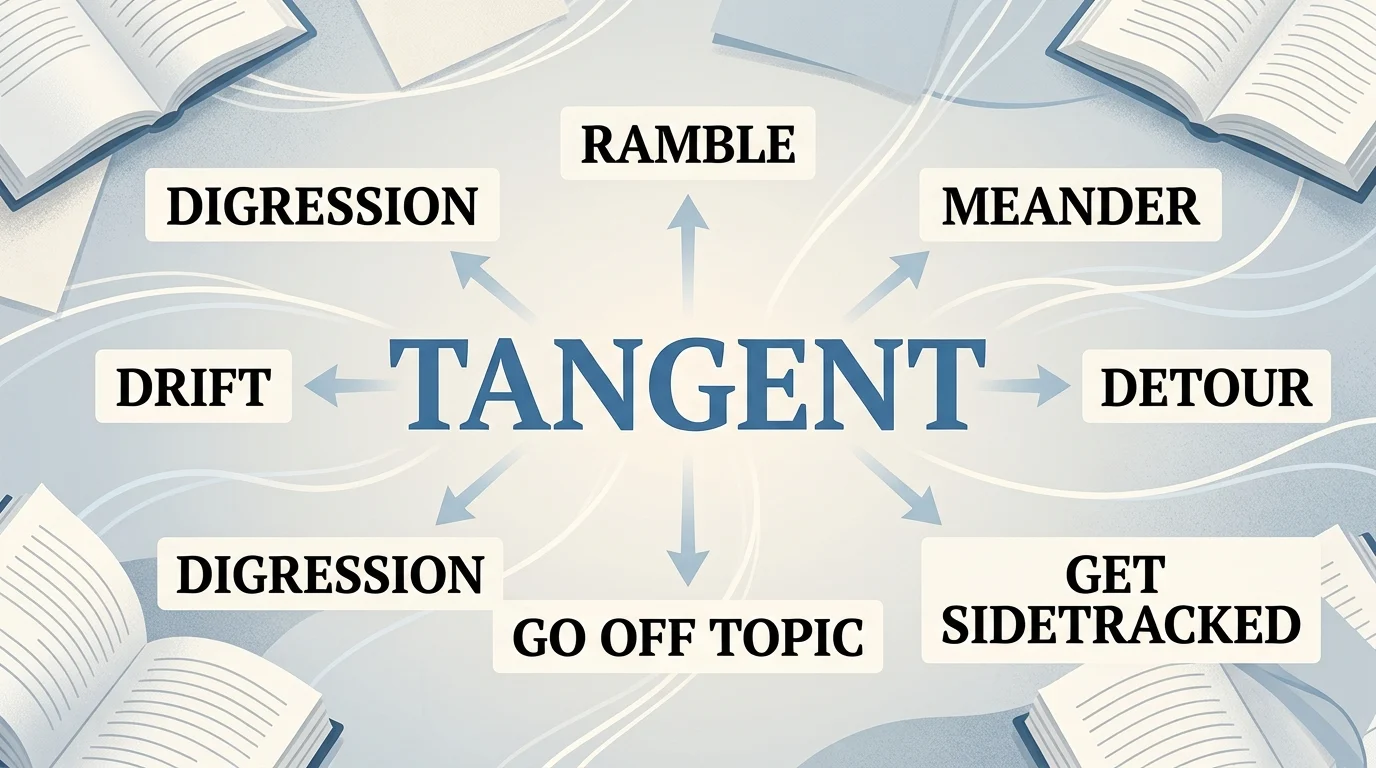
Below are 30 useful alternatives to tangent. Some are direct synonyms, while others are closely related expressions that work naturally in similar situations.
1. Digression
Meaning: A temporary move away from the main subject.
Example:
“The speaker made a brief digression before returning to the main topic.”
Best usage context: Formal writing, speeches, lectures, and academic discussions.
2. Diversion
Meaning: A change from the main subject or activity.
Example:
“The conversation took an unexpected diversion when they started discussing travel.”
Best usage context: General conversation and writing.
3. Detour
Meaning: A temporary move away from the main path, subject, or idea.
Example:
“Our discussion took a detour when someone mentioned the new project.”
Best usage context: Informal speech and writing; especially useful as a metaphor.
4. Digress
Meaning: To move away from the main topic while speaking or writing.
Example:
“I don’t want to digress, so let’s return to the original question.”
Best usage context: Formal and semi formal communication.
5. Deviate
Meaning: To move away from the usual, expected, or main direction.
Example:
“The discussion deviated from the original purpose of the meeting.”
Best usage context: Formal, academic, and professional writing.
6. Stray
Meaning: To move away from the main subject or idea.
Example:
“His explanation began to stray from the question.”
Best usage context: Everyday English and informal writing.
7. Wander
Meaning: To move from one idea to another without a clear direction.
Example:
“Her thoughts wandered from the assignment to her plans for the summer.”
Best usage context: Conversations, creative writing, and descriptions of thoughts.
8. Ramble
Meaning: To talk or write for a long time without staying focused.
Example:
“He tends to ramble when explaining complicated ideas.”
Best usage context: Informal English, especially when criticizing unfocused speech.
9. Meander
Meaning: To move slowly or indirectly from one idea to another.
Example:
“The essay meanders through several unrelated topics before reaching its conclusion.”
Best usage context: Writing criticism, literature, and descriptive language.
10. Go Off Topic
Meaning: To start discussing something that is not the main subject.
Example:
“We’re going off topic, so let’s focus on the original question.”
Best usage context: Meetings, classrooms, online discussions, and everyday conversation.
11. Stray from the Subject
Meaning: To stop focusing on the main topic.
Example:
“The discussion strayed from the subject after several questions were raised.”
Best usage context: Formal and informal communication.
12. Go Off Track
Meaning: To move away from the correct or intended direction.
Example:
“Our conversation went off track after we started discussing unrelated problems.”
Best usage context: Everyday conversation and workplace communication.
13. Change the Subject
Meaning: To begin talking about a different topic.
Example:
“She changed the subject when I asked about the missing report.”
Best usage context: Everyday conversation.
Important nuance: This expression can suggest that someone intentionally avoids the original topic.
14. Shift Focus
Meaning: To move attention from one subject to another.
Example:
“The discussion shifted focus from costs to customer satisfaction.”
Best usage context: Business, academic writing, presentations, and professional communication.
15. Switch Topics
Meaning: To begin discussing a different subject.
Example:
“After discussing the exam, the students switched topics and talked about their holiday plans.”
Best usage context: Casual conversation.
16. Go Down a Rabbit Hole
Meaning: To become deeply involved in a subject that leads to many related ideas or questions.
Example:
“I started researching one historical fact and ended up going down a rabbit hole for three hours.”
Best usage context: Informal speech, social media, blogs, and online discussions.
17. Branch Off
Meaning: To move from the main idea into a related idea.
Example:
“The presentation branched off into a discussion about future technology.”
Best usage context: Discussions, presentations, education, and writing.
18. Branch Out
Meaning: To move into a new subject, area, or activity.
Example:
“The conversation branched out into several interesting topics.”
Best usage context: General English and professional communication.
Note: Branch out often has a positive meaning and does not necessarily suggest losing focus.
19. Side Track
Meaning: To cause someone to move away from the main topic or task.
Example:
“Several questions sidetracked the meeting.”
Best usage context: Workplace, academic, and everyday situations.
20. Get Sidetracked
Meaning: To become distracted from the original task or topic.
Example:
“I was supposed to clean my room, but I got sidetracked by an old photo album.”
Best usage context: Informal and everyday English.
21. Digress from
Meaning: To depart from the main subject.
Example:
“The author occasionally digresses from the central argument.”
Best usage context: Academic and formal writing.
22. Drift
Meaning: To gradually move away from the main subject.
Example:
“The conversation slowly drifted toward childhood memories.”
Best usage context: Natural conversation and descriptive writing.
23. Drift Away from the Topic
Meaning: To gradually stop discussing the main subject.
Example:
“After an hour, the group had drifted away from the original topic.”
Best usage context: Meetings, discussions, and informal writing.
24. Depart from the Subject
Meaning: To move away from the main subject.
Example:
“The author briefly departs from the subject to provide historical background.”
Best usage context: Formal and academic writing.
25. Move Away from the Main Point
Meaning: To stop focusing on the central idea.
Example:
“The explanation moved away from the main point and became difficult to follow.”
Best usage context: Essays, presentations, meetings, and educational settings.
26. Lose Focus
Meaning: To stop concentrating on the main subject or purpose.
Example:
“The writer lost focus halfway through the article.”
Best usage context: Writing, studying, work, and everyday conversation.
27. Get Distracted
Meaning: To stop paying attention to the main task because something else attracts attention.
Example:
“I got distracted while studying and started watching videos.”
Best usage context: Everyday English.
28. Take a Side Route
Meaning: To temporarily follow a different direction or subject.
Example:
“The article takes a side route to explain the history behind the invention.”
Best usage context: Writing, explanations, and descriptive language.
29. Explore a Related Idea
Meaning: To discuss another idea connected to the main subject.
Example:
“The teacher explored a related idea before returning to the original lesson.”
Best usage context: Education, essays, presentations, and thoughtful discussions.
Note: This is usually more positive and purposeful than go off on a tangent.
30. Pursue a Side Topic
Meaning: To spend time discussing a secondary subject.
Example:
“The author pursues a side topic before returning to the central argument.”
Best usage context: Academic writing, articles, essays, and detailed discussions.
Tangent Synonyms Comparison Table
Not every alternative to tangent carries the same meaning. The table below can help you choose the most suitable word.
| Synonym / Expression | Main Meaning | Tone | Best Context |
|---|---|---|---|
| Digression | Temporary departure from the main topic | Formal | Academic writing |
| Diversion | Change in direction or subject | Neutral | General |
| Detour | Temporary side route | Neutral | Conversation/writing |
| Digress | Move away from the main subject | Formal | Speeches/writing |
| Deviate | Move away from an expected direction | Formal | Professional/academic |
| Stray | Move away from the subject | Neutral | General |
| Wander | Move between ideas without direction | Neutral | Creative writing |
| Ramble | Talk without focus | Informal/critical | Conversation |
| Meander | Move indirectly between ideas | Literary | Writing |
| Go off topic | Discuss something unrelated | Informal | Meetings/classes |
| Go off track | Lose the intended direction | Neutral | Work/conversation |
| Change the subject | Start discussing something else | Neutral | Conversation |
| Shift focus | Move attention to another subject | Neutral/formal | Business/academic |
| Switch topics | Start a new subject | Informal | Conversation |
| Go down a rabbit hole | Become deeply involved in a related subject | Informal | Online/casual |
| Branch off | Move into a related idea | Neutral | Discussions |
| Branch out | Expand into another area | Positive | General/professional |
| Get sidetracked | Become distracted | Informal | Everyday English |
| Drift | Gradually move away | Neutral | Conversation |
| Lose focus | Stop concentrating on the main idea | Neutral | Work/study |
| Get distracted | Lose attention | Informal | Everyday English |
Tangent vs. Digression: What’s the Difference?
Tangent and digression are very similar, but they are not always interchangeable.
A tangent often describes a sudden side thought or conversational direction.
“He went off on a tangent about his favorite movies.”
A digression is often more formal and can describe a deliberate or temporary departure from the main subject.
“The author includes a short digression about the history of the region.”
In casual conversation, tangent sounds more natural. In academic or formal writing, digression may be the better choice.
Tangent vs. Ramble
These words are also related but have an important difference.
To go on a tangent means to move onto another subject.
To ramble means to speak or write in a long, unfocused way.
Someone can ramble while staying on the same topic, while someone can go on a tangent and discuss a completely different topic.
Tangent:
“She went on a tangent about her new car.”
Ramble:
“He rambled for twenty minutes without making his main point clear.”
Tangent vs. Digress vs. Deviate
These three words can all describe moving away from a central idea, but their usage differs.
Tangent
Usually conversational and often suggests a side thought.
Digress
More formal and specifically connected to leaving the main subject.
Deviate
More general and often describes moving away from a planned path, standard, rule, or direction.
Examples:
“I went off on a tangent.”
“I don’t want to digress from the main argument.”
“The results deviate from the expected pattern.”
Positive and Negative Ways to Describe a Tangent
A tangent is not always a bad thing.
When a tangent is negative
Use words such as:
- Ramble
- Get sidetracked
- Lose focus
- Go off track
- Stray from the subject
- Wander
These expressions often suggest that the speaker has become unfocused.
Example:
“The meeting went off track because everyone started discussing unrelated issues.”
When a tangent is useful
Use expressions such as:
- Explore a related idea
- Branch off
- Branch out
- Shift focus
- Pursue a side topic
These can suggest that the new subject is useful or interesting.
Example:
“The lecturer briefly explored a related idea before returning to the main lesson.”
How to Choose the Right Tangent Synonym
The best synonym depends on what happened, why it happened, and the tone you want.
For Formal Writing
Choose:
- Digression
- Digress
- Deviate
- Depart from the subject
- Shift focus
These words work well in essays, reports, academic papers, and professional writing.
Example:
“The author briefly digresses from the central argument to provide additional context.”
For Casual Conversation
Choose:
- Go off on a tangent
- Go off topic
- Switch topics
- Get sidetracked
- Change the subject
- Go down a rabbit hole
These expressions sound natural in everyday English.
Example:
“Sorry, I went off on a tangent there.”
When Someone Is Unfocused
Choose:
- Ramble
- Wander
- Meander
- Stray
- Lose focus
- Go off track
These words are useful when the speaker or writer is having trouble staying focused.
Example:
“The essay starts strongly but begins to meander near the middle.”
When the New Topic Is Related
Choose:
- Branch off
- Branch out
- Explore a related idea
- Pursue a side topic
- Take a side route
These expressions work when the new subject is connected to the original idea.
Example:
“The discussion branched off into a useful conversation about workplace communication.”
Examples of “Tangent” in Different Situations
In a Classroom
“The teacher went on a tangent about the history of English.”
In a Meeting
“We’re getting off topic, so let’s return to the main issue.”
In an Essay
“The second paragraph contains a brief digression from the central argument.”
In Everyday Conversation
“Sorry, I went off on a tangent. What were you saying?”
In Social Media
“This post went down a complete rabbit hole, but I learned something interesting.”
In Creative Writing
“His thoughts wandered toward memories of his childhood.”
Common Expressions With “Tangent”
The word tangent commonly appears in a few useful expressions.
Go off on a tangent
This is the most common expression.
Meaning: To suddenly start talking about a different subject.
“I went off on a tangent while explaining the project.”
Go on a tangent
This has a similar meaning.
“She went on a tangent about modern technology.”
Go off at a tangent
This expression is especially common in British English.
Example:
“The discussion went off at a tangent after the question.”
A complete tangent
This describes a topic that is very far from the original subject.
“That’s a complete tangent, but it’s an interesting story.”
Why Learning Tangent Synonyms Matters
Learning synonyms is not simply about replacing one word with another.
Good vocabulary helps you communicate meaning, tone, intention, and context more accurately.
For example, saying that someone digressed sounds different from saying that they rambled.
Likewise, saying that a discussion branched off sounds more positive than saying that it went off track.
For students and ESL learners, understanding these differences can make both speaking and writing sound more natural.
For writers, choosing the right synonym can also make sentences more precise and prevent repetitive language.
Frequently Asked Questions About Tangent Synonyms
What is the best synonym for tangent?
Digression is one of the closest formal synonyms when tangent means moving away from the main subject. In casual conversation, going off topic or going off on a tangent may sound more natural.
What is another word for going off on a tangent?
You can say digress, ramble, wander, stray from the subject, go off topic, go off track, get sidetracked, or change the subject, depending on the situation.
Is “digression” the same as “tangent”?
They are very similar, especially when describing a departure from the main topic. However, digression is generally more formal, while tangent is especially common in conversational English.
What is a positive synonym for tangent?
If the new idea is useful or intentionally related, expressions such as explore a related idea, branch off, branch out, or shift focus can work better than words such as ramble or get sidetracked.
What is the opposite of going off on a tangent?
Depending on the context, useful opposites include stay on topic, remain focused, stick to the point, and stay on track.
Quick Synonym Guide
If you need a quick choice, use this guide:
For academic writing:
→ Digression
For casual conversation:
→ Go off on a tangent
For losing focus:
→ Get sidetracked
For talking too much:
→ Ramble
For a gradual change in ideas:
→ Drift
For a literary style:
→ Meander
For a related new idea:
→ Branch off
For an intentional change in attention:
→ Shift focus
For avoiding a question:
→ Change the subject
For becoming deeply involved in a new topic:
→ Go down a rabbit hole
Final Thoughts on Tangent Synonyms
Knowing different tangent synonyms gives you more control over your vocabulary. Although many alternatives describe moving away from a main topic, each word carries a slightly different meaning or tone.
Use digression for a more formal departure from the main subject. Choose ramble when someone talks without enough focus. Use get sidetracked when distraction causes someone to lose direction. For a gradual movement between ideas, drift or meander may be more appropriate.
When the new topic is useful or intentionally connected, expressions such as branch off, shift focus, and explore a related idea are often better choices.
The key is not to memorize every synonym and use them interchangeably. Instead, learn the context and nuance behind each one. That will help you sound clearer, more natural, and more confident in English.

I am Joel Michael, an enthusiastic language writer and synonym enthusiast. I enjoy exploring words, finding their meanings, and discovering useful alternatives. I create clear, helpful content to make vocabulary learning simple and enjoyable for every reader.