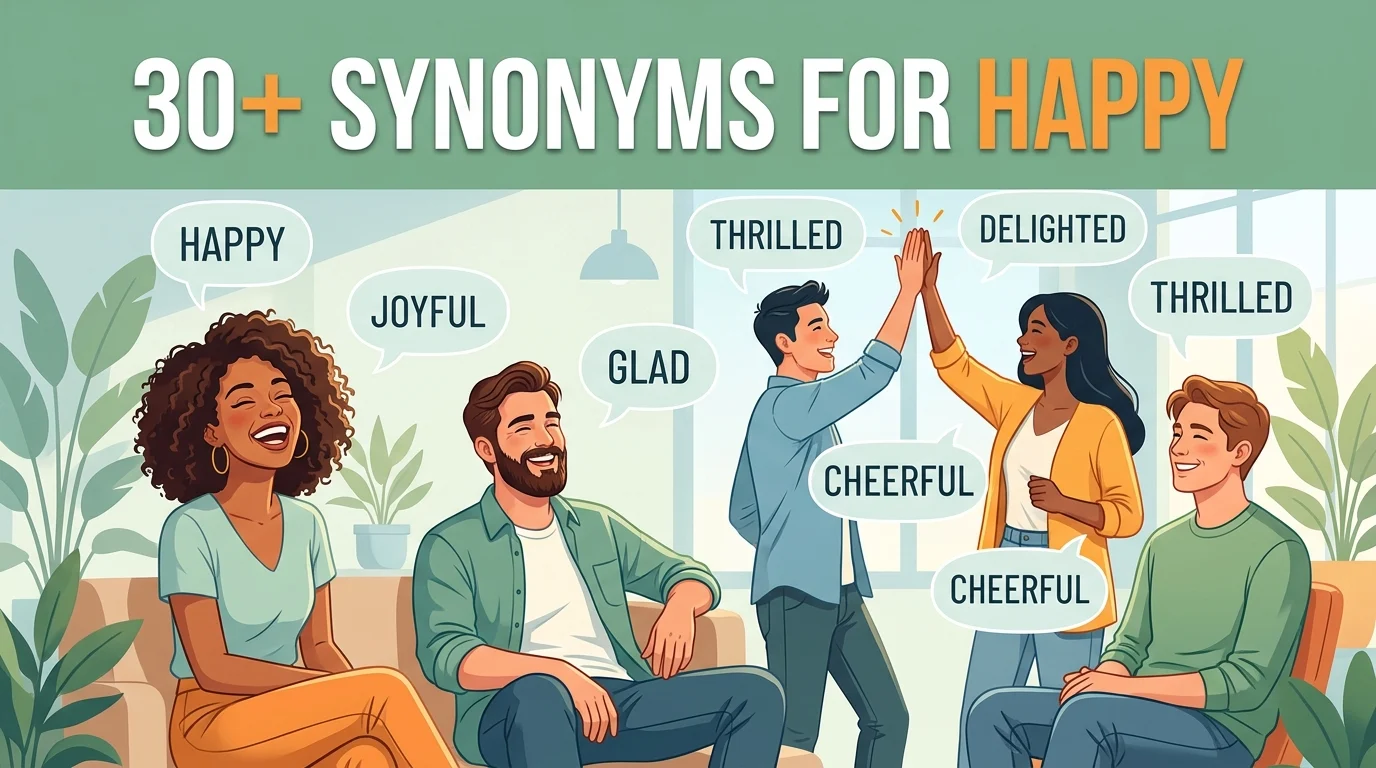
Finding the right word to describe happiness can make your writing clearer, more expressive, and more natural. While happy is one of the most common English words, it does not always communicate exactly how someone feels.
A person can be cheerful, delighted, thrilled, content, joyful, or simply pleased and each word carries a slightly different meaning.
Learning synonyms for happy is especially useful for students, ESL learners, writers, bloggers, and content creators. Using the right synonym helps you avoid repetition and lets you express different levels and types of positive emotions more precisely.
This guide explains 30 useful synonyms for happy in simple English. Each word includes an easy definition, an example sentence, and a short note explaining when it works best.
What Does “Happy” Mean?
Happy means feeling pleasure, joy, satisfaction, or contentment. It can describe a person’s emotional state, a positive situation, or something that creates pleasure.
For example:
She was happy to receive the good news.
The word happy is broad and flexible. It can describe mild satisfaction as well as strong excitement. However, the best synonym depends on the situation and the intensity of the emotion.
For example, content usually suggests quiet satisfaction, while thrilled suggests very strong excitement.
30 Synonyms for Happy
1. Joyful
Meaning: Feeling or showing great happiness and joy.
Example: The children were joyful during the holiday celebration.
Best usage: Use joyful for deep, visible, or heartfelt happiness.
2. Cheerful
Meaning: Happy, positive, and pleasant in mood.
Example: Maria is always cheerful when she comes to work.
Best usage: Good for describing someone’s usual personality or friendly mood.
3. Glad
Meaning: Feeling pleased or happy about something.
Example: I’m glad you decided to join us.
Best usage: Very common in everyday English, especially when reacting positively to news or events.
4. Delighted
Meaning: Very pleased and happy.
Example: We were delighted to hear that our project was successful.
Best usage: Useful when someone is especially pleased by something.
5. Pleased
Meaning: Feeling satisfied or happy about something.
Example: The teacher was pleased with her student’s progress.
Best usage: Appropriate for polite, professional, and formal situations.
6. Content
Meaning: Quietly satisfied with your situation.
Example: After a relaxing weekend, he felt content.
Best usage: Use content when happiness comes from peace, satisfaction, or having enough.
7. Satisfied
Meaning: Feeling that something is good enough or has met your expectations.
Example: The customer was satisfied with the service.
Best usage: Common in business, customer service, and practical situations.
8. Cheerful
Meaning: Bright, happy, and positive.
Example: Her cheerful attitude made everyone feel welcome.
Best usage: Particularly useful for describing a person’s behavior or personality.
9. Ecstatic
Meaning: Extremely happy and excited.
Example: He was ecstatic when he learned that he had won the competition.
Best usage: Use for exceptionally strong happiness.
10. Thrilled
Meaning: Extremely excited and pleased.
Example: She was thrilled to receive an invitation to the event.
Best usage: Ideal when happiness is connected with exciting news or an exciting opportunity.
11. Elated
Meaning: Extremely happy and excited.
Example: The team felt elated after winning the final match.
Best usage: A stronger and somewhat more formal alternative to happy.
12. Exuberant
Meaning: Very energetic, enthusiastic, and happy.
Example: The exuberant crowd celebrated the team’s victory.
Best usage: Great for lively people, celebrations, crowds, and energetic expressions of happiness.
13. Jubilant
Meaning: Extremely happy, especially because of a victory or success.
Example: The jubilant fans celebrated outside the stadium.
Best usage: Often used for celebrations after achievements, victories, or major successes.
14. Buoyant
Meaning: Cheerful, optimistic, and confident.
Example: Despite the difficult week, she remained buoyant and hopeful.
Best usage: Useful for describing a positive emotional outlook, especially during difficult circumstances.
15. Upbeat
Meaning: Positive, cheerful, and hopeful.
Example: He remained upbeat despite the unexpected problem.
Best usage: Common in modern everyday English when describing a positive attitude.
16. Merry
Meaning: Happy and cheerful, especially during a celebration.
Example: Everyone was in a merry mood during the festival.
Best usage: Often associated with holidays, parties, and festive situations.
17. Lighthearted
Meaning: Relaxed, cheerful, and free from serious worries.
Example: They enjoyed a lighthearted conversation over dinner.
Best usage: Best for relaxed moods, conversations, stories, and situations without tension.
18. Radiant
Meaning: Showing great happiness through your face or appearance.
Example: She looked radiant on her wedding day.
Best usage: Often used to describe someone whose happiness is clearly visible.
19. Beaming
Meaning: Smiling or looking extremely happy.
Example: He was beaming with pride after his daughter graduated.
Best usage: Great for describing visible happiness, especially through a smile.
20. Overjoyed
Meaning: Extremely happy.
Example: The parents were overjoyed when their child came home safely.
Best usage: Use when happiness is particularly strong and emotional.
21. Blissful
Meaning: Extremely peaceful, happy, and satisfied.
Example: They spent a blissful afternoon relaxing by the lake.
Best usage: Suitable for peaceful, deeply satisfying experiences.
22. Euphoric
Meaning: Feeling intense excitement and happiness.
Example: The players were euphoric after their unexpected victory.
Best usage: Best for unusually intense feelings of excitement or happiness.
23. Tickled
Meaning: Very pleased or amused.
Example: She was tickled by the thoughtful surprise.
Best usage: Informal English; useful when someone is pleasantly amused or pleased.
24. Delirious
Meaning: Extremely excited or happy.
Example: The supporters were delirious with excitement after the victory.
Best usage: Usually describes very intense excitement, often in dramatic writing.
25. Sanguine
Meaning: Optimistic and confident about the future.
Example: Despite the setback, the manager remained sanguine about the company’s future.
Best usage: More formal; useful when happiness is connected to optimism and confidence.
26. Triumphant
Meaning: Feeling or showing happiness because of a victory or success.
Example: The triumphant students proudly displayed their awards.
Best usage: Use when happiness comes specifically from overcoming a challenge or achieving success.
27. Buoyant
Meaning: Cheerfully optimistic and emotionally positive.
Example: Her buoyant personality lifted everyone’s spirits.
Best usage: Good for describing a consistently positive attitude.
28. Merry-hearted
Meaning: Cheerful, joyful, and good-natured.
Example: The merry-hearted host welcomed everyone with a smile.
Best usage: More literary or creative; suitable for stories and descriptive writing.
29. Carefree
Meaning: Free from worry, stress, or responsibility.
Example: The children spent a carefree afternoon playing outside.
Best usage: Use when happiness comes from having few worries rather than from a specific success.
30. Satisfied
Meaning: Happy because your needs, expectations, or goals have been met.
Example: She felt satisfied after completing the difficult assignment.
Best usage: Particularly useful in academic, professional, and practical contexts.
Quick Comparison: Which Synonym for Happy Should You Use?
| Synonym | Strength | Main Idea | Best Context |
|---|---|---|---|
| Glad | Mild | Pleased | Everyday conversation |
| Cheerful | Mild moderate | Positive mood | Personality |
| Pleased | Mild moderate | Satisfaction | Professional situations |
| Content | Mild | Peaceful satisfaction | Personal life |
| Carefree | Mild | Free from worry | Relaxed situations |
| Upbeat | Moderate | Positive outlook | Modern everyday English |
| Joyful | Strong | Deep happiness | Emotional writing |
| Delighted | Strong | Great pleasure | Good news |
| Thrilled | Very strong | Excitement | Exciting events |
| Elated | Very strong | Intense happiness | Success |
| Overjoyed | Very strong | Extreme happiness | Emotional situations |
| Ecstatic | Very strong | Intense joy | Major achievements |
| Euphoric | Extreme | Intense excitement | Dramatic situations |
| Jubilant | Extreme | Celebration | Victory or success |
| Blissful | Strong | Peaceful happiness | Relaxation and experiences |
| Triumphant | Strong | Victory-related happiness | Achievements |
How to Choose the Right Synonym for Happy
Not every synonym for happy can be used in exactly the same situation. The easiest way to choose the right word is to think about why the person is happy and how strong the emotion is.
For Everyday Happiness
Use:
- glad
- cheerful
- pleased
- upbeat
These words sound natural in everyday conversations and general writing.
Example:
I’m glad you came.
This sounds more natural than using a very strong word such as ecstatic.
For Peaceful Happiness
Use:
- content
- blissful
- carefree
- lighthearted
These words work well when someone feels relaxed, peaceful, satisfied, or free from stress.
Example:
She felt content sitting quietly in her garden.
For Strong Happiness
Use:
- joyful
- delighted
- elated
- overjoyed
These words are appropriate when someone feels much happier than usual.
Example:
The family was overjoyed by the good news.
For Extreme Happiness and Excitement
Use:
- thrilled
- ecstatic
- euphoric
- delirious
These words communicate powerful emotions.
Example:
The fans were ecstatic after their team won.
For Happiness Caused by Success
Use:
- triumphant
- jubilant
- elated
- thrilled
These are particularly effective when someone achieves an important goal.
Example:
The students were jubilant after receiving their results.
For a Positive Personality
Use:
- cheerful
- upbeat
- buoyant
- lighthearted
These words describe someone’s general attitude rather than a temporary emotion.
Example:
She has a cheerful personality and always encourages others.
Synonyms for Happy in Different Types of Writing
In Academic Writing
Choose words such as:
- pleased
- satisfied
- content
- optimistic
- buoyant
Academic writing usually benefits from precise and less emotional vocabulary.
Example:
Participants reported feeling satisfied with the results.
In Creative Writing
Stronger and more descriptive words can make a scene more vivid:
- joyful
- radiant
- blissful
- exuberant
- jubilant
- ecstatic
Example:
She entered the room with a radiant smile.
In Professional Writing
Use:
- pleased
- satisfied
- glad
- delighted
- optimistic
Example:
We are delighted to announce the successful completion of the project.
In Casual Conversation
Natural choices include:
- happy
- glad
- pleased
- thrilled
- excited
- cheerful
Example:
I’m so glad you’re here!
Happy vs. Glad
Happy and glad are very similar, but they are not always interchangeable.
Happy can describe a general emotional state:
She is happy with her new job.
Glad often expresses a positive reaction to a particular event:
I’m glad you called.
A useful rule is:
Happy = general positive feeling
Glad = pleased about something specific
Happy vs. Joyful
Joyful is stronger and more expressive than happy.
Compare:
She was happy during the celebration.
She was joyful during the celebration.
The second sentence suggests a deeper, more visible feeling of joy.
Happy vs. Content
Content describes peaceful satisfaction rather than excitement.
He was happy with his simple life.
He was content with his simple life.
The second sentence emphasizes that he feels satisfied and does not need anything more.
Happy vs. Excited
These words are related but different.
Happy describes pleasure or satisfaction.
Excited describes strong anticipation or enthusiasm about something.
For example:
I’m happy about my new job.
I’m excited to start my new job.
You can be both happy and excited at the same time.
Happy vs. Pleased
Pleased often sounds slightly more formal than happy.
The teacher was pleased with the student’s work.
This is especially natural in professional, academic, and formal contexts.
Common Related Words for Happy
Understanding related vocabulary can make your English more flexible. Here are some useful words and phrases associated with happiness:
- Joy — a strong feeling of happiness
- Delight — great pleasure
- Pleasure — a feeling of enjoyment
- Contentment — peaceful satisfaction
- Cheerfulness — a positive and happy mood
- Happiness — the general state of feeling happy
- Enjoyment — pleasure gained from an activity
- Satisfaction — a feeling that something is good or complete
- Excitement — strong enthusiasm about something
- Optimism — hopefulness about the future
Antonyms of Happy
Learning opposites can also help you understand the meaning of happy more clearly.
Common antonyms include:
- sad
- unhappy
- miserable
- gloomy
- depressed
- disappointed
- sorrowful
- upset
- unhappy
- distressed
The best opposite depends on the situation. For example, sad is a general opposite, while disappointed specifically describes unhappiness caused by an expectation not being met.
How to Avoid Repeating “Happy” in Your Writing
Repeating the same word too often can make writing sound simple or monotonous. Instead of replacing every occurrence of happy, first consider the exact feeling you want to communicate.
Instead of:
She was happy. Her parents were happy. Everyone was happy.
You could write:
She was delighted. Her parents were overjoyed, and everyone else was cheerful.
The revised version is more precise because each word communicates a slightly different shade of positive emotion.
However, avoid replacing happy simply to sound sophisticated. If happy is the most natural word, use it. Good vocabulary is about precision, not using the most complicated word available.
Frequently Asked Questions About Synonyms for Happy
What is the best synonym for happy?
There is no single best synonym. Glad, pleased, joyful, delighted, and content are useful choices, depending on the situation.
What is a stronger word for happy?
Strong alternatives include delighted, thrilled, elated, overjoyed, ecstatic, and euphoric.
What is a simple synonym for happy?
Glad, cheerful, and pleased are simple and common alternatives that ESL learners can use confidently.
What is a formal synonym for happy?
Depending on the context, pleased, satisfied, content, and elated can work in more formal writing.
What is a synonym for happy and excited?
Thrilled, ecstatic, elated, and euphoric can describe a combination of strong happiness and excitement.
What is a synonym for happy and peaceful?
Content, blissful, carefree, and lighthearted are useful choices.
What is a synonym for happy because of success?
Triumphant, jubilant, elated, thrilled, and overjoyed are especially appropriate.
Final Takeaway: Choosing the Best Synonym for Happy
There are many useful synonyms for happy, but each one communicates a slightly different feeling. Glad and pleased are natural choices for everyday situations, while content suggests peaceful satisfaction.
Joyful and delighted express stronger positive emotions, and words such as thrilled, ecstatic, and euphoric describe intense excitement and happiness.
The key is to consider the strength, cause, and tone of the emotion before choosing a synonym. If you are writing for school, work, creative projects, or everyday conversation, precise vocabulary can make your English clearer and more engaging.
Most importantly, you do not need to avoid the word happy completely. It is a useful, natural English word. The goal of learning synonyms is to give yourself more choices so you can express exactly what you mean.

I am Scarlett Jane, a passionate language writer who loves exploring synonyms and word meanings. I create helpful content that makes vocabulary easier, clearer, and more enjoyable for everyone.