The word simple is one of the most common words in English. We use it to describe something that is easy to understand, easy to do, uncomplicated, plain, or not overly elaborate.
Because it has several meanings, finding the right alternative can make your writing more precise and natural.
Knowing different synonyms for simple is especially useful for students, ESL learners, writers, bloggers, and content creators. Instead of repeating “simple” in every sentence, you can choose a word that communicates the exact idea you mean.
For example, easy works well when you are talking about difficulty, while plain may describe appearance or language.
Basic can describe something at an introductory level, while straightforward often suggests that something is clear and uncomplicated. Understanding these small differences helps you sound more confident and accurate in English.
What Does “Simple” Mean?
Simple generally means something that is easy to understand, do, use, or deal with and does not contain unnecessary complexity.
However, the meaning can change depending on context.
- Simple instructions = easy to understand and follow
- A simple design = not complicated or heavily decorated
- A simple meal = easy to prepare and not elaborate
- A simple person = modest, uncomplicated, or unsophisticated, depending on context
- A simple explanation = easy for someone to understand
- A simple problem = not difficult to solve
Because “simple” has several shades of meaning, there is no single perfect synonym for every sentence.
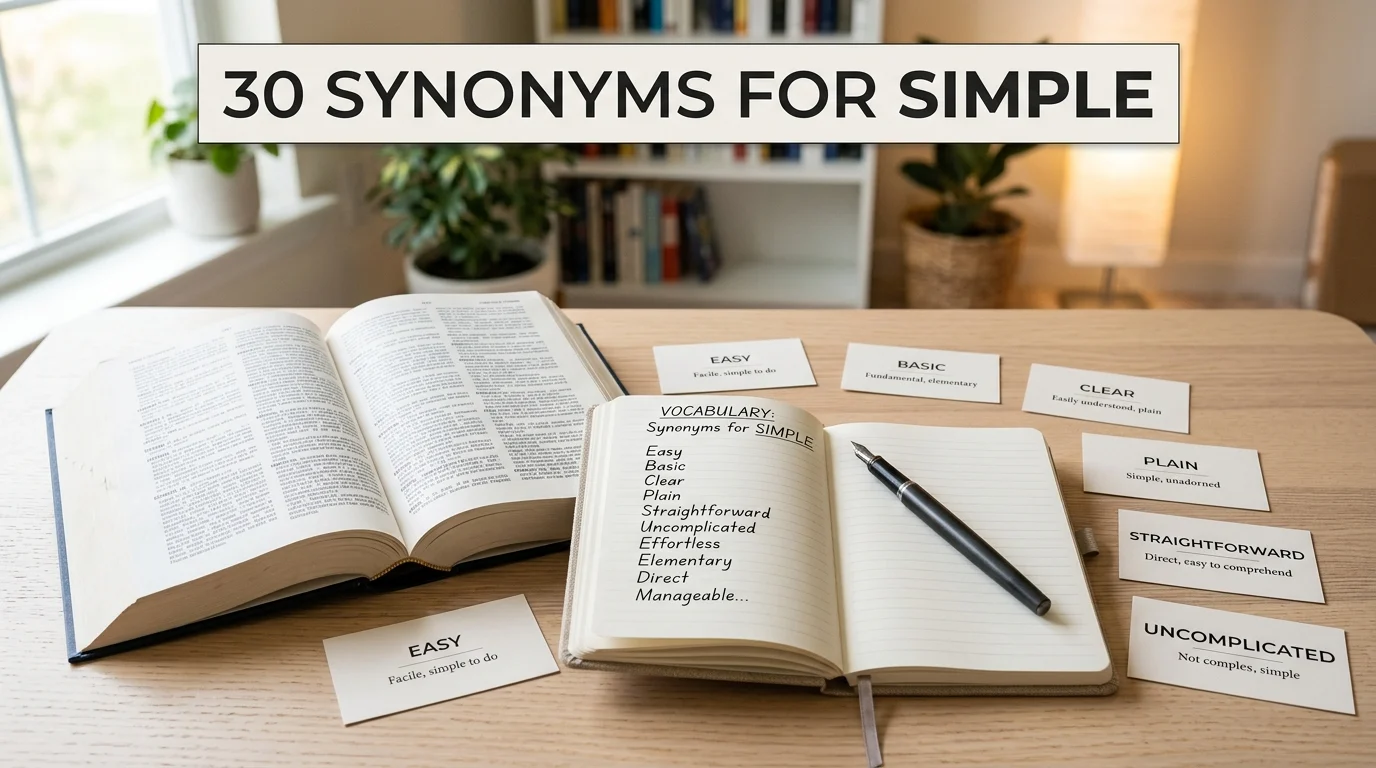
30 Synonyms for Simple
Here are 30 useful alternatives to simple, with their meanings, examples, and best contexts.
1. Easy
Meaning: Something that does not require much effort, skill, or difficulty.
Example:
The teacher gave us an easy exercise to complete.
Best usage: Use easy when you mean something is not difficult.
2. Basic
Meaning: Simple and at an introductory or fundamental level.
Example:
The course teaches basic computer skills.
Best usage: Use basic for fundamental knowledge, features, skills, or ideas.
3. Plain
Meaning: Simple, ordinary, or without decoration or unnecessary detail.
Example:
She chose a plain white dress for the event.
Best usage: Best for appearance, language, food, or things without decoration.
4. Straightforward
Meaning: Easy to understand, follow, or deal with.
Example:
The application process is straightforward.
Best usage: Excellent for instructions, explanations, procedures, and situations.
5. Uncomplicated
Meaning: Not difficult, confusing, or complex.
Example:
The solution to the problem was surprisingly uncomplicated.
Best usage: Useful when emphasizing the absence of complexity.
6. Clear
Meaning: Easy to understand or recognize.
Example:
The manager gave clear instructions to the team.
Best usage: Ideal for communication, explanations, writing, and instructions.
7. Effortless
Meaning: Requiring little or no apparent effort.
Example:
She made the difficult task look effortless.
Best usage: Use it when something appears very easy to accomplish.
8. Elementary
Meaning: Basic or suitable for beginners.
Example:
The book provides an elementary introduction to economics.
Best usage: Best for beginner level subjects, knowledge, or education.
9. Undemanding
Meaning: Not requiring much effort, skill, or attention.
Example:
He wanted an undemanding job that allowed him to relax after work.
Best usage: Useful for tasks, jobs, activities, or responsibilities.
10. Manageable
Meaning: Easy enough to handle or complete successfully.
Example:
Breaking the project into smaller tasks made it more manageable.
Best usage: Use it when something may seem difficult but can still be handled.
11. User-friendly
Meaning: Designed to be easy for people to use or understand.
Example:
The new website has a clean, user friendly interface.
Best usage: Particularly useful for websites, apps, software, devices, and systems.
12. Accessible
Meaning: Easy to understand, use, reach, or obtain.
Example:
The professor explains complex ideas in an accessible way.
Best usage: Great for information, education, writing, services, and technology.
13. Unpretentious
Meaning: Natural, modest, and not trying to appear more important or impressive than necessary.
Example:
They enjoyed an unpretentious meal at a small local restaurant.
Best usage: Use it for people, places, lifestyles, writing, or experiences that feel modest and genuine.
14. Modest
Meaning: Not excessive, elaborate, expensive, or showy.
Example:
They live in a modest apartment near the city center.
Best usage: Common for homes, lifestyles, achievements, clothing, and possessions.
15. Minimal
Meaning: Using only what is necessary, with very little extra.
Example:
The website uses a minimal design with plenty of empty space.
Best usage: Best for design, decoration, features, or amounts.
16. Minimalist
Meaning: Following a style that uses very few elements and avoids unnecessary details.
Example:
She prefers a minimalist approach to interior design.
Best usage: Use it for design, art, architecture, lifestyle, and creative styles.
17. Unadorned
Meaning: Without decoration, embellishment, or extra features.
Example:
The room had plain, unadorned walls.
Best usage: Mostly used for physical appearance, writing, or presentation.
18. Uncomplicated
Meaning: Easy to understand or deal with because there are few difficulties or complexities.
Example:
We needed an uncomplicated plan that everyone could follow.
Best usage: Suitable for plans, relationships, processes, solutions, and situations.
19. Painless
Meaning: Easy and causing little difficulty, inconvenience, or discomfort.
Example:
The software update was quick and painless.
Best usage: Often used informally for processes, changes, or tasks that could otherwise be troublesome.
20. Simple minded
Meaning: Lacking complexity in thought or understanding.
Example:
The novel avoids simple minded explanations of a complicated issue.
Best usage: Use carefully. It can sound critical or insulting when describing a person or their thinking.
21. Uncomplicated
Meaning: Free from unnecessary difficulty or complexity.
Example:
She prefers an uncomplicated lifestyle.
Best usage: Particularly effective for lifestyles, plans, relationships, and processes.
22. Direct
Meaning: Clear and without unnecessary steps or indirect language.
Example:
He gave a direct answer to the question.
Best usage: Use direct for communication, approaches, answers, and methods.
23. Concise
Meaning: Expressing an idea clearly using few words.
Example:
Please keep your answer concise and focused.
Best usage: Best for writing, speeches, explanations, emails, and responses.
24. Brief
Meaning: Short in duration or length.
Example:
The manager gave us a brief explanation of the new policy.
Best usage: Use it when “simple” means short rather than complex.
25. Neat
Meaning: Clean, orderly, and uncomplicated in appearance or arrangement.
Example:
He created a neat layout for the presentation.
Best usage: Useful for appearance, organization, handwriting, designs, and arrangements.
26. Uncomplicated
Meaning: Not complex or difficult to manage.
Example:
Their agreement was uncomplicated and easy to understand.
Best usage: A strong general alternative when you want to emphasize ease and lack of complexity.
27. Elementary
Meaning: Very basic or at an early stage of learning.
Example:
Students first learn elementary grammar before studying advanced structures.
Best usage: Best for education, beginner knowledge, and fundamental concepts.
28. Lucid
Meaning: Very clear and easy to understand.
Example:
The author provides a lucid explanation of the scientific theory.
Best usage: More formal than “clear”; excellent for academic and professional writing.
29. Intelligible
Meaning: Clear enough to be understood.
Example:
The speaker’s explanation was brief but intelligible.
Best usage: Useful in formal, academic, and technical contexts.
30. Unassuming
Meaning: Modest and not trying to attract attention or appear important.
Example:
Despite his success, he remained quiet and unassuming.
Best usage: Best for people, personalities, places, and styles that are modest rather than flashy.
Quick Comparison: Synonyms for Simple
| Synonym | Main Meaning | Best Context | Tone |
|---|---|---|---|
| Easy | Not difficult | Tasks and activities | Everyday |
| Basic | Fundamental | Skills and knowledge | Neutral |
| Plain | Without decoration | Appearance and language | Neutral |
| Straightforward | Easy to understand | Instructions and processes | Neutral |
| Clear | Easy to understand | Communication | Neutral |
| Uncomplicated | Not complex | Problems and situations | Neutral |
| Effortless | Requiring little effort | Performance and tasks | Positive |
| Manageable | Easy enough to handle | Work and projects | Neutral |
| Minimal | Very little extra | Design and features | Modern |
| Concise | Short and clear | Writing and speech | Formal |
| Lucid | Extremely clear | Academic writing | Formal |
| Modest | Not excessive or showy | Lifestyle and possessions | Neutral |
| Unpretentious | Natural and modest | People, places, experiences | Positive |
| Direct | Without unnecessary steps | Communication | Neutral |
| Unassuming | Modest and low key | People and personalities | Positive |
Simple vs. Easy: What’s the Difference?
Simple and easy are often used interchangeably, but they are not always identical.
Simple usually describes something that has little complexity.
Easy usually describes something that requires little effort or skill.
For example:
- “The instructions are simple.” → The instructions are uncomplicated.
- “The exercise is easy.” → The exercise is not difficult.
Something can be simple but not easy. A simple-looking task might require a lot of effort.
Likewise, something can sometimes be easy but not simple. For example, an advanced computer program might perform a difficult calculation automatically, making the user’s task easy even though the underlying process is complex.
Simple vs. Basic
These words are closely related but have different uses.
Basic usually means fundamental or introductory.
Simple can mean uncomplicated.
Compare:
- Basic English = beginner-level English
- Simple English = English that is easy to understand
A text can be written in simple English even when it discusses an advanced topic.
Simple vs. Plain
Plain often describes appearance, style, or language.
For example:
- plain clothing
- plain food
- plain language
- plain design
Simple has a broader meaning and can describe things that are easy, uncomplicated, modest, or not elaborate.
Simple vs. Straightforward
Straightforward is particularly useful when something is clear and easy to follow.
Compare:
The instructions are simple.
and:
The instructions are straightforward.
The first emphasizes a lack of complexity. The second emphasizes clarity and ease of following the instructions.
“Straightforward” is often a strong choice in professional writing.
Simple vs. Minimalist
These words are common in discussions about design.
A simple design may simply avoid unnecessary complexity.
A minimalist design usually follows a deliberate style that uses very few visual elements.
For example:
The logo has a simple design.
means the logo is not complicated.
The office has a minimalist design.
suggests a particular aesthetic based on simplicity, limited decoration, and carefully selected elements.
Synonyms for Simple in Different Contexts
Choosing a synonym becomes much easier when you first identify what “simple” means in your sentence.
When You Mean “Easy”
Use:
- easy
- effortless
- manageable
- undemanding
- painless
Example:
“This is a simple task.”
Possible alternatives:
- “This is an easy task.”
- “This is a manageable task.”
- “This is an undemanding task.”
When You Mean “Not Complex”
Use:
- uncomplicated
- straightforward
- basic
- clear
- elementary
Example:
“The process is simple.”
Better alternatives may include:
- “The process is straightforward.”
- “The process is uncomplicated.”
- “The process is clear.”
When You Mean “Without Decoration”
Use:
- plain
- minimal
- minimalist
- unadorned
- modest
Example:
“She chose a simple dress.”
Depending on the intended meaning, you could say:
- “She chose a plain dress.”
- “She chose a minimalist dress.”
- “She chose a modest dress.”
When You Mean “Clear Communication”
Use:
- clear
- straightforward
- direct
- concise
- lucid
- intelligible
Example:
“He gave a simple explanation.”
Possible alternatives:
- “He gave a clear explanation.”
- “He gave a straightforward explanation.”
- “He gave a concise explanation.”
- “He gave a lucid explanation.”
When You Mean “Modest or Not Showy”
Use:
- modest
- unpretentious
- unassuming
- plain
Example:
“They live a simple lifestyle.”
You might write:
“They live a modest lifestyle.”
or:
“They live an unpretentious lifestyle.”
How to Choose the Right Synonym for Simple
The best synonym depends on what you are trying to communicate, not simply on finding another word that appears in a thesaurus.
1. Ask: Is it difficult?
If you mean something requires little effort, choose easy, manageable, or effortless.
2. Ask: Is it complicated?
If you mean something has few complications, choose straightforward or uncomplicated.
3. Ask: Is it basic?
If you mean something is at an introductory level, choose basic or elementary.
4. Ask: Is it visually plain?
If you mean something lacks decoration, choose plain, minimal, or unadorned.
5. Ask: Is the communication easy to understand?
Choose clear, direct, concise, straightforward, or lucid.
6. Ask: Is it modest?
Choose modest, unpretentious, or unassuming.
This approach helps you avoid choosing a synonym that technically looks correct but sounds unnatural in context.
Formal Synonyms for Simple
If you are writing an essay, report, article, or professional document, these alternatives can make your writing more precise:
- straightforward
- uncomplicated
- concise
- lucid
- intelligible
- elementary
- accessible
- direct
For example, instead of:
“The author gives a simple explanation.”
You could write:
“The author provides a clear and accessible explanation.”
Or, in a more formal context:
“The author provides a lucid explanation of the concept.”
Informal Synonyms for Simple
In everyday conversation, these words are more natural:
- easy
- basic
- plain
- clear
- manageable
- straightforward
For example:
“Don’t worry. It’s easy.”
sounds much more natural in casual conversation than:
“Don’t worry. It’s uncomplicated.”
Positive Alternatives to Simple
Sometimes “simple” can sound positive, especially when it suggests elegance, clarity, or ease.
Good positive alternatives include:
- effortless
- straightforward
- accessible
- user-friendly
- elegant
- minimalist
- unpretentious
- clear
For example:
“The website has a simple design.”
could become:
“The website has a clean and minimalist design.”
This version communicates a more specific and positive impression.
Words That Can Replace Simple in Writing
Here are some useful substitutions depending on your sentence:
Simple solution
→ straightforward solution
→ uncomplicated solution
→ practical solution
Simple explanation
→ clear explanation
→ accessible explanation
→ lucid explanation
Simple language
→ plain language
→ clear language
→ accessible language
Simple design
→ minimalist design
→ clean design
→ unadorned design
Simple process
→ straightforward process
→ uncomplicated process
→ manageable process
Simple lifestyle
→ modest lifestyle
→ unpretentious lifestyle
→ uncomplicated lifestyle
Simple answer
→ direct answer
→ concise answer
→ clear answer
Why Using Synonyms for Simple Improves Your Writing
Using synonyms is not just about avoiding repetition.
The right synonym can make your writing more precise.
Consider these two sentences:
“She gave a simple answer.”
This sentence is understandable, but “simple” does not tell us exactly what kind of answer it was.
Now compare:
“She gave a concise answer.”
This tells us that the answer was short.
Or:
“She gave a direct answer.”
This suggests that she answered without avoiding the question.
Or:
“She gave a clear answer.”
This tells us that the answer was easy to understand.
Each word communicates a slightly different idea.
Common Mistakes When Using Synonyms for Simple
Mistake 1: Assuming Every Synonym Has the Same Meaning
Words listed as synonyms often have different meanings and tones.
For example, easy, plain, and modest can all relate to “simple,” but they cannot always replace one another.
You would say:
“The exam was easy.”
But not normally:
“The exam was modest.”
Mistake 2: Using Formal Words in Casual Writing
Words such as lucid and intelligible are useful, but they may sound overly formal in everyday conversation.
Instead of:
“The instructions were highly intelligible.”
a natural speaker would usually say:
“The instructions were very clear.”
Mistake 3: Ignoring Negative Connotations
Some alternatives require care.
For example, simple-minded can suggest that someone is unintelligent or unable to understand complex ideas. It can sound insulting.
Therefore, it should not automatically be used as a neutral synonym for “simple.”
Mistake 4: Choosing a Word Only Because It Sounds Advanced
Good writing is not about using the most complicated vocabulary.
If easy is the most accurate word, use easy.
If clear communicates your meaning best, use clear.
Strong vocabulary means choosing the right word, not the biggest word.
Frequently Asked Questions About Synonyms for Simple
What is the best synonym for simple?
There is no single best synonym because the meaning depends on context. Easy, basic, plain, straightforward, and uncomplicated are among the most useful general alternatives.
What is a synonym for simple in formal English?
Good formal alternatives include straightforward, uncomplicated, concise, lucid, intelligible, and accessible.
What is another word for simple and easy?
Depending on the sentence, you can use straightforward, effortless, manageable, uncomplicated, or undemanding.
What is a synonym for simple in writing?
If you mean easy to understand, use clear, straightforward, accessible, or lucid. If you mean short and focused, concise may be better.
What is a synonym for simple in design?
Useful alternatives include minimal, minimalist, plain, clean, and unadorned, depending on the exact style.
What is the opposite of simple?
Common antonyms include complex, complicated, difficult, elaborate, intricate, and sophisticated, depending on the context.
Final Thoughts on Synonyms for Simple
The word simple is useful because it can describe many different ideas: something easy, uncomplicated, basic, plain, modest, or clear. However, its broad meaning can sometimes make writing less precise.
Learning alternatives such as easy, basic, straightforward, clear, uncomplicated, plain, minimal, concise, modest, unpretentious, and lucid gives you more control over your vocabulary.
The most important rule is to choose a synonym according to meaning and context. Use easy for lack of difficulty, basic for fundamental ideas, plain for something without decoration, straightforward for clarity, concise for short communication, and minimalist for a particular style of simplicity.
For students and ESL learners, understanding these differences can improve vocabulary, speaking, essays, and everyday communication. For writers and content creators, using precise alternatives makes content more natural, varied, and useful to readers.
In short, don’t simply replace “simple” with another word. Choose the word that expresses exactly what you mean.

I am Connor James, Administrator at SynoHut. I enjoy exploring synonyms, improving vocabulary, and helping readers discover clear, useful, and engaging word alternatives for everyday writing and communication.