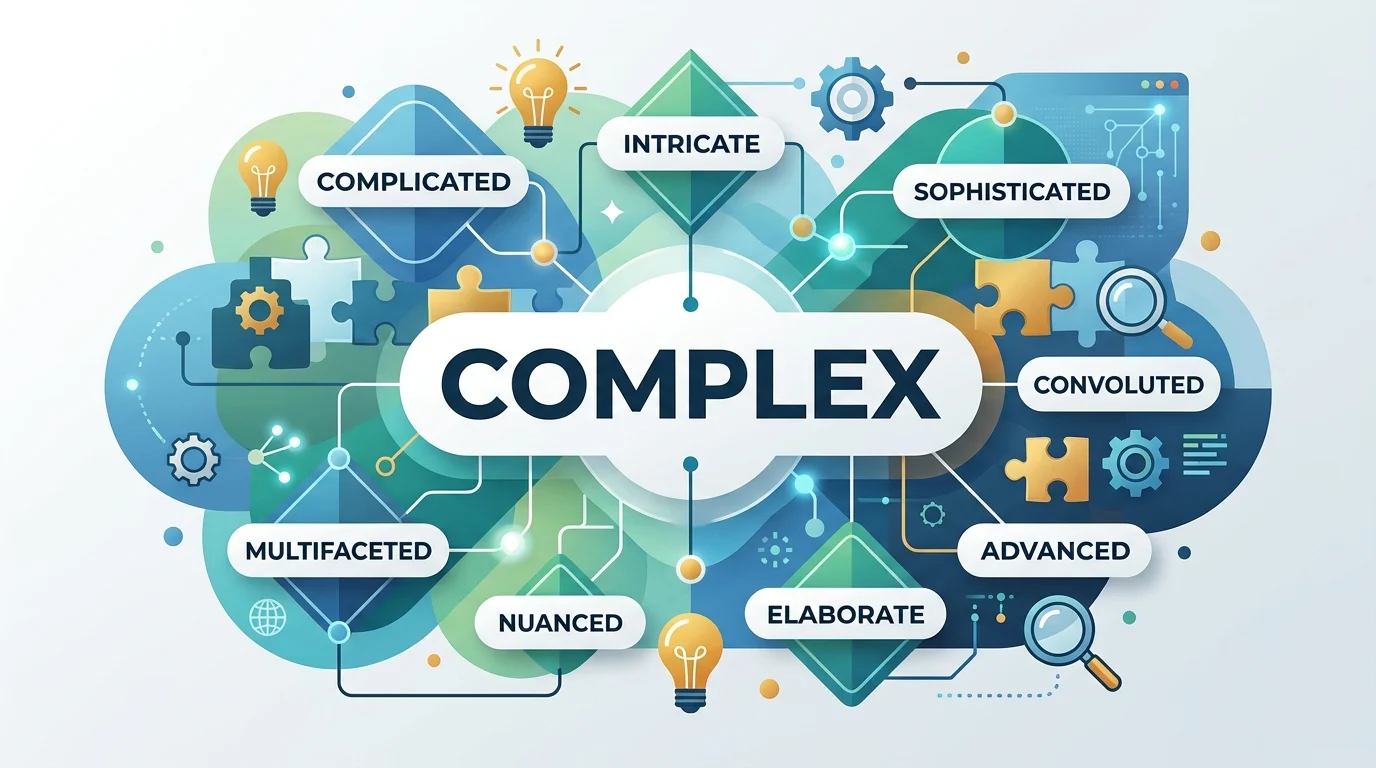
Finding the right synonyms for complex can make your writing clearer, more precise, and more engaging. The word complex is useful, but it can sometimes feel too general.
Depending on what you are describing, words such as complicated, intricate, sophisticated, or multifaceted may communicate your exact meaning much better.
If you are a student writing an essay, an ESL learner building vocabulary, a writer looking for variety, or a content creator trying to make your writing more natural, understanding the differences between these words is important. Not every synonym for complex works in every situation.
In this guide, you will find 30 synonyms for complex, along with simple meanings, example sentences, and notes about when each word works best. You will also learn how to choose the right synonym based on tone, context, and meaning.
What Does “Complex” Mean?
The adjective complex describes something that has many connected parts, details, ideas, or factors and is therefore not easy to understand, explain, or deal with.
Simple definition
Complex means complicated because it contains many different parts or ideas.
For example:
The human brain is a complex organ.
Here, complex means that the brain has many interconnected parts and functions.
The word can describe many things, including:
- Ideas
- Problems
- Systems
- Machines
- Relationships
- Processes
- Situations
- Emotions
- Designs
- Organizations
Complex vs. complicated
Complex and complicated are close in meaning, but there can be a small difference.
Complicated often emphasizes that something is difficult to understand or deal with.
Complex can emphasize that something has many interconnected parts.
For example:
The instructions are complicated.
This suggests the instructions are difficult to follow.
The climate system is complex.
This suggests that many different factors interact with one another.
30 Synonyms for Complex
Here are 30 useful alternatives to complex, each with its own shade of meaning.
1. Complicated
Meaning: Difficult to understand, solve, or deal with because there are many details or parts.
Example:
The legal process was complicated and required professional help.
Best usage context: Everyday writing, conversations, problems, instructions, and situations.
Complicated is one of the closest and most common synonyms for complex.
2. Intricate
Meaning: Made up of many small or carefully connected parts.
Example:
The artist created an intricate pattern on the wall.
Best usage context: Designs, systems, artwork, machinery, details, and processes.
Intricate often suggests something detailed and carefully constructed.
3. Compounded
Meaning: Made more difficult by several problems or factors occurring together.
Example:
The economic crisis was compounded by rising unemployment.
Best usage context: Problems, difficulties, risks, and negative situations.
This word is particularly useful when one problem makes another problem worse.
4. Multifaceted
Meaning: Having many different aspects, features, or sides.
Example:
Climate change is a multifaceted issue that affects societies around the world.
Best usage context: Academic writing, social issues, careers, personalities, and broad topics.
Multifaceted is excellent when you want to emphasize that a subject cannot be understood from only one perspective.
5. Sophisticated
Meaning: Highly developed, advanced, or involving a lot of knowledge and skill.
Example:
The company uses a sophisticated security system.
Best usage context: Technology, systems, methods, products, ideas, and professional writing.
Unlike complicated, sophisticated can have a strongly positive meaning.
6. Elaborate
Meaning: Detailed and carefully developed.
Example:
They prepared an elaborate plan for the event.
Best usage context: Plans, explanations, designs, ceremonies, systems, and creative work.
Elaborate often suggests that considerable effort has gone into creating something.
7. Convoluted
Meaning: Extremely complicated and difficult to understand.
Example:
The contract contained several convoluted clauses.
Best usage context: Arguments, explanations, rules, writing, systems, and procedures.
Convoluted usually has a negative tone.
8. Knotty
Meaning: Very difficult to solve or understand.
Example:
The committee faced a knotty problem involving several departments.
Best usage context: Difficult problems, questions, debates, and intellectual challenges.
Knotty is less common in everyday speech but useful in sophisticated writing.
9. Challenging
Meaning: Difficult and requiring effort, skill, or careful thought.
Example:
Learning a new language can be challenging.
Best usage context: Tasks, projects, studies, careers, and problems.
Challenging is often more positive than complicated because it can suggest an opportunity to learn or improve.
10. Difficult
Meaning: Not easy to understand, accomplish, or deal with.
Example:
The students had to solve a difficult mathematical problem.
Best usage context: General writing and everyday English.
Difficult is broader than complex. Something can be difficult without having many interconnected parts.
11. Advanced
Meaning: Highly developed or requiring a high level of knowledge or skill.
Example:
The course covers advanced topics in computer science.
Best usage context: Education, technology, science, medicine, and professional subjects.
Use advanced when the main idea is a high level of development rather than confusion.
12. Detailed
Meaning: Containing many specific pieces of information.
Example:
The researcher provided a detailed explanation of the experiment.
Best usage context: Reports, explanations, instructions, descriptions, and research.
Detailed focuses on the amount of information rather than difficulty.
13. Sophisticate
Meaning: A person with considerable knowledge, experience, or refined taste.
Example:
She is a sophisticated professional with years of international experience.
Best usage context: People, behavior, tastes, and social or professional experience.
Note that sophisticated is normally the adjective used as a synonym for complex; sophisticate is generally a noun referring to a person.
14. Nuanced
Meaning: Containing small but important differences or distinctions.
Example:
The author gives a nuanced view of the political debate.
Best usage context: Opinions, arguments, analysis, literature, culture, and academic writing.
Nuanced is ideal when something contains subtle layers of meaning.
15. Layered
Meaning: Containing several levels, meanings, or aspects.
Example:
The novel tells a layered story about family and identity.
Best usage context: Literature, films, stories, emotions, arguments, and creative work.
Layered suggests that there is more to something than what appears on the surface.
16. Multifactorial
Meaning: Caused or influenced by many different factors.
Example:
The researchers described the issue as multifactorial.
Best usage context: Science, medicine, psychology, economics, and academic writing.
This is a particularly useful technical term when several causes contribute to an outcome.
17. Interconnected
Meaning: Closely connected so that different parts influence one another.
Example:
The city’s transportation and economic systems are deeply interconnected.
Best usage context: Systems, organizations, technology, society, science, and relationships.
Use this word when the connections between parts are especially important.
18. Sophisticated
Meaning: Advanced, refined, or highly developed.
Example:
Modern software can perform sophisticated calculations in seconds.
Best usage context: Technology, methods, equipment, analysis, and professional contexts.
Although this word appeared earlier in the list, it is worth emphasizing because sophisticated is one of the most useful positive alternatives to complex.
19. Byzantine
Meaning: Extremely complicated, usually because of many rules, procedures, or details.
Example:
The organization’s Byzantine approval process frustrated employees.
Best usage context: Bureaucracy, regulations, organizations, politics, and complicated procedures.
Byzantine is a strong and expressive word, but it is more advanced vocabulary.
20. Tangled
Meaning: Confused, complicated, or difficult to separate or resolve.
Example:
The investigation uncovered a tangled network of financial relationships.
Best usage context: Problems, relationships, situations, stories, and networks.
Tangled can be literal or figurative.
21. Confusing
Meaning: Difficult to understand or follow.
Example:
The instructions were confusing for many first-time users.
Best usage context: Instructions, explanations, information, and communication.
Use confusing when the focus is on how difficult something is for the person trying to understand it.
22. Intriguing
Meaning: Interesting because something contains unusual or mysterious details.
Example:
The scientist presented an intriguing theory about the origins of the universe.
Best usage context: Ideas, stories, theories, discoveries, and mysteries.
Intriguing is not a direct synonym for complex. It is useful when complexity makes something especially interesting.
23. Deep
Meaning: Containing serious, important, or difficult ideas.
Example:
The film raises deep questions about human nature.
Best usage context: Ideas, emotions, philosophical questions, and intellectual discussions.
Deep focuses more on meaning or seriousness than on the number of parts.
24. Sophisticating
Meaning: Making something more advanced or refined.
Example:
New technology is sophisticating the way businesses analyze data.
Best usage context: Rare or specialized usage.
In most situations, sophisticated is the more natural choice. ESL learners should generally avoid sophisticating unless the specific context calls for it.
25. Complicated
Meaning: Containing many parts or steps that make something difficult to understand or complete.
Example:
The application process is more complicated than I expected.
Best usage context: Everyday situations, instructions, procedures, and tasks.
This is one of the safest alternatives when you need a simple replacement for complex.
26. Comprehensive
Meaning: Including many details, areas, or aspects of a subject.
Example:
The report provides a comprehensive analysis of the problem.
Best usage context: Reports, research, guides, reviews, and academic writing.
Comprehensive is not always interchangeable with complex. It emphasizes completeness rather than difficulty.
27. Extensive
Meaning: Covering a large amount or wide range of information, activities, or material.
Example:
The project required extensive research.
Best usage context: Research, experience, studies, information, and large-scale projects.
Extensive emphasizes size or range.
28. Sophisticatedly Designed
Meaning: Created using advanced methods or a high level of skill.
Example:
The device is sophisticatedly designed to operate in extreme conditions.
Best usage context: Technical, engineering, design, and product descriptions.
In natural everyday English, however, sophisticated design or advanced design is usually smoother.
29. Multifaceted
Meaning: Having several different sides, dimensions, or characteristics.
Example:
Her role in the organization is multifaceted.
Best usage context: People, careers, problems, subjects, and social issues.
This word is especially useful when you want to show that something has several meaningful dimensions.
30. Intricately Structured
Meaning: Organized in a detailed way with many connected elements.
Example:
The novel is intricately structured around several interconnected timelines.
Best usage context: Literature, systems, architecture, designs, arguments, and creative projects.
This phrase is useful when complex refers specifically to the structure of something.
Quick Comparison: Synonyms for Complex
Choosing the right word depends on what kind of complexity you mean.
| Synonym | Main Meaning | Tone | Best Used For |
|---|---|---|---|
| Complicated | Difficult to understand or deal with | Neutral | Problems, tasks, instructions |
| Intricate | Detailed and carefully connected | Often positive | Designs, systems, patterns |
| Multifaceted | Having many aspects | Neutral/positive | Issues, people, subjects |
| Sophisticated | Advanced or highly developed | Positive | Technology, methods, systems |
| Elaborate | Detailed and carefully developed | Positive/neutral | Plans, designs, explanations |
| Convoluted | Excessively complicated | Negative | Arguments, rules, writing |
| Nuanced | Full of subtle distinctions | Positive/neutral | Ideas, opinions, analysis |
| Layered | Having several levels | Neutral/positive | Stories, emotions, arguments |
| Interconnected | Parts influence each other | Neutral | Systems, society, technology |
| Challenging | Difficult and requiring effort | Positive/neutral | Tasks, learning, projects |
| Difficult | Not easy | Neutral | General situations |
| Advanced | Highly developed | Positive | Education, science, technology |
| Detailed | Full of specific information | Neutral/positive | Reports, explanations |
| Tangled | Confused or difficult to resolve | Negative | Situations, relationships |
| Confusing | Hard to understand | Negative/neutral | Instructions, explanations |
| Comprehensive | Covering everything important | Positive | Reports, guides, research |
| Extensive | Large in range or amount | Neutral | Research, experience |
| Multifactorial | Influenced by many factors | Technical | Science, medicine, research |
| Byzantine | Extremely complicated | Negative | Bureaucracy, procedures |
| Knotty | Difficult to solve | Neutral | Problems, questions |
Synonyms for Complex by Context
The best synonym changes depending on what you are describing.
For a complex problem
Try:
- Complicated
- Difficult
- Challenging
- Knotty
- Convoluted
- Tangled
Example:
The company is facing a complicated financial problem.
Or:
The committee must solve a knotty political issue.
For a complex system
Try:
- Intricate
- Interconnected
- Sophisticated
- Multifaceted
- Advanced
- Elaborate
Example:
The human immune system is an intricate network of cells and processes.
For a complex idea
Try:
- Nuanced
- Deep
- Multifaceted
- Sophisticated
- Layered
- Difficult
Example:
The professor presented a nuanced explanation of the theory.
For complex writing
Try:
- Convoluted
- Elaborate
- Detailed
- Layered
- Nuanced
- Sophisticated
Be careful here. If you say that someone’s writing is convoluted, you are usually criticizing it. If you say it is nuanced, you are generally praising its subtlety.
For complex technology
Try:
- Sophisticated
- Advanced
- Intricate
- Elaborate
- Interconnected
Example:
The laboratory uses sophisticated equipment to analyze samples.
Positive Synonyms for Complex
Sometimes you want to describe complexity as a strength rather than a problem.
Good choices include:
- Sophisticated
- Intricate
- Nuanced
- Multifaceted
- Elaborate
- Advanced
- Layered
- Comprehensive
For example:
The researcher developed a sophisticated model.
This sounds more positive than:
The researcher developed a complicated model.
Negative Synonyms for Complex
When complexity creates unnecessary difficulty, these words are more appropriate:
- Complicated
- Convoluted
- Confusing
- Tangled
- Byzantine
- Difficult
For example:
The company’s convoluted rules made the process unnecessarily difficult.
Here, convoluted clearly suggests that the complexity is a problem.
Academic Synonyms for Complex
Students and academic writers may want more precise vocabulary. Useful choices include:
- Multifaceted
- Multifactorial
- Nuanced
- Interconnected
- Sophisticated
- Intricate
- Comprehensive
- Advanced
Example
Basic:
Poverty is a complex problem.
More academic:
Poverty is a multifaceted social issue influenced by numerous interconnected economic and political factors.
The second sentence gives the reader more information instead of simply replacing one word with a fancier word.
Synonyms for Complex in Everyday English
If you are an ESL learner, you do not always need advanced vocabulary.
The most natural everyday alternatives are:
- Complicated
- Difficult
- Confusing
- Challenging
- Detailed
- Tangled
Example
Instead of:
This is a complex problem.
You can say:
This is a complicated problem.
Or:
This is a difficult problem.
Both are natural and easy to understand.
Complex Synonyms for Writing and Content Creation
Writers often need alternatives to avoid repeating the same word. However, replacing every occurrence of complex with a synonym can make writing less natural.
Instead, choose a word that adds a specific meaning.
Example
Weak repetition:
The complex system has complex rules and creates complex problems.
Better:
The intricate system contains detailed rules and creates challenging problems.
The second version is more precise and easier to read.
How to Choose the Right Synonym for Complex
Choosing a synonym is not simply about finding a word with a similar dictionary definition. Think about what kind of complexity you want to communicate.
1. Use “complicated” for general difficulty
Choose complicated when something has many parts or steps and is difficult to understand or handle.
The instructions are complicated.
This is probably the easiest direct replacement for complex.
2. Use “intricate” for detailed structure
Choose intricate when something contains many carefully connected details.
The watch has an intricate mechanism.
It often creates a sense of craftsmanship or precision.
3. Use “multifaceted” for multiple aspects
Choose multifaceted when a topic has several different sides.
Education is a multifaceted issue.
This is especially useful in essays and academic writing.
4. Use “sophisticated” for advanced development
Choose sophisticated when complexity comes from advanced knowledge, technology, or design.
The company developed a sophisticated software system.
It usually has a positive tone.
5. Use “convoluted” for unnecessary complexity
Choose convoluted when something is so complicated that it becomes difficult to follow.
The explanation was convoluted and difficult to understand.
This word often expresses criticism.
6. Use “nuanced” for subtle differences
Choose nuanced when something contains small distinctions that are important.
She offered a nuanced interpretation of the novel.
This is especially useful for analysis and thoughtful writing.
7. Use “interconnected” when parts affect each other
Choose interconnected when different components are linked.
Economic and environmental problems are often interconnected.
This gives a more precise meaning than simply saying complex.
Complex vs. Complicated
These words are often interchangeable, but they are not always identical.
| Word | Meaning | Example |
|---|---|---|
| Complex | Having many connected parts or factors | The ecosystem is complex. |
| Complicated | Difficult to understand or deal with | The instructions are complicated. |
A complex thing is not necessarily bad or confusing.
For example:
The human brain is complex.
That does not mean the brain is poorly designed. It means it contains many interacting parts.
By contrast:
The instructions are complicated.
This suggests that the instructions may be difficult for users.
Complex vs. Intricate
Intricate usually emphasizes detail and structure.
The machine has a complex design.
The machine has an intricate design.
The second sentence suggests that the design contains many carefully arranged details.
Intricate is especially effective for:
- Art
- Jewelry
- Architecture
- Machinery
- Patterns
- Systems
Complex vs. Sophisticated
Sophisticated usually carries a more positive meaning.
The software is complex.
This simply says the software has many elements or is difficult to understand.
The software is sophisticated.
This suggests that the software is advanced, capable, or highly developed.
Therefore, use sophisticated when you want to emphasize quality or advancement.
Complex vs. Multifaceted
These words are especially useful in academic writing.
Complex means something has many connected elements or is difficult to understand.
Multifaceted means something has many different aspects or dimensions.
For example:
The causes of poverty are complex.
Poverty is a multifaceted social issue.
The second sentence highlights the fact that poverty has economic, political, cultural, educational, and social dimensions.
Common Collocations With “Complex”
Learning common word combinations can help ESL learners use complex naturally.
Complex problem
Scientists are working to solve a complex problem.
Complex system
The human body is a complex system.
Complex relationship
The two countries have a complex relationship.
Complex process
Building a successful company is a complex process.
Complex issue
Climate change is a complex issue.
Complex structure
The molecule has a complex structure.
Complex situation
The organization found itself in a complex situation.
Complex idea
The teacher explained a complex idea using a simple example.
Common Mistakes When Using Synonyms for Complex
Mistake 1: Assuming every synonym has exactly the same meaning
Synonyms are rarely identical in every situation.
For example, sophisticated, convoluted, and nuanced can all relate to complexity, but they communicate very different ideas.
Mistake 2: Using advanced words unnecessarily
You do not need to replace complex with multifactorial simply to sound intelligent.
Instead, ask:
Does this word make my meaning clearer?
If not, complex may be the better choice.
Mistake 3: Using “complicated” when you mean “detailed”
Consider:
The report is complicated.
This suggests the report is difficult to understand.
If you mean the report contains lots of information, say:
The report is detailed.
The difference is small but important.
Mistake 4: Using “sophisticated” negatively
Sophisticated usually has a positive or neutral meaning.
If you mean that something is unnecessarily difficult, convoluted or complicated may be better.
Frequently Asked Questions About Synonyms for Complex
What is the best synonym for complex?
Complicated is usually the closest general synonym. However, the best choice depends on context. Intricate works well for detailed structures, multifaceted for topics with many aspects, and sophisticated for advanced systems or technology.
What is a simple synonym for complex?
The simplest alternatives are complicated, difficult, and challenging.
What is a positive synonym for complex?
Good positive alternatives include sophisticated, intricate, nuanced, multifaceted, and advanced.
What is a negative synonym for complex?
Depending on the context, convoluted, confusing, tangled, complicated, and Byzantine can communicate negative complexity.
What is a formal synonym for complex?
Formal alternatives include multifaceted, multifactorial, intricate, sophisticated, interconnected, and nuanced.
What is the opposite of complex?
Common opposites include:
- Simple
- Easy
- Straightforward
- Basic
- Clear
- Uncomplicated
- Plain
For example:
The complex instructions were replaced with a simple, straightforward guide.
Can “difficult” replace “complex”?
Sometimes, but not always.
Difficult describes something that is not easy, while complex often suggests that something has many interconnected parts.
For example, a simple task can be difficult because it requires great physical strength. It is difficult, but not necessarily complex.
Is “intricate” the same as “complex”?
They are closely related. Intricate emphasizes many small, carefully connected details, while complex has a broader meaning.
Is “sophisticated” a synonym for complex?
Sometimes. Sophisticated can describe something advanced or highly developed, which may also make it complex. However, it usually has a more positive meaning than complex.
Final Takeaway: Finding the Best Synonym for Complex
There are many useful synonyms for complex, but the right word depends on the exact meaning you want to express.
Use complicated for general difficulty, intricate for detailed structures, multifaceted for subjects with many sides, and sophisticated for advanced systems or technology.
Choose nuanced when subtle differences matter, interconnected when different parts influence one another, and convoluted when complexity makes something unnecessarily difficult to understand.
For students and ESL learners, the most important lesson is not to use the longest or most advanced synonym. The goal is to choose the most accurate and natural word for the situation.
A strong vocabulary gives you more than different words. It gives you more precise ways to communicate your ideas.
When you understand the differences between complex, complicated, intricate, multifaceted, sophisticated, and other related words, your writing becomes clearer, more natural, and more expressive.

I am Derek Thomas, a passionate word enthusiast and writer. I enjoy exploring synonyms, expanding vocabulary, and helping readers find clear, accurate, and meaningful words for better writing.