The word different is one of the most common words in English. We use it when we want to show that one person, thing, idea, or situation is not the same as another.
For example, you might say, “This book is different from the one I read yesterday,” or “She has a different way of solving problems.”
Although different is correct in almost every situation, using the same word repeatedly can make your speaking and writing sound simple or repetitive.
Learning synonyms for different can help you express exactly how something is different if it is unusual, unique, distinct, contrasting, varied, modified, or unfamiliar.
This guide explains 30 synonyms for different in simple English. Each word includes its meaning, an example sentence, and the situation where it works best. This makes the list useful for students, ESL learners, writers, bloggers, and content creators who want more precise vocabulary.
What Does “Different” Mean?
Different means not the same as someone or something else.
It can describe differences in appearance, personality, opinions, behavior, quality, size, style, method, or situation.
Simple examples
- My answer is different from yours.
- We have different opinions about the movie.
- She chose a different career.
- This restaurant has a different style.
- Every person has a different experience.
The word can be neutral. It does not always mean better or worse it simply means not the same.
Different vs. Unusual
These words are related but not identical.
Different means something is not the same as another thing.
Unusual means something is uncommon or not normally expected.
For example:
“His approach is different from mine.”
This simply compares two approaches.
“His approach is unusual.”
This suggests that his approach is uncommon.
Understanding these small differences helps you choose a synonym that communicates your exact meaning.
30 Synonyms for Different
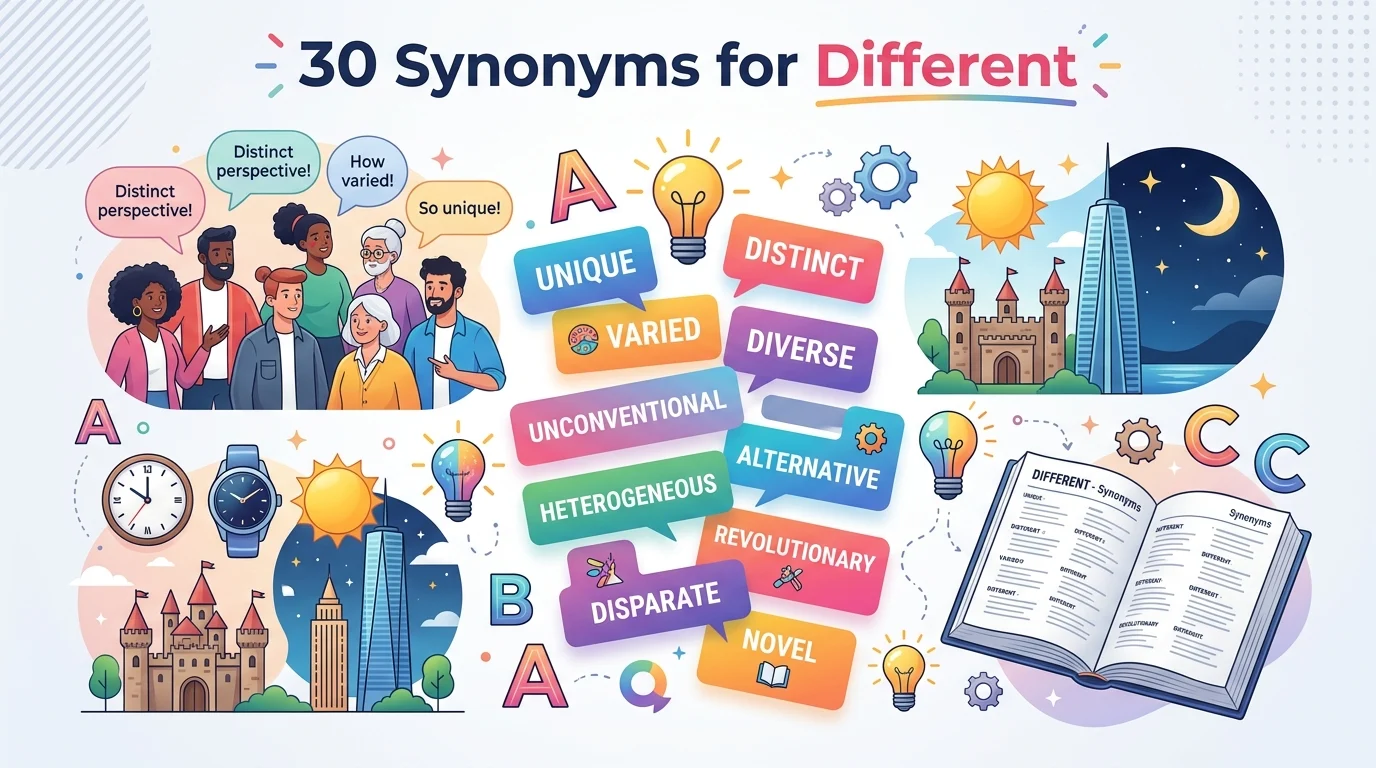
Here are 30 useful alternatives to different, ranging from everyday vocabulary to more precise words for academic and creative writing.
1. Distinct
Meaning: Clearly separate or noticeably different from something else.
Example:
The two products have distinct features.
Best usage:
Use distinct when you want to emphasize that two things can be clearly recognized as separate.
2. Diverse
Meaning: Including many different types, forms, or groups.
Example:
The city has a diverse population.
Best usage:
Use diverse when talking about variety within a group, collection, community, or environment.
3. Unique
Meaning: One of a kind or unlike anything else.
Example:
The artist has a unique style.
Best usage:
Use unique when something has qualities that make it especially unusual or one of a kind.
Note: In everyday English, people often use unique to mean “very unusual,” even though its strict meaning suggests something truly one of a kind.
4. Unlike
Meaning: Not similar to someone or something.
Example:
Unlike his brother, Daniel enjoys working alone.
Best usage:
Use unlike when directly comparing two people, objects, or situations.
5. Dissimilar
Meaning: Not alike or not similar.
Example:
The two paintings are quite dissimilar.
Best usage:
This is useful in formal, academic, and analytical writing.
6. Varied
Meaning: Including several different types or forms.
Example:
The hotel offers a varied selection of meals.
Best usage:
Use varied for choices, experiences, activities, subjects, or collections containing several types.
7. Contrasting
Meaning: Very different, especially in a way that makes the difference noticeable.
Example:
The designer used contrasting colors throughout the room.
Best usage:
Use contrasting when two things are different in a way that highlights their opposing qualities.
8. Unusual
Meaning: Not common or not normally expected.
Example:
It was unusual to see snow in that region during summer.
Best usage:
Use unusual when something is outside what people normally expect.
9. Uncommon
Meaning: Not frequently seen, found, or experienced.
Example:
The bird has an uncommon pattern on its wings.
Best usage:
Use uncommon when something is relatively rare without necessarily being strange.
10. Alternative
Meaning: Another choice or possibility.
Example:
We need to find an alternative solution.
Best usage:
Use alternative when referring to another option, method, plan, or possibility.
11. Separate
Meaning: Existing apart from something else.
Example:
The company operates as a separate division.
Best usage:
Use separate when the main idea is that things are divided or independent rather than simply different.
12. Individual
Meaning: Belonging to one particular person or thing rather than being shared by a group.
Example:
Students have individual learning needs.
Best usage:
Use individual when emphasizing personal qualities, needs, choices, or characteristics.
13. Variegated
Meaning: Having different colors, patterns, or types.
Example:
The garden was filled with variegated leaves.
Best usage:
This word is especially useful for describing visual variety, plants, patterns, or mixtures.
14. Disparate
Meaning: Very different from each other, especially in nature or character.
Example:
The report combines data from several disparate sources.
Best usage:
Use disparate in formal or academic writing when describing things that are fundamentally different.
15. Divergent
Meaning: Developing or moving in different directions.
Example:
The researchers reached divergent conclusions.
Best usage:
Use divergent for opinions, ideas, paths, trends, results, or viewpoints that move away from one another.
16. Contradictory
Meaning: Completely different in a way that cannot easily be true at the same time.
Example:
The witness gave contradictory statements.
Best usage:
Use contradictory when two statements, ideas, or claims conflict with each other.
17. Opposite
Meaning: Completely or directly different.
Example:
Their opinions are almost opposite.
Best usage:
Use opposite when the difference is strong and involves contrasting qualities or positions.
18. Novel
Meaning: New, original, or different from what has existed before.
Example:
The scientist proposed a novel approach to the problem.
Best usage:
Use novel in academic, professional, and formal contexts when describing a new idea or method.
19. Innovative
Meaning: Introducing new ideas, methods, or technology.
Example:
The company developed an innovative way to reduce waste.
Best usage:
Use innovative when the difference comes from creativity, improvement, or new thinking.
20. Original
Meaning: New, creative, or not copied from something else.
Example:
She presented an original idea during the meeting.
Best usage:
Use original when emphasizing creativity, independence, or lack of copying.
21. Peculiar
Meaning: Strange or noticeably unusual.
Example:
There was something peculiar about the old house.
Best usage:
Use peculiar when something is different in a strange or unexpected way.
22. Atypical
Meaning: Not typical or not representative of what is normally expected.
Example:
His response was atypical of his usual behavior.
Best usage:
Use atypical in formal, academic, medical, or analytical contexts.
23. Exceptional
Meaning: Unusually good, impressive, or outside the normal range.
Example:
She demonstrated exceptional skill during the competition.
Best usage:
Use exceptional when being different is connected to unusually high quality or ability.
24. Extraordinary
Meaning: Very unusual, remarkable, or impressive.
Example:
The team achieved an extraordinary result.
Best usage:
Use extraordinary when something is far beyond what is normal or expected.
25. Distinctive
Meaning: Having a quality that makes something easy to recognize.
Example:
The building has a distinctive architectural style.
Best usage:
Use distinctive when a particular feature makes something stand out from others.
26. Discrete
Meaning: Separate or individually distinct.
Example:
The study divided the information into several discrete categories.
Best usage:
Use discrete mainly in technical, scientific, mathematical, and formal contexts.
Important: Discrete and discreet are different words. Discreet means careful about keeping something private.
27. Heterogeneous
Meaning: Made up of different kinds of people, things, or elements.
Example:
The sample contained a heterogeneous mixture of materials.
Best usage:
Use heterogeneous in scientific, academic, technical, or formal writing.
28. Multifaceted
Meaning: Having many different aspects, qualities, or parts.
Example:
Climate change is a multifaceted issue.
Best usage:
Use multifaceted when something is complex and contains several different dimensions.
29. Idiosyncratic
Meaning: Unusual in a way that is characteristic of a particular person or thing.
Example:
The author’s idiosyncratic writing style makes the novel memorable.
Best usage:
Use idiosyncratic when describing a distinctive personal habit, style, behavior, or characteristic.
30. Altered
Meaning: Changed from its original form or condition.
Example:
The architect presented an altered version of the original design.
Best usage:
Use altered when something has been changed rather than simply being unlike something else.
Quick Comparison: Synonyms for Different
Not every synonym for different works in the same situation. The table below makes the distinctions easier to understand.
| Synonym | Main Meaning | Tone | Common Use |
|---|---|---|---|
| Different | Not the same | Neutral | Everyday English |
| Distinct | Clearly separate | Neutral/Formal | Comparisons |
| Diverse | Many different types | Neutral | Groups and collections |
| Unique | One of a kind | Positive/Neutral | People, products, ideas |
| Unlike | Not similar | Neutral | Direct comparisons |
| Dissimilar | Not alike | Formal | Academic writing |
| Varied | Having many types | Neutral | Choices and experiences |
| Contrasting | Clearly different | Neutral | Colors, ideas, styles |
| Unusual | Not common | Neutral | Events and behavior |
| Uncommon | Rare | Neutral | Objects, traits, events |
| Alternative | Another option | Neutral | Choices and solutions |
| Separate | Apart or independent | Neutral | Groups and things |
| Disparate | Fundamentally different | Formal | Research and analysis |
| Divergent | Moving in different directions | Formal | Opinions and trends |
| Contradictory | Conflicting | Neutral/Formal | Statements and claims |
| Opposite | Directly different | Neutral | Views and qualities |
| Novel | New or original | Formal | Ideas and methods |
| Innovative | New and creative | Positive | Technology and solutions |
| Original | Creative or new | Positive | Ideas and work |
| Peculiar | Strange | Neutral/Negative | Behavior and situations |
| Atypical | Not typical | Formal | Analysis |
| Exceptional | Unusually good | Positive | Skills and results |
| Extraordinary | Remarkably unusual | Positive | Achievements and events |
| Distinctive | Easily recognizable | Positive/Neutral | Style and appearance |
| Multifaceted | Having many aspects | Formal | Complex subjects |
Different Synonyms by Meaning
One of the easiest ways to choose the right synonym is to first ask what kind of difference you mean.
If you mean “not the same”
Use:
- Different
- Distinct
- Unlike
- Dissimilar
- Separate
Example:
“The two methods are distinct from each other.”
If you mean “many types”
Use:
- Diverse
- Varied
- Heterogeneous
- Multifaceted
Example:
“The conference attracted a diverse group of professionals.”
If you mean “unusual”
Use:
- Unusual
- Uncommon
- Peculiar
- Atypical
- Extraordinary
Example:
“She had an unusual approach to the problem.”
If you mean “new or creative”
Use:
- Novel
- Innovative
- Original
Example:
“The researchers developed an innovative solution.”
If you mean “clearly recognizable”
Use:
- Distinctive
- Unique
- Idiosyncratic
Example:
“The musician has a distinctive voice.”
If you mean “strongly opposed”
Use:
- Contrasting
- Opposite
- Contradictory
- Divergent
Example:
“The two experts expressed divergent opinions.”
How to Choose the Right Synonym for Different
Choosing a synonym is not just about finding another word with a similar dictionary definition. The best word depends on context, tone, and the type of difference you want to communicate.
For everyday conversations
Choose simple words such as:
- different
- unlike
- unusual
- separate
- opposite
These words are natural and easy to understand.
Example:
“I tried a different restaurant this weekend.”
For academic writing
Consider:
- distinct
- dissimilar
- divergent
- disparate
- atypical
- heterogeneous
These words can make analytical writing more precise when used correctly.
Example:
“The researchers identified two distinct patterns.”
For professional writing
Useful choices include:
- alternative
- innovative
- distinct
- diverse
- multifaceted
- original
Example:
“The team proposed an alternative strategy.”
For creative writing
Try:
- unique
- distinctive
- peculiar
- idiosyncratic
- extraordinary
- unusual
These words can give descriptions more personality.
Example:
“She wore a distinctive silver necklace that immediately caught everyone’s attention.”
When you want a positive meaning
Consider:
- unique
- innovative
- original
- distinctive
- exceptional
- extraordinary
These words can suggest that being different is valuable or impressive.
When you want a neutral meaning
Use:
- different
- distinct
- varied
- diverse
- unlike
- separate
These generally describe differences without strongly judging them.
When you want to suggest something strange
Use:
- unusual
- peculiar
- atypical
- idiosyncratic
Be careful with these words because some can suggest that the difference is strange or unexpected.
Synonyms for Different in Different Sentences
The best synonym changes depending on the sentence.
Instead of:
“She has a different style.”
You could say:
“She has a distinctive style.”
This emphasizes that her style is easy to recognize.
Instead of:
“We need a different solution.”
You could say:
“We need an alternative solution.”
This emphasizes another possible solution.
Instead of:
“The students come from different backgrounds.”
You could say:
“The students come from diverse backgrounds.”
This sounds natural and emphasizes variety.
Instead of:
“He used a different method.”
You could say:
“He used an innovative method.”
This suggests that the method is new and creative.
Instead of:
“The results were different.”
You could say:
“The results were divergent.”
This is more formal and suggests that the results moved in different directions.
Common Mistakes When Using Synonyms for Different
Learning synonyms is useful, but replacing a word mechanically can create awkward sentences.
Mistake 1: Using “unique” for every kind of difference
Unique is stronger than ordinary different. It suggests something special or one of a kind.
Instead of:
“My phone is unique from yours.”
Say:
“My phone is different from yours.”
Or:
“My phone has a unique design.”
Mistake 2: Using formal words in casual conversations
Words such as disparate, heterogeneous, and idiosyncratic can sound overly formal in everyday conversation.
For example, instead of saying:
“Our opinions are disparate.”
In normal conversation, you might simply say:
“Our opinions are very different.”
Mistake 3: Confusing “alternative” with “different”
Alternative usually means another option.
“We need an alternative plan.”
It does not simply mean that something is different.
Mistake 4: Confusing “unusual” with “unique”
Something can be unusual without being one of a kind.
For example, an unusual hairstyle may be uncommon, but other people may have the same hairstyle.
Mistake 5: Choosing a synonym without considering tone
Words such as peculiar can imply that something is strange, while distinctive can sound more positive.
Compare:
“She has a peculiar style.”
with:
“She has a distinctive style.”
The first may suggest something strange. The second often suggests something memorable or recognizable.
Synonyms for Different for Students and ESL Learners
If you are learning English, you do not need to memorize all 30 words at once.
Start with the most useful everyday alternatives:
- Different
- Unlike
- Distinct
- Diverse
- Varied
- Unusual
- Unique
- Separate
- Opposite
- Alternative
Once these are comfortable, gradually learn more advanced words such as disparate, divergent, atypical, heterogeneous, multifaceted, and idiosyncratic.
A useful vocabulary strategy is to learn synonyms in groups rather than as isolated words. For example:
Different → unusual → uncommon → peculiar
These words are related, but each has a slightly different meaning and tone.
Another useful strategy is to create your own sentences. If you learn the word distinctive, write a sentence about a person’s voice, clothing, writing style, or appearance. Using a word in a realistic sentence makes it easier to remember.
Frequently Asked Questions About Synonyms for Different
What is the best synonym for different?
There is no single best synonym. Distinct, unlike, diverse, varied, unique, unusual, and alternative can all work in different situations. The best choice depends on what kind of difference you want to describe.
What is a formal synonym for different?
Some formal alternatives include distinct, dissimilar, disparate, divergent, atypical, and heterogeneous.
For academic writing, distinct and dissimilar are often useful because they clearly describe differences without sounding overly emotional.
What is a positive synonym for different?
Depending on the context, unique, distinctive, innovative, original, exceptional, and extraordinary can have positive meanings.
For example:
“The company created an innovative product.”
Here, being different is presented as an advantage.
What is a synonym for different in academic writing?
Useful academic choices include distinct, dissimilar, disparate, divergent, atypical, and heterogeneous.
However, always choose the word that accurately expresses the intended meaning instead of choosing a more complicated word simply to sound formal.
What is a synonym for “very different”?
Possible choices include:
- Contrasting
- Opposite
- Disparate
- Dissimilar
- Divergent
- Distinct
The best choice depends on the context.
What is the opposite of different?
The most direct opposite of different is same or similar, depending on the sentence.
For example:
“These two shirts are different.”
The opposite would be:
“These two shirts are the same.”
Or:
“Their opinions are different.”
The opposite could be:
“Their opinions are similar.”
Final Takeaway
The word different is simple, useful, and extremely common, but English offers many more precise alternatives. The right synonym can tell your reader what kind of difference you mean.
Use distinct when things are clearly separate, diverse when there are many types, unique when something is one of a kind, unusual when something is uncommon, alternative when you mean another option, and contrasting when two things have noticeably opposing qualities.
For formal writing, words such as dissimilar, disparate, divergent, atypical, and heterogeneous can add precision. For creative or descriptive writing, distinctive, peculiar, idiosyncratic, and extraordinary can create a stronger impression.
The key is not to replace different with the most complicated synonym available. Instead, choose the word that communicates your exact meaning naturally. That approach will make your English clearer, more accurate, and more interesting.

I am Connor James, Administrator at SynoHut. I enjoy exploring synonyms, improving vocabulary, and helping readers discover clear, useful, and engaging word alternatives for everyday writing and communication.