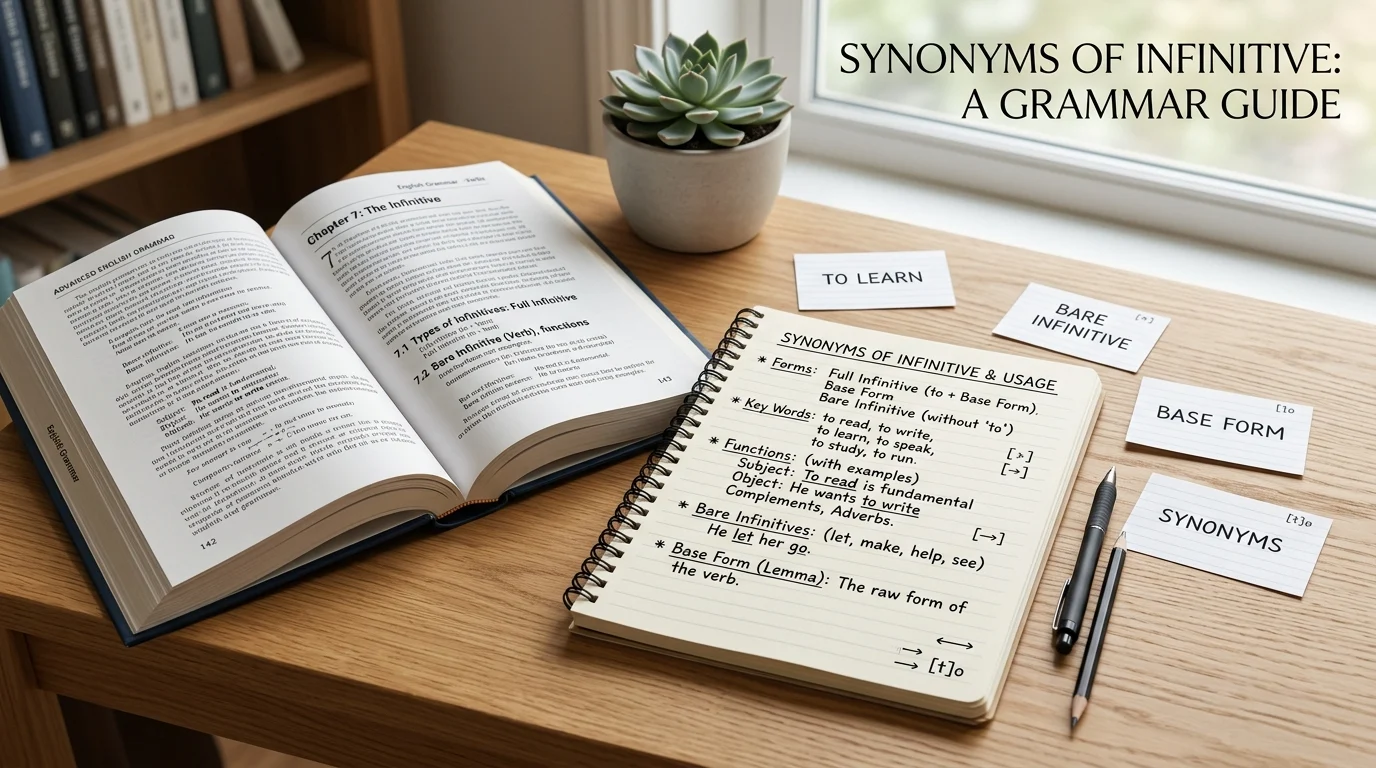
The term infinitive is an important part of English grammar. It usually refers to the basic form of a verb, most commonly written with to, such as to eat, to learn, to write, and to travel. Infinitives can function in several ways in a sentence, including as subjects, objects, complements, and modifiers.
However, finding exact synonyms of infinitive can be confusing. Unlike ordinary vocabulary words, grammatical terms often do not have perfect one-word synonyms. Instead, several terms describe the infinitive, its forms, its uses, or closely related grammatical structures.
This guide explains 30 useful terms related to infinitive, using simple English, clear examples, and practical usage notes. It is designed for students, ESL learners, writers, teachers, and anyone who wants to understand English grammar more confidently.
What Does “Infinitive” Mean?
An infinitive is a verb form that is not marked for tense, person, or number in the way a normal finite verb is.
The most familiar form is the to-infinitive:
- to read
- to play
- to study
- to understand
- to improve
For example:
She wants to learn English.
Here, to learn is an infinitive.
English also has a bare infinitive, which is the base verb without to:
She can swim.
In this sentence, swim is a bare infinitive following the modal verb can.
Infinitive vs. Finite Verb
Compare these examples:
- He works every day. → works is a finite verb.
- He wants to work every day. → to work is an infinitive.
The finite verb changes according to tense or subject, while the infinitive generally keeps its basic form.
30 Synonyms and Related Terms for “Infinitive”
Because infinitive is a technical grammatical term, many of the words below are not exact synonyms. They are near-equivalent terms, grammatical labels, forms, or concepts closely associated with infinitives.
1. Base Form
Meaning: The basic form of a verb before endings such as -s, -ed, or -ing are added.
Example:
“Write” is the base form of the verb.
Best usage: Use base form when discussing the basic dictionary form of a verb.
Note: A base form can be used as a bare infinitive, but not every use of the base form is necessarily called an infinitive.
2. Bare Infinitive
Meaning: An infinitive used without the word to.
Example:
You should go now.
Best usage: Common after modal verbs such as can, should, must, and will.
3. To-Infinitive
Meaning: An infinitive formed with to followed by the base form of a verb.
Example:
I hope to visit London someday.
Best usage: Use this term when you specifically mean the to + verb construction.
4. Verb Form
Meaning: A particular grammatical form of a verb.
Example:
“To study” is an infinitive verb form.
Best usage: Useful in general grammar discussions.
Note: Verb form is broader than infinitive, so it is not an exact synonym.
5. Nonfinite Verb
Meaning: A verb form that does not normally show tense or agreement with a subject.
Example:
She decided to leave.
Best usage: Use nonfinite verb in more technical grammar discussions.
Note: Infinitives are one type of nonfinite verb.
6. Nonfinite Form
Meaning: A grammatical verb form that does not behave like a finite verb.
Example:
“To understand” is a nonfinite form.
Best usage: Academic grammar and linguistics.
7. Verbal
Meaning: A word or form derived from a verb that can perform another grammatical function.
Example:
“To swim” is a verbal form in “He likes to swim.”
Best usage: Useful when explaining how verb forms can function like nouns, adjectives, or other sentence elements.
8. Verbals
Meaning: Verb derived forms that can function differently from ordinary finite verbs.
Example:
Infinitives, gerunds, and participles are commonly discussed as verbals.
Best usage: Grammar textbooks and classroom instruction.
9. Verb-Noun Form
Meaning: A verb derived structure that can perform a noun-like function.
Example:
To travel can be expensive.
Best usage: Helpful for beginners learning that an infinitive can act like a noun.
Note: This is a descriptive term rather than a strict synonym.
10. Noun Like Verb Form
Meaning: A verb form that can perform a function similar to a noun.
Example:
To read is a useful habit.
Best usage: Beginner-friendly grammar explanations.
11. Dictionary Form
Meaning: The basic form in which a verb is normally listed in a dictionary.
Example:
“Eat” is the dictionary form of the verb eat.
Best usage: Vocabulary and grammar lessons.
Note: The dictionary form and infinitive are closely related but are not always identical concepts.
12. Citation Form
Meaning: The form used to identify or cite a verb as a lexical item.
Example:
The citation form of the verb is “run.”
Best usage: Linguistics and advanced grammar.
13. Lemma
Meaning: The basic dictionary representation of a word, including its different grammatical forms.
Example:
“Go” is the lemma associated with forms such as goes, went, and gone.
Best usage: Dictionaries, computational linguistics, and academic language study.
Important: A lemma is not an exact synonym for an infinitive.
14. Lexical Verb Form
Meaning: A form representing the main meaning of a verb rather than serving only as an auxiliary.
Example:
“To write” represents the lexical meaning of the verb write.
Best usage: Advanced grammar and linguistics.
15. Basic Verb Form
Meaning: The simplest form of a verb.
Example:
“Play” is the basic verb form in “I want to play.”
Best usage: ESL teaching and beginner grammar.
16. Uninflected Verb
Meaning: A verb form that does not carry normal inflection for tense, person, or number.
Example:
“To work” is an uninflected verb form.
Best usage: Formal grammar and linguistics.
17. Dictionary Verb Form
Meaning: The basic form used when identifying a verb in reference materials.
Example:
The dictionary verb form is “learn.”
Best usage: Vocabulary instruction and grammar references.
18. Verb Complement
Meaning: A word or phrase that completes the meaning of another verb.
Example:
She wants to leave.
Here, to leave complements wants.
Best usage: Sentence analysis.
Note: Not every verb complement is an infinitive, so this is a related concept rather than a synonym.
19. Infinitival Phrase
Meaning: A phrase built around an infinitive.
Example:
She wants to learn Spanish quickly.
The complete phrase to learn Spanish quickly is an infinitival phrase.
Best usage: Sentence structure and advanced grammar.
20. Infinitive Phrase
Meaning: A phrase containing an infinitive and its modifiers, objects, or complements.
Example:
To finish the project on time was difficult.
Best usage: Common grammar terminology.
21. To-Infinitive Phrase
Meaning: A phrase beginning with to followed by a verb in its base form.
Example:
He decided to study harder.
Best usage: When specifically discussing phrases beginning with to + verb.
22. Bare Verb
Meaning: A verb appearing in its basic form without to in certain grammatical constructions.
Example:
Let him go.
Best usage: Informal descriptions of the base form in constructions requiring a bare infinitive.
Note: In formal grammar, bare infinitive is usually more precise.
23. Root Verb
Meaning: A term sometimes used informally for the basic verb form.
Example:
“Write” is the root verb in “to write.”
Best usage: Beginner explanations.
Note: Root has a more specific meaning in linguistics, so base form is usually safer.
24. Main Verb Form
Meaning: The principal verb form carrying the main lexical meaning.
Example:
“To understand” contains the main verb understand.
Best usage: General grammar explanations.
25. Verb Stem
Meaning: The part of a verb to which grammatical endings may be added.
Example:
In some grammatical analyses, the stem of a verb is used to build different forms.
Best usage: Morphology and advanced grammar.
Note: A verb stem is not always identical to an infinitive.
26. Nonfinite Verb Phrase
Meaning: A verb phrase centered on a nonfinite verb form.
Example:
She hopes to become a doctor.
Best usage: Advanced sentence analysis.
27. Infinitival Construction
Meaning: A grammatical construction involving an infinitive.
Example:
He went to the library to study.
Best usage: Academic writing and grammar analysis.
28. Purpose Infinitive
Meaning: An infinitive used to explain the purpose of an action.
Example:
She went outside to get some fresh air.
Best usage: Explaining why someone does something.
29. Complementary Infinitive
Meaning: An infinitive that completes the meaning of another word, especially a verb or adjective.
Example:
They decided to stay.
Best usage: Sentence analysis and grammar lessons.
30. Infinitival Verb
Meaning: A verb appearing in infinitive form.
Example:
“To read” is an infinitival verb form.
Best usage: Formal grammatical descriptions.
Quick Comparison: Infinitive and Related Terms
| Term | Meaning | Example | Exact Synonym? |
|---|---|---|---|
| Infinitive | Basic nonfinite verb form | to read | — |
| Base form | Basic form of a verb | read | Close |
| Bare infinitive | Infinitive without to | read | Very close |
| To-infinitive | Infinitive with to | to read | Very close |
| Nonfinite verb | Verb without normal finite marking | to read | Broader |
| Verbal | Verb-derived grammatical form | to read | Related |
| Dictionary form | Basic form used in dictionaries | read | Related |
| Lemma | Dictionary representation of a word | read | Related |
| Infinitive phrase | Phrase built around an infinitive | to read books | Related |
| Infinitival phrase | Another term for an infinitive phrase | to read books | Related |
| Purpose infinitive | Infinitive showing purpose | to learn | Specialized |
| Verb complement | Element completing a verb’s meaning | to leave | Broader |
| Verb stem | Part used to build verb forms | work | Related |
| Uninflected verb | Verb without ordinary inflection | work | Related |
| Infinitival construction | Construction containing an infinitive | to study | Related |
Are There Exact Synonyms for “Infinitive”?
This is an important point for students and ESL learners.
Infinitive does not have 30 true synonyms in the same way that ordinary words do.
For example, happy can have synonyms such as joyful, cheerful, and pleased. These words can often replace one another depending on context.
Infinitive is different because it is a grammatical label. Terms such as to-infinitive, bare infinitive, and infinitival phrase describe specific forms or structures rather than providing completely interchangeable alternatives.
Therefore, if you are writing a grammar article or academic paper, it is better to use the most precise grammatical term rather than replacing infinitive with a loosely related word.
Types of Infinitives in English
Understanding the different types of infinitives makes these related terms easier to remember.
1. To Infinitive
The to infinitive consists of to + the base form of a verb.
Examples:
- to read
- to write
- to eat
- to travel
- to understand
Example:
I want to learn English.
2. Bare Infinitive
A bare infinitive does not use to.
Example:
She can dance.
Other examples include:
You must leave now.
Let him speak.
I heard her sing.
The exact grammatical environments where bare infinitives occur depend on the construction.
3. Perfect Infinitive
The perfect infinitive is formed with:
to + have + past participle
Examples:
- to have finished
- to have seen
- to have forgotten
Example:
She seems to have forgotten the appointment.
4. Continuous Infinitive
The continuous infinitive is generally formed with:
to + be + -ing form
Example:
He appears to be sleeping.
It emphasizes an action that is or was in progress.
5. Passive Infinitive
The passive infinitive is generally formed with:
to + be + past participle
Example:
The report needs to be completed.
It focuses on the action received by the subject rather than the person performing it.
6. Perfect Passive Infinitive
This combines perfect and passive forms:
to + have + been + past participle
Example:
The documents appear to have been misplaced.
This structure can describe an earlier passive action.
Infinitive Examples in Everyday English
Infinitives appear frequently in normal communication.
Expressing a desire
I want to improve my writing.
Expressing a plan
We plan to visit the museum.
Expressing a purpose
She went to the store to buy bread.
After an adjective
I am happy to help.
As the subject of a sentence
To exercise regularly is beneficial.
In everyday English, a gerund is often more natural in some subject positions:
Exercising regularly is beneficial.
This illustrates why understanding grammatical function is more useful than simply memorizing terminology.
Infinitive vs. Gerund
One of the most common challenges for English learners is choosing between an infinitive and a gerund.
| Infinitive | Gerund |
|---|---|
| to read | reading |
| to swim | swimming |
| to learn | learning |
| to travel | traveling |
| to write | writing |
Examples:
I want to travel.
I enjoy traveling.
Some verbs commonly take an infinitive, while others commonly take a gerund. Some can take either, sometimes with a change in meaning.
Compare:
I stopped to smoke.
This means I stopped another activity in order to smoke.
I stopped smoking.
This means I quit the activity of smoking.
So, learning the structure and the meaning together is important.
Infinitive vs. Base Form
These terms are closely connected but should not automatically be treated as identical.
Base form
eat
To infinitive
to eat
Bare infinitive
eat
For example:
I want to eat.
Here, to eat is a to-infinitive.
I can eat.
Here, eat is a bare infinitive.
The word eat is also the base form of the verb.
How to Choose the Right Term
Choosing the correct term depends on what you are trying to describe.
When discussing “to + verb”
Use:
- to-infinitive
- infinitive
- infinitival form
Example:
“To study” is a to-infinitive.
When discussing an infinitive without “to”
Use:
- bare infinitive
- base form when appropriate
Example:
“Go” is a bare infinitive after can.
When discussing broader grammar
Use:
- nonfinite verb
- nonfinite form
- verbal
Example:
An infinitive is a type of nonfinite verb.
When discussing a complete group of words
Use:
- infinitive phrase
- infinitival phrase
- infinitival construction
Example:
“To learn a new language” is an infinitive phrase.
When discussing dictionaries
Use:
- dictionary form
- citation form
- lemma
These terms are useful in linguistic or reference contexts, but they are not interchangeable with infinitive in every situation.
Common Mistakes With Infinitives
Mistake 1: Adding an unnecessary “to”
After certain modal verbs, English uses the bare infinitive.
Incorrect:
She can to swim.
Correct:
She can swim.
Mistake 2: Confusing an infinitive with a gerund
Incorrect in some contexts:
I enjoy to read.
Correct:
I enjoy reading.
The verb enjoy normally takes a gerund rather than a to-infinitive.
Mistake 3: Assuming every base verb is an infinitive
The base form go can appear in several grammatical environments.
For example:
I go to school every day.
Here, go is a finite verb.
But:
I can go now.
Here, go functions as a bare infinitive.
Context matters.
Mistake 4: Treating every related term as a true synonym
Words such as lemma, verb stem, and nonfinite verb have specialized meanings.
Replacing infinitive with one of these words without considering the context can make a grammar explanation less accurate.
Why Understanding Infinitives Matters
Infinitives are important because they allow English speakers to express many different ideas efficiently.
They can show:
- purpose
- intention
- possibility
- plans
- desires
- decisions
- results
- actions connected to another verb
For example:
She studied hard to pass the exam.
They decided to move.
I hope to see you soon.
He went outside to get some air.
Understanding these structures can improve both speaking and writing.
Frequently Asked Questions About Synonyms of Infinitive
What is another word for infinitive?
There is no single perfect synonym for infinitive. Depending on context, related terms include to infinitive, bare infinitive, nonfinite verb, infinitival form, and infinitival construction.
Is “base form” a synonym for infinitive?
Not exactly. The base form is the basic form of a verb, while an infinitive is a particular grammatical use or form of the verb. A base form can function as a bare infinitive.
Is “to infinitive” the same as “infinitive”?
A to infinitive is one type of infinitive. It consists of to plus the base form of the verb.
What is a bare infinitive?
A bare infinitive is an infinitive without to, such as go in:
You should go.
What is an infinitive phrase?
An infinitive phrase contains an infinitive along with other words connected to it.
Example:
To learn English quickly takes practice.
Are gerunds synonyms for infinitives?
No. Gerunds and infinitives are both nonfinite verb forms, but they are different grammatical structures.
Compare:
Reading is enjoyable.
To read is enjoyable.
Both can have similar functions in some contexts, but they are grammatically different.
Is “nonfinite verb” the same as “infinitive”?
No. Nonfinite verb is a broader category. Infinitives are one type of nonfinite verb, alongside forms such as participles and gerunds.
Final Takeaway
The keyword synonyms of infinitive can be misleading because infinitive is a grammatical term rather than an ordinary descriptive word. As a result, it does not have dozens of perfect synonyms.
Instead, English grammar provides many closely related terms and forms, including base form, bare infinitive, to infinitive, nonfinite verb, verbal, infinitival phrase, infinitive phrase, dictionary form, uninflected verb, and infinitival construction.
The most important distinction to remember is simple: a to infinitive uses “to + base verb,” while a bare infinitive uses the base verb without “to.” Knowing these forms helps you understand sentence structure and avoid common grammar mistakes.
For students and ESL learners, the best approach is to learn each term according to its function rather than trying to memorize a long list of supposed synonyms. That will make your grammar more accurate and your writing much clearer.

I am Joel Michael, an enthusiastic language writer and synonym enthusiast. I enjoy exploring words, finding their meanings, and discovering useful alternatives. I create clear, helpful content to make vocabulary learning simple and enjoyable for every reader.