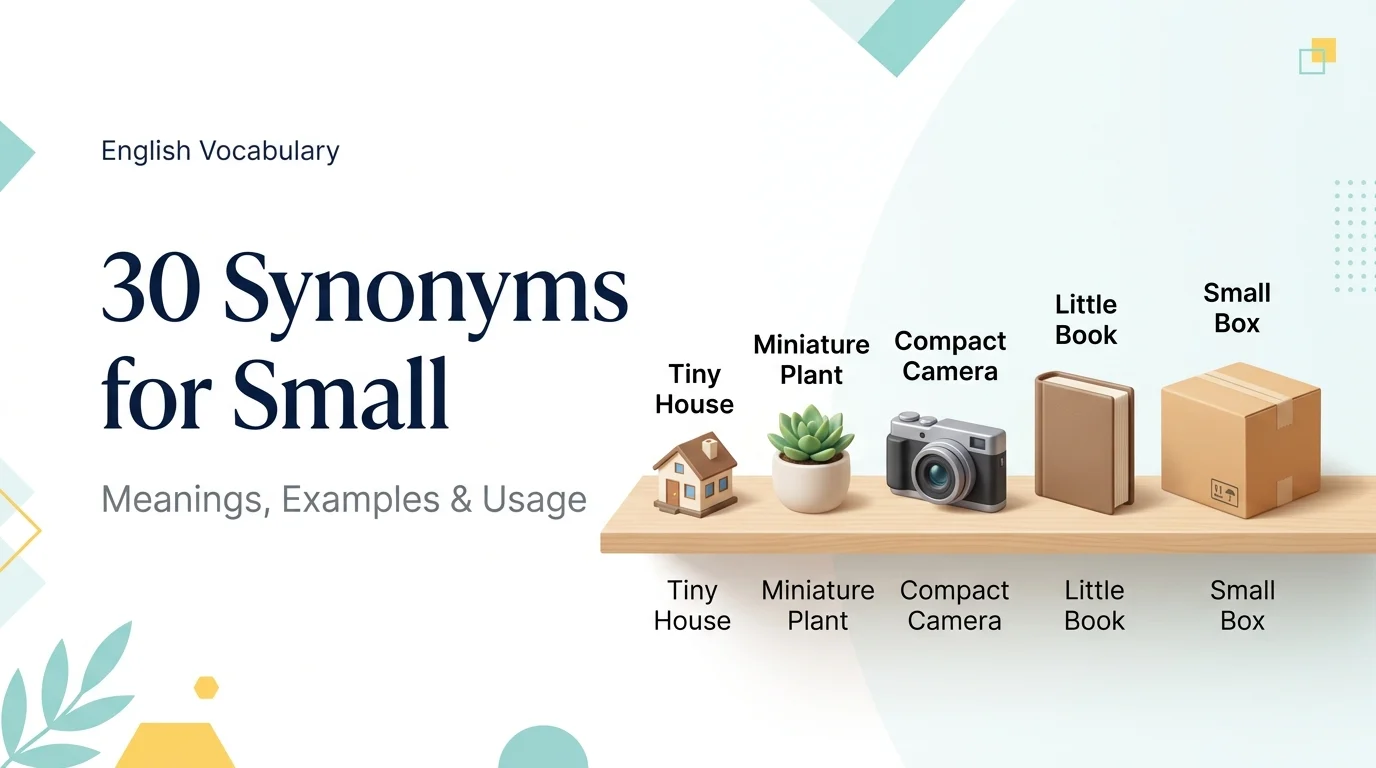
Looking for the right synonyms for small can make your writing clearer, more precise, and more interesting. Although small is one of the most common words in English, it can describe many different ideas: limited size, low quantity, short distance, young age, minor importance, or even a delicate appearance.
Choosing a more specific synonym helps you communicate exactly what you mean. For example, tiny emphasizes very small size, compact suggests something small but efficiently arranged, while minor describes something of little importance rather than physical size.
This guide explains 30 useful synonyms for small in simple, ESL friendly English. Each word includes an easy definition, an example sentence, and a note explaining when it works best.
What Does “Small” Mean?
Small generally means not large in size, amount, number, degree, or importance.
For example:
- She lives in a small apartment.
- We made a small mistake.
- He has a small amount of money.
- The meeting was attended by a small group.
The correct synonym depends on the context. A word that works well for physical size may sound unnatural when talking about an amount or an idea.
30 Synonyms for Small
1. Tiny
Meaning: Extremely small in size.
Example:
The kitten was so tiny that it could fit in one hand.
Best usage: Use tiny when something is noticeably or unusually small.
2. Little
Meaning: Small in size, amount, or degree.
Example:
She lives in a little house near the lake.
Best usage: Common in everyday English. It can also sound warm, friendly, or affectionate.
3. Miniature
Meaning: A very small copy or version of something larger.
Example:
The museum displayed a miniature model of the castle.
Best usage: Use miniature for models, replicas, or deliberately reduced versions of something.
4. Petite
Meaning: Small and delicately built, especially when describing a person.
Example:
She has a petite frame and prefers clothes designed for smaller body types.
Best usage: Mainly used for people’s physical build, especially in clothing and fashion.
5. Compact
Meaning: Small but arranged efficiently without wasting space.
Example:
This compact camera is easy to carry while traveling.
Best usage: Excellent for products, vehicles, homes, devices, and spaces where efficient size matters.
6. Diminutive
Meaning: Unusually or noticeably small.
Example:
The diminutive dog followed its owner around the park.
Best usage: More formal or literary than tiny or little.
7. Minute
Meaning: Extremely small or difficult to see.
Example:
The scientist noticed a minute change in the temperature.
Best usage: Common in formal, scientific, and technical writing. It is pronounced differently from the word meaning sixty seconds.
8. Microscopic
Meaning: So small that it can only be seen with a microscope, or extremely small in a figurative sense.
Example:
The laboratory examined microscopic organisms.
Best usage: Best for scientific contexts or for emphasizing extremely tiny size.
9. Minuscule
Meaning: Extremely small.
Example:
There was only a minuscule amount of sugar left in the jar.
Best usage: Useful in formal writing when you want to strongly emphasize very small size or quantity.
10. Wee
Meaning: Very small or little.
Example:
They bought a wee cottage in the countryside.
Best usage: Informal and often associated with British or Irish English. It can sound playful or affectionate.
11. Petite-sized
Meaning: Designed for people with a smaller body frame.
Example:
The store has a wide selection of petite-sized jackets.
Best usage: Mostly used in clothing and fashion contexts. Petite is usually more natural in everyday writing.
12. Compact-sized
Meaning: Relatively small and easy to fit into a limited space.
Example:
We bought a compact-sized refrigerator for the apartment.
Best usage: Useful when emphasizing convenience and space saving design. In many cases, simply compact is more natural.
13. Narrow
Meaning: Having little width from side to side.
Example:
The house is connected to the street by a narrow path.
Best usage: Use narrow when you specifically mean limited width rather than overall size.
14. Slight
Meaning: Small in degree or amount.
Example:
There was a slight improvement in his writing.
Best usage: Best for changes, differences, problems, effects, and physical characteristics that are small in degree.
15. Minor
Meaning: Small or not very important.
Example:
The car had a minor problem with the brakes.
Best usage: Use minor when something is relatively unimportant, limited, or not serious.
16. Modest
Meaning: Not large, expensive, or impressive.
Example:
They live in a modest home with a small garden.
Best usage: Useful for describing homes, incomes, goals, amounts, or achievements without suggesting something is inadequate.
17. Limited
Meaning: Restricted in size, amount, range, or availability.
Example:
The restaurant has a limited number of tables.
Best usage: Best for quantities, choices, resources, opportunities, or availability.
18. Scant
Meaning: Barely enough or less than what is needed.
Example:
The report provides scant evidence to support the claim.
Best usage: Mostly formal. Use it when emphasizing that there is very little of something.
19. Meager
Meaning: Smaller or less than what is needed or expected.
Example:
The workers received a meager salary for their long hours.
Best usage: Often describes money, food, resources, or supplies that are insufficient.
20. Sparse
Meaning: Thinly distributed or having few things in an area.
Example:
The village has sparse vegetation because of the dry climate.
Best usage: Use sparse for populations, vegetation, information, objects, or things spread out over an area.
21. Insignificant
Meaning: Too small or unimportant to have much effect.
Example:
The difference in price was insignificant.
Best usage: Best when small means unimportant rather than physically small.
22. Trivial
Meaning: Very small or unimportant.
Example:
They argued over a trivial detail.
Best usage: Use for problems, details, disagreements, or matters that do not deserve much attention.
23. Inconsiderable
Meaning: Very small in amount, size, or importance.
Example:
The project required an inconsiderable amount of additional funding.
Best usage: Formal writing. It is less common in everyday conversation.
24. Negligible
Meaning: So small that it can almost be ignored.
Example:
The new system produced a negligible increase in costs.
Best usage: Excellent for statistics, costs, risks, effects, measurements, and scientific or business writing.
25. Paltry
Meaning: Very small and often disappointingly small.
Example:
The athlete received a paltry reward for winning the competition.
Best usage: Often expresses criticism or disappointment about an amount.
26. Subtle
Meaning: Small, slight, or difficult to notice.
Example:
There was a subtle difference between the two designs.
Best usage: Use when a difference, change, effect, or detail is small but meaningful.
27. Feeble
Meaning: Weak or lacking strength.
Example:
He made a feeble attempt to open the heavy door.
Best usage: Use when small refers to weak strength, effort, influence, or intensity rather than physical dimensions.
28. Low
Meaning: Small in amount, level, degree, or value.
Example:
The company reported low sales during the winter.
Best usage: Appropriate for levels, prices, numbers, temperatures, quantities, and measurements.
29. Short
Meaning: Small in length, distance, or duration.
Example:
We took a short walk after dinner.
Best usage: Use short for length, height, distance, time, or duration—not as a general replacement for small.
30. Compact
Meaning: Small and efficiently arranged.
Example:
The compact desk fits perfectly into the corner of my room.
Best usage: Particularly useful for objects, furniture, technology, cars, homes, and other things where saving space matters.
Note: Compact appears twice conceptually in this guide because it is one of the most useful and natural alternatives to small. If you want 30 completely distinct alternatives, replace the second occurrence with restricted: restricted means limited in size, range, or availability.
Synonyms for Small: Quick Comparison Guide
Not every synonym for small means exactly the same thing. The table below can help you choose the most natural word.
| Synonym | Main Meaning | Tone | Common Context |
|---|---|---|---|
| Tiny | Very small | Neutral | Objects, animals |
| Little | Small | Casual | Everyday English |
| Miniature | Small copy | Neutral | Models, replicas |
| Petite | Small and delicate | Neutral | People, clothing |
| Compact | Small and efficient | Positive/neutral | Products, homes |
| Diminutive | Noticeably small | Formal | People, objects |
| Minute | Extremely small | Formal | Science, details |
| Microscopic | Extremely tiny | Technical | Science |
| Minuscule | Extremely small | Formal | Amounts, objects |
| Wee | Very small | Informal | Everyday/British English |
| Narrow | Limited width | Neutral | Roads, spaces |
| Slight | Small in degree | Neutral | Changes, differences |
| Minor | Small in importance | Neutral | Problems, issues |
| Modest | Not large or impressive | Neutral/positive | Homes, goals, income |
| Limited | Restricted amount | Neutral | Resources, choices |
| Scant | Barely enough | Formal | Evidence, supplies |
| Meager | Too little | Negative | Food, money, resources |
| Sparse | Few and spread out | Neutral | Population, information |
| Insignificant | Unimportant | Formal | Effects, differences |
| Trivial | Unimportant | Often negative | Details, problems |
| Negligible | Almost too small to matter | Formal | Costs, effects, risks |
| Paltry | Disappointingly small | Negative | Money, rewards |
| Subtle | Small and difficult to notice | Neutral | Differences, changes |
| Feeble | Weak | Negative | Efforts, attempts |
| Low | Small in level/amount | Neutral | Prices, numbers |
| Short | Small in length/duration | Neutral | Time, distance |
How to Choose the Right Synonym for Small
The easiest way to choose a synonym is to first ask what kind of “small” you mean.
If You Mean Physically Very Small
Choose:
- Tiny
- Minuscule
- Minute
- Microscopic
- Diminutive
Example:
Instead of a small insect, you could say a tiny insect.
If the insect is so small that it requires magnification to see clearly, microscopic may be more appropriate.
If You Mean Small but Convenient
Choose:
- Compact
- Miniature
- Petite
Example:
A compact laptop is useful for people who travel frequently.
Here, compact suggests that the laptop is small and convenient to carry.
If You Mean a Small Amount
Choose:
- Limited
- Scant
- Meager
- Negligible
- Paltry
- Minuscule
The emotional meaning matters.
Compare:
- a limited budget → the budget is restricted
- a meager budget → the budget is insufficient
- a paltry budget → the budget is disappointingly small
- a negligible cost → the cost is so small it hardly matters
If You Mean Small in Importance
Choose:
- Minor
- Trivial
- Insignificant
- Negligible
For example:
It was a minor mistake.
This suggests the mistake was not serious.
It was a trivial mistake.
This suggests the mistake was so unimportant that it barely deserves attention.
If You Mean a Small Difference or Change
Choose:
- Slight
- Subtle
- Minor
For example:
There was a slight change in the temperature.
Use subtle when the change is difficult to notice:
There was a subtle change in her expression.
If You Mean a Small Physical Space
Choose:
- Compact
- Narrow
- Little
- Modest
For example:
A compact apartment emphasizes efficient use of space.
A narrow apartment would emphasize limited width.
A modest apartment suggests that the apartment is not large or luxurious.
Small vs. Tiny vs. Little
These three words are common, but they are not interchangeable in every sentence.
Small
The general and neutral choice.
They have a small garden.
Tiny
Stronger than small and emphasizes very limited size.
A tiny insect landed on the table.
Little
Often sounds more casual, personal, or affectionate.
She has a little dog.
The best choice depends on both meaning and tone.
Small vs. Minor
These words are sometimes confused.
Small can describe physical size, amount, degree, or importance.
Minor usually describes something that is not serious or important.
Compare:
I live in a small house.
Here, small describes physical size.
I made a minor mistake.
Here, minor describes the seriousness of the mistake.
You would not normally say a minor house to mean a physically small house.
Small vs. Little
Although small and little are often synonyms, little has additional uses.
For example:
I have little money.
This means I have not much money.
But:
I have a little money.
This means I have some money, although the amount is not large.
That small difference can completely change the meaning.
Small vs. Compact
Compact has a positive or practical meaning that small does not always have.
Compare:
a small car
This simply tells us that the car is not large.
a compact car
This suggests a smaller car designed to use space efficiently.
Therefore, compact is especially useful when writing product descriptions, travel content, technology reviews, or lifestyle articles.
Small vs. Negligible
These words describe different levels of importance.
The company experienced a small increase in costs.
The increase was not large.
The company experienced a negligible increase in costs.
The increase was so small that it had almost no meaningful effect.
Negligible is therefore much stronger when you want to communicate that something can practically be ignored.
Common Collocations With Small
Learning common word combinations can help ESL learners sound more natural.
Common phrases with “small”
- small amount
- small number
- small business
- small town
- small group
- small mistake
- small change
- small difference
- small chance
- small room
- small house
- small problem
- small improvement
- small detail
- small percentage
Some synonyms work naturally with only certain combinations.
For example:
- a tiny amount
- a minor problem
- a slight difference
- a compact car
- a narrow street
- a negligible effect
- a modest increase
- a sparse population
This is why simply replacing small with the first synonym you find is not always the best approach.
Common Mistakes When Using Synonyms for Small
1. Using “tiny” for every type of small
Tiny mainly emphasizes physical size.
Less natural:
The company made a tiny improvement.
Better:
The company made a slight improvement.
2. Using “minor” for physical objects
Minor usually relates to importance or seriousness.
Less natural:
He bought a minor car.
Better:
He bought a small car.
Or:
He bought a compact car.
3. Using “negligible” when something is simply small
Negligible means small enough to have almost no significance.
For example:
The difference was negligible.
This tells the reader that the difference was practically unimportant not merely that it was small.
4. Using “meager” as a positive word
Meager often suggests that there is not enough.
The family survived on a meager income.
This sounds negative because the income is insufficient.
If you simply mean that the income is not high, modest may be more appropriate:
The family lives on a modest income.
Synonyms for Small by Tone
Neutral
Use these in ordinary writing:
- Small
- Little
- Tiny
- Compact
- Slight
- Minor
Formal
Useful in academic, scientific, or professional writing:
- Minute
- Minuscule
- Negligible
- Insignificant
- Inconsiderable
- Scant
Negative
These often communicate criticism or insufficiency:
- Meager
- Paltry
- Trivial
- Feeble
Positive or Practical
These can suggest that being small is useful or attractive:
- Compact
- Petite
- Modest
- Miniature
Synonyms for Small in Different Types of Writing
Academic Writing
Prefer precise words such as:
- slight
- minor
- negligible
- limited
- insignificant
- marginal
Example:
The study found a slight difference between the two groups.
Business Writing
Useful choices include:
- modest
- limited
- minor
- slight
- negligible
Example:
The company recorded a modest increase in revenue.
Creative Writing
More expressive choices include:
- tiny
- little
- wee
- miniature
- diminutive
- petite
Example:
A tiny cottage stood at the edge of the forest.
Product Descriptions
Useful choices include:
- compact
- miniature
- petite
- small
- lightweight
Example:
This compact speaker fits easily into a travel bag.
Scientific Writing
Prefer precise terms such as:
- microscopic
- minute
- minuscule
- negligible
- slight
Example:
The researchers detected a minute variation in pressure.
Frequently Asked Questions About Synonyms for Small
What is the best synonym for small?
There is no single best synonym. Tiny is useful for very small physical objects, compact works well for space saving products, minor describes unimportant problems, and slight describes small changes or differences.
What is a stronger word for small?
Tiny, minuscule, minute, microscopic, and diminutive can all express stronger degrees of smallness. The right choice depends on context.
What is a formal synonym for small?
Some formal alternatives include minute, minuscule, negligible, insignificant, inconsiderable, and scant.
What is a positive synonym for small?
Compact, petite, miniature, and modest can have positive or neutral associations depending on context.
What is a synonym for a small amount?
Depending on meaning, you can use limited, scant, meager, minuscule, negligible, or paltry.
What is a synonym for a small problem?
Minor is usually the most natural choice.
For example:
It was only a minor problem.
What is a synonym for a small difference?
Slight and subtle are excellent choices.
For example:
There was a slight difference between the results.
Final Takeaway: Choose the Synonym That Matches the Meaning
Knowing synonyms for small is more than memorizing a list of alternative words. Good vocabulary means understanding the small differences between those words and choosing the one that communicates your exact meaning.
Use tiny when something is very small, compact when small size is practical, petite for a small and delicate build, minor for something unimportant, slight for a small change, negligible for something almost too insignificant to matter, and meager when a small amount is insufficient.
For students and ESL learners, the most important lesson is simple: do not choose a synonym just because it appears in a thesaurus. Consider the meaning, tone, and context first.
The right synonym can make a sentence more precise, natural, and engaging. Once you understand these distinctions, you can move beyond repeatedly using small and choose vocabulary that expresses exactly what you want to say.

I am Connor James, Administrator at SynoHut. I enjoy exploring synonyms, improving vocabulary, and helping readers discover clear, useful, and engaging word alternatives for everyday writing and communication.