Finding the right synonyms for big can make your writing clearer, more precise, and more interesting. While big is one of the most common words in English, it can describe many different ideas: physical size, importance, quantity, strength, success, or even emotional impact.
For students and ESL learners, learning alternatives to big is especially useful because different synonyms carry different meanings and tones. For writers and content creators, choosing a more precise word can make a sentence sound natural instead of repetitive.
In this guide, you will find 30 useful synonyms for big, with simple meanings, example sentences, and practical notes about when to use each word. The goal is not simply to replace big but to help you choose the word that best matches what you want to say.
What Does “Big” Mean?
The word big generally means large in size, amount, degree, importance, or impact.
For example:
- They live in a big house. → large in physical size
- She made a big mistake. → serious or important
- The company had a big increase in sales. → a large amount
- He is a big name in the industry. → very important or famous
Because big has so many meanings, there is no single synonym that works in every situation.
Tone and Usage of “Big”
Big is an everyday, informal-to-neutral word. It is perfectly natural in conversation and ordinary writing.
However, in academic, professional, creative, or descriptive writing, a more specific word may communicate your meaning better.
Compare:
The company had a big increase in profits.
with:
The company had a substantial increase in profits.
The second sentence sounds more precise and formal.
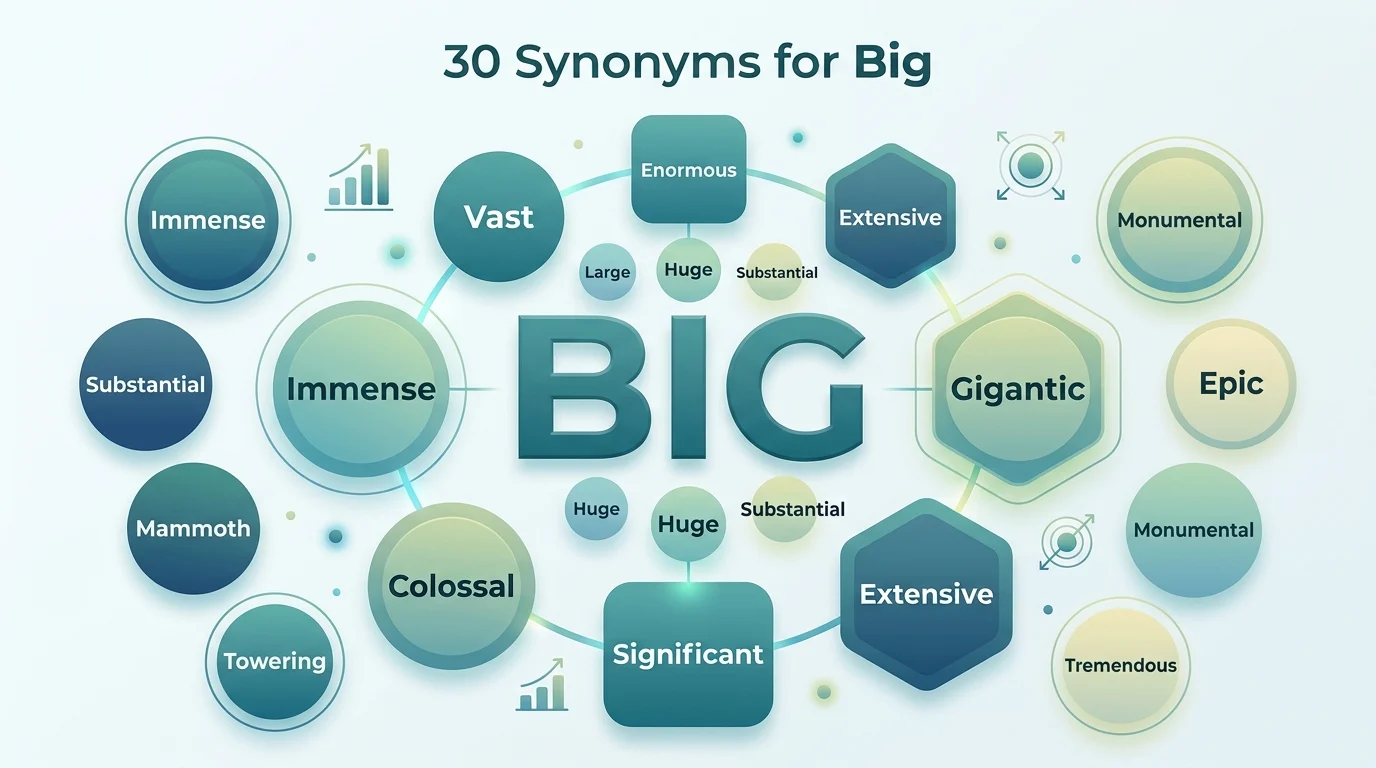
30 Synonyms for Big
Below are 30 useful alternatives to big. Each word has its own meaning and best use situation.
1. Large
Meaning: Greater than average in size, amount, or number.
Example:
They moved into a large apartment near the city center.
Best usage: Use large as the most direct and neutral alternative to big. It works well in everyday, academic, and professional English.
2. Huge
Meaning: Extremely large.
Example:
The new shopping center attracted a huge crowd.
Best usage: Use huge when something is much larger than normal. It is common in informal and conversational English.
3. Enormous
Meaning: Extremely large in size, amount, or degree.
Example:
The project required an enormous amount of time and money.
Best usage: Use enormous when you want to strongly emphasize size, quantity, or degree.
4. Massive
Meaning: Very large, heavy, or extensive.
Example:
The construction project involved a massive investment.
Best usage: Massive is useful for physical objects, amounts, projects, changes, and events. It often creates a stronger impression than large.
5. Gigantic
Meaning: Extremely, almost unbelievably large.
Example:
They saw a gigantic whale near the coast.
Best usage: Use gigantic for dramatic descriptions of physical size. It is particularly common in storytelling and descriptive writing.
6. Immense
Meaning: Extremely large or great.
Example:
The discovery had an immense impact on modern science.
Best usage: Immense works especially well for abstract ideas such as impact, importance, pressure, value, or influence.
7. Vast
Meaning: Extremely large and covering a wide area or amount.
Example:
The researchers explored a vast area of desert.
Best usage: Use vast for spaces, areas, quantities, collections, and abstract ranges.
8. Substantial
Meaning: Large enough to be important or noticeable.
Example:
The organization received a substantial donation.
Best usage: This is a strong choice for formal, academic, business, and professional writing.
9. Considerable
Meaning: Fairly large or important.
Example:
The company has made considerable progress this year.
Best usage: Use considerable when something is significant in size, amount, effort, or importance without suggesting that it is enormous.
10. Significant
Meaning: Important, noticeable, or large enough to matter.
Example:
The study found a significant increase in customer satisfaction.
Best usage: Significant is especially useful in academic, scientific, business, and analytical writing.
Important: It does not always mean physically large. It often means important or meaningful.
11. Sizable
Meaning: Fairly large in size or amount.
Example:
The company has a sizable customer base.
Best usage: Use sizable when something is clearly larger than average but not necessarily enormous.
12. Colossal
Meaning: Extremely large or enormous.
Example:
The company faced a colossal financial challenge.
Best usage: Use colossal for dramatic emphasis. It works for both physical things and abstract situations.
13. Tremendous
Meaning: Very great in size, amount, strength, or degree.
Example:
The athlete showed tremendous determination during the competition.
Best usage: Tremendous is excellent for abstract nouns such as effort, success, support, energy, or enthusiasm.
14. Monumental
Meaning: Extremely important, significant, or large in scale.
Example:
The scientists made a monumental contribution to medical research.
Best usage: Use monumental when describing something historically important, highly significant, or impressive in scale.
15. Stupendous
Meaning: Extremely impressive, large, or remarkable.
Example:
The concert was a stupendous success.
Best usage: This word is more expressive and dramatic than big. It works particularly well in enthusiastic or creative writing.
16. Mammoth
Meaning: Extremely large.
Example:
The team faced a mammoth task before the deadline.
Best usage: Mammoth is common for very difficult, demanding, or large-scale tasks, projects, and challenges.
17. Towering
Meaning: Extremely tall or rising high above something.
Example:
Towering mountains surrounded the small village.
Best usage: Use towering when the important feature is height rather than overall size.
18. Bulky
Meaning: Large and difficult to carry, move, or store.
Example:
The bulky piece of furniture would not fit through the doorway.
Best usage: Use bulky when something takes up a lot of space or is awkward to handle.
Note: Bulky can have a slightly negative meaning.
19. Oversized
Meaning: Larger than the standard or expected size.
Example:
He bought an oversized jacket for a relaxed look.
Best usage: Use oversized for clothing, furniture, equipment, luggage, and other objects that are intentionally or unusually large.
20. Grand
Meaning: Large, impressive, important, or elaborate.
Example:
They planned a grand celebration for the company’s anniversary.
Best usage: Use grand when big also means impressive, elegant, ambitious, or important.
21. Great
Meaning: Large in amount, degree, importance, or intensity.
Example:
The invention brought great changes to the industry.
Best usage: Great can replace big in some contexts involving importance or degree, but it is not a direct synonym for physical size in every sentence.
22. Major
Meaning: Very important, serious, or significant.
Example:
The company announced a major change to its business strategy.
Best usage: Use major when big means important or significant, rather than physically large.
23. Extensive
Meaning: Covering a large area, range, or amount.
Example:
The researchers conducted extensive testing before releasing the product.
Best usage: This is especially useful in formal and academic writing for research, work, damage, knowledge, experience, or activities.
24. Widespread
Meaning: Existing or happening across a large area or among many people.
Example:
The new technology has gained widespread popularity.
Best usage: Use widespread when big refers to how broadly something exists, spreads, or affects people.
25. Expansive
Meaning: Covering a large area or having a broad scope.
Example:
The hotel offers an expansive view of the ocean.
Best usage: Use expansive for physical spaces, views, ideas, discussions, plans, and opportunities.
26. Broad
Meaning: Wide or covering a large range.
Example:
The course provides a broad introduction to economics.
Best usage: Broad is best when big refers to range, scope, topics, knowledge, or ideas rather than physical size.
27. Hefty
Meaning: Large, heavy, or substantial.
Example:
The company received a hefty fine for breaking the regulations.
Best usage: Use hefty in informal or semi-formal English for amounts, costs, fines, weights, or demands.
28. Whopping
Meaning: Surprisingly or impressively large.
Example:
The restaurant received a whopping 10,000 online orders in one week.
Best usage: Whopping is informal and expressive. It is useful when you want to emphasize that a number or amount is surprisingly high.
29. Astronomical
Meaning: Extremely large, especially in amount or cost.
Example:
The company faced astronomical costs after the accident.
Best usage: Use astronomical figuratively for prices, numbers, costs, profits, or amounts that seem extraordinarily high.
30. Prodigious
Meaning: Very large, impressive, or remarkable in amount, ability, or achievement.
Example:
The young musician showed a prodigious talent for composition.
Best usage: This is a more advanced word. Use it in formal, literary, or sophisticated writing when you want to emphasize an unusually great ability, amount, or achievement.
Quick Comparison: Which Synonym for Big Should You Use?
Choosing the right synonym depends on what you mean by big.
| Synonym | Main Idea | Tone | Common Uses |
|---|---|---|---|
| Large | Greater than average | Neutral | Objects, amounts, groups |
| Huge | Extremely large | Informal | Objects, crowds, amounts |
| Enormous | Extremely large | Neutral | Size, amounts, problems |
| Massive | Very large/heavy | Strong | Projects, objects, investment |
| Gigantic | Extremely large | Informal | Physical objects, animals |
| Immense | Extremely great | Formal | Impact, pressure, importance |
| Vast | Very large area/range | Formal | Land, space, knowledge |
| Substantial | Large and important | Formal | Money, evidence, increase |
| Considerable | Fairly large | Formal | Progress, amount, effort |
| Significant | Important/notable | Formal | Changes, results, differences |
| Sizable | Fairly large | Neutral | Groups, amounts, businesses |
| Colossal | Extremely large | Dramatic | Problems, projects, amounts |
| Tremendous | Very great | Neutral | Effort, success, support |
| Monumental | Highly important | Formal | Achievements, changes |
| Mammoth | Extremely large/demanding | Expressive | Tasks, projects, challenges |
| Towering | Very tall | Descriptive | Buildings, mountains |
| Bulky | Large and awkward | Neutral | Furniture, equipment |
| Oversized | Larger than standard | Neutral | Clothing, objects |
| Grand | Large and impressive | Positive | Events, buildings, plans |
| Major | Very important | Neutral/Formal | Changes, decisions |
| Extensive | Large in scope | Formal | Research, work, damage |
| Widespread | Spread over a large area | Formal | Problems, beliefs, popularity |
| Expansive | Broad or extensive | Descriptive | Views, spaces, ideas |
| Broad | Wide in range | Neutral | Topics, knowledge, ideas |
| Hefty | Large/heavy amount | Informal | Fines, costs, payments |
| Whopping | Surprisingly large | Informal | Numbers, prices, amounts |
| Astronomical | Extremely high | Expressive | Prices, costs, figures |
| Prodigious | Exceptionally great | Advanced/Formal | Talent, achievement, output |
Synonyms for Big Based on Meaning
The best synonym depends on the sense of big you are trying to express.
When You Mean Physically Large
Choose:
- Large
- Huge
- Enormous
- Massive
- Gigantic
- Colossal
- Bulky
- Oversized
Example
Instead of:
They bought a big table.
You could write:
They bought a large table.
For stronger emphasis:
They bought an enormous table.
If the table is awkward to move:
They bought a bulky table.
Each sentence gives the reader slightly different information.
When You Mean Very Important
Choose:
- Major
- Significant
- Monumental
- Great
- Tremendous
Example
Instead of:
It was a big decision.
You could say:
It was a major decision.
For a more dramatic meaning:
It was a monumental decision.
The word major is usually the safest choice in professional and academic writing.
When You Mean a Large Amount
Choose:
- Substantial
- Considerable
- Sizable
- Hefty
- Whopping
- Enormous
Example
Instead of:
She received a big payment.
Try:
She received a substantial payment.
For informal writing:
She received a whopping payment.
For something that is simply larger than expected:
She received a sizable payment.
When You Mean a Large Area or Range
Choose:
- Vast
- Extensive
- Expansive
- Broad
- Widespread
Example
Instead of:
They own a big area of land.
You could write:
They own a vast area of land.
Instead of:
The research covered a big range of topics.
A better version is:
The research covered a broad range of topics.
When You Mean a Large Number or High Figure
Choose:
- Huge
- Enormous
- Massive
- Whopping
- Astronomical
- Substantial
For example:
The company received a huge number of applications.
More formal:
The company received a substantial number of applications.
More dramatic:
The company received a whopping 50,000 applications.
Formal vs. Informal Synonyms for Big
Not every synonym fits every situation.
More formal choices
Use these in essays, reports, research, and professional writing:
- Substantial
- Considerable
- Significant
- Immense
- Vast
- Extensive
- Major
- Monumental
- Prodigious
Neutral choices
These work in most everyday situations:
- Large
- Huge
- Enormous
- Massive
- Sizable
- Great
- Broad
- Expansive
More informal or expressive choices
These are better for conversation, blogs, casual writing, or enthusiastic descriptions:
- Gigantic
- Mammoth
- Hefty
- Whopping
- Stupendous
- Colossal
How to Choose the Right Synonym for Big
A useful way to choose a synonym is to ask yourself one question:
What exactly do I mean by “big”?
1. Big in Physical Size
Choose large, huge, enormous, massive, or gigantic.
Example:
They live in a huge house.
2. Big in Importance
Choose major, significant, monumental, or great.
Example:
This was a major turning point in her career.
3. Big in Amount
Choose substantial, considerable, sizable, or hefty.
Example:
The project requires a substantial investment.
4. Big in Area
Choose vast, extensive, or expansive.
Example:
The park covers a vast area.
5. Big in Scope
Choose broad, extensive, or widespread.
Example:
The report provides a broad overview of the subject.
6. Big in a Dramatic or Emotional Sense
Choose tremendous, colossal, stupendous, mammoth, or astronomical.
Example:
The team made tremendous progress.
Common Mistakes When Using Synonyms for Big
Learning synonyms is useful, but replacing big mechanically can make writing sound unnatural.
Mistake 1: Using “vast” for every large object
You would normally say:
a large house
rather than:
a vast house
Vast usually suggests a very large area, range, or extent.
Mistake 2: Using “significant” to mean physical size
Significant usually means important or meaningful, not simply physically large.
a significant change ✓
a significant house ✗
Mistake 3: Using “whopping” in academic writing
Whopping is expressive and informal.
For a research paper, choose substantial or considerable instead.
Mistake 4: Assuming every synonym has exactly the same meaning
Words that appear similar can communicate different ideas.
For example:
- Bulky → large and awkward
- Towering → very tall
- Vast → very large in area or range
- Major → important
- Hefty → large or heavy
- Widespread → spread across a large area or group
The best synonym is the one that adds the exact meaning you need.
“Big” vs. “Large”: What Is the Difference?
Big and large are often interchangeable, but their tone is slightly different.
Big is more conversational:
That’s a big problem.
Large is somewhat more neutral and formal:
That’s a large problem.
However, native speakers often prefer big in everyday expressions:
- big mistake
- big decision
- big deal
- big opportunity
- big difference
In these cases, replacing big with large may sound unnatural.
For example:
She made a big mistake. ✓
She made a large mistake. ✗
So, choosing a synonym is not only about dictionary meaning. Natural usage matters too.
Synonyms for Big in Academic Writing
When writing an essay, report, or research paper, avoid repeatedly using big when a more precise word is available.
Instead of:
There was a big increase in population.
Consider:
There was a significant increase in population.
Instead of:
The study collected a big amount of data.
Consider:
The study collected a substantial amount of data.
Instead of:
The researchers conducted a big study.
Consider:
The researchers conducted an extensive study.
These alternatives make the writing more precise without making it unnecessarily complicated.
Synonyms for Big in Creative Writing
Creative writing gives you more freedom to choose vivid language.
Instead of:
A big mountain stood in the distance.
You might write:
A towering mountain stood in the distance.
Instead of:
A big storm approached the village.
You could write:
A massive storm approached the village.
The right synonym helps readers visualize what is happening.
Synonyms for Big in Business Writing
Business writing generally benefits from precise, professional vocabulary.
Useful choices include:
- Substantial
- Significant
- Major
- Considerable
- Extensive
- Sizable
For example:
The company experienced a significant increase in revenue.
This is generally more professional than:
The company experienced a big increase in revenue.
A Simple Synonym Guide for ESL Learners
If you are learning English, start with these high use alternatives:
Easy and common
Large, huge, enormous, massive, great, major
Useful for formal writing
Substantial, significant, considerable, extensive, vast
Useful for descriptive writing
Gigantic, towering, colossal, immense, expansive
Useful for informal English
Hefty, whopping, mammoth
You do not need to memorize all 30 words at once. Learn a few based on the situations in which you commonly use big.
Frequently Asked Questions About Synonyms for Big
What is the best synonym for big?
Large is usually the closest general synonym for big. However, the best choice depends on the context. For example, use major for importance, vast for area, and substantial for an amount.
What is a stronger word for big?
Words such as huge, enormous, massive, gigantic, colossal, and immense are stronger alternatives. The best choice depends on whether you are describing size, amount, importance, or impact.
What is a formal synonym for big?
Common formal alternatives include substantial, considerable, significant, extensive, immense, and major.
What is an informal synonym for big?
Huge, whopping, hefty, gigantic, and mammoth can work in informal contexts, depending on the sentence.
What is a synonym for big in academic writing?
Significant, substantial, considerable, extensive, and major are useful academic alternatives. Choose based on the precise meaning.
What is a synonym for big in terms of importance?
Good choices include major, significant, important, monumental, and great.
What is a synonym for a big amount?
Depending on the sentence, you can use substantial, considerable, sizable, hefty, enormous, or whopping.
Final Takeaway: Choosing the Best Synonym for Big
There are many useful synonyms for big, but the best word is not necessarily the most impressive one. Good vocabulary is about precision.
Use large for a simple, neutral alternative. Choose huge, enormous, or massive when you want to emphasize size. Use vast for large areas or ranges, substantial and considerable for formal descriptions of amounts, and major or significant when big means important.
For creative writing, words such as towering, colossal, immense, and mammoth can create stronger images. In casual English, whopping and hefty can add an informal tone.
The most effective writers do not simply avoid repeating big. They choose a word that tells the reader how something is big, why it matters, or what kind of size or importance is being described. Once you understand these differences, your vocabulary becomes more precise, natural, and powerful.

I am Joel Michael, an enthusiastic language writer and synonym enthusiast. I enjoy exploring words, finding their meanings, and discovering useful alternatives. I create clear, helpful content to make vocabulary learning simple and enjoyable for every reader.