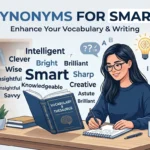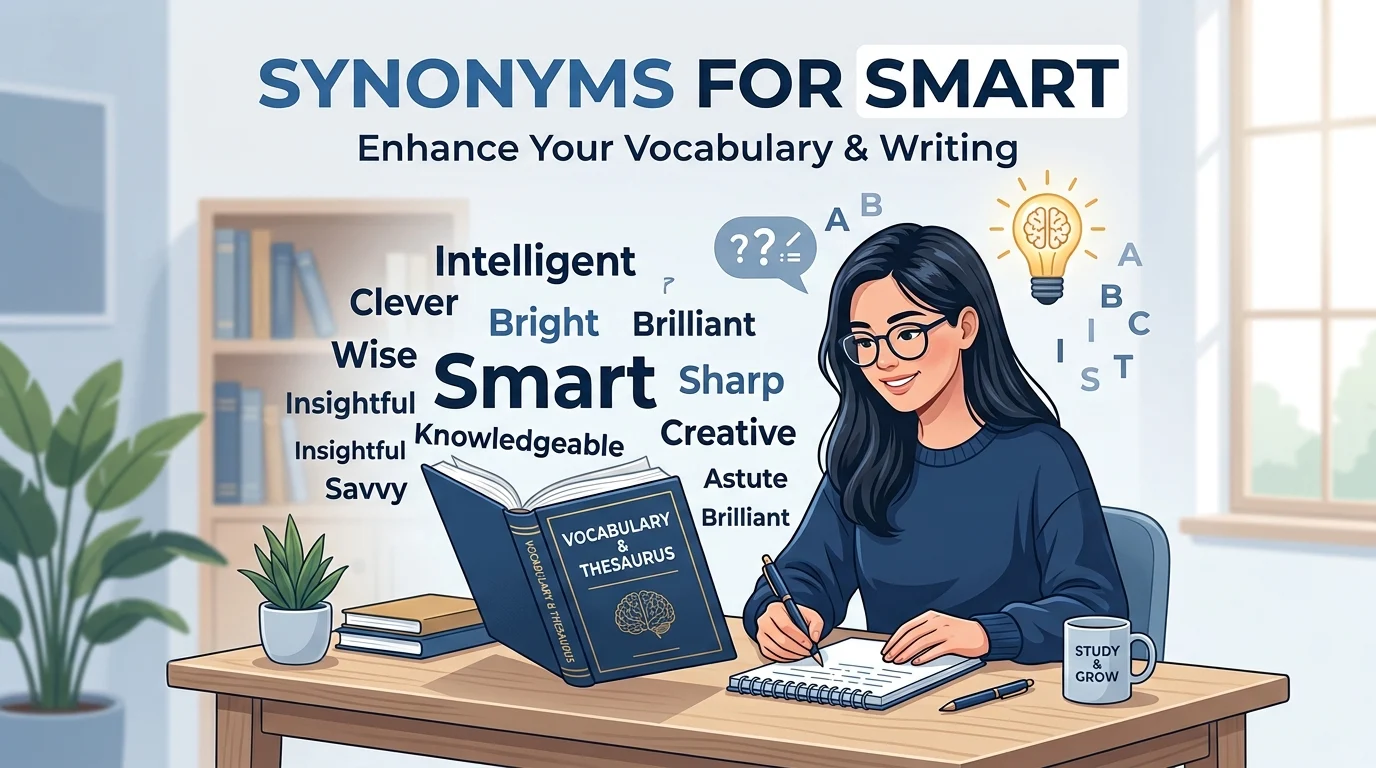
If you are looking for synonyms for smart, you have many choices beyond the basic word smart. Depending on the situation, you might want to describe someone as intelligent, clever, bright, brilliant, sharp, wise, knowledgeable, or quick witted.
Each word has a slightly different meaning and tone.Learning these differences can make your English more natural and precise.
For students and ESL learners, understanding synonyms is especially useful because the right word can communicate not only intelligence but also experience, judgment, creativity, knowledge, or quick thinking.
This guide explains 30 synonyms for smart in simple English. Each synonym includes an easy definition, an example sentence, and the best context for using it.
If you are writing an essay, improving your vocabulary, creating content, or simply trying to speak more naturally, this list will help you choose the right word.
What Does “Smart” Mean?
The word smart can have several meanings, but when we talk about a person’s mind or abilities, it usually means intelligent, quick to understand things, or good at solving problems.
For example:
Maya is smart enough to understand difficult mathematical problems quickly.
In everyday English, smart is a flexible and common word. However, it can sometimes be too general. Someone may be smart because they learn quickly, have excellent knowledge, make good decisions, think creatively, or solve problems effectively.
That is why using a more specific synonym can make your writing stronger.
Smart: Tone and Usage
Smart is generally neutral and informal enough for everyday conversation. It can also be used in professional and academic contexts, although more precise alternatives such as intelligent, knowledgeable, or analytical may sound more appropriate in formal writing.
For example:
- Everyday: She’s really smart.
- Academic: She is highly intelligent and analytical.
- Professional: He is a knowledgeable and capable engineer.
- Creative: She is an exceptionally inventive designer.
30 Synonyms for Smart
Below are 30 useful alternatives to smart, with simple meanings and practical examples.
1. Intelligent
Meaning: Having a strong ability to learn, understand, and think.
Example:
Liam is an intelligent student who enjoys solving complex problems.
Best usage: Use intelligent when you want a clear, neutral, and slightly formal word for smart.
2. Clever
Meaning: Good at thinking quickly and finding effective solutions.
Example:
That was a clever way to fix the broken computer.
Best usage: Use clever for someone who finds smart or creative solutions, especially in everyday English.
3. Bright
Meaning: Intelligent and quick to learn.
Example:
Sara is a bright student who understands new concepts quickly.
Best usage: Common in informal and educational contexts, especially when describing students or young people.
4. Brilliant
Meaning: Extremely intelligent, talented, or impressive.
Example:
The scientist came up with a brilliant solution to the problem.
Best usage: Use brilliant when you want to emphasize an unusually high level of intelligence or ability.
5. Sharp
Meaning: Quick to notice, understand, or respond to things.
Example:
Our new manager is very sharp and rarely misses an important detail.
Best usage: Excellent for describing quick thinking, awareness, or mental alertness.
6. Brainy
Meaning: Very intelligent or interested in intellectual subjects.
Example:
My brother is brainy and loves reading science books.
Best usage: Informal English. It can sound friendly or playful.
7. Wise
Meaning: Able to make good decisions because of knowledge and experience.
Example:
Her grandmother gave her some wise advice about choosing a career.
Best usage: Use wise when intelligence is connected with judgment, maturity, or life experience.
8. Knowledgeable
Meaning: Having a lot of information or understanding about a subject.
Example:
The guide was extremely knowledgeable about local history.
Best usage: Best when you want to emphasize what someone knows rather than their general intelligence.
9. Astute
Meaning: Very good at understanding situations and making sensible judgments.
Example:
The astute business owner recognized the changing market early.
Best usage: Useful in professional, business, and formal writing.
10. Quick-witted
Meaning: Able to think and respond quickly, often in an amusing or intelligent way.
Example:
She is quick-witted and always has an interesting response.
Best usage: Ideal for someone who thinks quickly during conversations or unexpected situations.
11. Brainy
Meaning: Highly intelligent or academically capable.
Example:
He was known as the brainy student in his class.
Best usage: Informal descriptions of someone who is intellectually strong.
12. Genius
Meaning: A person with exceptional intellectual ability or extraordinary talent.
Example:
Many people considered the young mathematician a genius.
Best usage: Use carefully because genius suggests an unusually exceptional level of ability.
13. Gifted
Meaning: Naturally talented or unusually capable in a particular area.
Example:
She is a gifted musician with an excellent understanding of rhythm.
Best usage: Best for exceptional natural ability, particularly in academics, arts, sports, or other skills.
14. Talented
Meaning: Naturally good at doing something.
Example:
Daniel is a talented programmer who creates impressive applications.
Best usage: Use talented when someone’s ability is connected to a particular skill rather than intelligence in general.
15. Brilliant minded
Meaning: Having an exceptionally capable or creative mind.
Example:
The project was developed by a brilliant-minded group of engineers.
Best usage: More descriptive than everyday; useful in creative or complimentary writing.
16. Perceptive
Meaning: Good at noticing and understanding things that other people may miss.
Example:
She is perceptive and quickly noticed that something was wrong.
Best usage: Excellent when describing awareness, observation, and understanding of people or situations.
17. Insightful
Meaning: Showing a deep understanding of a subject or situation.
Example:
The professor gave an insightful explanation of the economic crisis.
Best usage: Particularly useful for comments, opinions, analyses, articles, and observations.
18. Analytical
Meaning: Good at examining information carefully and logically.
Example:
His analytical approach helped the team identify the cause of the problem.
Best usage: Strong choice for academic, scientific, technical, and professional writing.
19. Logical
Meaning: Able to think in a clear and sensible way.
Example:
She gave a logical explanation for her decision.
Best usage: Use when intelligence is demonstrated through clear reasoning.
20. Rational
Meaning: Based on reason rather than emotion or guesswork.
Example:
We need to make a rational decision based on the available evidence.
Best usage: Particularly useful in formal, academic, business, and argumentative writing.
21. Competent
Meaning: Having enough skill, knowledge, and ability to do something successfully.
Example:
The new employee is competent and learns quickly.
Best usage: Best for professional situations where ability and effectiveness matter.
22. Capable
Meaning: Having the ability to do something successfully.
Example:
She is a capable leader who handles difficult situations calmly.
Best usage: Use when someone has the skills and ability to accomplish a task.
23. Resourceful
Meaning: Good at finding practical ways to solve difficult problems.
Example:
The resourceful student repaired the project using materials he already had.
Best usage: Great for describing practical intelligence and problem-solving ability.
24. Ingenious
Meaning: Extremely clever and creative when solving a problem.
Example:
They designed an ingenious device using inexpensive materials.
Best usage: Use when intelligence involves creativity and originality.
25. Savvy
Meaning: Having practical knowledge and good judgment in a particular area.
Example:
She is financially savvy and knows how to manage her money.
Best usage: Common in business, technology, finance, marketing, and everyday conversation.
26. Skilled
Meaning: Having a high level of ability gained through talent, practice, or experience.
Example:
He is a skilled engineer with years of experience.
Best usage: Use when someone’s intelligence is demonstrated through practical ability.
27. Educated
Meaning: Having received substantial education or knowledge.
Example:
She is an educated professional with a strong background in economics.
Best usage: Appropriate when discussing formal education or a person’s academic background.
28. Learned
Meaning: Having extensive knowledge, especially from study and education.
Example:
The learned professor had written several books about ancient history.
Best usage: Formal or literary English; especially useful when describing scholars or academics.
29. Wise-minded
Meaning: Showing good judgment, thoughtful reasoning, and maturity.
Example:
His wise-minded approach helped the group avoid an unnecessary argument.
Best usage: A less common descriptive expression; use more naturally with wise or sound-minded in most everyday writing.
30. Savant
Meaning: A person with exceptional knowledge or ability in a particular field.
Example:
The young chess savant could remember thousands of possible moves.
Best usage: Use in specialized or formal contexts when describing extraordinary expertise.
Quick Comparison: Synonyms for Smart
Not every synonym for smart means exactly the same thing. The table below makes the differences easier to understand.
| Synonym | Main Idea | Tone | Best Context |
|---|---|---|---|
| Intelligent | Strong mental ability | Neutral/Formal | General writing |
| Clever | Good at finding solutions | Neutral/Informal | Everyday situations |
| Bright | Quick to learn | Informal | Students and learners |
| Brilliant | Exceptionally intelligent | Strong | Praise |
| Sharp | Quick-thinking and alert | Informal | Conversation |
| Wise | Good judgment | Neutral | Advice and life experience |
| Knowledgeable | Knows a lot | Neutral/Formal | Subjects and professions |
| Astute | Excellent judgment | Formal | Business and decisions |
| Quick-witted | Thinks and responds quickly | Informal | Conversation |
| Perceptive | Notices subtle details | Neutral/Formal | People and situations |
| Insightful | Deep understanding | Formal | Analysis and opinions |
| Analytical | Thinks logically about information | Formal | Academic/professional |
| Logical | Uses clear reasoning | Neutral | Arguments and decisions |
| Rational | Uses reason | Formal | Academic/professional |
| Resourceful | Solves problems practically | Neutral | Real-life challenges |
| Ingenious | Clever and creative | Neutral/Formal | Inventions and solutions |
| Savvy | Practically knowledgeable | Informal | Business and technology |
| Capable | Able to succeed | Neutral | Work and leadership |
| Competent | Has sufficient professional ability | Formal | Workplace |
| Gifted | Naturally exceptional | Neutral | Talent and education |
How to Choose the Right Synonym for Smart
The best synonym depends on what kind of intelligence you want to describe.
For General Intelligence
Choose:
- Intelligent
- Bright
- Brainy
- Brilliant
Example:
Amir is an intelligent student.
These words work when you simply want to say that someone has strong mental ability.
For Quick Thinking
Choose:
- Sharp
- Quick-witted
- Clever
- Bright
Example:
She is quick witted and can answer difficult questions immediately.
These words emphasize speed and mental alertness.
For Good Judgment
Choose:
- Wise
- Astute
- Rational
- Perceptive
Example:
His wise decision prevented a serious problem.
These alternatives are better when intelligence involves judgment and decision-making.
For Knowledge
Choose:
- Knowledgeable
- Educated
- Learned
- Savant
Example:
The professor is extremely knowledgeable about medieval history.
These words focus more on information and expertise than raw intelligence.
For Problem-Solving
Choose:
- Resourceful
- Ingenious
- Clever
- Analytical
- Logical
Example:
Her resourceful approach helped the team solve the problem.
These words are especially useful when someone demonstrates intelligence through action.
For Professional Writing
Choose:
- Intelligent
- Analytical
- Astute
- Knowledgeable
- Competent
- Capable
- Perceptive
These choices generally sound more precise and professional than simply repeating smart.
Smart vs. Intelligent: What’s the Difference?
Smart and intelligent are close in meaning, but they are not always interchangeable.
Smart is broader and more common in everyday English. It can describe someone who is intelligent, practical, capable, or good at making decisions.
Intelligent more specifically describes strong mental ability.
Compare:
Jack is smart.
This could mean Jack is intelligent or generally capable.
Jack is intelligent.
This more directly means that Jack has strong intellectual ability.
For formal writing, intelligent is often the safer choice when you specifically mean mental ability.
Smart vs. Clever
Clever often suggests that someone can find an effective or unusual solution.
She is smart.
This gives a general description.
She found a clever solution.
This emphasizes the quality of the solution.
A person can be smart without necessarily being clever in every situation. Clever often has a stronger connection to creativity, tactics, or problem solving.
Smart vs. Wise
These words describe different qualities.
Smart generally refers to intelligence or ability.
Wise refers to good judgment, often developed through experience.
For example:
The student is smart enough to solve the equation.
The teacher is wise enough to understand the consequences of the decision.
Someone can be highly intelligent but make poor decisions. Likewise, someone can be wise because of experience even if they are not exceptionally academic.
Smart vs. Bright
Bright is commonly used to describe someone who learns quickly.
For example:
Ella is a bright child who learns new languages quickly.
It is especially natural when talking about students, children, and learners.
Smart is more general:
Ella is smart.
Both are correct, but bright can place more emphasis on quick learning.
Smart vs. Brilliant
Brilliant is much stronger than smart.
If you say:
He is smart.
You are giving a general compliment.
If you say:
He is brilliant.
You are suggesting an unusually high level of intelligence, talent, or achievement.
Because of this, brilliant should usually be reserved for particularly impressive situations.
Common Collocations With Smart
Learning common word combinations can help ESL learners use smart naturally.
Smart student
A smart student asks questions when something is unclear.
Smart decision
Buying a reliable car was a smart decision.
Smart choice
Taking the earlier train was a smart choice.
Smart solution
The team found a smart solution to the problem.
Smart strategy
The company developed a smart strategy for reaching new customers.
Smart move
Saving some money each month was a smart move.
Smart approach
Her smart approach made the project easier to manage.
Frequently Asked Questions About Synonyms for Smart
What is the best synonym for smart?
Intelligent is one of the best general synonyms for smart. However, the best choice depends on your meaning. Use wise for good judgment, clever for effective problem-solving, knowledgeable for expertise, and analytical for logical examination.
What is a stronger word for smart?
Words such as brilliant, exceptionally intelligent, and genius can express a stronger level of intelligence. However, they should not be used for ordinary situations because they suggest exceptional ability.
What is a simple synonym for smart?
Simple alternatives include clever, bright, intelligent, sharp, and brainy.
What is a professional synonym for smart?
For professional writing, consider intelligent, analytical, knowledgeable, astute, capable, competent, or perceptive, depending on the context.
What is a synonym for smart that means good judgment?
Wise and astute are especially useful. Rational also works when the focus is on making decisions based on reason.
What is a synonym for smart that means creative?
Ingenious and clever are good choices when intelligence involves creativity and original problem-solving.
Final Thoughts on Synonyms for Smart
Knowing different synonyms for smart can make your English more precise and expressive. Instead of using smart repeatedly, you can choose a word that describes the exact quality you mean.
Use intelligent for general mental ability, clever for effective thinking, bright for quick learning, brilliant for exceptional ability, wise for good judgment, and knowledgeable for strong subject knowledge.
When you need more specific language, words such as analytical, perceptive, resourceful, ingenious, astute, and quick witted can add much more detail.The most important lesson is that synonyms are not always perfect replacements.
Each word carries its own tone, strength, and context. Choosing the right synonym is therefore less about finding a word with the same dictionary definition and more about expressing exactly what you mean.
For students, ESL learners, writers, and content creators, building this kind of vocabulary makes communication clearer, more natural, and more engaging.
The next time you are tempted to write smart, pause and ask yourself: What kind of smart do I actually mean? That question will usually lead you to a stronger word.
Related vocabulary: intelligent synonyms, clever synonyms, words for intelligent, words meaning smart, advanced English vocabulary, academic vocabulary, personality adjectives, positive adjectives, English synonyms, ESL vocabulary.

I am Derek Thomas, a passionate word enthusiast and writer. I enjoy exploring synonyms, expanding vocabulary, and helping readers find clear, accurate, and meaningful words for better writing.