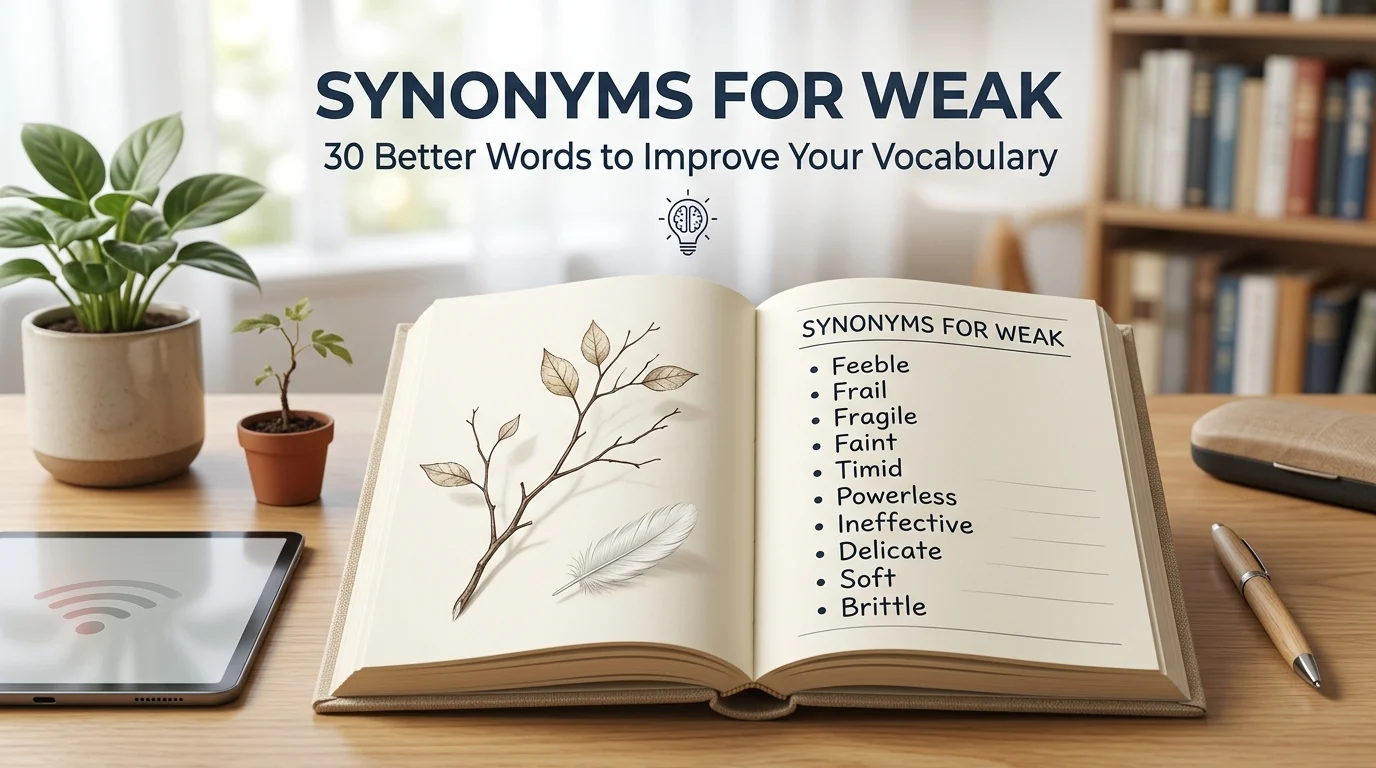
Finding the right word can make your writing clearer, more precise, and more interesting. The word weak is common and useful, but it does not always express exactly what you mean.
Depending on the situation, you may want to describe someone as frail, an argument as flimsy, a signal as faint, or a drink as diluted.Learning synonyms for weak helps students, ESL learners, writers, and content creators choose words that match the exact meaning and tone they want.
Some alternatives are neutral, while others suggest physical weakness, lack of strength, poor quality, lack of confidence, or ineffective performance.In this guide, you will find 30 useful synonyms for weak, along with simple meanings, example sentences, and practical usage notes.
The goal is not simply to replace one word with another, but to understand the differences between similar words so you can use them naturally.
What Does “Weak” Mean?
Weak generally means not strong, powerful, effective, or physically capable.
The meaning changes depending on context:
- Physical: “He felt weak after the long journey.”
- Physical structure: “The bridge has a weak support.”
- Argument: “The writer presented a weak argument.”
- Character or confidence: “She felt weak in the face of criticism.”
- Quality: “The coffee has a weak flavor.”
- Signal or force: “The phone has a weak signal.”
- Ability: “Math is his weak subject.”
Because “weak” has many meanings, there is no single perfect synonym. The best alternative depends on what kind of weakness you are describing.
30 Synonyms for Weak
1. Feeble
Meaning: Having very little physical strength, energy, or force.
Example:
The elderly man spoke in a feeble voice.
Best usage: Use feeble when someone or something lacks noticeable physical strength or force.
2. Frail
Meaning: Physically weak, delicate, or easily injured.
Example:
The frail patient needed help getting out of bed.
Best usage: Commonly used for people, especially those who are physically delicate or vulnerable.
3. Fragile
Meaning: Easily damaged, broken, or harmed.
Example:
The fragile glass must be handled carefully.
Best usage: Best for objects, situations, relationships, or people that can be easily damaged.
Note: Fragile focuses more on vulnerability than a simple lack of strength.
4. Delicate
Meaning: Easily damaged or requiring careful treatment.
Example:
The plant has delicate stems that can break easily.
Best usage: Useful when weakness is connected with sensitivity or vulnerability.
5. Flimsy
Meaning: Not strong, solid, or well made.
Example:
The flimsy chair broke after only a few uses.
Best usage: Best for weak physical objects, materials, or structures.
6. Infirm
Meaning: Weak or unhealthy, especially because of age or illness.
Example:
The infirm man required assistance while walking.
Best usage: A formal word often used to describe physical weakness or poor health.
7. Powerless
Meaning: Having no power, control, or ability to influence a situation.
Example:
She felt powerless to stop the argument.
Best usage: Use when someone lacks control rather than simply lacking physical strength.
8. Helpless
Meaning: Unable to help yourself or change a difficult situation.
Example:
The lost child felt helpless in the unfamiliar city.
Best usage: Appropriate when weakness involves an inability to act or respond.
9. Vulnerable
Meaning: Easily harmed, attacked, influenced, or affected.
Example:
Young children are particularly vulnerable to extreme weather.
Best usage: Use when someone or something is exposed to danger or harm.
10. Puny
Meaning: Small and lacking physical strength.
Example:
The puny puppy struggled to climb the large step.
Best usage: Informal; often used for someone or something that looks noticeably small or weak.
11. Languid
Meaning: Lacking energy, enthusiasm, or physical vitality.
Example:
After spending all day in the heat, he felt languid and tired.
Best usage: Useful for describing a relaxed or low energy physical state.
12. Lethargic
Meaning: Having very little energy or enthusiasm.
Example:
I felt lethargic after staying awake all night.
Best usage: Best for temporary tiredness, low energy, or lack of activity.
13. Exhausted
Meaning: Extremely tired and without much energy left.
Example:
The exhausted runners collapsed onto the grass.
Best usage: Use when weakness results from intense physical or mental effort.
14. Powerless
Meaning: Unable to control or influence what happens.
Example:
The residents felt powerless against the sudden flood.
Best usage: Particularly useful for emotional, social, or situational weakness.
15. Ineffectual
Meaning: Not producing the desired result.
Example:
His attempts to solve the problem were ineffectual.
Best usage: Best for actions, methods, efforts, or people that fail to achieve an intended result.
16. Ineffective
Meaning: Not successful in producing the expected effect.
Example:
The old treatment proved ineffective.
Best usage: A common, neutral choice for methods, plans, strategies, or actions that do not work well.
17. Inadequate
Meaning: Not good enough or not sufficient for a particular purpose.
Example:
The company had inadequate resources to complete the project.
Best usage: Use when something fails to meet a required standard.
18. Deficient
Meaning: Lacking something necessary or important.
Example:
The report was deficient in supporting evidence.
Best usage: More formal; useful in academic, professional, and technical writing.
19. Flawed
Meaning: Having a mistake, weakness, or imperfection.
Example:
The researcher’s argument was based on a flawed assumption.
Best usage: Excellent for arguments, plans, systems, reasoning, or designs that contain weaknesses.
20. Unconvincing
Meaning: Not persuasive or believable.
Example:
His explanation was unconvincing.
Best usage: Use when describing a weak argument, explanation, excuse, or claim.
21. Feeble-minded
Meaning: A dated expression suggesting limited intellectual ability.
Example:
The term “feeble-minded” appears in some older literature.
Best usage: Mainly historical or literary contexts. Avoid using it casually because it can be insulting and outdated when applied to a person.
22. Faint
Meaning: Weak in strength, intensity, sound, light, smell, or visibility.
Example:
We heard a faint sound coming from the hallway.
Best usage: Excellent for weak sounds, smells, colors, signals, light, or sensations.
23. Mild
Meaning: Not strong, intense, or severe.
Example:
The sauce has a mild flavor.
Best usage: Use when something is weaker than expected in intensity, especially flavors, reactions, or conditions.
24. Watery
Meaning: Too thin or diluted, often lacking flavor or strength.
Example:
The soup tasted watery and bland.
Best usage: Commonly used for food and drinks that lack richness or concentration.
25. Diluted
Meaning: Made weaker by adding another substance, usually liquid.
Example:
The juice was diluted with too much water.
Best usage: Best for liquids, chemicals, mixtures, or ideas that have been weakened by addition.
26. Thin
Meaning: Lacking strength, substance, density, or depth.
Example:
The evidence supporting the claim was thin.
Best usage: Useful for arguments, evidence, resources, mixtures, and physical materials.
27. Shaky
Meaning: Weak, uncertain, unstable, or unreliable.
Example:
The theory is based on shaky evidence.
Best usage: Informal and useful for arguments, evidence, plans, confidence, or physical stability.
28. Unsteady
Meaning: Not firm, stable, or controlled.
Example:
He walked with an unsteady step.
Best usage: Best for movement, physical balance, hands, voices, or unstable situations.
29. Spineless
Meaning: Lacking courage, determination, or the ability to stand up for oneself.
Example:
Calling him spineless simply because he avoided an unnecessary argument was unfair.
Best usage: Informal and strongly negative; use when describing a perceived lack of courage or determination.
30. Timid
Meaning: Lacking confidence or courage and easily nervous around others.
Example:
The timid student was hesitant to speak in front of the class.
Best usage: Best for personality or behavior involving shyness and lack of confidence.
Quick Comparison: Which Synonym for Weak Should You Use?
| Synonym | Main Meaning | Best Context | Tone |
|---|---|---|---|
| Feeble | Very little strength | People, voices, forces | Neutral |
| Frail | Physically delicate | People | Neutral |
| Fragile | Easily damaged | Objects, people, situations | Neutral |
| Flimsy | Poor physical strength | Objects, structures | Informal/neutral |
| Infirm | Physically weak | Health, age | Formal |
| Powerless | No control or influence | Situations, people | Neutral |
| Helpless | Unable to act | Difficult situations | Emotional |
| Vulnerable | Easily harmed | People, systems | Neutral/formal |
| Puny | Small and weak | People, animals, objects | Informal |
| Lethargic | Low energy | People | Neutral |
| Ineffective | Does not work well | Methods, plans | Neutral |
| Inadequate | Not sufficient | Resources, performance | Formal |
| Deficient | Lacking something needed | Academic/professional writing | Formal |
| Flawed | Contains weaknesses | Arguments, plans | Neutral |
| Unconvincing | Not persuasive | Arguments, explanations | Neutral |
| Faint | Low intensity | Sounds, light, signals | Neutral |
| Mild | Low intensity | Flavors, reactions | Neutral |
| Diluted | Made less concentrated | Liquids, mixtures | Neutral |
| Shaky | Unreliable or unstable | Evidence, arguments | Informal |
| Unsteady | Not stable | Movement, balance | Neutral |
| Timid | Lacking confidence | Personality | Neutral |
| Spineless | Lacking courage | Character/behavior | Strongly negative |
Synonyms for Weak by Meaning
The easiest way to choose the right synonym is to first identify what kind of weakness you mean.
Physical weakness
Use:
- Feeble
- Frail
- Infirm
- Puny
- Lethargic
Example:
Instead of “He was weak,” you could say, “He was frail after months of illness.”
Easily damaged
Use:
- Fragile
- Delicate
- Vulnerable
- Flimsy
Example:
“The material is fragile and needs careful handling.”
Weak arguments or ideas
Use:
- Flawed
- Unconvincing
- Shaky
- Thin
- Deficient
Example:
“The proposal was unconvincing because it lacked evidence.”
Weak performance or results
Use:
- Ineffective
- Ineffectual
- Inadequate
- Deficient
Example:
“The new strategy was ineffective.”
Weak confidence or courage
Use:
- Timid
- Helpless
- Powerless
- Spineless
Example:
“The normally confident speaker became timid during the interview.”
Weak intensity
Use:
- Faint
- Mild
- Diluted
- Watery
Example:
“The coffee was too weak, so I added another spoonful.”
How to Choose the Right Synonym for Weak
Choosing a synonym is not simply about finding another word with the same dictionary definition. Good writing depends on precision.
1. Ask what is weak
Is it:
- A person?
- A physical object?
- An argument?
- A signal?
- A drink?
- A plan?
- Someone’s confidence?
The answer immediately narrows your choices.
2. Consider the tone
For everyday writing, words such as weak, frail, fragile, and ineffective are usually safe.
For formal writing, consider:
- Deficient
- Inadequate
- Ineffectual
- Infirm
For informal writing, you might use:
- Puny
- Shaky
- Flimsy
- Spineless
Remember that some informal words can sound judgmental.
3. Think about the exact type of weakness
Compare these sentences:
The patient was frail.
This describes physical delicacy.
The argument was flawed.
This describes a problem with reasoning.
The signal was faint.
This describes low intensity.
The plan was ineffective.
This describes poor results.
Although all four situations could loosely be described as “weak,” the more specific word makes the sentence much clearer.
Weak vs. Similar Words: Important Differences
Weak vs. Fragile
Weak means lacking strength.
Fragile means easily damaged or broken.
A person can be physically weak without being fragile, while an object can be fragile even if it is strong in some respects.
Weak vs. Frail
Frail usually describes a person or living thing that is physically delicate.
Weak has a much broader meaning.
Weak vs. Powerless
Weak can mean lacking physical or general strength.
Powerless specifically emphasizes a lack of control or influence.
Weak vs. Ineffective
Weak can describe many things.
Ineffective specifically means something does not produce the desired result.
Weak vs. Timid
Weak does not necessarily describe personality.
Timid specifically refers to a lack of confidence or courage.
Weak vs. Flimsy
Flimsy generally describes something that lacks physical strength or solidity.
For example:
- “a flimsy box”
- “a flimsy excuse”
- “a flimsy argument”
It is usually less appropriate for describing someone’s physical health.
Example Sentences Using Synonyms for Weak
Here are some natural examples showing how different alternatives change the meaning:
- Feeble: His feeble voice was difficult to hear.
- Frail: The frail bird could barely fly.
- Fragile: The fragile vase was wrapped in several layers of paper.
- Flimsy: The flimsy fence could not withstand the wind.
- Powerless: We felt powerless to change the decision.
- Vulnerable: Small businesses can be vulnerable during economic downturns.
- Ineffective: The medicine proved ineffective.
- Inadequate: The team had inadequate equipment.
- Flawed: The study contained a flawed methodology.
- Unconvincing: His excuse sounded unconvincing.
- Faint: A faint light appeared in the distance.
- Mild: The curry had a mild flavor.
- Diluted: The cleaning solution had been diluted too much.
- Shaky: Her argument rested on shaky evidence.
- Timid: The timid child stayed close to her parents.
These examples demonstrate why context matters. A synonym may be grammatically correct but still sound unnatural if it does not match the specific type of weakness.
Why Learning Synonyms for Weak Matters
Expanding your vocabulary gives you more control over your writing.
For students, precise vocabulary can make essays and assignments more sophisticated. ESL learners can use synonyms to avoid repeating the same basic words. Writers can create more vivid descriptions, while content creators can make their writing easier and more engaging to read.
Instead of repeatedly writing:
“The argument was weak.”
You could write:
- “The argument was unconvincing.”
- “The evidence was thin.”
- “The reasoning was flawed.”
- “The claim was based on shaky evidence.”
Each sentence communicates a slightly different idea.
That is the real value of learning synonyms: precision, not just variety.
Frequently Asked Questions About Synonyms for Weak
What is the best synonym for weak?
There is no single best synonym. Feeble is useful for physical strength, frail for physical delicacy, ineffective for poor results, faint for low intensity, and unconvincing for weak arguments.
What is a formal synonym for weak?
Depending on the context, formal alternatives include deficient, inadequate, ineffectual, and infirm.
What is a synonym for weak in an argument?
Good choices include unconvincing, flawed, shaky, thin, and deficient.
What is a synonym for physically weak?
Useful alternatives include feeble, frail, infirm, puny, and delicate.
What is a synonym for weak confidence?
Timid, hesitant, insecure, powerless, and uncertain can work depending on the exact meaning.
What is the opposite of weak?
Common opposites include strong, powerful, robust, forceful, resilient, and vigorous.
Final Thoughts on Synonyms for Weak
The word weak is simple, but its meaning can change dramatically depending on context. Someone can be physically weak, emotionally vulnerable, intellectually unconvincing, ineffective at a task, or simply lacking intensity.
The best synonym communicates the specific kind of weakness you want your reader to understand. Use frail for physical delicacy, flimsy for poorly made objects, faint for low intensity, ineffective for something that does not work, unconvincing for poor arguments, and timid for a lack of confidence.
For students, ESL learners, writers, and content creators, learning these distinctions is much more valuable than memorizing a long list of replacement words. When you choose a synonym based on meaning, context, and tone, your writing becomes more natural, precise, and powerful.

I am Scarlett Jane, a passionate language writer who loves exploring synonyms and word meanings. I create helpful content that makes vocabulary easier, clearer, and more enjoyable for everyone.